Day 93: Whiteboards & More Whiteboards

AP Physics: Whiteboarding Angular Momentum

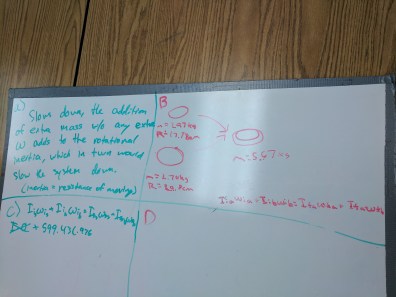
Thanks to a reminder from Dan Burns, I kicked class off with a clip from The Simpsons where Principal Skinner uses conservation of angular momentum to save Ralph. Afterwards, students whiteboarded and discussed yesterday’s problems. I focused on the conceptual problems, and I was pleased by how many students opted to use tools like SOS diagrams to guide their thinking, whether or not the problems asked for them. I also had some groups use analogies to linear momentum to answer questions since they found it easier to visualize. I got really excited when a couple of groups used Newton’s 3rd Law to solve one of the problems, though I didn’t think to take a photo of their boards.12th.jpg
Physical Science: Whiteboarding Motion Graphs

Students whiteboarded their video analysis results for constant velocity. This was the first time I’ve had them talking about graphs, and they made a lot of great observations. After the discussion, we used Logger Pro to look at a constant speed buggy in front of a motion detector and refine some some of the things we saw in the video analysis; after seeing me change the axes on the v vs. t graph from the motion detector, most groups looked at the scale on their v vs. t graphs and decided they should be horizontal lines. It was also fun to see the expressions on some faces when I found the slope of the buggy’s x vs. t graph and they saw it was the speed.

9th

Day 92: Angular Momentum & Motion Graphs

AP Physics: Angular Momentum

Students took a  quiz on conservation of momentum, then we finished yesterday’s discussion to introduce the idea of angular momentum. I showed them a Direct Measurement Video of two people on carts pushing off each other, followed by one of a rotating iPod to get a clear analogy for conservation of angular momentum. I think this would be worth taking the time to make a more student-centered discussion with students whiteboarding explanations next time around.ipod-rotates

Physical Science: Motion Graphs

Students used Vernier Video Physics to do some simple video analysis of a mini hover disk and start looking at position vs. time and velocity vs. time graphs. I had them stay in Video Physics to view the graphs, but students are struggling to make sense of their graphs for constant velocity with the auto scale. I’m debating how I want to change it for next year. I’m leaning towards spending 1-2 days doing constant velocity with a low-tech, breadcrumb approach. I’d probably have students calculate the speed over each interval to make a velocity vs. time graph. Then, we can switch over to video analysis for constant acceleration.

ramp

Day 91: Whiteboarding & Engineering

AP Physics: Whiteboarding

Students whiteboarded some problems from Friday and yesterday’s Direct Measurement Video. There was some good discussion about a problem about a collision between a Hummer and a VW Bug, comparing the force, the change in momentum, and the acceleration of each. A lot of students did some really good wrestling with the conceptual distinctions between those ideas. There was also some good discussion about whether momentum is conserved when an object starts rotating. All the groups that said rotation takes some momentum had a calculation, while the groups who said rotation does not impact conservation of momentum used a few different approaches, which gave a nice opportunity to talk not only about uncertainty, but the value of multiple lines of evidence.

Physical Science: Engineering

I decided to expand the big engineering project we have this trimester to include both motion and forces, so today we introduced the project. We spent some time talking about what engineers do, and I was very excited that collaborate was the first thing a student mentioned. We also did some problem scoping, where I gave students a fictitious memo from our “client” and had them use the information to describe the problem, the criteria for success, and the constraints we’ll have to work within, as well as start brainstorming some of the science knowledge they will need for the project. I’ve tended to skip problem scoping, since a fake client feels cheesy to me, but it was interesting to see students really analyze the fairly short text of the memo; it was also interesting that students are thinking about the constraints as reasonable client requests instead of arbitrary obstacles I imposed (at least for now).

engineers

Day 90: Angular Momentum & Mirror Mazes

AP Physics: Angular Momentum

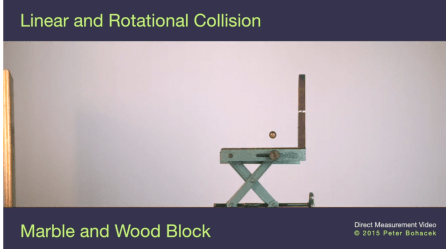
Students used a Linear and Rotational Collision Direct Measurement Video to get some practice with conservation of momentum. In the first question, I asked students to determine whether momentum was conserved in a certain collision using a calculation, and I was surprised by how many students struggled to understand the question. I might change up wording on some of the problems we did to explicitly have them state whether momentum is conserved or if there is an external force, similar to how I approach force problems by first asking students whether the forces are balanced.

I also asked some questions about whether momentum is conserved in collisions where the block starts to spin, and I heard some great conversations about uncertainty, external forces, and other big ideas that have me really looking forward to tomorrow’s discussion.

momentum-dmv

Physical Science: Mirror Mazes

Students used what they know about refection to solve some mirror mazes. I had some where students were given the placements of the mirrors and had to place the target and others where they were given the target’s location and had to place the mirrors. Since we haven’t done much with ray diagrams, this seemed to really solidify what I mean by the path of light.

obstacle

Day 89: Conservation of Momentum & Refraction

AP Physics: Conservation of Momentum

Students worked on some problems using conservation of momentum. I used some problems that require them to shift how they are define their system, which students found challenging at first, but once they got the hang of it, many seemed to appreciate how shifting their system can make a problem easier.

Physical Science: Refraction

Students did a lab making lots of observations of objects in a clear cup of water. Afterwards, we shifted to making some observations as a whole-class of a laser pointer in a fish tank. Once they summarized the big ideas based on observations, I set up a washer in the bottom of a fish tank and aimed a PVC tube to view the washer. Students predicted where, relative to the tube, they should aim a dowel and a laser pointer in order to hit the washer. I was very pleased at how successful students were at this task; I do wish I’d had them write a CER for this problem since a lot of students struggled to explain their prediction.

Day 88: Collisions & Mirrors

AP Physics: Collisions

Students finished collecting data to compare momentum before and after a collision of two carts, then had just enough time to talk through results. I just gave students a data table from the Modeling Instruction curriculum, but I think my students could have handled something more open-ended as long as I can plan how I will make sure students get a good variety of collisions. I ended up falling into a pretty teacher-centered “discussion” after the lab to limit how much time we spent, but I think we missed out on a really good opportunity to talk about uncertainty and assumptions. Next year, I might have each group do just a few collisions so we spend more time discussing the results.

lab

Physical Science: Mirrors

I gave students three questions about the images formed by a mirror and tasked them with writing a CER for each question. This is the least structured lab I’ve given students so far this year, which made some students nervous, but I was pleased with the results. I had students whiteboard their CERs so we could have some discussion, but I had students stay at their lab tables and a lot of students kept going back to small group discussions. I think this was because I’ve established a very clear routine where the desks are for whole-class discussion and the lab tables are for lab group discussions. Next time, I’ll probably keep the discussion in the lab area, but have students stand up and move away from their tables to get the physical cue that its time to shift focus to the whole class.

Day 87: Assessment & EM Spectrum

AP Physics: Assessment

Students took an assessment over momentum. On the last few assessments, I’ve had a fair number of students use the full class period, when normally I try to keep the weekly assessments closer to half a class period. I need to take a look at my assessments compared to the AP exam to decide if I should shorten the weekly assessments, put a time limit on them so students have to practice pacing themselves, or stick with what I’ve been doing and let them take the time they take.

Physical Science: EM Spectrum

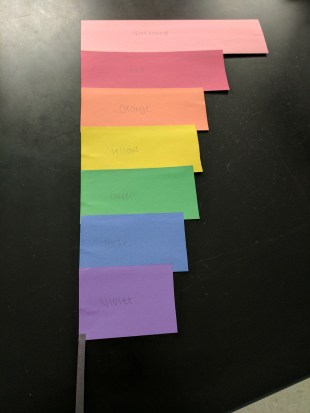
Students worked on a model of part of the EM spectrum, cutting paper to scale to represent the wavelength of some different types of waves. I started this activity when I included more calculations in the course, so it was partly a chance to practice working with scientific notation and switching between wavelength and frequency, but I’ve been taking out a lot of the calculation in the course and the only conceptual ideas this activity gets at is comparing the wavelengths. The standard this activity goes with is about identifying parts of the EM spectrum, so I need to spend some time looking for other activities that can meet the standard better.

spectrum

Day 86: Collisions & Presentations

AP Physics: Collisions

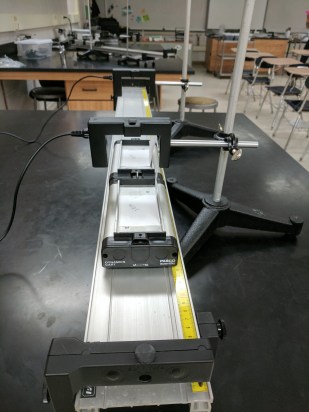
Today, we started expanding the momentum transfer model to cases where two objects are moving before the collision. We got out the photogates so students could find the velocity before and after various collisions of two carts. I got a kick out of how exciting it was for some students to use .

collisions.jpg

Physical Science: Presentations

Students presented their research projects on different energy sources. I like the sort-of-public forum to share their work, but it is tough for students to sit through a bunch of presentations, even though I never spend more than half the class period on them. For next year, I want to put some thought into other formats that might balance the public accountability with more active engagement. Maybe a poster session with some kind of task for students as they view each others’ work.

Day 85: Impulse & Color

AP Physics: Impulse

I introduced impulse today by rolling a cart into a force sensor with a bumper to look at the momentum vs. time and force vs. time graphs. I did this as a demo since we only have one bumper. In my 2nd hour, we got pretty nice data and students easily saw that the area of the force vs. time graph equaled the change in momentum, but my 4th hour got pretty ugly data and I’m not sure why. Afterwards, I borrowed from Michael Lerner again and had students work on solving some impulse problems using SOS diagrams.

bumper

Physical Science: Color

Students wrapped up the lab on color. Using some colored paddle filters, they observed white light bulbs, colored light bulbs, white paper, and colored felt. Next time, I might have them look at the felt under the colored light bulbs, as well, to strengthen their ideas about colored objects under different light sources. After the lab, we confirmed some observations using a diffraction grating on an overhead projector to get colored light. Finally, we revisited the video I’d shown them before the lab to refine and expand their initial explanations. In what is probably old news to people familiar with the role of phenomena in NGSS, the concrete goal of explaining an unexpected observation seemed to help students participate more, as well as give them a firmer grasp on what it looks like to understand the learning target. I’m wondering if using phenomena to frame more labs could help students coming to me from another teacher adapt to my classroom.

filters

Diffraction grating with paddle filters

Day 84: Physics Puzzles & Color

AP Physics: Physics Puzzle

My classes were pretty thin today since the senior social studies classes were watching the inauguration. I gave students who were here the opportunity to do some in-class retakes. I also picked out a couple of fun puzzles from Mad About Physics that students could work on. Students got pretty into the puzzles, especially one where they can get a marble to roll “upwards” by adjusting the space between some straws in a v.

puzzlePhysical Science: Color

Yesterday, a lot of my students were talking about standing waves and longitudinal waves as two separate things, so I started by hooking a spring up to a wave generator to produce some standing waves and show the familiar patterns. Afterwards, I showed them a short video of some demos with a pair of 3D glasses, using it to prompt some questions to motivate a lab on color.