Days 133-137: Bouncy Balls & Torque

This week was a little odd since we didn’t have any classes on Tuesday to accommodate state testing. The juniors took the ACT, but the seniors had an asynchronous day. A lot of the seniors really appreciated having a day to follow their own schedule and relax a bit.

Physics: Bouncy Balls

We started an evidence-based reasoning activity to determine what interaction dissipates a bouncy ball’s energy (you can find more details in my article from The Science Teacher). This week we focused on preparing for doing the video analysis by sketching energy bar charts, force diagrams, and motion graphs for if air resistance is responsible for most of the dissipated energy and for if the impact with the table is responsible for most of the dissipated energy. We then used those diagrams to get to some testable predictions about things we can measure with video analysis that will distinguish between those two explanations. Students found this process challenging, but I was really pleased by how they connected other ideas from this course to energy.

AP Physics: Torque

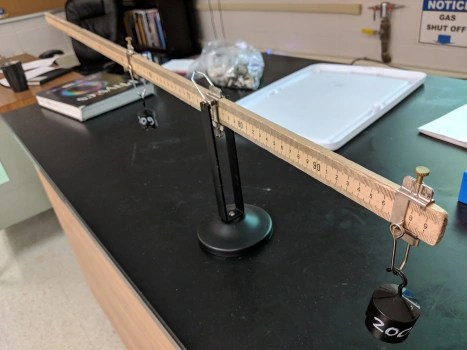
To introduce torque, students set up some meter sticks as levers and looked for a relationship between the force exerted by a hanging mass on the meter stick and the force required to balance the meter stick. After we discussed that lab and took some notes on torque, I showed students a second class lever and asked them to determine if that type of lever showed the same relationship as the first class lever we started with. While I don’t discuss the classes of levers with students, I like that this activity helps emphasize it is the direction of the torque, rather than the direction of the force that is important. This activity was tougher for my students than I expected, I think because I rushed the post-lab discussion after the first class lever, so they weren’t as clear as they needed to be about the relationship we’d found the first day.
Days 128-132: Energy Conservation & Rotational Kinematics

Physics: Energy Conservation

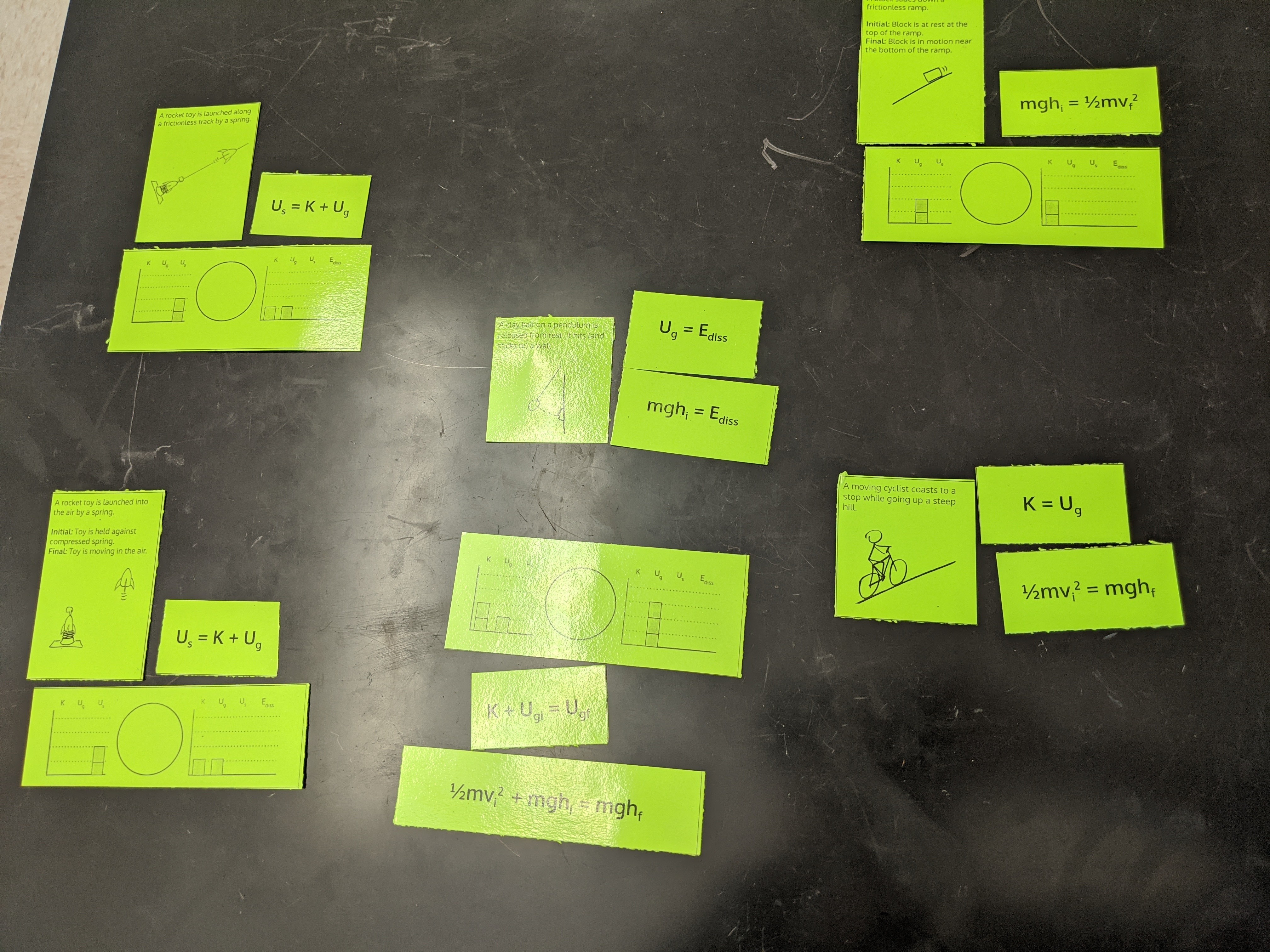
This week we worked on making the transition to setting up problems for conservation of energy. Before doing problems, we did a card sort where students matched scenarios to energy bar charts, conservation of energy equations using only energy forms, and conservation of energy equations where the formulas were substituted for the energy forms. This seemed to really help students connect the two different versions of the conservation of energy equations and were something I was able to refer back to when students were working on calculations on paper. Whenever students refer back to an activity as we tackle the next challenge, that is a sign to me that the activity was worthwhile.

AP Physics 1: Rotational Kinematics

This week we worked through rotational kinematics. We started with an activity on Pivot Interactives where students analyzed the motion of some dots on a spinning wheel (disclaimer: I write activities for Pivot Interactives. This one should be published soon!). Students very quickly made connections to linear kinematics, which was exactly what I was hoping for. From there, we did a card sort with motion graphs for rotational kinematics where students again saw the connections to linear kinematics really clearly. I’d printed and cut this card sort back in February 2020 with the intention of using it that spring, so it was exciting to finally pull it out of the cabinet! One of the advantages of students making those connections is these activities served as a really natural review, which I try to incorporate into these last topics as the countdown to the AP exam begins.

Days 123-127: Kinetic Energy & Centripetal Force

Physics: Kinetic Energy

The biggest task this week was a lab to determine the equation for kinetic energy. On some recent labs, students have struggled to get good data. I think part of the issue is many don’t buy into the idea that knowledge should come from the labs they do, so they don’t invest the effort or attention into getting good data, which makes it hard to see how it leads to physics concepts or equations and becomes a self-reinforcing cycle I wanted to interrupt with this lab. We talked a little about what I observed and my hypothesis, then I re-did the gravitational potential energy lab as a demo and made a point of discussing the things I was doing to get good measurements and check the quality of my data as I went. When we were getting ready to whiteboard, I also checked in with groups to make sure they had quantities on the correct axis and were seeing that they needed to linearize. The result was data that really nicely showed the quadratic relationship between kinetic energy and velocity and most graphs even had slopes very close to half the mass of the carts students used! A lot of students were really proud of their results, which was great to see and I’m hoping will encourage them to continue those good data collection practices.

AP Physics 1: Centripetal Force

I like to ignore the College Board’s recommendation to do centripetal force as unit 3 because it is such a nice opportunity for built-in review of a lot of ideas about forces. We started by spinning some rubber stoppers on strings to talk qualitatively about how we could change the force in the string before moving over to Pivot Interactives to collect quantitative data (disclaimer: I am a content writer for Pivot Interactives). Next, we used an activity I originally got from Lucas Walker using exoplanet data to find the law of universal gravitation. Students are making the connections I want them to, but I can tell they are starting to feel some fatigue. I typically rely a lot on Pivot Interactives for this topic since we don’t have much equipment, but students got pretty into the brief hands-on activities we did this week, so I think I should make sure to keep working those in to help my students stay engaged these next few weeks.

Days 118-122: Energy Bar Charts & Springs

This week, we came back from spring break and started trimester 3.

Physics: Energy Bar Charts

This week we focused on drawing energy bar charts. Students have struggled to connect representations, so I tried starting by having students draw the more familiar energy pie charts. Then, we got out the Mathlink cubes to use as a manipulative representing the types of energy (an idea I think I first saw in Scott Hertting’s article in The Physics Teacher). Once students had rearranged the cubes to represent at least two different snapshots, I had them sketch how they arranged the cubes on a bar chart. One thing I was really excited about is as the week progressed, I had some students ask if they could keep using the cubes, which tells me they were a useful tool. I also saw a lot of students sketching energy pie charts to help figure out what the bar charts should look like, which tells me they are connecting the two representations when seeing relationships between representations has been really challenging this year.

Cubes in three stacks on a whiteboard. Each stack is labeled with a type of energy.

AP Physics: Oscillating Springs

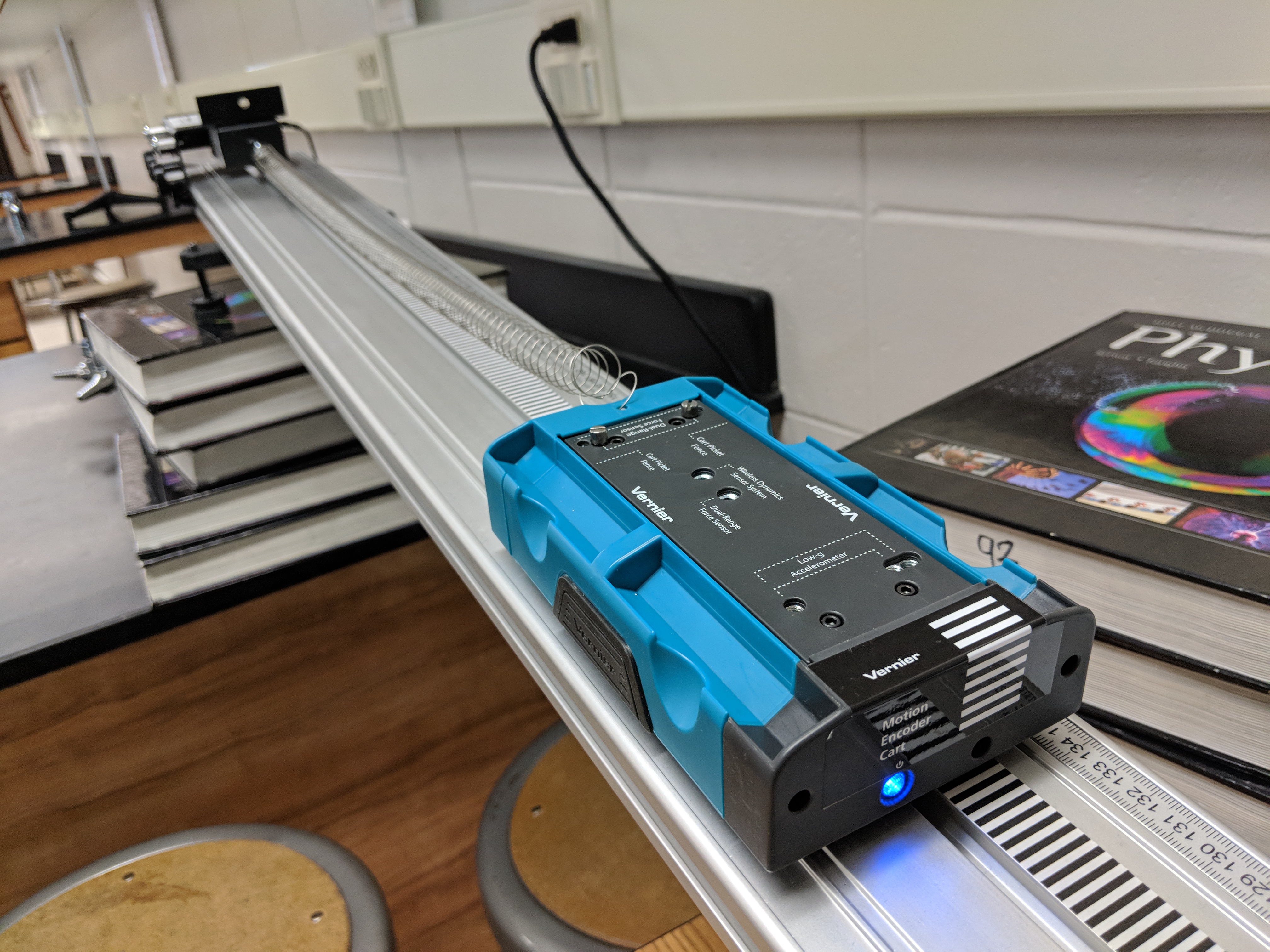
Students did a lab to find the equation for the period of a spring, then we dove into some problems. Students did really well with the problems focused on representations and showed a lot of growth from earlier this year on the problems from the College Board’s AP Physics 1 workbook. The workbook problems included a lot of predictions about how various factors would affect the period of a spring, so we used a spring to connect a motion encoder cart to a force sensor on a track so we could change the angle the spring was at, as well as factors students had already tested like mass and amplitude. I also made sure to use this as an opportunity to review some basics on motion graphs since exam day is starting to loom.

Days 113-117: Final Exams

This week wrapped up trimester 2. Staff and students alike are very ready for spring break.

Physics

We stuck with our usual structure of using half the final exam period for a lab practical and half the period for an individual written final. One of the interesting things is that while students have been struggling to collect high-quality data during labs, most groups had pretty accurate results on the lab portion of the final. I think a lot of students have been struggling to connect different representations in general, including how their lab data connects to the concepts and mathematical models we are using. If students see the labs as disconnected, why should they invest the effort to get good quality data? I think that’s become self-reinforcing because when few groups have good quality data, it is harder to see the connection between the labs and the models we are developing. The new trimester will be a good time to interrupt this cycle. I think we will try collecting data as a class for a lab so that I can model things like graphing as I go and re-doing data points that don’t match the apparent pattern. On the final, I think grades provided an extrinsic motivation for high-quality data. I don’t want to default to making data quality a part of a students’ grade in my current grading system, but I could provide other extrinsic motivation like stickers for being below a given percent difference from the accepted value.

AP Physics 1

Students took a practice AP exam for their final. I’m really pleased by how well students scored, especially I gave students the full multiple choice even though there are some topics we haven’t covered yet. On the free response, I noticed some students struggled with parsing what the question was actually asking for, which is not unusual. Especially once we wrap up content and focus on review, I think I need to make sure we spend time on reading strategies for making sense of AP problems.

Days 110-112: Energy Pie Charts & Pendulum Practical

With President’s Day on Monday and a PD day on Friday, we had a 3-day week.

Physics: Energy Pie Charts

This week we did mistakes whiteboarding with energy pie charts. There was some great discussion, both as students prepared and as they presented the whiteboards, that came from students working through what differences represented someone making a mistake vs. what differences represented different, but equally valid choices.

We also briefly revisited momentum transfer this week. On the last quiz, I saw a lot of evidence that students were struggling to connect the equations and math for conservation of momentum to their momentum bar charts, which fits with a larger pattern I’ve seen this year of students struggling to connect different representations. As we get into conservation of energy at the start of next tri, I need to give a lot of thought into how I’m going to support students in making connections between mathematical and graphical representations. I do a lot of card sorts to try and help with these connections, but I think I might need to plan some discussion that specifically focuses on how the mathematical representations relate to the diagrams.

AP Physics: Pendulum Practical

This week, we wrapped up pendulums. My students could use more practice and feedback on designing experiments and writing procedures, so I decided a pendulum practical would be a good opportunity to practice this. I tasked students with finding the length of a string without using a meterstick or ruler. Before they could get their string, they had to write out their procedure on a whiteboard and get it approved by me. I think this would have been tough to manage in a large class, but I currently only have 11 students in AP, so was able to pretty easily take time to give groups meaningful feedback and check their revisions before cutting them a piece of string to use.

Days 105-109: Energy & Pendulums

Physics: Energy

Students did a lab to introduce energy where they pulled carts up ramps at different angles, always raising the cart to the same height above the table, then measured the average force they needed and the distance they had to pull the cart for each angle. Then, they sketch force vs. distance graphs and see they always have the same area. The data was rough enough this year that students could see that a steeper angle required a larger force and a smaller distance, but the areas varied a lot. We’ve had a few labs lately where the data came out pretty rocky. I think part of what’s going on is it’s been tough this year in general for students to see connections between what happens in the lab and the physics concepts we are learning. If the labs are something disconnected from the rest of your learning, why would you invest time and attention into collecting high-quality data? We’re also at the end of a trimester when more students than usual are scrambling to raise their grades after an unusually challenging term and the February doldrums have been hitting everyone harder than usual, so students have less attention and mental energy to go around than usual. Aside from the final, we won’t have any more labs until tri 3, which is a good time for a fresh start. In the meantime, the other physics teacher and I need to do some thinking about how we will continue to draw connections between labs and physics concepts and make sure students have what they need to get good-quality data.

AP Physics 1: Pendulums

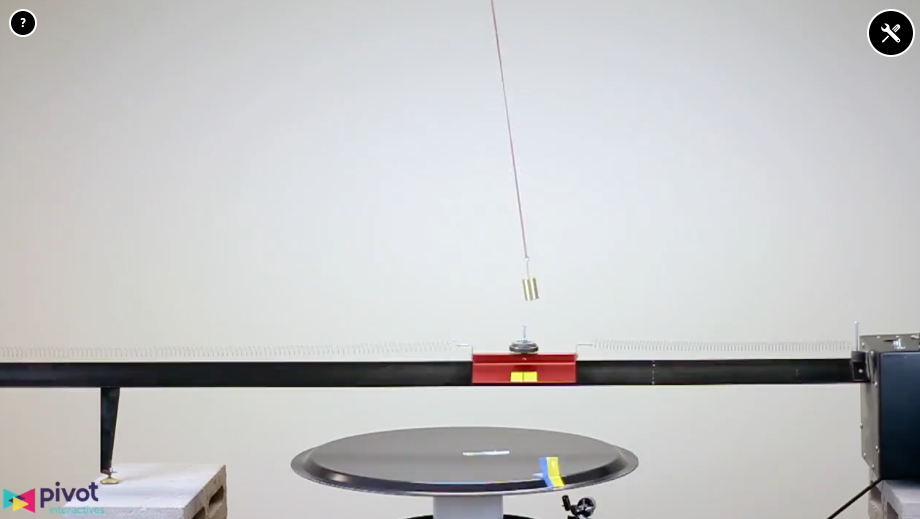
This week, we started working on simple harmonic motion. For the first activity, students used a video from Pivot Interactives that shows a pendulum, a cart attached to springs, and a spinning disk all in synchronized simple harmonic motion. Students made position vs. time graphs for each object, which always works well for some discussion not only of how the motion of all three is similar, but to establish some important ideas like the non-constant force and the repeating patterns in the motion of each object. After that, we dove into a deeper focus on pendulums by doing a lab to find the factors that affect the period of a pendulum. This model is going to be split over spring break, which got me thinking about how I currently have the unit structured. Right now, I have one standard for pendulums and one standard for springs. But, especially since I start by emphasizing how similar those two kinds of motion are, I wonder if it would make sense to instead have a standard about using multiple representations like motion graphs and energy bar charts to describe simple harmonic motion that includes both springs and pendulums, then a separate standard on the mathematical relationships and factors that affect the period which also applies to both pendulums and springs. That seems like it would better represent the different kinds of thinking I ask students to do over the course of the unit.

Days 100-104: Momentum Conservation & Projectile Practical

Physics: Momentum Conservation

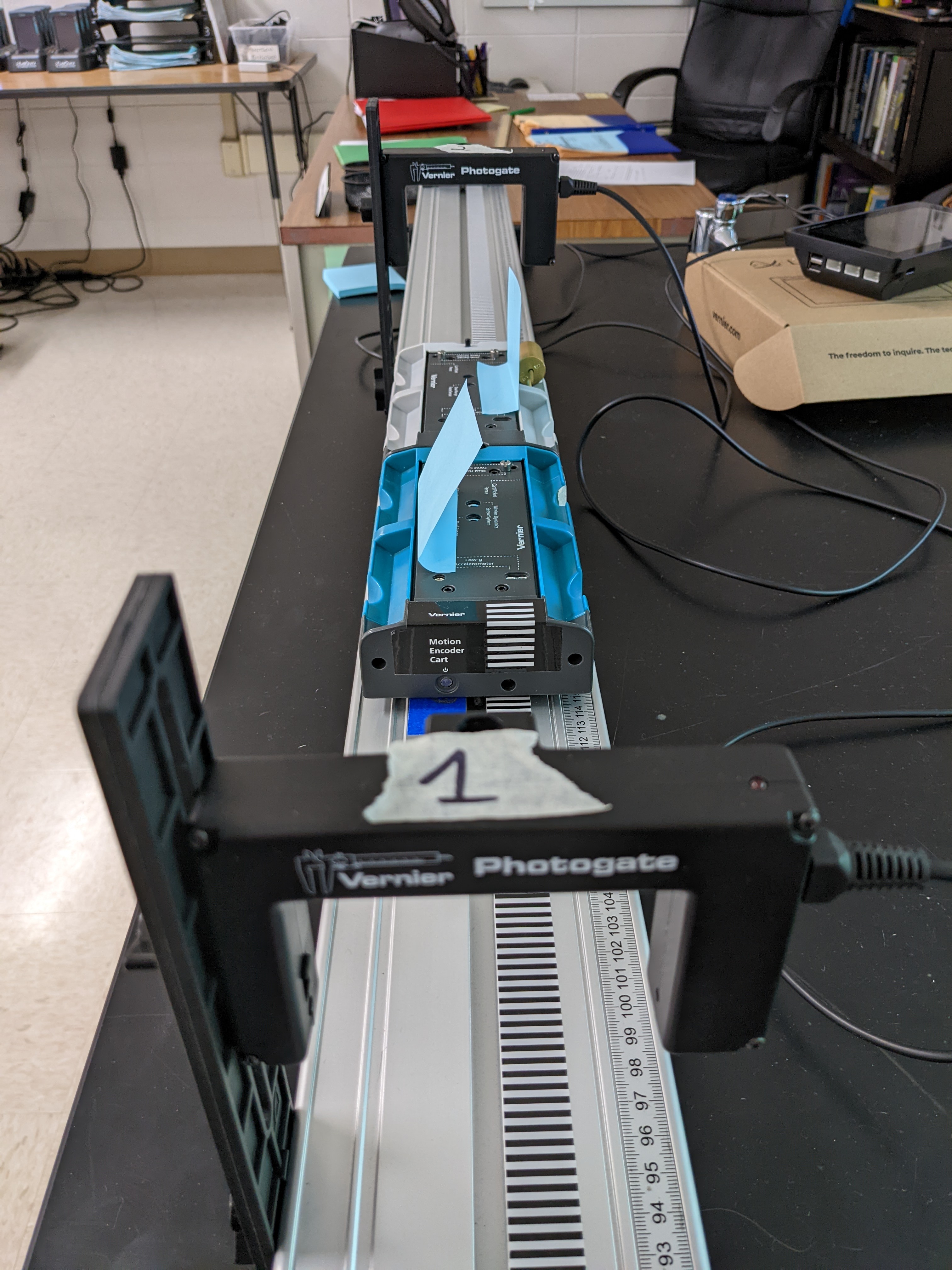
This week we did a lot of work on conservation of momentum. We started with using photogates to measure the velocity of carts before and after a collision to reinforce the idea that momentum is transferred, then we did a momentum representations card sort from Kelly O’Shea before students tried some problems on their own. One thing I noticed is a lot of students are still struggling with what momentum is. I think a lot of students were having trouble taking in new ideas during distance learning, and are now struggling to build on those ideas. Students had a lot of great conversations during the card sort, and it was a lot of fun to see how they applied that thinking to the problems later in the week.

AP Physics 1: Projectile Practical

This week we wrapped up projectile motion. Students did a projectile practical where they predicted where a marble would hit the floor. I like to take advantage of the different masses of marbles I have and ask students to predict how the landing spot would change if they switched to a lighter marble, and students consistently nailed it. One fun thing has been seeing students use multiple different models to think about projectiles and the confidence I’m starting to see from more students.

Days 95-99: Cart Explosion Lab & Projectile Graphs

Physics: Cart Explosion Lab

This week, we wrapped up the cart explosion lab and started working on momentum bar charts. My students had really good results on the cart explosion lab, but connecting it to momentum in the discussion is always rough. Students launch a spring-loaded cart and a standard cart off each other, figuring out where on a track to start them so they reach the ends at the same time, then record the ratio of the cart’s masses and the ratio of the distances they travelled before changing the mass and trying again. While I love that this low-tech approach incentivizes students to look for a pattern while they are collecting data, students struggle to connect the distances travelled to the velocities, I think mostly because there are so many different numbers flying around. During the discussion, my students had great results, but needed a lot of support to connect them to momentum. I want to rethink our momentum unit anyway, and I think part of that will include clarifying what I want students to get out of this lab and whether there are better ways to achieve that purpose.

AP Physics 1: Projectile Graphs

We started the week with a Pivot Interactives activity that shows three views of a projectile (full disclosure: I am an activity writer for Pivot Interactives). I’ve done video analysis, but I really like the way seeing the motion from different angles solidifies what I mean by the horizontal and vertical motion. It’s been a while since we did much with velocity vs. time graphs and students made solid connections to the forces acting on the projectile. We also worked through an activity I got from Michael Lerner where students describe the motion of an orange falling from a tower using every model we’ve learned so far, which really helped reinforce for students are aren’t really doing something new, just applying what we know to a new context.

Days 90-94: Impulse Problems & Energy Practical

This week we were back in-person after two weeks online.

Physics: Impulse Problems

A big theme I saw across my classes is that students had a pretty decent grasp of impulse, but didn’t think they had learned much the last two weeks. I kept thinking about my PhD research so far where, in some data I collected pre-pandemic, I found that even when students were mastering the material, they struggled to build confidence and self-efficacy from activities that were purely computer-based. In addition, right before we went online, my students also made clear that they really value discussion and collaboration as a way to learn physics, but I struggled to get students talking to each other online. With those things in mind, this week was all about giving students space and time for discussion and collaboration to build their confidence. We spent a lot of time whiteboarding various problems, including some that were assigned while we were online, so that students could talk to each other. I also gave much more feedback than usual while students were working on whiteboards to point out what they had correct or what they were doing well, which seemed to really help students see just how much they had learned the past two weeks.

AP Physics: Energy Practical

My students have been feeling pretty good about doing problems with conservation of energy, I think in part because we were able to start them in-person, then do a lot of practice while we were online. I wanted to give students something hands-on before we wrap up energy, so I got out the popper hopper toys and tasked students with finding the spring constant. To help my students with writing procedures, I had each group write a procedure on a whiteboard, then give it to another group to follow. They were allowed to go ask the group who’d written the procedure questions to clarify steps or discuss changes as both as a way to give feedback to the group who wrote the procedure and to ensure that every group was able to complete the task, even if there were issues with the procedure they were given. I think that helped give students a concrete target for what needs to be in a procedure.