Day 119: Pendulum Problems & Representing Reactions

Physics: Pendulum Problems

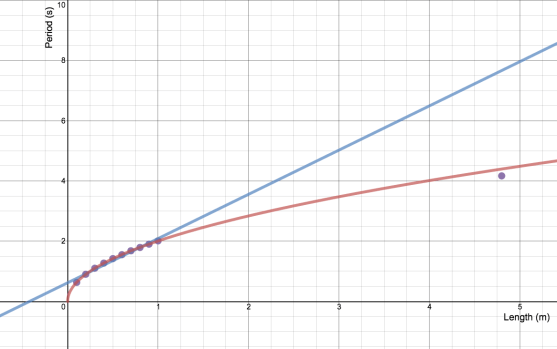
We had a brief discussion about the results of the pendulum lab, especially why a linear fit for the data my students collected usually looked pretty good, but did a very poor job of predicting the period of a large pendulum. I need to do a much better job of having my students talk about their intercepts, including whether or not an intercept of zero makes sense. Most of the groups who tried a square root function to fit their data gave it a shot because they didn’t like the intercept on the linear fit.

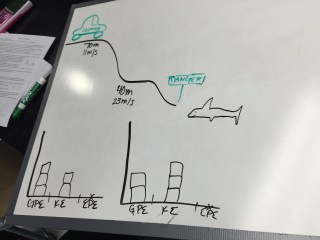
Afterward, students worked on a pendulum worksheet I put together where they drew energy bar graphs and free body diagrams for the pendulum at key points in its motion, then sketched position vs. time, velocity vs. time, and acceleration vs. time graphs for the pendulum.

pendulum graph

Chemistry: Representing Reactions

Students practiced translating between statements, chemical equations, and reaction diagrams. A lot of students needed some support to work through what a coefficient means vs. a subscript, but they did get there.

Day 118: Giant Pendulum & Conservation of Mass

Physics: Big Pendulum

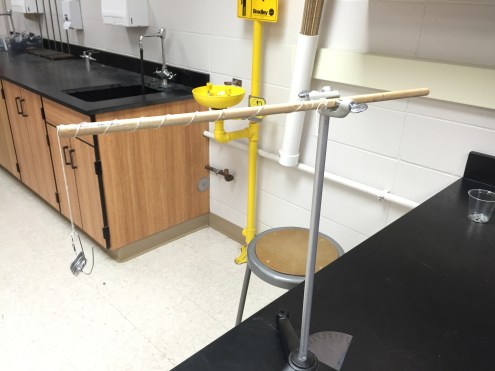
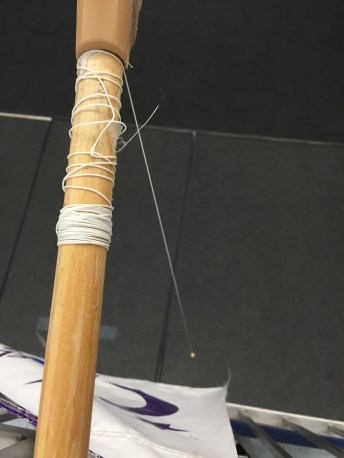
Before discussing the results of yesterday’s pendulum lab, we went to the main entrance of the school where we could hang a string from the second floor down to the first to make a 5 m long pendulum. Students used their mathematical models to predict what the period should be. Most groups used a linear fit for their data, and ended up predicting a period that was too big as a result. The really long pendulum provided a reason to refine their models by collecting more data and trying some linearization.

IMG_1736

Chemistry: Conservation of Mass

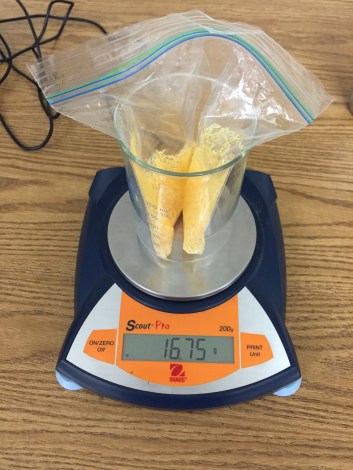
Students reacted calcium chloride, baking soda, and bromthymol blue in a Ziploc bag, making sure to take the mass of everything at various stages. This tri, I gave each group a beaker to place their bag in when using the balance, rather than having them set the bag directly on the balance pan, and the results were much better; students were able to use their results to articulate the law of conservation of mass very nicely.

IMG_1737

Day 117: Pendulums & Mystery Tubes

Physics: Pendulums

Students started collecting data to make a mathematical model for the period of a pendulum. This is the first lab that was framed more generally as make a model, rather than as to find a relationship between two variables, so we started with some discussion about what variables could matter. Today was one of those days where I felt a bit extraneous; students are getting pretty good at designing experiments and deciding how much data is “enough”, so I wasn’t fielding many questions.

IMG_1735

Chemistry: Mystery Tubes

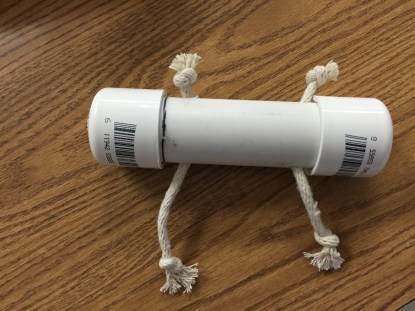
With the start of a new tri, I restarted the course today with a new group of students. This time, I decided to start with the mystery tubes. Students practiced making observations, then forming and testing hypotheses to figure out what is going on inside the tube. We wrapped up with a brief discussion comparing the tubes to learning chemistry and I introduced the idea of chemistry as a series of models that make good predictions, rather than a set of facts.

IMG_1734

Day 116: Tri 2 Reflections

Its day 2 of final exams, so I’ve got some time before I get a nice stack of tests to grade and figured I’d use it to look back on the trimester.

Physics

This trimester, I saw many of my students truly become fearless when it comes to physics. They don’t hesitate to ask questions that go beyond how to do the day’s task and are quick to propose and try experiments just because they’re curious and not because it will be on the test. They are not only starting to think like scientists, but to embrace and enjoy the scientific process.

My biggest frustration is that I’m still talking a lot during discussions. Some students tell me they aren’t usually sure what’s worth saying or talking about and worry about taking the class on a tangent. That tells me I’m framing the discussion in a way where its about what I want them to learn from a task, not what they found confusing or interesting or what they notice looking at other whiteboards. Before the next board meeting, I want to take a few minutes to have a conversation with my students to help them see their questions and observations are the point of the discussion, not a distraction, and assure them its my problem, not theirs, if we somehow don’t get to the intended content.

Next year, I need to work on the storyline I use for electricity and magnetism. Both my students and I felt like the concepts never really came together as nicely as mechanics does. I’m not sure E&M will ever build as seamlessly as mechanics can, but I want to spend some time this summer revising my sequence to at least improve the connections. I did manage to bring in a lot more concepts from mechanics to use as a foundation for E&M, and am pleased by how that went.

Chemistry

This course as typically been taught with a fairly traditional approach, so this time around I’ve been revising or replacing a lot of materials to put much more emphasis on conceptual understanding and active learning. There were some aspects it was fairly easy to get students to embrace. A lot of them really liked some of the visual representations I borrowed from the Modeling Chemistry curriculum. Students not only used those representations unprompted, but a few came up with ways to effectively apply those representations to new situations that surprised me. It was great to see.

The biggest struggle, however, was getting students out of a very passive approach to school. Since this course is the lowest of our four levels of chemistry, it is a class filled with “those kids” and I think that’s what they’ve gotten used to. Its interesting to me how often students would show me they could reason through how to do a problem using their conceptual understanding, but not recognize what they’d done and ask me for the steps. I shied away from doing much culture-building or metacognitive reflection since the course is pretty short, but I think I need to invest that time if I’m going to continue the changes I made. I may not cover as much chemistry, but its worth it for students to truly understand the chemistry we do get to. Even more importantly, I’d love for “those kids” to leave my class believing that they can construct knowledge, and not just receive it.
Day 115: Final Exams

Physics: Collaborative Exam

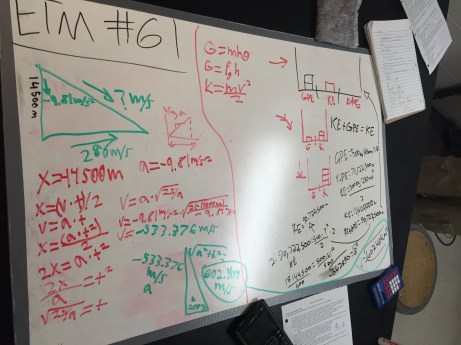
Since physics is both very lab-based and very collaborative, we decided the final should be as well. We planned lab practicals based on the models from this trimester. Students are getting a test to complete individually that has descriptions of each lab practical, but no numbers. Students will have about an hour to set up equations and plan what they will need to do in the lab. For the last half hour, students will be placed into groups where they will actually complete each of the lab practicals.

IMG_1733

Chemistry: Final Exam

I went with a fairly traditional written exam, though there was enough time that I could have done a two stage collaborative exam. I might try that next trimester, though I’ll need to think about how I will make sure students make effective use of the collaborative time. I also need to rethink how I approach the review assignment. I allowed students to use their review on the final, and several students answered some questions by just copying over their answer from the review, even when the test question was looking at a different reaction or element. Many of my students read below grade level, so I’m wondering if that was a factor in students who missed the ways the test was different from the review.

Day 114: Gallery Walk

Tomorrow is the start of final exams, so both classes today went over their final review assignments. I decided to go with a gallery walk, with each group preparing a whiteboard for a different problem. Then, one member of each group stayed put to answer questions while the others moved around the room to check out the other whiteboards. Especially in my largest class, I really like that the gallery walk gets more students involved in the conversation. A few students decided to play the “reverse mistakes game” during the gallery walk by pretending to hold a misconception as they asked questions at a whiteboard.

IMG_1730

This group asked if they could try their problem with both constant acceleration and energy transfer.


Day 113: More Final Review

Students in both courses continued to work on their final review assignments. After a three-day weekend, both classes were much less focused than they were on Thursday. In chemistry, I talked to them a bit about the strategies I saw during class, and how they could improve on them. The students who were working pretty well on Thursday seemed receptive and tried to refine their approach. There were some groups that had great conversations about the problems on the review. In physics, I saw a lot less collaboration than on Thursday and a lot more off-task behavior in general. A lot of students talked about feeling fried from studying and working on final papers or projects over the weekend, and I saw more students working on other homework than usual. I think a lot of students are just feeling fried by the end of the tri. Tomorrow, I’ll switch to something more structured, especially since it will be time to go over the reviews.

Day 112: Final Review

We’re down to three class periods before finals (possibly two, if the basketball team makes the state tournament). In both of my courses, we started the final review. While both reviews were pretty similar, it was interesting to contrast how my two classes approached it. In physics, students were quick to grab whiteboards to collaborate on and pull out old quizzes and other work to jog their memory. I also saw a lot of students jumping around in the assignment, looking for the problems and questions they found most challenging to use those as a starting point. In chemistry, we talked about strategies to prioritize what to work on, but most students took a very linear approach and only a few pulled out work from earlier in the term. I saw much more variation in how students approached working together. Two students in particular did a really nice job of bouncing ideas off each other and challenging the other one’s thinking, but other groups “worked together” by agreeing to divide up who would do what portions of the review. No one opted to use a whiteboard for brainstorming and collaborating; when I asked some students about it, they saw it as extra work since they would have to transfer their work onto their paper.IMG_1713

Contrasting these classes really reinforced for me how important it is to work with students in this chemistry course on how to be a student. In physics, I have some of the top students in the school and they come to me expecting that they need to understand the daily work to do well on assessments and knowing that having the right answer down is very different from understanding how to answer the question. Many of my chemistry students don’t see that connection between assessments and what happens day-to-day, so don’t value the daily work as much. I need to keep working on making the value of daily work explicit to my students. There are a few who’ve bought into the idea that what they do today influences how their test will go, and they tell me chemistry is one of their highest grades. My challenge for next tri is to get more students to that point.


Day 111: TIPERs & Half-Life

Physics: TIPERs

Students worked through some questions related to magnetic forces from TIPERs. I overheard a lot of good discussions, and students shifting their ideas as they went.

IMG_1711

Chemistry: Half Life

We spent some time going over the results of yesterday’s lab, then students worked on some half-life problems. Based on conversations with my students, many were struggling to connect the definition of half-life to the process for solving problems. I need to rework the lab discussion for next time to try and help students really get what half-life means.

Day 110: Motors & Half Life

Physics: Electric Motors

Students built simple electric motors, then experimented with how they could change the behavior of the motor. They drew a lot of nice connections between their observations and the previous work we’ve done on wires in magnetic fields. I let students use power supplies, and the sparks that showed up at higher voltages were very popular.

IMG_2206

A student took this photo that’s way cooler than anything I got

Chemistry: Half Life

Students simulated radioactive decay using M & M’s, with one side representing the parent isotope and other representing the daughter. To reinforce half-life is based on probabilities, rather than hard and fast rules, I wanted to have students compare several runs of this experiment. Each group did the experiment twice, then submitted their averages to a Google Form. Tomorrow, we’ll look at the class data to see how it compares to the results of individual groups.