Day 157: FCI & Review

AP Physics: FCI

Students took the FCI today. I didn’t get my act together to give anything as a pre-test this year, but I want to start doing a pre- and post-test again next year and am trying to decide whether I’d rather use the FCI or the CTSR. To help decide, I’m going to see if one test correlates better to my students’ scores on the AP Physics 1 exam.

Earth Science: Review

I had students whiteboard their answers from Friday’s review for discussion. On a question about what causes different types of volcanoes, I realized students were having trouble separating characteristics of the different types from what causes the different types, so we spent some time discussing that. Next time I teach this course, I need to think about how to shift this unit (and several others) to help students more clearly separate cause and effect.

wb (5).jpg

Day 156: Base Sliding & Synthesis Day

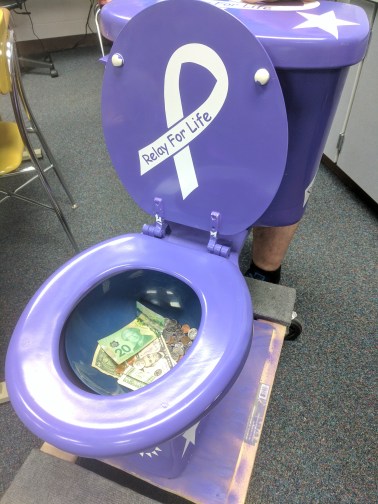
Today is Tartan’s Relay for Life and one of my classes got visited by the infamous purple toilet. Note the Canadian bill donated by one of my students.

toilet

AP Physics: Base Sliding

Students are wrapping up data collection and analysis for their final projects. I’ve got two students looking at the physics of sliding into a base to try and answer whether feet first or head first is better. They’re in different hours, so I’m not too worried about the repetition, but they are also looking at some different perspectives. One is looking at angular momentum as the player moves from running to sliding while the other is focusing on the actual slide. Its actually a little too bad they are in separate hours since it could be fun to have them compare notes.

Earth Science: Synthesis Day

I feel like this unit has been pretty disjointed and students are not making connections between volcanoes, mountains, folds, faults, and plate tectonics. I had them work through some conceptual questions today to explicitly draw connections between those ideas, which illuminated some specific areas I need to revise in this unit. For example, one of the questions asked students to determine whether mountains or volcanoes are more likely to have folds, and it came out that a lot of students don’t have a mental model for how a fold forms.

Day 155: Hockey Pucks & Vocab

AP Physics: Hockey Pucks

Students continued to work on their projects today. One of my students is analyzing momentum transfer between a hockey puck and a stick and found a surprising result. He expected the puck to have a fairly constant acceleration while in contact with the stick, but his data shows a big jump in the puck’s acceleration when the blade of the stick starts to flex. The next challenge is to try and figure out why!

Earth Science: Vocab

This class had a sub today, so no photos. There’s been a lot of vocabulary this unit, so I had student work on a short activity to put the vocab into student-friendly language and do some synthesis with the terms. I’ll find out tomorrow how things went.

Day 154: Colliding Bouncy Balls & Isostacy

AP Physics: Colliding Bouncy Balls

Students continued to work on their final projects. One student worked on colliding pairs of bouncy balls together at different speeds to see how bouncing changes against an elastic surface instead of a hard one.

Earth Science: Isostacy

We didn’t actually use the word isostacy today, but students floated blocks of different kinds of wood in a bucket of water and measured the ratio of the block above the water to below the water. I’d love to plan ahead better and get a better mix of blocks with several with the same density, but different volumes. I was able to get around that by having them stack two identical blocks to see the ratio stays the same.

isostacy

Day 153: Charlie Brown & Volcanic Landforms

AP Physics: Charlie Brown

Students continued work on their projects. One student did some video analysis of a clip of Charlie Brown kicking a football to explain why he falls down after Lucy pulls it away.

Earth Science: Volcanic Landforms

I did some notes on volcanic landforms, but tried to break it up a bit by explicitly having students annotate their notes at a few points during class. I also tried a “give one, get one” at the end since many of my students have been skipping writing questions based on their notes, but I don’t think students saw the value in that activity. Partly, since I’ve managed to cut down on the notes, I haven’t spent much time laying the foundation for Cornell notes, and students haven’t had much practice in my class writing questions based on notes.

Day 152: Project & Mountain-Building

AP Physics: Project

Students continued work on their projects. Both of my classes are wrapping up the theory and planning portions of the project, and the different personalities of those classes is incredibly apparent. In my 2nd hour, there was a lot of noise and chaos as students worked through their ideas out load as they typed or wrote. In my 4th hour, you could hear a pin drop as students worked out their ideas independently.

Earth Science: Mountain-Building

Today was one of those days in my earth science class. I’d put together an activity on mountain-building and volcano formation in PhET’s Plate Tectonics simulation that I was pretty excited about. When my students fired up the laptops, only thee out of 35 were able to get the simulation running. Plan B was to demo the activity on the SMARTBoard, but the teacher computer failed to load the simulation with a different error. With half the period gone, I resorted to notes. Our tech guy got the issue fixed, so now I have to decide whether I want to try again, or hold on to the activity for the next time I teach earth science.

Day 151: Space Yo-Yos & Volcano Types

AP Physics: Space Yo-Yos

Students continued work on their projects. I showed students Rhett Allain’s recent post on fidget spinner physics as a really strong example of what I’d like. Yesterday was also the last AP exam that a large percentage of seniors at my school take, and the combined result is a lot of students seemed much more focused on their projects today. In one hour, a student was talking through the physics behind some yo-yo tricks, and started trying to figure out which tricks should work in space and why. Turns out, there is video evidence for some of the tricks he said don’t require gravity!


Earth Science: Volcano Types

Today, I introduced students to the three main types of volcanoes. First, they predicted whether wet sand, ooblek, or a pile of scoria could make a taller volcano to get them thinking about the physical properties that lead to the shapes of the different types of volcanoes.

wb

Day 150: Project & Fault Blocks

AP Physics: Project

Most of my students were gone for the AP Calculus test today. The students who were here continued work on their projects. While I’ve got a lot of students who are legitimately excited about this project, I also have some who see it as post-AP test filler, so I need to keep revisiting what I’m looking for and why it is worthwhile to complete a project like this. One of my students has never been all that confident on rotation, so he decided to dig deeply into the behavior of the flippers in a pinball machine so that he could improve his understanding of rotation, which is awesome.

Earth Science: Fault Blocks

This unit includes a learning target about types of faults. Students built paper fault blocks to explore different fault types. I liked giving them a manipulative, but it was tricky for them to make sense of how the pieces related before they were assembled. Next time, I might number the layers on each side of each piece before I run copies to make that a little clearer.

I also have to brag about a comment from a student when I was handing back the most recent quiz. She said, as she wrote her answers, she “felt like a scientist”, which is especially exciting with what I’ve read about the importance of science identity in retaining women and students of color in STEM. I need to keep giving students opportunities to feel like a scientist!

fault blocks.jpg

Day 149: Project & Earthquake Engineering

AP Physics: Project

I took a few minutes today to clarify what I’m looking for in the project, and that seemed to help some students shape their next steps. A lot of students would like to use video analysis, so I booked a few days in the computer lab next week. We have some iPads with Vernier Video Physics loaded, so I may see if I can have a few of those in the classroom in the meantime.

Earth Science: Earthquake Engineering

Students tested their towers to see how they held up in an earthquake. Most groups had a pretty wide base, with a narrow tower on top since I made the main criteria height. I’d love to find a good way to measure the acceleration at the top of the tower; I think in a longer project, this could provide students with more opportunities to connect their design to their science knowledge, especially if they were encouraged to try some exotic solutions, like tuned mass damping.

tower.jpg

Day 148: Projects & Earthquake Engineering

AP Physics: Projects

Students continued to work on their final projects. There was a range of how well students were using the time; I suspect part of the problem is they aren’t clear on what I’m looking for in the final product, so I need to spend some time clarifying that Monday and reviewing my expectations. I’m pretty excited about the projects students are working on so far; one student is digging into a certain move in his favorite video game using video analysis and got stuck figuring out how to deal with the camera panning during the move. He ended up tracking a background point, then using a calculated column to find the character’s position relative to that point, which produced a beautiful parabola.

Earth Science: Earthquake Engineering

Students designed towers intended to stay upright during an earthquake. We ran out of time to test the towers, so that will wait until Monday.  Students are just using straws, but I’d like to think about how to encourage students to think about stability at the highest levels. This is also a tough activity for students to really connect to their science knowledge; they are better equipped to justify ideas for shake tests than to justify ideas for a tower design. Even so, students pulled in some interesting ideas from geometry. A few students who were in my class last tri also took some ideas from the Marshmallow Challenge we’d done.

IMG_20170505_085141