Day 7: Impulse, Ramps, & Particle Diagrams

AP Physics: Impulse

Students graphed their data from yesterday. Since I was also introducing them to Desmos and my expectations for their lab portfolios, we ran out of time for the board meetings. The slopes are not coming out as nicely as I’d hoped, which I think is because this is their first quantitative lab and it always takes some time for students to get back into those careful practices. I’m trying to decide whether a different setup might be more forgiving.impulse wn

Physics: Ramps

Students started collecting data to find a relationship between distance and time down a ramp. A major purpose of this lab was to give students an introduction to dynamics tracks and LabQuests, so we had them set everything up from scratch at the start of each hour. Most groups only got one or two data points, but they now see how pieces attach to the dynamics track and have a sense of how to use the LabQuests, so tomorrow should move pretty quickly.
ramp.jpg

Chemistry Essentials: Particle Diagrams

Students worked on a worksheet from the Modeling Instruction curriculum on drawing particle diagrams. I had to do a lot of prompting about what a particle diagram is supposed to show, so I need to think about how to help students connect the name for the diagram to what they should draw. I think students are also struggling to see why the particle diagrams are useful, so I need to think about how to solidify that.

Day 6: Impulse, Big Pendulum, & Alka Seltzer

AP Physics: Impulse

Students did a lab I saw at a Modeling Instruction workshop over the summer. They connected a cart to a force sensor with an elastic string, and used motion detectors to produce velocity vs. time graphs. They collected data to make a graph comparing the area of the force vs. time graph to the change in velocity over the same time period. Introducing the lab felt pretty hand-wavy, so I need to think about how to do a better job of motivating the lab, but the data tables are looking good.

impulse

Physics: Big Pendulum

My big goal today was to motivate relationships besides linear. Since the data collected in the classroom for the pendulum lab tends to look pretty linear, I had students predict the period for a pendulum about 5 m long, then we went to a spot in the school where we could test it out. Since the period was shorter than expected, we started looking for other flaws in the linear fit, which lead to some good discussion on the intercepts of the linear graphs before we took a look at some other relationships and learned how to linearize.

pendulum big

Chemistry Essentials: Alka Seltzer

Today, I replaced beakers with plastic cups and we looked at the change in mass of Alka Seltzer in water before sketching some particle diagrams. Every group connected the fizzing in the water to the loss of mass, which lead nicely into the idea that gas has mass. There was some great discussion afterward; students were not only eager to ask interesting questions like what would happen if we had a way to trap the gas, they were also excited to share their ideas about what should happen and why. I usually start the second half of this course with a chemical reaction in a plastic bag to show conservation of mass, but I’m thinking about moving it up since it addresses questions that students are excited and curious about right now.

alka.jpg

Day 5: Mistakes Game, Pendulums, & Dissolving

AP Physics: Mistakes Game

On Friday, as students finished the FCI, they picked up some problems translating between momentum vs. time graphs, motion maps, and written descriptions. Today, we went over them using the Mistakes Game.  Students pretty readily embraced this approach, which was great to see. I did notice a lot of students were not clear on whether arrows between the dots on a motion map represent the momentum vector or a “tap”, which I think goes back to how I introduced the bowling ball lab. Asking students about the spacing on the motion map got them to think about whether there should be a tap, which seemed to help.

mistakes

Physics: Pendulums

Students worked on finding a relationship between the length and period of a pendulum. On Friday, we’d measured a single period as a class to motivate the need to measure multiple periods. Today, I verbally reminded students of that discussion, but, once in the lab, a lot of students were unclear about what it meant to measure multiple periods; I think it would have been useful to demo that to help with their language. Most groups were able to get a graph done, and have done a linear fit with a nice big intercept, which will lead nicely into motivating the need for other relationships tomorrow.

pendulum.jpg

Chemistry Essentials: Dissolving

We continued the mass and change sequence from the Modeling Instruction chemistry curriculum. My plan was to get through both sugar and Alka Seltzer dissolving in water, but I wasn’t thinking when I grabbed beakers this morning and ended up with way more mass than the balances could handle. I ended up having my students do a lot of math, which many found overwhelming, especially since they had to add some blanks to the handout I’d made. If I’d been thinking, I would have pulled out some lightweight plastic cups to replace the beakers. Tomorrow, I’ll use those for the Alka Seltzer lab.

Day 4: Concept Inventories Galore!

Today, all of my classes took some kind of concept inventory. Physics and AP Physics took the FCI while Chemistry Essentials took the CCI. The other Physics teacher and I talked about giving the FCI on day 1, but I’m glad we waited since it gave me a chance to start establishing a classroom culture before I gave students something I knew they’d get low scores on. Waiting also meant I could use the first few days to set the tone for what my classes should look like.

concept inventories.jpg

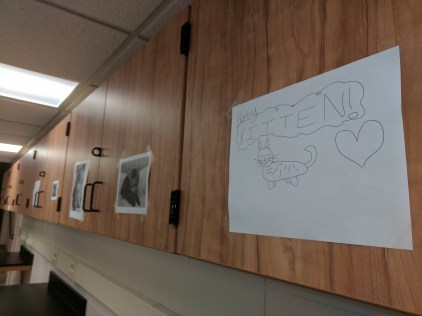
On a side note, I hid a line in my syllabus this year asking students to find or draw me a kitten picture once they’ve read it. As the pictures come in, I’m posting them in my room without comment. So far, I’m up to 5 kittens, which is a better response rate than last year!

kittens2

Day 3: Motion Detectors, Board Meeting, & Burning

AP Physics: Motion Detectors

This concept development sequence comes from conversations with Michael Lerner, Kelly O’Shea, and the rest of the Physics! PLC!

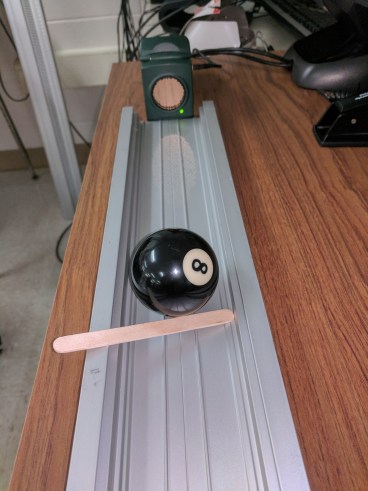
One of the tasks I gave students yesterday was to sketch a momentum vs. time graph for getting a bowling ball moving, then reversing its direction. There was a lot of disagreement about what that graph should look like, so today we had some brief discussion about how the momentum vs. time graph should compare to the velocity vs. time graph, then got out motion detectors and billiard balls to try some of yesterday’s tasks. The discussion afterward lead very nicely into the significance of a negative momentum, as well as the meaning of the slope on a momentum vs. time graph.

billiard.jpg

Physics: Board Meeting

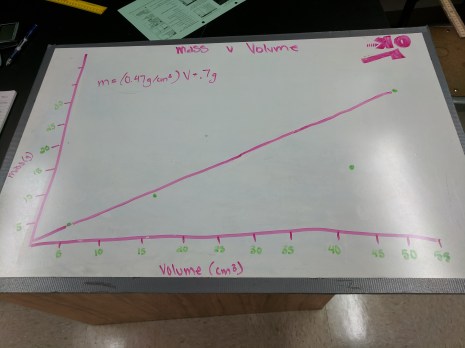
We had a board meeting for the dowel lab, following Casey Rutherford’s Observations, Claims, Evidence structure. Even though all of the dowels were made of the same material, slopes were all over the place, so we had some discussion about how to improve the results next time. A lot of groups just wrote down their calculated volume, rather than the values they measured, which made it difficult to check their calculations, so we discussed the value in recording the measured values.

hour 2 summary.jpg

Chem Essentials: Burning

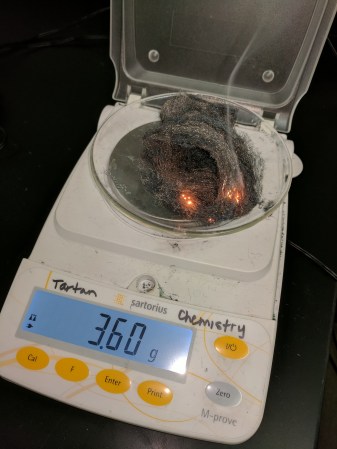
We continued the mass and change experiments, which today included burning steel wool. I needed to do a better job of framing this lab as being about the mass of the steel wool. A lot of groups missed recording the initial mass before they lit the wool, which I could have addressed by checking they had that value before giving them any matches. I also saw a lot of groups blowing on their wool or tossing used matches onto the dish with their wool, which reinforces that they were not thinking about the mass as important here.

steel wool

Day 2: p vs. t Graphs, Graphing, & CER

AP Physics: p vs. t Graphs

This concept development sequence comes from conversations with Michael Lerner, Kelly O’Shea, and the rest of the Physics! PLC!

There was still some debate from yesterday about whether the bowling ball had a constant speed after a tap, so I pulled out the Motion Shot app to make a motion map. Afterwards, students did a variation on the bowling ball lab with combinations of taps to introduce momentum vs. time graphs. I picked a few scenarios to help them get the idea of negative values for force and momentum as well as some to get at the significance of a non-zero intercept on the graph.

Motion_Shot_2017_09_06_09_41_24

Physics: Graphing

Students worked on their graph for the dowel lab, then we talked about “translating” the equation for the line of best fit by adding units and variables appropriate to the quantities they graphed. Students seemed to do well wrapping their heads around that step. Tomorrow, I’m going to have them write the slope as a statement a la Arons.

I’m also thinking about repeating the data collection tomorrow. Students are getting a wide range of slopes and intercepts and, if we’re going to take the time for a unit on experimental design and graphing, I’d like to establish careful practices right off the bat.

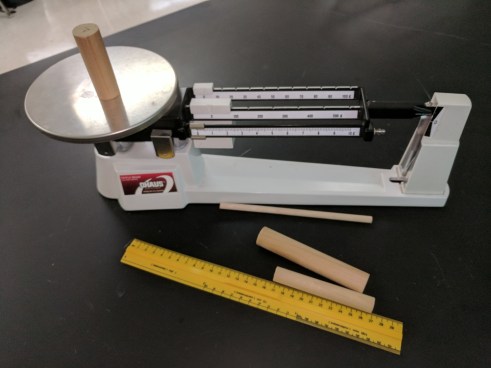
Next year, it could be interesting to mess with the calibration of the triple beam balances to give a non-zero intercept. I’m not sure yet if I would do that immediately, or if I would do a second round of data collection with the balances off.

dowel lab

Chemistry Essentials: CER

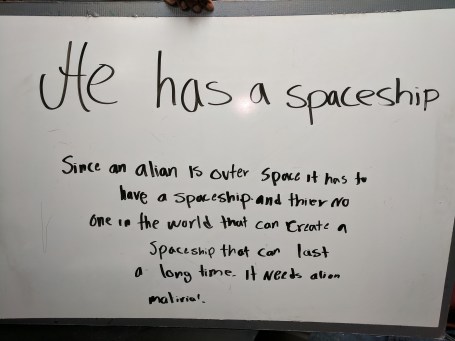
I put a CER at the end of yesterday’s lab, and students seemed pretty thrown by the reasoning piece. Today, I played the “My Dad’s an Alien” commercial and had students identify the kid’s claim and some of her evidence. Then, students got into their groups and had to fill in the reasoning for at least one piece of evidence. A lot of groups looked at why she might see something as evidence (like why the car seems like a spaceship), as well as why the evidence might support the claim. Yesterday, I felt like I was struggling to keep students on track, but today they were very engaged and even enthusiastic about the task. I think today I was much clearer about what they should be doing and what that looks like.

alien cer

Day 1: Bowling Balls, Dowels, & Steel Wool

The first day of school is in the books!

AP Physics: Bowling Balls

This concept development sequence comes from conversations with Michael Lerner, Kelly O’Shea, and the rest of the Physics! PLC!

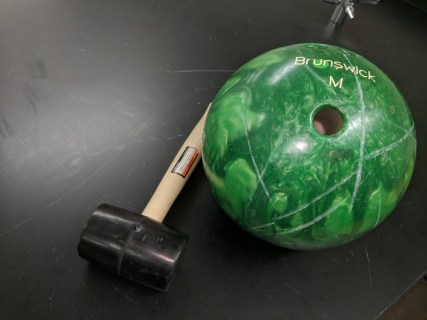
I’m starting the year with momentum, so the first idea I want students to build is the impulse-momentum theorem. Today, we started with a version of Frank Noschese’s bowling ball & mallets activity. For the first time, when I asked students to whiteboard the pattern or rule they’d found, I had multiple groups write out the classic wording of Newton’s 3rd Law. These groups struggled to connect their statement to the lab, but still resisted changing their whiteboard because they knew their statement was true. I think this happened because we don’t have the class culture yet for every student to feel comfortable taking an intellectual risk. Tomorrow, I want to spend some time on the difference between true statements and useful statements to push some of those students away from quoting textbooks.

bowling

Physics: Dowels

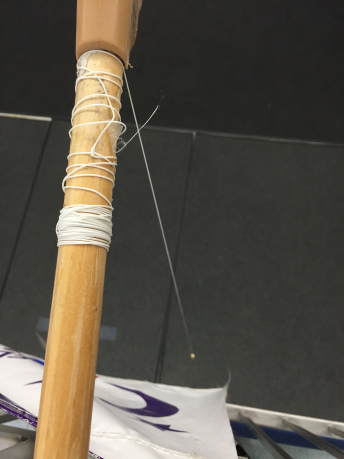
We’re starting the year with a unit on experimental design and graph interpretation based around a series of labs. For the first one, students are graphing mass vs. volume for some dowels. Things went well overall, but I should have spent a little more time on how to find the volume; I just told them to find it, and a lot of groups weren’t ready to make that leap on their own the first day of school.

dowel

Chemistry Essentials: Steel Wool

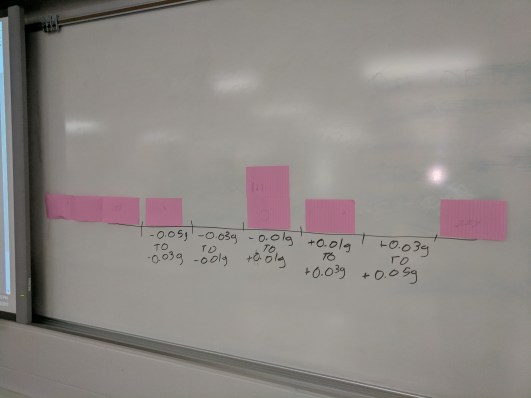
Students started the mass and change lab from the chemistry Modeling Instruction curriculum. To make the histogram, I had each group write their change on a Post-It, then place it in a physical bin matching their value before I transferred the Post-Its to the whiteboard. The balances were acting up, so most groups saw pretty big changes.

chem histo

Day 170: End of Year Reflections

We let our seniors go a week early, so I have no students today, making it a good time to reflect on the school year.

AP Physics

The more I look back on this year, the more excited I am about my plan to start next year with momentum. The big reason I’m making the switch is there are a lot of problems on the AP exam (and in physics in general!) that can be solved very elegantly with momentum and energy, but my students tend to default to kinematics and dynamics since those are the lenses they developed first. I’m hoping to make momentum their default approach, instead.

I’m also hoping starting with momentum will help with some of the divide between students during kinematics. Our calculus teacher emphasizes motion graphs, especially velocity vs. time, which is fantastic! The trick is about half of my students took her class last year, so they breezed through kinematics and kept asking when physics would get hard. The other half of my students often got frustrated that they needed time to master what their peers already knew. Starting with momentum will give the calculus kids something new to chew on from the start, while giving the rest of the students time to build a strong physics foundation that will put them on more even footing when we get to kinematics.

The other big thing I’m thinking about is reassessments and grading. I had a lot more students frustrated with standards-based grading this year than last, and I had very few students complete reassessments. Next year, I need to make sure I spend more time talking about the grading system with my students, especially how it translates into a letter grade. I also need to do a much better job of building in in-class reassessment opportunities. I give quizzes about once a week, so it shouldn’t be a huge leap to cover 2-3 weeks of standards on each quiz.

9th Grade Science (Earth Science & Physical Science)

While AP Physics felt much higher stakes, this was a more challenging prep. The last time I taught earth science as in 2008-2009, during my first year of teaching when I worked at a different school, so I was rusty on a lot of the content and relied heavily on the existing curriculum. The person I followed is very good at planning for what kinds of experiences will work well on a given day; for example, doing something simple during the first week so students can experience immediate success in the course or saving a particularly exciting lab for the day before a long weekend to help harness students’ energy. I had trouble, however, finding the storyline in this sequencing and a lot of the feedback I got from students was that the class felt very disjointed. The next time I teach earth science, I need to shore up my content knowledge so that I clearly see the connections between various learning targets and topics, in addition to rethinking the sequence within each unit.

My other big takeaway is I underestimated the need for classroom culture-setting at the start of a new trimester. The last few years, I’ve only had 9th graders 1st trimester. Since they expect high school to be a change, I didn’t have to work very hard to get them on board with what I was doing. This year, I taught 9th grade all year and each trimester, about 2/3 of my students were new to me. 2nd tri, I didn’t make explicit why I take the approaches I do, and I struggled to get students to see the value in some of what I asked of them. 3rd tri, I was more intentional about how I introduced the early discovery labs, talking not only about what I wanted to see from students, but why I wanted to see it, and the transition was much smoother as a result. It was a good reminder that I need to keep in mind the classrooms my students are coming from and be prepared to help them adjust to mine.

Day 169: Final Exam

Earth Science: Final Exam

Today is my last day with students! I finally managed to include a collaborative, lab-ish portion on a 9th grade final exam. We’ve been spending a lot of time on topographic maps, so part of the exam is interpreting a map with their lab group. The rest is a pretty traditional written exam.

Day 168: Review

Earth Science: Review

Today is the last day of regular classes for the year. Students worked on a review for the final exam. I used a pretty traditional review assignment, but I want to keep working on better ways to review.  The students who need the most support to prepare for the final struggled to use the review assignment effectively, with many of them relying on getting answers directly from a classmate or the textbook. I need to keep working on review strategies that will scaffold students toward more effective studying.