Day 27: Collisions, Graph Stacks, & Linked Balloons

AP Physics: Collisions

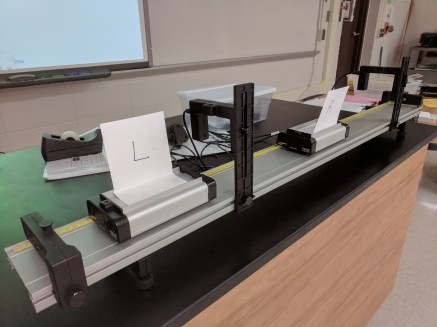
Students started collecting data for the momentum before and after a series of different collisions to discover conservation of momentum. Several groups had a lot of trouble with what we meant by before or after the collision, which showed up as trouble both in filling out the table I gave them and in seeing how to place the carts and photogates appropriately. I wonder if having students draw an SOS diagram for the first collision would have helped with that.
collisions.jpg

Physics: Graph Stacks

We used the motion encoder to check the graphs students drew for objects on ramps earlier this week. Afterward, students started working on translating between our different representations for accelerated motion. A lot of my conversations with students today have me thinking that many of them are memorizing shapes of graphs without understanding what they represent. I need to keep working on ways to help students attach meaning to the shapes.

Chemistry Essentials: Pressure

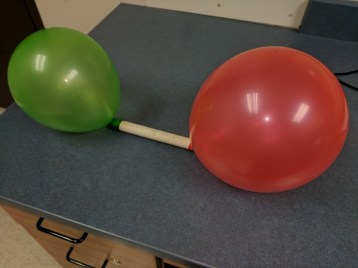
I put a large balloon and a small one on opposite ends of a PVC pipe, using alligator clips to close both. Students sketched particle diagrams to predict what should happen when I removed the clips; I wish I’d had them write CERs instead to encourage more interpretation of the particle diagrams. After I showed students both balloons stays the same size, I had them do a second round of particle diagrams to explain why. There was some great conversation about pressure, but I think that phase also would have been better served with a CER.
balloons

Day 26: CoM Board Meeting, Breaking Down Problems, & Gas Laws

AP Physics: Center of Mass Board Meeting

We had a board meeting to discuss the results of the video analysis from the last few days. I asked students to write a CER for whether the forces on each system of pucks were balanced or unbalanced. This lead nicely into some conversation about what exactly we mean by the two -puck system. I ended up wishing students had more experience interpreting position vs. time graphs prior to this discussion; we’ve mostly worked with velocity vs. time graphs so far, and the various uncertainties piled up to make it look like the velocity was changing. The position vs. time graphs were much more convincing, but students weren’t as likely to look at those.

Afterwards, we played with the coupled carts from Kaar, Pollack, Lerner, and Engles’ The Physics Teacher article. The graphs were very satisfying.

Physics: Breaking Down Problems

On the last quiz, a lot of students really struggled to interpret the problems, so we spent some time today on how to break down a physics problem. As we discussed how to approach a problem, we took time for students to apply each step to the problems on the most recent quiz.

quiz tips

Chemistry Essentials: Gas Laws

We used the results of yesterday’s simulation to develop the gas laws. I’ve found a lot of my students really struggle with algebra, so, rather than developing equations, we came up with statements using proportional reasoning which students then applied to some problems. Some of my students who really struggled to manipulate the density equation were very successful with today’s gas laws problems, so I think this approach was a success.

Day 25: Center of Mass, Board Meeting, & Gas Laws

AP Physics: Center of Mass

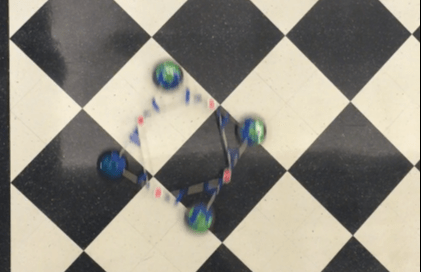
Students continued yesterday’s video analysis, based on the article by Taylor Kaar, Linda Pollack, Michael Lerner, and Robert Engles in The Physics Teacher. Today, students analyzed the motion of four hover disks linked into a square from several different perspectives. They were a little bothered that it was tricky to spot the center of the square, but I like that we’ll be able to have a conversation about whether there has to be any mass at the center of mass.

square disks.PNG

Physics: Board Meeting

Students whiteboarded their results from the video analysis the last few days. Framing this around a CER with a more specific question than usual had the desired effect and I saw students keeping much more complete records than usual. Students are continuing to struggle with recognizing the physical meaning of features on the graph, so I need to keep giving students opportunities to work on that.

phys cer

Chemistry Essentials: Gas Laws Simulation

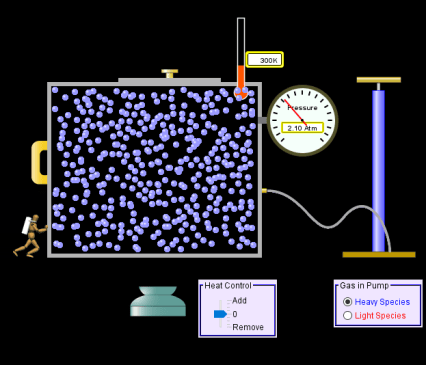
Students used the PhET Gas Properties simulation to take quantitative data for the ideal gas laws. I think the class would have benefited from a little more discussion prior to using the simulation to set up what we were measuring and why, rather than just giving them an assignment in Google Classroom that told them what to measure. However, students were very successful in recognizing the quantitative relationships I wanted them to see.

Gas Laws Sim.PNG

Day 24: Center of Mass, Ramps, & Gas Laws

AP Physics: Center of Mass

Students started a video analysis activity by Taylor Kaar, Linda Pollack, Michael Lerner, and Robert Engles that recently appeared in The Physics Teacher. I gave students a video of two linked hover disks and had students first track one of the disks, then track the center of mass for the system. In their article, the authors say their students resist tracking the disks, wanting to jump straight to the center of mass. My students, however, were very happy to track the motion of the disks, which made for a really satisfying payoff when they saw how much simpler the motion of the center of mass is.

Physics: Ramps

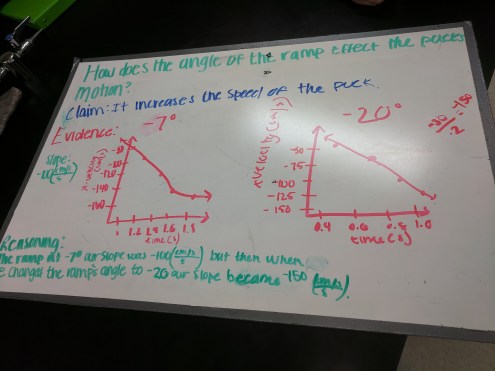
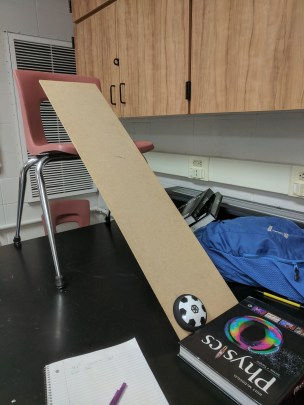
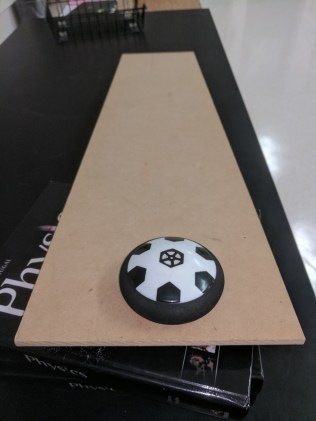
I’ve found a lot of groups are recording pretty incomplete data during labs. I think since groups don’t make much use of their individual results, some of these students aren’t seeing the value in recording that information. To give them a little more purpose, today we had some discussion to identify changes that could affect the motion of a hover disk on a ramp, then tasked them with collecting data to write a CER to answer how the change affects the motion. This will hit some points I wanted to get anyway, while also giving each group their own task using their data.

ramp hover

Chemistry Essentials: Gas Laws

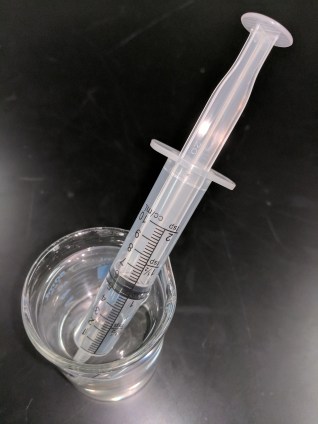
Students made qualitative observations using sealed syringes in water baths. The ice machine in the school is broken, so the cold water tests didn’t work out very well, but we got some great results with hot water. A few groups had some trouble distinguishing between a change in pressure and a change in volume, so I wish we’d spent some time discussing how we could tell when the pressure in the syringe went up prior to the lab. However, by the end of the hour, groups were able to come up with qualitative descriptions of the ideal gas laws.

syribge.jpg

Day 23: Elevators, Board Meeting, & Pressure

AP Physics: Elevators

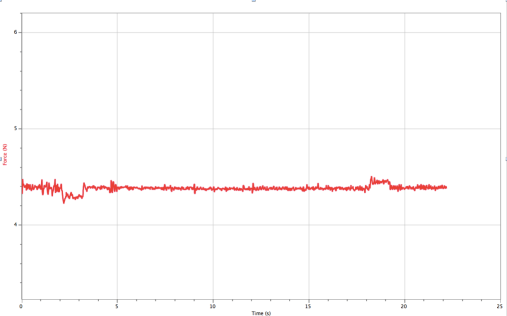
I took some time today to introduce students to the CER framework. I showed them a force vs. time graph I made by riding the elevator with a mass hanging on a force sensor, then asked them to determine whether I was riding the elevator up or down. We haven’t done much with unbalanced forces yet, but they were pretty successful determining which direction I rode it.

Elevator Ride Down.png

Physics: Board Meeting

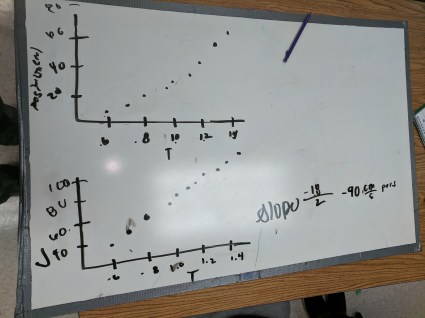
Students whiteboarded sketches of their graphs from yesterday. Its been taking longer and longer for groups to prepare whiteboards, so I think I will try setting a time on the SMARTBoard to try and speed things up. I also found a lot of groups were missing information we’d discussed recording prior to the lab yesterday, so I think we need to revisit lab notebook practices. The discussion was very abbreviated, so we only got a chance to discuss a little about the position vs. time graphs, but students were able to recognize the key ideas. On Monday, we’ll talk about the v-t graphs and look at some variations.

vid wb

Chemistry Essentials: Pressure

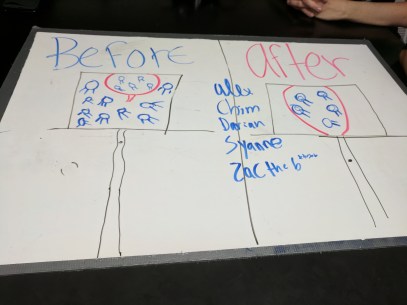
To introduce pressure, students watched a balloon in a vacuum chamber, then whiteboarded what they thought was happening. Students were pretty successful at coming up with useful ideas to explain what they saw and inventing the idea of pressure.

chem wb (1)

Afterward, we boiled water in the vacuum chamber. We ran out of time to whiteboard it, but, on a whim, I got out my thermal camera and recorded a video to show the water stays cool.


Day 22: 3rd Law, Video Physics, & Thermal Expansion

AP Physics: 3rd Law

Students predicted which cart would experience a larger force for several different collisions, then we got out the force sensors and hoop springs to find out. In one of my classes, the computer was acting up, so we relied on the hoop springs and slow motion video. Fortunately, students found the video very convincing and even described watching the hoop springs compress as satisfying.

collision lab f-t graph

Physics: Video Physics

We started constant acceleration today. Students used photogates with a cart on a ramp during the first unit, so I decided to have students analyze hover disks on a ramp using Video Physics.  I’m hoping that some of the features, like seeing the points in the video, will help students connect the representations we’re using to their physical meaning.

hover

Chemistry Essentials: Thermal Expansion

I did a few demos of thermal expansion, and had students complete particle diagrams of each one. Students seem to be getting the big ideas, and I’m seeing students naturally improving how they represent key elements of their particle diagrams as time goes on. One student called me on falling into pretty teacher-centered habits during the whiteboard discussions; I have a tendency to talk to much the first time I teach a lesson, and this is my first time through Chemistry Essentials A, so that’s happening a lot. I need to spend a little more time during my lesson planning making sure I clarify the goal of each discussion and planning out some open-ended questions so I can give students more of the reigns.

chem wb

Day 21: Lab Practical, More Problems, & States of Matter

AP Physics: Lab Practical

Students worked on a balanced forces lab practical to determine an unknown mass given the tensions supporting it. I just made one set-up, and it was interesting to see that in one class, each group wanted to take their own measurements, while the other class wanted to just have one person take the measurements and record them on the whiteboard. The hour that took measurements as a whole class actually took longer to get everyone the data, but had a lot more conversation about what they needed.

static prac

Physics: More Problems

I’ve got enough students struggling with constant velocity that we took a day to do a Modeling worksheet that I usually skip. Talking to students, there were several groups who thought the area of the velocity vs. time graph only gave displacement in special cases. I’m also seeing a lot of evidence that students are losing track of the physical meaning of the graphs and their connections with the math. For example, when writing an expression based on a graph, a lot of students are using units and variables from the dowel lab, which tells me they know a procedure to turn y=mx+b into “physics”, but don’t have a conceptual understanding of what they are doing. These challenges have been a recurring theme in physics this year; we’re starting constant acceleration tomorrow, and I think I want to revamp the lab a bit to try and prevent some of these issues.

Chemistry Essentials: States of Matter

Students melted ice into steam and made observations and drew particle diagrams along the way. This led nicely into the idea that as the temperature increases, the particles are moving more. Students also made some nice connections to yesterdays’ demo with food coloring in water.

boil ice

Day 20: Force Diagrams, v-t Graphs, & Diffusion

AP Physics: Force Diagrams

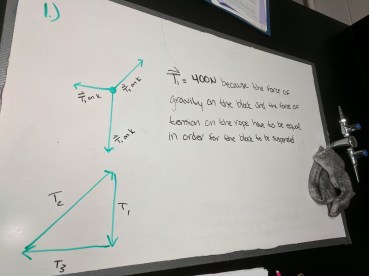
We went over the force problems from last week. I skipped having them whiteboard all of the trig and algebra, and just had students whiteboard the diagrams and some selected reasoning. There was some good debate on whether the normal force should equal gravity on some of the problems, and the vector addition diagrams were a great tool for reasoning that through.

vad wb

Physics: v-t Graphs

Students whiteboarded their solutions to Friday’s constant velocity problems. The problems were a lot more challenging than I expected. One big struggle for a lot of groups was making sense of what the problem was asking. The other big struggle was connecting strategies and ideas from one problem to the next one. For example, after using the area of a velocity vs. time graph to find displacement on the first problem, many students struggled to find the displacement from a v-t graph on the second problem. This tells me students were following a procedure without understanding why, so I need to think about how to step back and get that idea across.

vt wb

Chemistry Essentials: Diffusion

Students whiteboarded particle diagrams for perfume dispersing through the classroom and food coloring dispersing through water. In both cases, students made a lot of great observations prior to whiteboarding and had a lot of good foundation on their whiteboards.

diffusion.jpg

Day 19: Plickers, Dueling Buggies, & Quiz

AP Physics: Plickers

After a quiz, I introduced students to Plickers. One piece of feedback I got from students last year was that they would have liked to practice multiple choice earlier in the year so, this year, I’m planning to spend part of each Friday on that. I have students read the question silently and vote on an answer, then vote again after talking to their peers. My 4th hour had some great, spirited discussion and was actually disappointed when I told them it was time to put the cards away and head to lunch.

plicker

Physics: Dueling Buggies

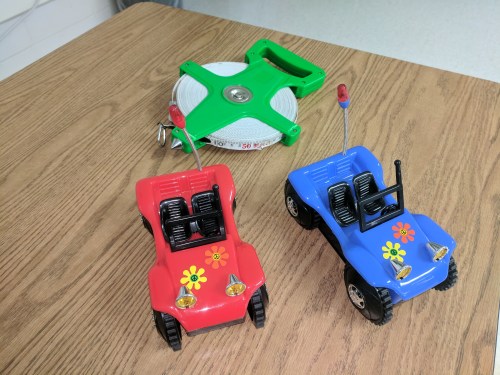
We wrapped up the dueling buggies lab practical. For the rear end collision, most of my groups got a crash position behind where both of the buggies started, so I paused the class to look at what results would make sense. I’m debating whether its worth having that conversation sooner next year, or if it is better to wait until there is a need. This fits with a pattern I’ve noticed this year where more students than usual are struggling to connect their graphs and math to what is physically happening.

I couldn’t get a volunteer to release the second buggy or to film the collisions for me, so here’s a video from a couple years ago.


Chemistry Essentials: Quiz

Students spent most of the hour on their density quiz. While I haven’t graded them yet, there were some stark differences in how students did on the quiz. Several students immediately made a connection to some of the worksheets and labs we’d done and found the quiz extremely easy. Others thought the quiz was completely unfamiliar and really struggled. I need to keep working on helping students to make connections across different days, as well as supporting my students in developing as independent thinkers.


Day 18: Trig It Out, Dueling Buggies, & Density Problems

AP Physics: Force Problems

Students worked on using vector addition diagrams to solve balanced force problems (one of many things I learned from Kelly O’Shea). I really like that while many of my students still ended up using a version of components, they see where the components come from. Once students set up their vector addition diagrams, the slogan for the day was “Trig it out!”, a line from last year’s students.

Physics: Dueling Buggies

Students worked on the Modeling Instruction lab practical to predict where two buggies will collide. I didn’t give quite enough instruction to my 1st hour, but once I suggested they try drawing some representations and play with them, they started making some progress.

One of my goals this year is to help students value ways of being successful in class besides knowing the answer quickly, so as part of the lab practical I gave them a list of skills based on similar lists from Kelly O’Shea and Ilana Horn, then asked them to identify at least one example for each group member where they demonstrated one of those skills. I’m looking forward to reading their responses.

dueling buggy.jpg

Chemistry Essentials: Density Problems

Students worked on some density calculations. Some students really struggled with the algebra, so I’m trying to decide whether that really needs to be in the course. Most are getting to a point where they are successful with the graph, and I think that is more valuable in the long term than using the equation.

I also handed back the first quiz; most students performed about how I expected, but I was surprised at how many students had underestimated how they did and were genuinely excited about their score. Several confirmed with me (multiple times, in one case) that they got to keep their quiz so they could show their parents. I need to work on reinforcing the connections between our day-to-day work and the assessments so that more students will see that kind of success.