Day 37: Dueling Buggies, Dueling Fan Carts, & Chemical Change

AP Physics: Dueling Buggies

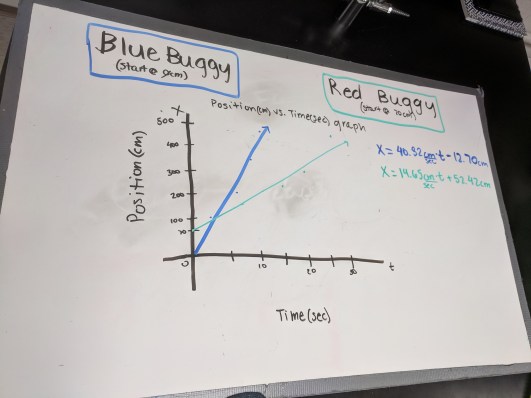
Students wrapped up the dueling buggies lab practical with very satisfying results. Usually, most of my students look for the intersection of the position vs. time graphs, but this year I had a lot of groups decide to solve the system of equations. I think that is just an artifact of doing the lab later than usual, when students are in the routine of connecting math and physics, and of moving pretty quickly through the CVPM worksheets.


Physics: Dueling Fan Carts

We talked about the rules students had for tapping and motion after yesterday’s bowling ball lab, then moved into a version Frank Noschese’s dueling fan carts. Frank’s activity calls for high vs. off, but I added in off vs. high as a separate scenario to help with the idea of directionality. This is the first time I had groups revise their rule after the fan carts, and I was really pleased with how that went. I think that approach also helped cement the connections between the bowling ball lab and the fan carts, and the connections are something I’ve seen missing so far.
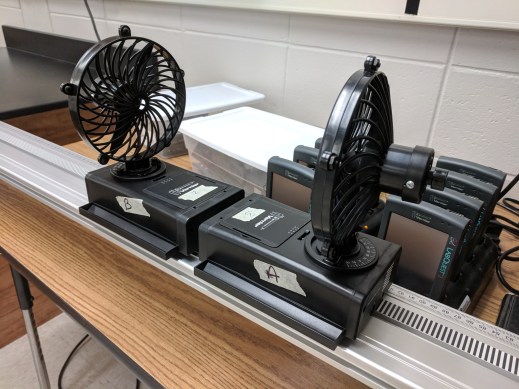
fan carts,

Chemistry Essentials: Chemical Change

Students heated yesterday’s mixture of iron and sulfur to see if the properties changed. Just about everyone was very excited about using fire, but it was tough to keep them focused on making and interpreting their observations. Since I only had a few questions, I projected them, rather than making a handout, but something about a handout seems to give my students more sense of individual accountability. I think the handout serves as a physical reminder of the questions they need to answer, so I will try to stick with making handouts.
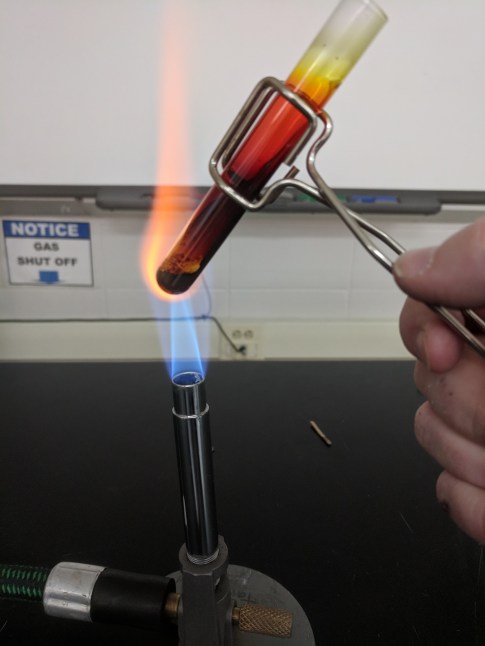
chem change

Day 36: Dueling Buggies, Bowling Balls, & Properties of Mixtures

AP Physics: Dueling Buggies

We did an abbreviated whiteboard session on Thursday’s problems since students had correct answers and were feeling pretty confident on the material. Afterward, we started working on the dueling buggies lab practical. I had several groups decide to have different people try different approaches, then compare answers as a way to check their work. Tomorrow, we’ll actually crash the buggies.

buggies.jpg

Physics: Bowling Balls

I started class today by talking a little about why I use Modeling Instruction and the kinds of actions that make a student successful in this type of classroom. Students seemed receptive and the atmosphere in the room was much more positive than it has been in a while. I think moving on to forces was a good call.

Students worked on the bowling ball and mallets lab to start building ideas about forces. I also gave students roles within their groups and explained this was to help them learn how to be a productive member of the group, even when they don’t know the answers. Students were much more consistently engaged than I’ve seen this year and a lot of great conversations were happening in groups.

bowling

Chemistry Essentials: Properties of Mixtures

As a demo, I asked students to observe properties of water and ethanol before and after mixing. The whole class discussion got a little rocky because a lot of students had great questions and great observations, but it was tough to keep them from talking over each other (or me). That’s something I need to keep working on with this class, but its a good problem to have.

Afterward, students did something very similar with solid sulfur and iron. Again, there were a lot of great observations. Students seem pretty clear on the idea that a mixture has a combination of properties from both materials.

fe s.jpg

Day 35: Motion Representations, Lab Practical, & Mystery Tubes

AP Physics: Motion Representations

Students started practicing translating between different representations of constant velocity. Students have already done some similar problems with momentum vs. time graphs, so things went very smoothly.

Today’s quiz also included the first free response problem from an AP exam that students have worked. Afterwards, as they discussed their answers, there were a lot of kids high-fiving each other while another student told me she enjoyed the quiz. Its great to see students getting the hang of physics and feeling good about it.

Physics: Lab Practical

Students continued work on yesterday’s lab practical. I only had a few groups finish and was running into a lot of the same roadblocks I’ve been seeing for most of the unit. Both my students and I feel like we are beating our heads against the wall with this unit; since we’ll get another crack at acceleration with unbalanced forces, I think its best to cut our losses for now. On Monday, before we dive into balanced forces, I’ll take some time to have some conversation with students about what’s working and what isn’t so we can try to get on a better path.

Chemistry Essentials: Mystery Tubes

Today was a quiz day. About half of my students take their quizzes in the special ed room and usually stay up there the full period, while those who stay in the classroom rarely need more than half the period, so I’m trying to plan interesting activities that aren’t required for the content. Today, I pulled out the mystery tubes and it was fantastic. Every student was engaged, making fantastic observations and sharing ideas about what’s going on inside. One student in particular who is normally pretty checked out asked if she could sit the activity out because it seemed too hard, but got into it once she got her hands on a tube. The best part was when the para supporting the class stopped by at the end and asked about the tubes, this student confidently insisted he check out her model to see exactly how the tubes work. It was a great way to end the week.IMG_1734


Day 34: Board Meeting, CAPM Practical, & Freezing Acid

AP Physics: Board Meeting

We had a board meeting to wrap up the buggy lab. A lot of students who are normally quiet in whole class discussions spoke up today, which was great. In addition, there were some interesting observations that don’t always come up, like the student who commented the intercept did not depend on the slope. At the end of the hour, I also asked groups to whiteboard a CER for what the momentum vs. time graph should look like and, while we didn’t have a chance to discuss the boards, groups consistently were on the right track and not only connected the buggy lab to the definition of momentum, but to Newton’s 1st Law by discussing whether they could identify unbalanced forces on the buggy.

buggy wb

Physics: CAPM Practical

Students started working on a constant acceleration lab practical where they try to get a marble rolling down a ramp to land in a cup attached to a moving buggy. Some groups got a starting position for the marble while others got a starting position for the buggy. A lot of groups had trouble focusing on individual pieces of the task; tomorrow, I may take a few minutes to talk through the major steps students need to take. I’m also seeing students continue to struggle with confidence; they are nailing the problems, but just don’t believe that they get it, which makes it difficult to approach a challenging lab practical.

marble

Chemistry Essentials: Freezing Acid

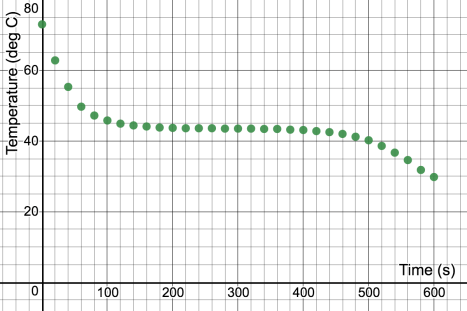
We discussed the results of yesterday’s lab. At the end of the hour yesterday, a lot of students didn’t seem convinced that temperature stays constant during a phase change, partly because they were focusing on their data tables and saw very small temperature variations. Today, I projected a graph from one of the groups for the discussion, and students saw much more clearly that the temperature is pretty constant. When students graph in Desmos, I usually allow one group member to make a graph as long as everyone sketches it (I don’t have a good way for students to print), but I think that’s making it too easy for most of the group to just glance at the graph so I need to work on ways to get students looking closer. I usually have a handout for labs in this course, so I’ll probably add some questions to prompt students to look carefully at their group’s graph to the next lab to see if that helps.

desmos-graph

Day 33: Buggies, Problems, & Freezing Acid

AP Physics: Buggies

Students collected data to produce position vs. time graphs for a buggy travelling at a constant speed. While I really like this lab for the start of the year, it was fun to see a group that has a pretty strong class culture and is developing some good skills tackles a fairly easy lab like this one. My students were also SUPER excited about the buggies; I don’t think I’ve ever had students who were so into them.

buggy (1)

Physics: CAPM Problems

Students worked on another problem set to practice constant acceleration. We’re at a point where a lot of students are getting it and just doing more problems won’t get them there, so its time to move on.

Chemistry Essentials: Freezing Acid

Students made temperature vs. time graphs for freezing lauric acid. A lot of students are still not convinced that the temperature stays constant during a phase change, so I’ll need to make sure we spend some time going over the graphs tomorrow.

chem lauric.jpg

Day 32: Whiteboarding Galore

Between having a sub on Wednesday and no school on Thursday or Friday, today was all about getting my classes back on track.

AP Physics: Conservation of Momentum Problems

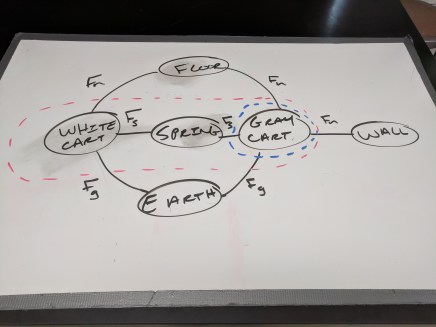
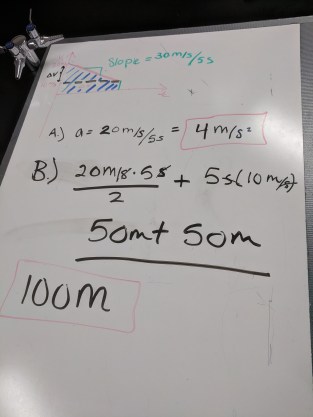
Students whiteboarded the conservation of momentum problems from last Tuesday. Many of the problems require students to shift between thinking about the system as a whole and thinking about individual objects, and interaction diagrams (or system schema) proved to be incredibly powerful tools. The first year I used the Modeling Instruction curriculum, I didn’t quite get them and, as a result, my students never really saw the value, but my students and I are now huge fans.

interaction.jpg

Physics: Constant Acceleration Problems

On Wednesday, I left my students some problems that included several that started with graphs they’d already sketched and annotated. My students admitted that they made very little progress on Wednesday, partly because they got confused and shut down. This has been pretty common with my students this year, so we spent some time discussing alternative strategies for when they are stuck. Afterward, students whiteboarded the problems for a gallery walk. They are making good progress on connecting the features of the graph to the physical meaning it represents.

phys graph soln.jpg

Chemistry Essentials: Phase Change Bar Charts

On Wednesday, students watched a short video lecture where I talked about the results of Tuesday’s phase change lab and introduced energy bar charts. While students got nice graphs from the lab, they were confused by the video lecture, so we spent most of the hour discussing it. It turns out the main issue is we haven’t spent much time on what the particles are doing during a phase change, so they weren’t willing to accept that explanation for the constant temperature in the lab without some additional convincing. I fired up a PhET simulation, which seemed to fill in some of the necessary gaps and allowed students to take a much more successful second shot at Wednesday’s bar chart problems.

phase change phet.PNG

Day 31: Multiple Choice, Problems, & Bar Charts

I was home sick today, so wasn’t able to take any photos.

AP Physics: Multiple Choice

Students worked on some multiple choice problems off practice AP exams. I usually have students answer individually with Plickers, then talk to each other and answer again before we have some whole-class discussion.  To try and replicate that, I gave students two spaces to answer the questions so they can do all of them individually, then talk about each one with their group. I put in my notes to have some whole-class discussion about the answers at the end, which I’ll be curious to hear how it goes.

Physics: Problems

Students took the plunge to start calculations  with constant acceleration. As part of their worksheet annotating graphs, I had students sketch and annotate v-t graphs given just the statement part of some of today’s problems. I’ll be curious to see if that is a useful bridge.

Chemistry Essentials: Bar Charts

Students worked on some bar charts for objects heating up and going through phase changes. We ran out of time to discuss the lab, so I ended up recording a video lecture that gives away the big ideas from the lab.

Day 30: Problems, Annotating Graphs, & Boiling Ice

AP Physics: Problems

Students worked on some conservation of momentum problems. When students asked for help, I could tell pretty quickly who had sketched interaction diagrams. Especially now that I’m embedding center of mass, they have become an incredibly powerful tool. I also demonstrated exploding carts on a balanced track and was pleased at how easily students used the center of mass of the system to explain why it stayed balanced, even when the carts had different masses.


Physics: Annotating Graphs

Students whiteboarded their solutions to yesterday’s problems. I’m pleased to see a lot of students starting to make sense of the physical meaning of the graphs. I was surprised by some students who struggled to differentiate between initial velocity and maximum velocity, but I think they were able to clear up their confusion by the end of the hour.

graph soln

Chemistry Essentials: Boiling Ice

Students recorded temperatures as ice melted and eventually boiled. A lot of students where quick to say their results didn’t make sense when they saw minimal temperature changes during the phase changes, which was great.

ice melting.jpg

Day 29: Conservation of Momentum, Annotating Graphs, & Temperature vs. Heat

AP Physics: Conservation of Momentum

We had a board meeting on last week’s conservation of momentum lab. As part of their whiteboards, I asked students to write a CER on whether their results made sense and encouraged them to use Newton’s Laws in their thinking. The 1st Law was a much more popular approach than the 3rd Law, but I was pleased at the connections were making.

ap cons.jpg

Physics: Annotating Graphs

Students started working on some problems to annotate velocity vs. time graphs and write equations for the area. I think this is helping some of my students to make more connections to what the graph actually represents, which will be an important stepping stone to solving problems. I also added some problems that just ask students to sketch and annotate a v-t graph from the kind of written description that would start a problem.

phys anno

Chemistry Essentials: Temperature vs. Heat

We took some notes on heat and temperature, then I asked students to predict whether there would be a larger temperature change when I added a small amount of boiling water or a large amount of warm water to a large beaker of room temperature water. Students seemed to wrap their heads around the difference and were able to explain why the warm water produced a bigger temperature change after the demo.

chem temp.jpg

Day 28: Conservation of Momentum, Mistakes Game, & Measurement

AP Physics: Collisions

After their quiz, students wrapped up the data collection on the collisions lab. Things went very smoothly, and a lot of groups have already commented on the pattern in their momentums.  This is one of the times I love having quantitative uncertainty in the course, because students are independently deciding whether their momentums are close or effectively equal.

Physics: Mistakes Game

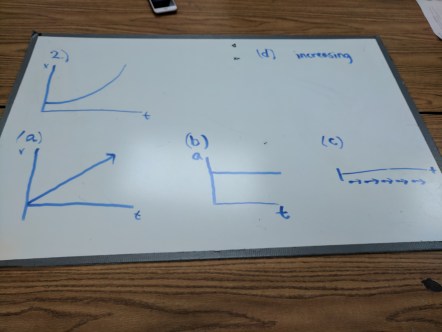
Students played the mistakes game with stacks of kinematic graphs. In class discussions, I’ve been struggling to get students to speak up and it is usually one or two students who do most of the talking after lots of long silences. Today, one of those students asked a question about the a vs. t graph, a member of the group presenting said, without any shame or fear, “We don’t really understand those graphs, so we just drew something.” All of the sudden, the whole class was animated and students who are normally quiet, even in small groups, were jumping in with fantastic questions. It was a fantastic way to end the week with that class.

phys wb.jpg

Chemistry Essentials: Measurement

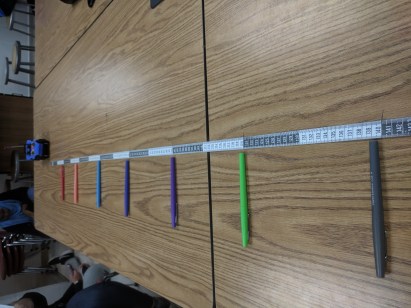
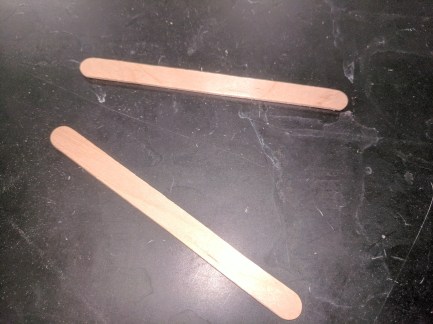
When I gave some notes on temperature scales yesterday, I had a student ask whether Kelvin is a more accurate scale than Fahrenheit and several others questioned it when I said 98.6 rounds to 100. I’m really excited about the thinking about measurement this shows, so I decided to lean in and do a Modeling Instruction measurement lab I’d skipped during the first unit. I had students measure the lab tables with popsicle sticks, gradually adding marks to make them more accurate. Next time, I think I will have them measure a bigger mix of objects, including some shorter than their tool.

pop sticks.jpg