Day 84: SHM Trio, Kinetic Energy, & Lauric Acid Take 2

Yesterday was a snow day.

AP Physics: SHM Trio

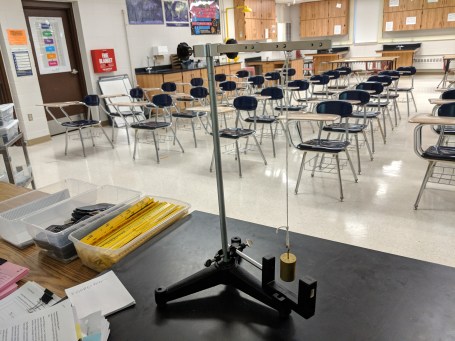
Students analyzed a video from Pivot Interactives of a pendulum, a spring, and a rotating disk in synchronized simple harmonic motion. I overheard some really good conversations about differences between the x-position vs. time and y-position vs. time graphs for the pendulum; a few students relate it back to the projectile Pivot Interactive we’d done and tried to imagine a camera that just showed the vertical motion of the pendulum.

SHM Trio.PNG

Physics: Kinetic Energy

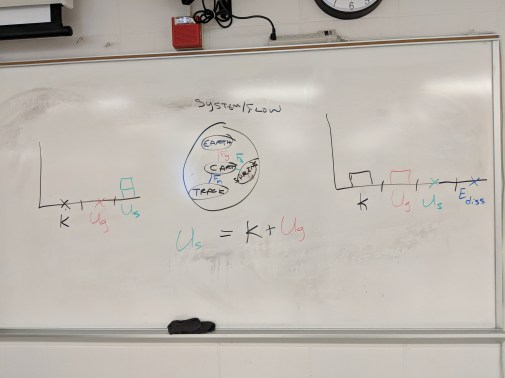
Students started collecting data to find a relationship between the change in height of a cart on a ramp and the velocity at the bottom. On the elastic potential energy lab, a lot of students just measured the height of the cart, rather than the change in height, so I spent some extra time on the pre-lab discussion to make sure students saw why the change is important.

ke.jpg

Chemistry Essentials: Lauric Acid Take 2

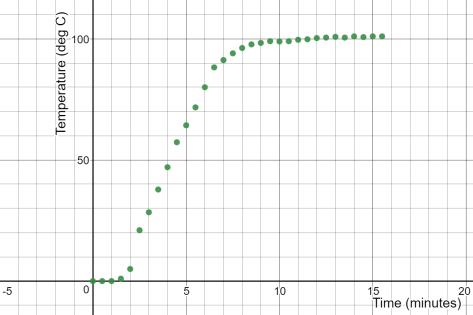
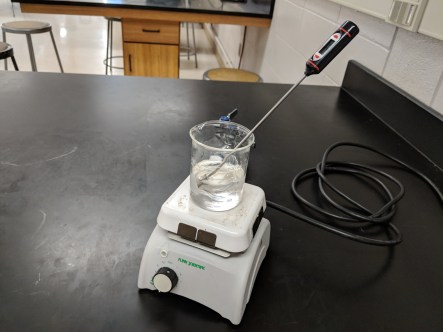
We took another shot at finding the freezing point of lauric acid since the weather on Monday cut us short. A few students who’d collected some data were frustrated that they had to start fresh, rather than picking up where they left off. It will probably be worth spending some time tomorrow on why they had to start fresh, especially since it connects to what the graph physically means.

Maker:S,Date:2017-10-21,Ver:6,Lens:Kan03,Act:Lar02,E-ve

Day 83: Inertial vs. Gravitational Mass, Board Meeting, & Freezing Lauric Acid

Several nearby districts had snow days today, so most of my classes were a little more off-task than usual today.

AP Physics: Inertial vs. Gravitational Mass

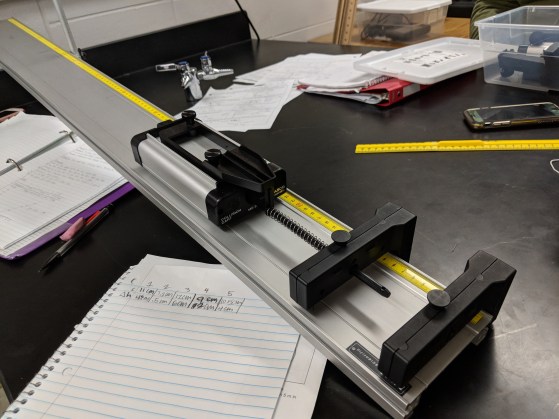
Students finished collecting data and making graphs for the period of a spring lab. We didn’t have enough time for a board meeting, but every group had decided mass is what matters so we took a few minutes to decide whether it is gravitational or inertial mass by comparing the period of a cart on a spring at different angles. This is the first year I’ve used the Pasco equal length springs, and several groups were able to get some pretty nice data for period and spring constant.

spring ramp.jpg

Physics: Board Meeting

Students whiteboarded their results from last week’s lab. I gave different groups different springs, and the slopes reflected that variation nicely which lead smoothly into fitting k into the formula. I had conversations with some groups about whether their results were “right” that reinforced just how uncomfortable some of my students still are with being even partially wrong. Talking to them, I think they don’t see this fear of being wrong as an obstacle to learning physics.

epe board 2.jpg

Chemistry Essentials: Freezing Lauric Acid

We worked on a lab to find the freezing point of lauric acid by melting it in a hot water bath, then making a temperature vs. time graph as it cools in a cool water bath. This is the last class of the day and we ended up getting released 13 minutes early due to a snowstorm, so only one group was able to get data. Especially since a third of the class was gone by 6th hour, I’m thinking about just repeating the lab tomorrow.

Day 82: Springs, Linearization, & Whiteboarding

AP Physics: Springs

Students started collecting data for variables that affect the period of a spring. I found it interesting that students were quick to suggest stretching the spring farther to change the period after seeing angle doesn’t matter for a pendulum; I suspect they just aren’t making the connection yet. A lot of groups used motion detectors to measure the period, and one student found the graphs so satisfying she snapped a photo of the LabQuest to show off.

spring (1).jpg

Physics: Linearization

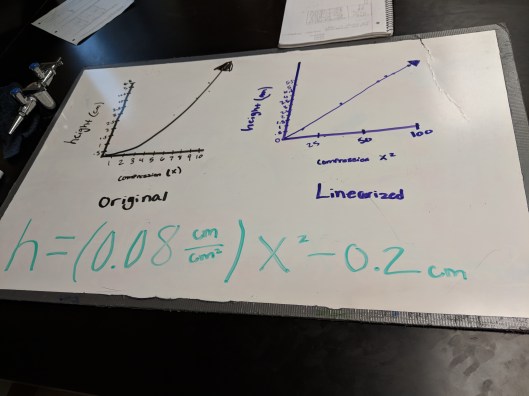
Students were pretty quick to treat yesterday’s data on the compression of a spring launcher vs. a cart’s change in height as linear, probably because we haven’t linearized any graphs in a while. We spent some time today talking about what intercept would make sense and why before a quick review of linearization. Afterwards, groups worked on making linearized graphs of their data.

Chemistry Essentials: Whiteboarding

Students did some whiteboarding the problems from yesterday. I had all groups whiteboard the same problem, when we shifted to whole group discussion. The physical space in my room lends itself pretty well to having whole group discussions with students at the lab tables, but a lot of students were having trouble with the transition to whole group discussion. Next time, I think I will have students physically move to give a clearer cue that we are changing the kind of activity.

Day 81: Board Meeting, Energy Transfer, & LOL Diagrams

AP Physics: Board Meeting

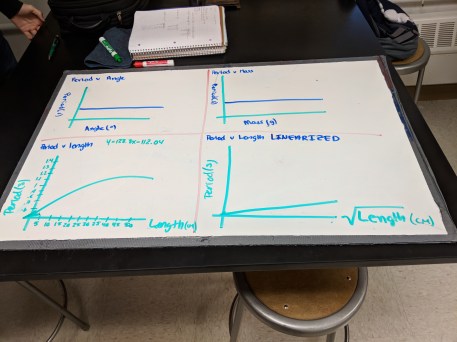
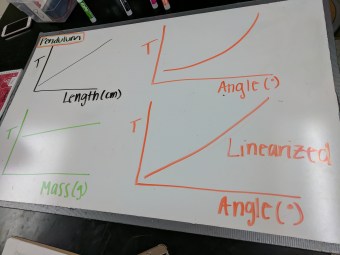
Students whiteboarded the graphs for the pendulum lab. It usually feels a little hand-wavy getting from the lines of best fit to the full equation; I had one group a couple of years ago that reasoned out gravity should be involved, and connected the dots from there. I’d like to work on scaffolding strategies next time to give students the opportunity to take those steps themselves.

pendulum wb.jpg

Physics: Energy Transfer

We revisited the previous energy transfer lab to come up with a formula for gravitational potential energy, then started a lab to find a relationship between the compression of a spring and the amount of gravitational potential energy transferred to a cart. Students were pretty quick to accept a linear fit to their data, so I want to make sure we spend some time tomorrow on the intercept of the graph.

epe to gpe.jpg

Chemistry Essentials: LOL Diagrams

I introduced students to LOL diagrams and they used them to represent some phase change problems. Students took to the diagrams pretty easily, which was great to see.

Day 80: Big Pendulum, Mistakes Game, & Phase Change

Classes were short today so we could work with our homerooms on registration for next year.

AP Physics: Big Pendulum

After a quiz, we went to the front entrance to measure the period of a 5 m long pendulum so students could see how well their model so far fits the result before tomorrow’s board meeting. I’m hoping the period of this pendulum will push students to try linearizing their data.

pendulum big

Physics: Mistakes Game

We did some mistakes whiteboarding with energy bar charts. One of my AVID students commented that it reminds her of AVID tutorials, which is spot on. I also had a group tell the class “If you need a hint, you should read the problem”, and I took the opportunity to point out that is always good advice.

Chemistry Essentials: Phase Change

Students graphed their data and we started talking about the results of the phase change lab. Last tri, when I let students have one group member put the data into Desmos, I found that the rest of the group would typically ignore the graph, so I had every student graph by hand today. while students paid more attention to the shape of their graph, it was pretty laborious so I want to keep thinking about how to approach the graph for this lab.

desmos-graph (1).png

Day 79: Pendulums, LOLs, & Phase Change

AP Physics: Pendulums

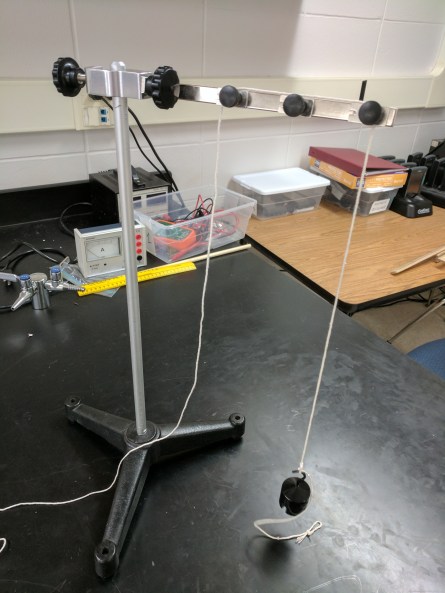
Students continued data collection and analysis for their pendulum lab. Today, I added that they need to predict the period of a roughly 5 m long pendulum we can hang in the front entrance, which drove some groups to get the longest pendulums they could at their lab tables. I had some groups try to use their formula sheets to calculate the period, rather than extrapolate from their data, but struggled to differentiate between the three formulas for period listed.

pend.jpg

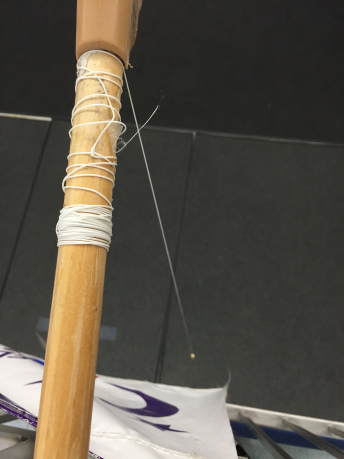
One solution for measuring angle

Physics: LOL Diagrams

Students whiteboarded the first part of the problems from Friday. In the section that had a sub, the majority of students did not attempt the problems and said it was because they were too confusing. I’m planning to spend some time tomorrow discussing general strategies for moving forward on a confusing problem.

lol.jpg

Chemistry Essentials: Phase Change

Students collected temperature vs. time data for heating up ice to boiling. Glancing at the numbers, I think most students will have pretty good results. Several groups called me over to say it wasn’t working since they didn’t have much temperature change at the beginning.

phase change.jpg

Day 78: Pendulums, Bar Charts, & Quiz

AP Physics: Pendulums

Students collected data for what variables affect the period of a pendulum. When we discussed what might be worth testing, one class was very quick to dismiss mass on the grounds that “mass never matters in physics”, which has me really excited for the period of a spring lab.

pendulum.jpg

Physics: Bar Charts

Students worked on representing energy with bar charts and switching between different systems. I had a sub for one section, but the section I was here was able to make the leap pretty independently, which was great to see.

Maker:S,Date:2017-10-21,Ver:6,Lens:Kan03,Act:Lar02,E-ve

Chemistry Essentials: Quiz

Students took their quiz on gas laws with a sub. This year, I framed the gas laws as proportional rules, rather than equations, and I’ve been pleased with how that’s impacted the math. I’m looking forward to see how that shows up on the quiz.

Day 132: Problems & Glaciers

AP Physics: Problems

Students worked on some oscillating particle problems. Students had some really good discussion about a cart on an angled ramp oscillating on a spring; a lot of groups really dug into what should happen when the angle of the ramp changes. At the end of the hour, we tested their predictions. I wasn’t paying much attention to when I started data collection, but still got a set of graphs my 2nd hour considered applause-worthy.


Earth Science: Glaciers

I gave students a brief overview of some glacial features, then had them use some sand in the stream tables to make a recreational area with a variety of glacial features. Students liked the activity, but they did not connect the vocabulary to how the features form or how they are related. I think I’d prefer to do this at the end of a glacier unit, where students would have the background to tie the features they are using together. At this point in the unit, I’d rather focus on how these features form to give some basis for naming them.

glacier

Day 131: Pendulums & Springs & Dam Removal

AP Physics: Pendulums & Springs

Students wrapped up their labs on what affects the period of  springs and pendulums, then whiteboarded the results. I could tell I was rushing the lab more than I have in the past and I ended up taking over a lot of the post-lab discussion and got a bit hand-wavy. As I rush through the last few topics, I haven’t been doing as much with uncertainty, and this is a lab where it would have really helped. I also skipped having students predict the period of a 5 m long pendulum, which made it much tougher to settle on which relationship works best for the length of a pendulum. Going into waves, I need to think about how I will balance the need to keep moving with giving students time to truly engage with the content.

pendwb

Earth Science: Dam Removal

Students continued work on their dam removal project. Today, they looked at a gradual release, which we modeled by removing one lay of foam at a time. I was very pleased at some of the detailed observations students made and how engaged they were in trying to think about why their observations happened. I’d love to re-work this unit to give students a better grasp of sediment transport in rivers before looking at dams specifically to give them more tools for thinking about the project.

dam

Day 129: Period & River Features

AP Physics: Period

Half the class did experiments to model the period of a pendulum, while the other half did experiments to model the period of a spring. We have three types of springs, and their spring constants are different enough that you can’t test all three with the same mass. Next year, I might have students start by using one spring to test how amplitude and mass affect period, then check their model with a second spring.

pend

Earth Science: River Features

Today, the curriculum called for notes on typical river features, followed by students looking for those features in topographic maps to classify rivers as young or old. Before we did any notes, I had students sort the rivers based on their own categories. They based their categories on things like width or windiness that resulted to very similar sorts to young and old and lead nicely into the vocabulary. When students went back to their groups to sort the rivers by age, I noticed students got less accurate, largely because they interpreted small curves as meanders, making rivers seem older.

topo