Day 126: SHM Trio & Water

AP Physics: SHM Trio

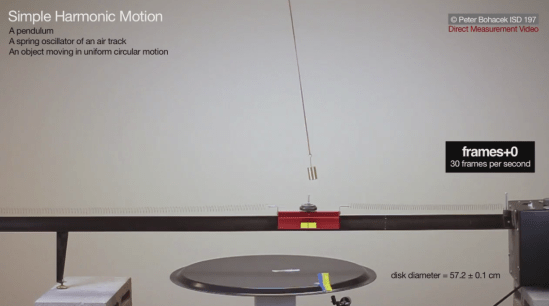
Students downloaded a Direct Measurement Video of three objects in simple harmonic motion and did some video analysis. There was lots of great discussion about why the pendulum’s y-position vs. time graph showed a different period than the x-position vs. time graph. I also really liked the conversations students had about whether the net force on each object is constant. My favorite moment was when a student called me over for help, and the person sitting next to her said “You need to think about it first!” The second student then started asking questions to help the first student figure out the answer she needed. Yay, students!
SHM Trio

Earth Science: Where is Earth’s Water?

Students filled beakers with their prediction for how Earth’s water is distributed, then got the actual distribution and compared. I liked how doing their own prediction first made it much more dramatic when they got the actual results, and saw just how little of Earth’s water is in a form we can really use.

water.jpg

Day 108: Collision Types & Building Again

AP Physics: Collision Types

We whiteboarded the results of Friday’s Direct Measurement Videos to get to the definitions of elastic and inelastic collisions. A lot of groups tried to answer purely conceptually, in spite of some quantitative questions on the activity. I think these groups were treating each question as separate, rather than thinking about how one answer could help them with the next piece of the activity. I want to make better use of lab notebooks (most likely starting next year) as a reflective tool, which I think might help students see more connections between problems.

ap-wb

Physical Science: Building Again

Students worked on their second round of building. I upped the cost of paper cups, which were the most popular material on the first go around, which lead to a little more variety in egg holders. I also did another round of visiting each group and asking them to explain their design choices using Newton’s Laws, and I can tell students are getting more confident with this skill.

eps-cx

Day 107: Collisions & Test Design

AP Physics: Collisions

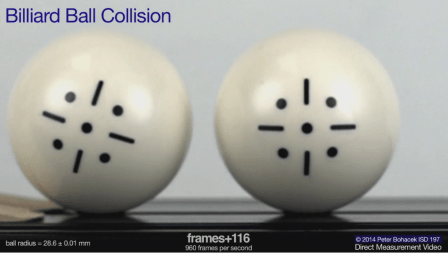
Students use a pair of Direct Measurement Videos, one of a collision between two billiard balls and one of a heavy disk tossed onto a cart, to explore changes in momentum and kinetic energy in the collisions. I haven’t done as much with uncertainty as I’d like, so I was very pleased with how clearly students were talking about it to decide if their values were “close enough.” I had students sketch momentum SOS and energy LOL diagrams, but students weren’t paying as much attention as I’d hoped to whether there were any dissipative forces present, so next year I want to do a better job of getting students into that habit. I was thrilled, however, when a student used some proportional reasoning to convince herself that you cannot conserve momentum and keep a constant kinetic energy when the objects are moving together after the collision. I was also pleased by how many students were interested in trying to explain the billiard ball that just spins in place right after the collision.

billiard balls.PNG

Physical Science: Test Design

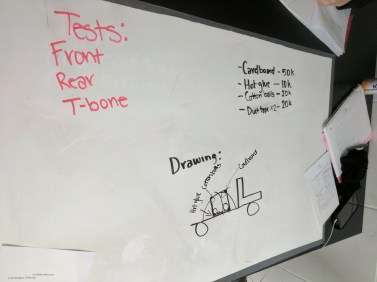
Students began working on designing a second iteration of their cargo carriers. To encourage new designs, I increased the cost of paper cups (the most popular component on the first round) and shuffled groups. We also talked about the limits of testing just the front-end collisions, and tasked students with coming up with their own tests for this round. The discussion was a little trickier this year than in the past; we dramatically upgraded the trucks the cargo carrier attaches to this year and the old trucks would pretty reliably tip over or roll off the side of the ramp at least once per class, which gave a nice tangible example of the test’s limits. That didn’t happen at all this time, so next year I might take off the rails we put on the side of the ramps to try to encourage some failed tests.

design.jpg

Day 91: Whiteboarding & Engineering

AP Physics: Whiteboarding

Students whiteboarded some problems from Friday and yesterday’s Direct Measurement Video. There was some good discussion about a problem about a collision between a Hummer and a VW Bug, comparing the force, the change in momentum, and the acceleration of each. A lot of students did some really good wrestling with the conceptual distinctions between those ideas. There was also some good discussion about whether momentum is conserved when an object starts rotating. All the groups that said rotation takes some momentum had a calculation, while the groups who said rotation does not impact conservation of momentum used a few different approaches, which gave a nice opportunity to talk not only about uncertainty, but the value of multiple lines of evidence.

Physical Science: Engineering

I decided to expand the big engineering project we have this trimester to include both motion and forces, so today we introduced the project. We spent some time talking about what engineers do, and I was very excited that collaborate was the first thing a student mentioned. We also did some problem scoping, where I gave students a fictitious memo from our “client” and had them use the information to describe the problem, the criteria for success, and the constraints we’ll have to work within, as well as start brainstorming some of the science knowledge they will need for the project. I’ve tended to skip problem scoping, since a fake client feels cheesy to me, but it was interesting to see students really analyze the fairly short text of the memo; it was also interesting that students are thinking about the constraints as reasonable client requests instead of arbitrary obstacles I imposed (at least for now).

engineers

Day 90: Angular Momentum & Mirror Mazes

AP Physics: Angular Momentum

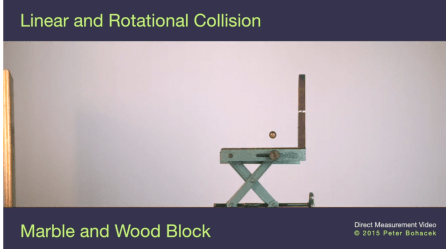
Students used a Linear and Rotational Collision Direct Measurement Video to get some practice with conservation of momentum. In the first question, I asked students to determine whether momentum was conserved in a certain collision using a calculation, and I was surprised by how many students struggled to understand the question. I might change up wording on some of the problems we did to explicitly have them state whether momentum is conserved or if there is an external force, similar to how I approach force problems by first asking students whether the forces are balanced.

I also asked some questions about whether momentum is conserved in collisions where the block starts to spin, and I heard some great conversations about uncertainty, external forces, and other big ideas that have me really looking forward to tomorrow’s discussion.

momentum-dmv

Physical Science: Mirror Mazes

Students used what they know about refection to solve some mirror mazes. I had some where students were given the placements of the mirrors and had to place the target and others where they were given the target’s location and had to place the mirrors. Since we haven’t done much with ray diagrams, this seemed to really solidify what I mean by the path of light.

obstacle

Day 44: Central Forces & Orbit Wrap-Up

AP Physics: Central Forces

Students whiteboarded their results from Monday’s activity. In the computer lab, there was a lot of debate about what forces were acting on the weight, so I had students include an FBD for the weight on their whiteboards, which lead to some fantastic discussion in my second hour. Students had strong opinions on whether or not there should be a force to balance the tension and were quick to offer an argument one way or another. Even better, a number of students who are usually quiet during whole-class discussions put ideas and arguments out there. Along the way, students connected this back to the bowling ball lab, where one of their tasks was to get the bowling ball to travel in a circle using a rubber mallet. This was the first time I really felt like I got to just sit and listen while my students figured out something important together, and it was fantastic. As the class came to a consensus, one student captured his take with the “mind blown” gesture and sound effect.img_2473

Earth Science: Orbit Wrap-Up

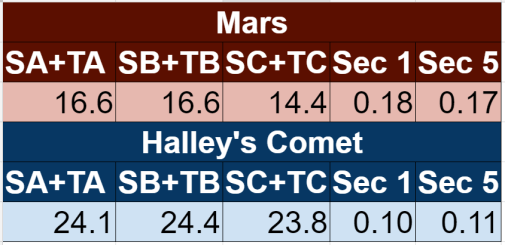
Students took a few minutes for students to finish their measurements for the look at the orbit of Halley’s Comet, and we discussed the results. Interestingly, when we looked at the total distance to the focal points, the class averages for Halley’s Comet was better than the class averages for Mars. When I played with the data on my prep, I saw that one group got dramatically different results from the rest of the class. Tomorrow, I’d like to take some time to look at that with my students to get at the idea of outliers and how to handle them in science.

comet-results

Day 41: Central Force & Comet Orbits

AP Physics: Central Force

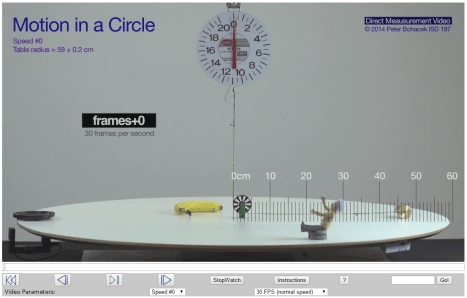
Students used a Direct Measurement Video of a weight on a rotating table to find a relationship between force and tangential velocity. One of the first questions on my activity was to draw a free-body diagram of the weight and determine whether there is any net force. A lot of groups had some great discussion as they tried to rectify the fact that the table rotates with a pretty constant speed with the fact that their free-body diagrams showed a net force on the weight. There were also some groups that asked questions like how the speed of the banana compared to the speed of the weight, bringing them back to a Direct Measurement Video of a rotating disk we’d used earlier in the year.

motin-in-a-circle-dmv

Earth Science: Comet Orbits

A major theme this week is comparing different kinds of solar system objects, so I decided to take an idea Michael Lerner gave me last week and have students compare the orbit of Halley’s Comet to Mars. I used an ellipse drawer to give students the orbit of both objects, then had them start by making some observations. Today, most groups only had time for the qualitative questions about the two orbits.

comet-orbit

Day 22: Wrap-Up & Review

AP Physics: Lots of Wrap-Up

Today was a lot of wrapping things up. We started by whiteboarding both the accelerated disk and free fall Direct Measurement Videos with some brief discussions about each. At this point, I was just trying to get students to recognize the parallels between angular acceleration and linear acceleration, so that didn’t feel too rushed. The discussion on free fall did skip over some important points, so I’ll be revisiting that topic next week. This is the first year I’ve included uncertainty in my class, and I could tell during the discussion that my students are starting to internalize those concepts, which added some nice layers to the discussion.

We also took some time to try and finish the lab practical we started Monday. Students are rolling a steel marble down a ramp with the goal of landing it in a tumble buggy driving by. Today, I threw them for a loop by adding that they need to pull off the same thing with glass and acrylic marbles, but the only new measurements they can take are mass. With the time for discussions, only a few groups got to test, so I’ll be making some adjustments next week to make sure students have a chance to finish.


Earth Science: Review

Students have another quiz tomorrow, so I repeated my review activity from last time. Students worked in groups to write a few questions for each learning target, then periodically traded whiteboards with another table to try and answer another group’s questions. This time, students were coming up with some deeper questions, which was great to see.

Day 21: Angular Acceleration & Satellite Data

AP Physics: Angular Acceleration

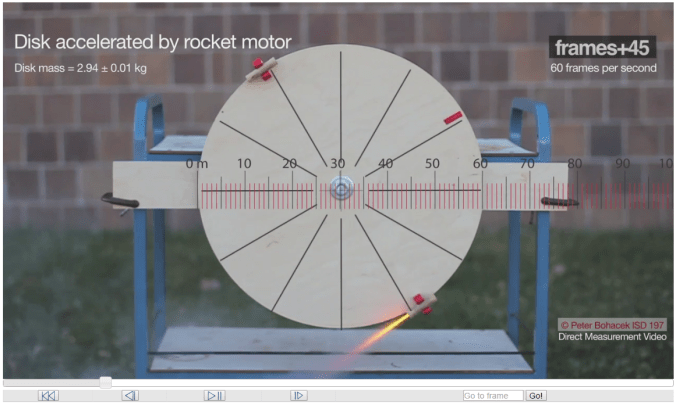
This year, I’m embedding circular motion concepts as we wrap up their linear motion analogues, so today students took their first look at angular acceleration. Students used a Direct Measurement Video to plot angle vs. time for a disk with a rocket motor attached. Students were quick to notice their graph looked a lot like position vs. time for an object with linear acceleration, and were able to extrapolate a lot from there.

rotating disk.PNG

Earth Science: Satellite Data

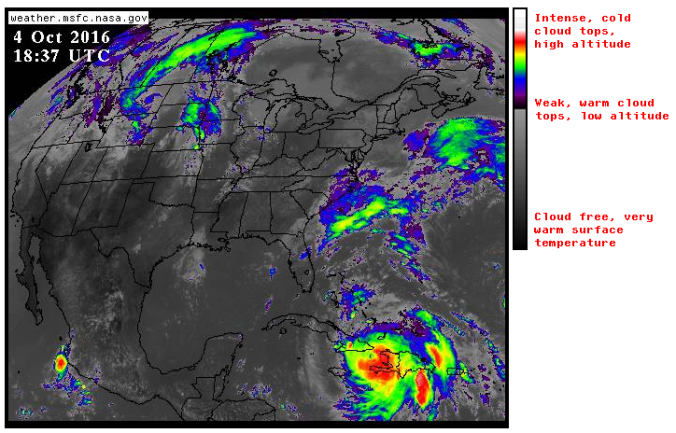
Students looked at some images of cloud cover produced by NASA’s GOES satellite to make some claims about the cloud cover and associated weather in a few areas of North America. I didn’t use my evidence-based reasoning graphic organizer today, and I don’t think its a coincidence that many students just stated their claims without any evidence. I need to keep being explicit about what good reasoning looks like and stay on students to keep including that in answers.

goes-infrared

Day 19: Free Fall & Humidity

AP Physics: Free Fall

Students worked on plotting position vs. time using a Direct Measurement Video of five different spheres in free fall. This is the first year I’ve had students use uncertainty, and I’m finding I really like how it shapes conversations. A lot of students were looking for specific times in the video, then estimating the position of the sphere at those times, but a quick conversation about the large uncertainty that produces in position quickly got them to see the value in switching their approach.

five objects.PNG

Earth Science: Humidity Analogy

Students worked through some questions using beakers of water as an analogy for air at different temperatures and how that impacts humidity. It was pretty tricky for many students to predict what should happen to the water level when a given amount was moved to a larger or smaller beaker, so I think I’d like to get out actual beakers and water the next time I do this activity to make it a little more concrete. They did seem to get the analogy and were able to make some good predictions about humidity and dew points by the end of the hour.