Day 11: Uncertainty, Problems, & More Problems

AP Physics 1: Uncertainty

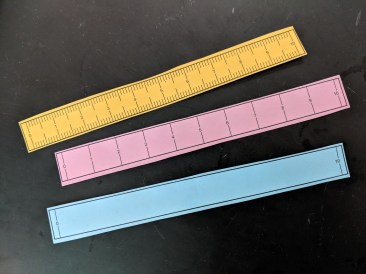
We did a quick preview of tomorrow’s lab on impulse, then talked about the challenges of finding the uncertainty of measurements given the tools we have so far. This lead into Brad Wysocki’s measurement lab to take a look at uncertainty caused primarily by your measuring tool. In my 2nd hour, I asked groups to find the area of some index cards using each ruler, but the size of the cards lined up too nicely with the rulers and the main points weren’t as clear as I’d like. In my 4th hour, I switched to Post-Its and the uncertainty was much clearer.
uncertainty.jpg

Physics: CVPM Problems

Students started working problems using CVPM. The problem set started with several descriptions of motion and students had to determine which statements CVPM could apply to. That was a more challenging task than I expected, largely because a lot of students were not clear about what I meant by CVPM, so I need to work on keeping that language clear. I also found my 1st hour, that mostly worked individually on the last problems, very easily shifted to working in groups today while a had a lot of students in my 6th hour opting to work alone, even though most of them went into groups on their own last time.

Chemistry Essentials: Density Problems

We started by discussing the results of yesterday’s lab. I ended up projecting some data I collected rather than making whiteboards. When we were talking about whether measuring a bigger dowel would give a different density, student comments revealed some of the class was interpreting data points on my graph as dots in a particle diagram. I’m really excited that my students are looking for connections between the different representations and are willing to share their thinking, even if we have some work to do on distinguishing between those representations.

Afterward, students worked on some problems relating particle diagrams, mass vs. volume graphs, and density. A lot of students had trouble getting started because they were struggling with the vocabulary; I pretty quickly wished I’d put together a short vocabulary activity to reinforce terms before we got to work.


Day 10: p-t Graphs, Groupwork Reflection, & Density

AP Physics: p-t Graphs

Students sketched momentum vs. time graphs for bowling balls hit with various combinations of taps, then we got out billiard balls and motion detectors to transition to true momentum vs. time graphs. It was a little tricky for students to predict what the graph would look like when the billiard ball reversed direction, but we got there by the end of the hour.

Physics: Groupwork Reflection

Today we had a few whiteboards to finish from Friday and a quiz to take. One of my goals this year is to improve the quality of the collaboration in my classroom, so we also took a few minutes to talk about some of the different abilities students needed to complete the problems and mistakes whiteboarding, then I asked students to complete a short reflection based on a list of things effective groups do I got from Scot Hovan at a modeling workshop. I haven’t had a chance to read the reflections yet, but it looked like students were giving it some good thought and I overheard several students showing their reflection to a peer they’d used as a positive example.

Chemistry Essentials: Density

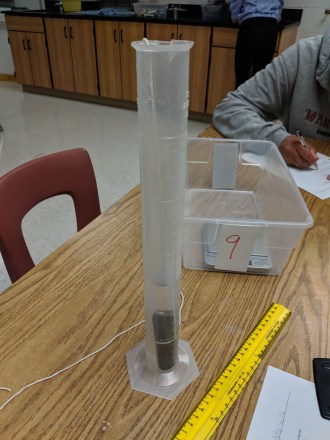
We got out the metal dowels from last week’s volume lab to find their density. I asked groups to design their own experiment, and wished I’d taken the time for a little more discussion on what makes a good experiment. The worksheet I used started with questions about what variables they needed and how to measure those variables, but a lot of students had trouble with articulating how they would get a variety of values for the data table.

volume.jpg

Day 9: Momentum, Mistakes Whiteboarding, & Board Meeting

AP Physics 1: Momentum

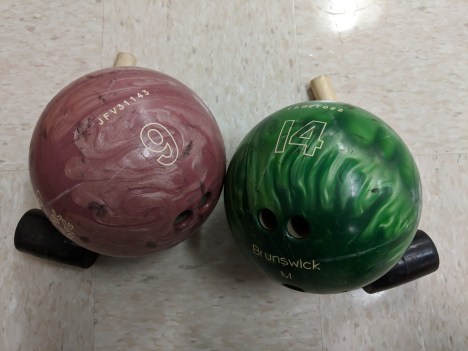
We discussed what students saw in yesterday’s bowling ball lab to get to a rule for how taps affect motion. Yesterday, a lot of groups started having conversations about how the size of the tap and the mass of the bowling ball plays into how much the motion changes, so I took advantage of that to introduce the definition of momentum, which lead smoothly into framing Newton’s 1st Law in terms of changes in momentum.

bowling ball race.jpg

Physics: Mistakes Whiteboarding

I introduced mistakes whiteboarding today with some photos from the first time I made fried mozzarella with nectarines and balsamic glaze so we could have some discussion about which photo did more for my learning. Students then whiteboarded yesterday’s problems and had some great discussion about the problems.

Chemistry Essentials: Board Meeting Continued

Today, we picked up discussing yesterdays lab on density. Since we’d made a good list of observations about the graphs yesterday, today I had students whiteboard “for every” statements describing their slopes, which, along with particle diagrams, lead nicely into a definition of slope. For next time, I’d love to find a second liquid that gives a pretty nice slope so students can contrast the two.

Day 8: Bowling Balls, Motion Maps, & Density

AP Physics 1: Bowling Balls

Students worked on a bowling ball and mallet lab based on Frank Noschese’s version. There was some good debate about whether a bowling ball needs to be tapped to roll at a constant speed, so we used the Motion Shot app to make a motion map we could use to check.

Motion_Shot_2017_09_05_12_06_19

Physics: Motion Maps

To introduce motion maps, I drove a fridge rover across my whiteboard and marked the position at regular time intervals. Motion maps also linked nicely back to the buggy lab, since I forced students to use time as the independent variable. Students then worked on problems; in my 1st hour, most of my students chose to work at desks mostly independently, which I think made the problems more challenging for both my students and for me. In my 6th hour, I started by letting students know the problems were designed to be done in groups and talked about the advantages of completing the task in a group. I’m also wondering if it would help if I made more use of a strategy I got from Designing Groupwork: Strategies for Heterogeneous Classrooms where we take time for some explicit class discussions about what skills are needed for a task to emphasize the value of multiple abilities.

motion map.jpg

Chemistry Essentials: Density of Water

Students did a lab to find the density of water, then we had a short board meeting with the results. We kept the board meeting pretty simple and I was very pleased with how it went; my favorite observation is a student who noticed that different groups had data points at different masses, but every group still got the same slope.

Day 7: Dueling Buggies, Board Meeting, & Volume

AP Physics 1: Dueling Buggies

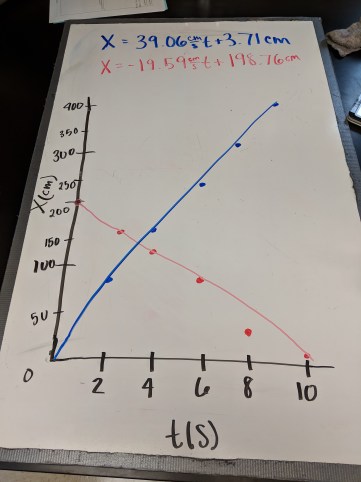
Students predicted where two buggies would collide based on their starting points and speeds. It was interesting to see how different sections approached this problem; most of the groups in my 2nd hour used motion maps while almost all of my 4th hour used position vs. time graphs. When my 4th hour discussed the buggy paradigm lab, students brought up the fact that some of the graphs intersected, with one even bringing up that position vs. time graphs can be used to elegantly solve the classic two trains problem.

Physics: Board Meeting

Students wrapped up the buggy lab and we had our board meeting. Before the board meeting, I once again had students do a gallery walk and jot some notes down on their lab sheet, which lead to some really good conversation during the board meeting. The downside is students are using the gallery walk to ask questions I’d normally hope to hear during the whole-class board meeting, like asking about what a group was doing when they collected data that gave a negative slope, but students bringing up those points during the whole-class phase, so it doesn’t feel like a big downside.

buggy lab

Chemistry Essentials: Volume

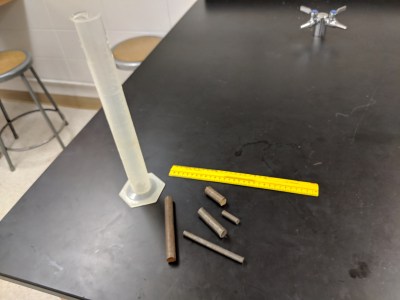
Today, students found a relationship between the amount of water displaced and a solid’s volume in cubic centimeters to get at the equivalence of milliLiters and cubic centimeters. I haven’t had great results with the Modeling Instruction volume lab, so this year I cut some rods from the metals teacher into short sections so that students only needed to find the volume of cylinders. I like that the lab I did today uses the same version of water displacement they’ll use later on, but the math was a struggle for a lot of students. About half of my groups finished data collection and the other half only got one data point because they were caught up calculating the volume. I need to keep working on how to make this lab accessible to all of my students.

volume lab


Day 6: Mistakes, Buggies, & Mass of Gas

AP Physics 1: Mistakes Whiteboarding

Students did mistakes whiteboarding, where groups include intentional mistakes in their solution, then the rest of the class asks questions to try to understand the mistake. I had a lot of groups pick mistakes they’d made working on the problems, which is perfect. In my big class, some students started turning to talk to their peers, which I let go at first since there were good conversations, but it quickly got hard to follow the main conversation and it was hard to shut the side conversations down once I let them start. Next time, I might try having some designated times for talking to a peer vs. talking as a whole class.

ap mistake

Physics: Buggy Lab

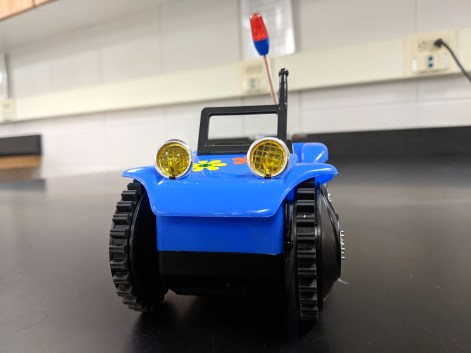
Students collected data for the buggy lab. I’ve found students are often very resistant to adjusting their procedure once they have any data written down, even if its only one point, so on the lab template we’re using, I have a step for students to test their procedure without recording any data. This time did exactly what I wanted today and I saw a lot of groups trying multiple approaches before settling on their steps.

buggy

Chemistry Essentials: Does Gas Have Mass?

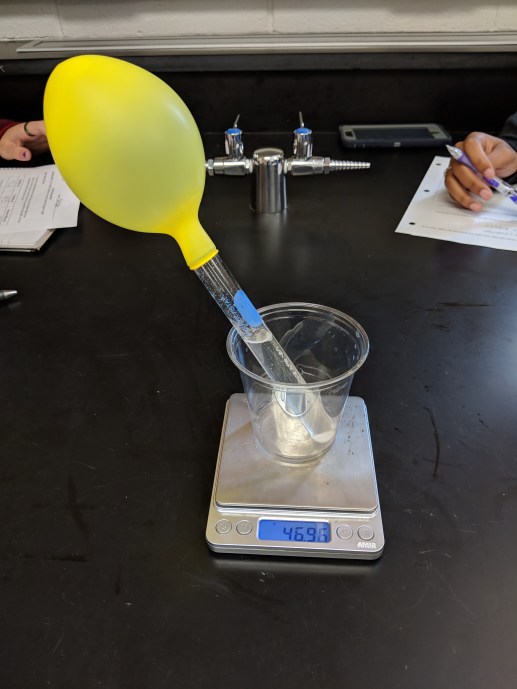
Students dropped Alka Seltzer into water, then measured the change in mass with and without a balloon on the test tube. This year, even though I had an approach in mind, we had some pre-lab discussion about possible strategies, and students had some neat ideas. There were a few things students came up with that provided a nice seque into this lab.

alka Seltzer

Day 5: Problems, FCI, & Problems

AP Physics 1: Problems

Students started working on some problems translating between constant velocity representations. Usually, I see a big difference between those who did and didn’t take calculus last year, but the gap seemed much smaller this year; my students who didn’t take calculus last year seemed very comfortable working with graphs and thinking through problems they aren’t entirely sure how to answer yet, which was great to see. My students are also already very collaborative, with students quick to step in when the realized a peer was stuck.

Physics: FCI

Students took the force concept inventory today. It was interesting that my students in this course seemed much more nervous about the pre-test than my AP students did on Friday. The pre-test is useful for the goal setting my district asks PLCs to do and I find looking at the gains, especially on specific questions, useful, but it does take a toll on students settling in to a challenging course to have a challenging pre-test so early on.

Chemistry Essentials: Particle Diagrams

We started by making and discussing histograms for Friday’s labs. There were some great observations and potential ideas to explain some of the changes we saw. Afterward, students got into groups to work on sketching particle diagrams for the experiments we’d done. I also introduced students to the group roles I’m using this year; I don’t think I did enough training to get the full benefit of the roles, but it did seem to help reinforce the idea that every group member has something to offer.

burning steel wool.jpg

Burning steel wool

Day 4: FCI, Board Meeting, & Mass and Change

AP Physics: FCI

Students took the FCI pre-test. When I asked what they thought of it, several students said it was fun, which bodes really well for the rest of the year.

Physics: Board Meeting

Students whiteboarded the dowel lab we’ve been working on for a board meeting. Time got tight, especially the last period of the day, partly because I was wiped out and didn’t keep as on top of my students as I needed to at this point in the year. In the lab template I’m using, students have a space to do a gallery walk with their lab group and start jotting down some observations, which seemed to help with the discussion during the actual board meeting.

dowel lab board

Chemistry Essentials: Mass and Change

We continued the mass and change sequence today with water melting into ice and a chemical reaction that forms a precipitate. Students consistently resist setting their ice aside to melt while they work on other parts of the lab, so I need to think about how to make things like that feel comfortable.

mass and change

Day 3: Board Meeting, Lab Template, & Burning Steel Wool

AP Physics: Board Meeting

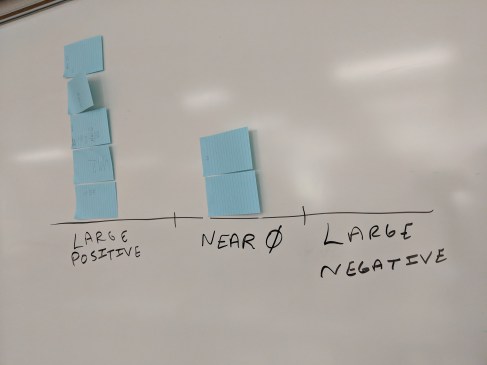
We did the first real board meeting using yesterday’s results from the buggy lab. Once again, I borrowed Casey Rutherford’s Observations, Claims, & Evidence structure. Some of the chemistry teachers have been integrating techniques from Modeling Instruction, and I got to reap rewards in a really good first board meeting. There was some discussion about whether some intercepts were small enough to call zero, which, along with a whiteboad where students plotted multiple trials, lead really nicely into an introduction to uncertainty. Next year, I think that would go even smoother if I push all groups to truly make time the independent variable and complete multiple trials.

Physics: Lab Template

For the second round of the dowel lab, I had students follow the lab template we’ll be using this year. I also changed the guiding question to “What is the relationship between the mass and volume of these dowels?” since that more naturally motivates measuring multiple dowels and is closer to the kind of guiding questions we’ll have on future labs.

dowels.jpg

Chemistry Essentials: Burning Steel Wool

We wrapped up yesterday’s lab by making a post-it histogram of the results students got yesterday, then had some discussion on the significance of those results. Afterward, we continued the mass and change sequence from Modeling Instruction by measuring changes in mass as steel wool burned.

steel wool.jpg

Day 2: Buggies Redux, Dowels, & Coffee Can

AP Physics 1: Buggies Redux

Today we repeated the buggy lab, but with a focus on preparing whiteboards that would make a meaningful comparison across groups. I had each group collect data for a standard buggy moving forward from zero and one other variation. One thing I’m really excited about is several groups played with ways to represent multiple trials on a single graph and one group came up with Frank Noschese’s effortless error bars on their own, which will be a great introduction to uncertainty.

Physics: Dowels

This class is also doing two rounds of the first real lab. Today, I asked students to use a bunch of small dowels to collect data that would let them predict the mass of a much larger dowel made out of the same type of wood and represent their data on a whiteboard. The majority of groups used proportions, which was great, but very few measured multiple small dowels on their own and no one thought to try a graph. In most labs, I ask students to find a relationship, and I wonder if that would be a more interesting prompt here.

Chemistry Essentials: Coffee Can

We did the exploding coffee can demo to introduce particle diagrams. I had a few students who were really willing to propose ideas to explain the changes in the can’s behavior as the flame burned, which was awesome.

coffee can