Day 64: Energy Practical & Mistakes Game

Physics: Energy Practical

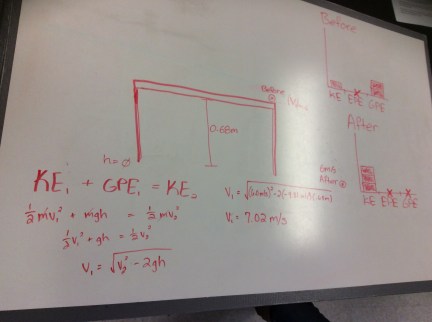
Students were given an elastic string to hang from the ceiling. Students had to find k for their string, then figure out how high above the ground to hold an action figure attached to the end so that, when they dropped it, the figure would just barely hit the ground. In the past, I’ve used a bucket of water and we go by the sound (“splash, but no thud”). This year, the other physics teacher suggested using a force plate and looking for a small spike in the force vs. time graph. While students like the splashing, the force plate is a lot easier to move around, and makes it possible to capture slow-motion video.

Chemistry: Mistakes Game

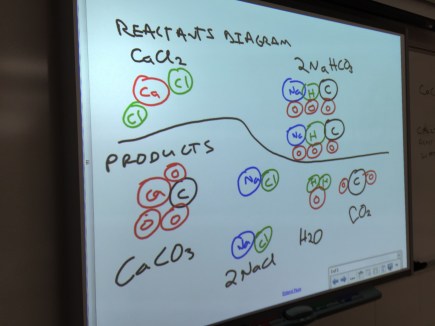
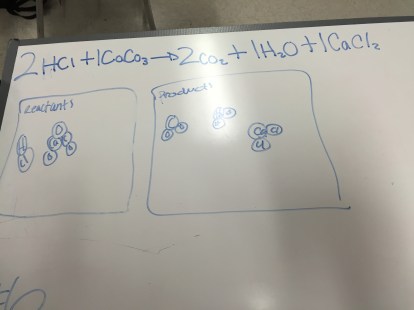
To go over Friday’s practice problems for balancing chemical equations, I had them do the mistakes game. Students focused on making their error an inconsistency in their representations of the reaction. I appreciated how willing my students were to try something new; they seemed to especially appreciate the safety inherent in the mistakes game.

IMG_1513

Day 63: Astroblaster & Balancing Equations

Physics: Astroblaster

After a quiz, students made some observations of the Astro Blaster and used conservation of energy to explain what they saw. Students also worked through some conservation of energy questions out of TIPERs.

IMG_1512

Chemistry: Balancing Chemical Equations

Students used what they found in the simulation yesterday to practice balancing chemical equations. I took a page from the Modeling Chemistry curriculum and had students sketch the molecules in the reaction, which turned out to be a really effective tool to make balancing a much more concrete process.

Day 62: Mistakes Game & Balancing Reactions

Physics: Mistakes Game

We played the mistakes game with yesterday’s conservation of energy problems. For students who had the other physics teacher last trimester, this was their first experience with the mistakes game. I was pleased with the way the students I had last tri took the lead, helping their peers come up with interesting mistakes and modeling good questions.

IMG_0317

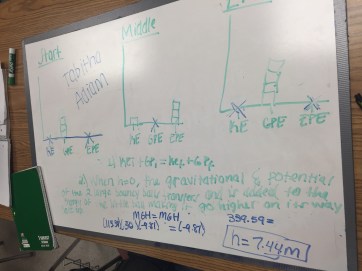
The mistake is a subtle sign error, but lead to some great discussion about determining whether an answer is reasonable.

Chemistry: Intro to Balancing Chemical Equations

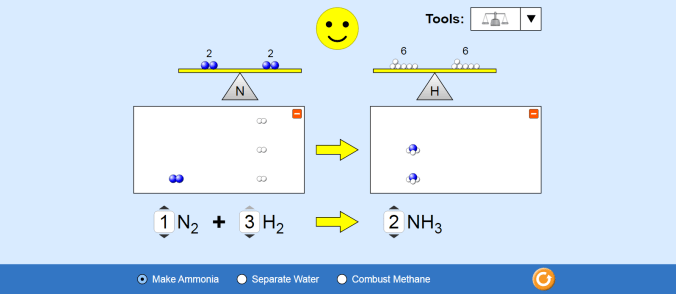
I took advantage of the visuals in PhET’s Balancing Chemical Equations sim to introduce my students to this process. I had them start by playing in the introduction to figure out what the different representations tell them about the chemical equation. After students had some time to play, we came back together. My students were able to articulate pretty clearly what it means for a reaction to be balanced, and what it has to do with conservation of mass. Students then spent some time testing their understanding by playing the game built into the simulation. Based on the conversations I overheard as they played, students were getting a much better understanding of not just how to balance chemical equations, but what all those numbers in the equation mean. I was also pleased to see the confidence my students gained while playing the game. I think a lot of them have started to assume they don’t understand things in the classroom, so seeing that immediate, consistently positive feedback from the game helped them see the way they’re thinking about these reactions really is useful.

phet balancing

Day 61: Problems & Representing Reactions

Physics: Conservation of Energy Problems

Students took their first look at conservation of energy calculations. I use a lot of problems that we could have done with earlier models to try to drive home that energy is a different way of looking at some very similar situations.

Chemistry: Representing Chemical Reactions

My students continued to practice translating between representations of chemical reactions. Several students were very confident by the end of the hour. I think we’re ready to look at balancing equations tomorrow.

Day 60: Bar Charts & Representing Reactions

Physics: Bar Charts

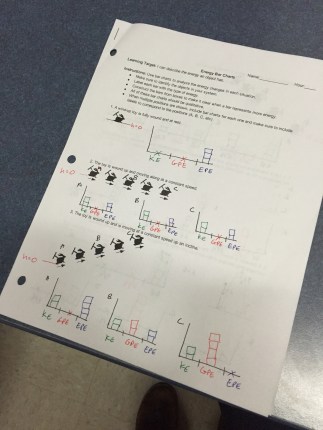
We used yesterday’s lab to define kinetic and gravitational potential energy, then students took their fist stab at drawing energy bar charts. Students took to the bar charts pretty easily.

IMG_1510

Chemistry: Representing Reactions

Today, students practiced translating between representations of a chemical reaction. Given a balanced equation for a reaction, I had them write a statement. This year, I took a page from the Modeling Instruction chemistry curriculum and also had them sketch a diagram that showed the atoms for both the reactants and products.

IMG_1509

Day 59: Energy Introduction & Conservation of Mass

Physics: Energy Introduction

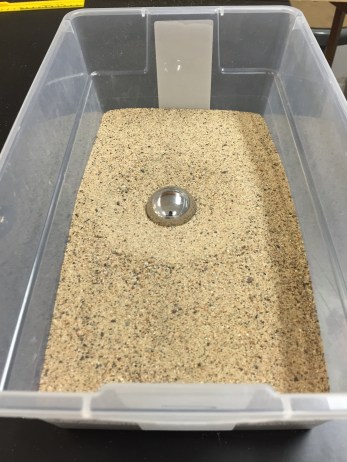
To introduce energy, we used a lab my colleague has done in the past. Students dropped a steel ball into a bucket of sand and measure the depth of the crater. I haven’t told my students yet, but we’re using the crater depth as a proxy for energy, similar to the “chalk-smashing ability” in Etkina’s PUM curriculum. Students collected data and graphed to get a relationship between the crater depth and the drop height, which we’ll use tomorrow to help define gravitational potential energy. I also had students use free fall to calculate the impact speed of the ball and graph the relationship between crater depth and impact speed, which will lead to the definition of kinetic energy.

IMG_1506

Chemistry: Conservation of Mass

This trimester, instead of teaching 9th grade physical science, I’m teaching the second half of a course called Chemistry Essentials. This two trimester course meets the minimum graduation requirements for my district. Most of the students tend to struggle in school, for a wide variety of reasons, and there is a high percentage of students who qualify for special education services.

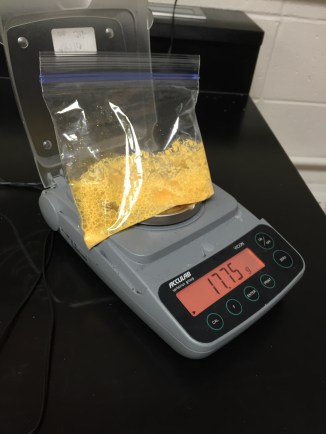
The first unit deals with writing and balancing chemical equations, so I decided to start with conservation of mass. Students put calcium chloride, sodium bicarbonate, and bromothymol blue into a sealed plastic bag, tracking the mass of everything involved. Once the reaction was finished, they measured the mass of the bag and its contents and found the total mass had stayed the same. I also had them measure the mass after removing as much gas as possible. The main issue was students had some trouble getting the plastic bag all the way on the pan of the balance, which impacted the mass they measured at the end. Next time, I’ll try having students set their bag in a rigid container like a beaker to get the total mass.

IMG_1508

Day 58: Tri 1 Reflections

Today is the second day of final exams, so today I’m taking some time to look back on how I think the trimester went.


image

Some students did a few minutes of power-posing to prep for their physics final

Physical Science

This year, I decided to change my order of topics to start with a unit on energy. Part of the appeal is its very natural to address the other topics in the course (motion, forces, sound, light, electricity, and magnetism) in terms of the energy. My students became very skilled at applying what they knew so far to new situations and, for the first time, I saw my students connecting ideas across topics, rather than treating each unit as a set of separate, unrelated ideas. I ended up really happy with how the new sequence worked.

The other big change I made to course content was taking out the majority of the calculations. In the past, students have been able to memorize how to use the formulas, but don’t get the relationships. By getting rid of the days spent learning and practicing the formulas, I was able to give students more time developing their conceptual understanding. Not surprisingly, they not only understood the concepts better, but they actually got the relationships that are summarized in the formulas. I know at least one of the other physical science teachers is interested in taking a similar approach, so I’m hoping this will be the norm in physical science.

Since the changes I made to the course content forced me to rethink most of my materials, it was a very natural time to shift from periodic inquiry labs to a truly inquiry-based approach. My 9th graders loved this approach and were fearless about sharing ideas, blurting out questions, and exploring whatever I put in front of them. They embraced ambiguity and mistakes much more easily than my seniors typically do, so I had to put very little effort in to culture building. The time I spent re-working my lessons paid huge dividends in student engagement and understanding.

Physics

The big change I made this year was the shift to standards-based grading. I’m much more confident in the grades I’m assigning to students this year, given how many students have shown growth over the course of a trimester. Just like last year, I had some students who struggled with constant acceleration continue to work on those skills, then absolutely shine by the time we got to projectile motion. Unlike last year, those students’ grades now reflect that they mastered constant acceleration, even if it wasn’t by the date of the original assessment. My only complaint is how many students waited until the end of the term to complete retakes; it not only was stressful for both my students and I to juggle that many retakes, but many of the students who waited just got further and further behind as we built on previous concepts to develop new ones. 2nd trimester, I’m going to have a strict limit on how many retakes a student may do per week and make sure I remind them of it regularly.

This fall, I also paid much more attention to culture building than I did last year. I introduced this as a course about process, not content, and periodically shared some of why I take this approach. I also had students play the mistakes game within the first week to start normalizing mistakes as part of the learning process. At this point in the year, my students seem much more comfortable with the structure of the class than last year’s group. When I used a very traditional curriculum, the culture could build very naturally, but now that I’m intentionally making students confused and uncomfortable almost daily, I need to be very conscious of giving students a sense of safety in my classroom.
Day 57: Final Exams

Today and tomorrow are final exams for first trimester, so both my classes are testing in 90 minute blocks.

Physical Science

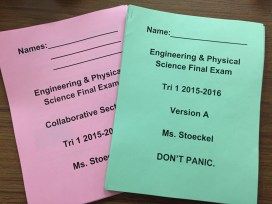
I made my final a two-stage collaborative exam. Students start with an individual portion that includes conceptual questions for all of the learning targets we’ve done this trimester. Once everyone was done, I put them in assigned groups of three for the collaborative portion, which includes fewer, but generally a little more conceptually challenging, questions. The collaborative portion counts for 25% of their final exam grade.

There are two big reasons I like the two stage collaborative exams. First, from a practical standpoint, they provide a way for students to get immediate feedback; many students figure out mistakes they made in the individual portion as they work on the group portion. Since I won’t be teaching any of these students next trimester, it will be tough for me to give them any feedback on their finals beyond a score. Second, the course is structured to be very collaborative, with students spending most of their time working in groups and discussing ideas with each other. It makes for an odd dichotomy when students are encouraged to rely on each other and discuss points of confusion when it comes to everything but the final, so the two-stage collaborative exam feels more in-line with the rest of the course.

I was also pleased by how many students recognized the reference to Hitchhiker’s Guide to the Galaxy I’d put on the cover, though I did get chided for coming up short of 42 questions.

IMG_1493

Physics

After the other physics teacher and I talked about the final, we agreed to take an approach he’s used in the past and use the final as one last retake opportunity. The final includes questions for each learning target for the course, and students are expected to complete every question. Based on their performance, their score for a given target can go up one level, down one level, or stay the same. Our goal is to base grades on where students are at now, rather than where they were in September.

Most students reacted positively to this approach and are feeling very confident since the Modeling Instruction curriculum does a really nice job of spiraling and linking content, so students never get a chance to be “done” with a concept or skill. A few students have let me know that they see the final as making their earlier quizzes and retakes worthless. That tells me I need to work on improving the feedback I put on the quizzes and on teaching my students how to effectively use their quizzes as a learning tool.

Day 56: Final Review

Final exams start tomorrow, so both classes were reviewing.

Physical Science

Yesterday, students wrote questions for each of the learning targets from this trimester. Last night, I picked some of the questions they’d written to make a Jeopardy-style review game.

Physics

Each group put a problem from the review assignment on a whiteboard and presented it to the class. One of the best discussions happened when a group had a few unintentional mistakes on their whiteboard, which lead to a lot of great conversation about what the answers should be. It was also great to see the progress students have made at communicating what they did by showing their work clearly.

IMG_1488

Day 55: Final Review

Final exams start on Wednesday, so both classes did some form of final review.

Physical Science

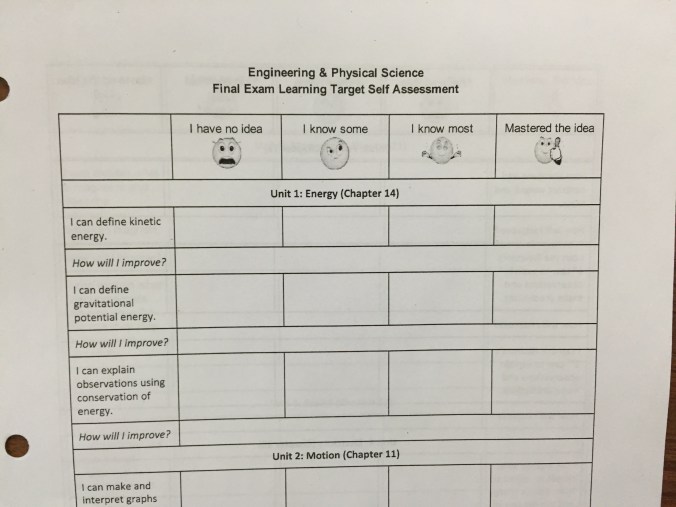
Students started by doing a short self-assessment on each of the learning targets from this trimester and we talked about how that could help them plan their studying. Next, I had each group come up with at least one possible test question for each learning target. I challenged students to come up with higher-level questions, even when the learning target is a simple one. Since AVID strategies are implemented pretty widely in the building, students were already familiar with Costa’s levels of questioning and provided a decent scaffold for students to make sure they were writing challenging questions. Students submitted their questions to a Google Form, which I’ll use to put together a review game for tomorrow. Having each group do one question per target turned out to be too much, so next year I will ask for one question per unit.

IMG_1485

Learning Target Self-Assessment Form

Physics

Students worked on a final review packet that goes back over all of the learning targets from this trimester. Tomorrow, I’ll have students whiteboard their solutions to the final review.