Day 5: Mistakes Game, Pendulums, & Dissolving

AP Physics: Mistakes Game

On Friday, as students finished the FCI, they picked up some problems translating between momentum vs. time graphs, motion maps, and written descriptions. Today, we went over them using the Mistakes Game.  Students pretty readily embraced this approach, which was great to see. I did notice a lot of students were not clear on whether arrows between the dots on a motion map represent the momentum vector or a “tap”, which I think goes back to how I introduced the bowling ball lab. Asking students about the spacing on the motion map got them to think about whether there should be a tap, which seemed to help.

mistakes

Physics: Pendulums

Students worked on finding a relationship between the length and period of a pendulum. On Friday, we’d measured a single period as a class to motivate the need to measure multiple periods. Today, I verbally reminded students of that discussion, but, once in the lab, a lot of students were unclear about what it meant to measure multiple periods; I think it would have been useful to demo that to help with their language. Most groups were able to get a graph done, and have done a linear fit with a nice big intercept, which will lead nicely into motivating the need for other relationships tomorrow.

pendulum.jpg

Chemistry Essentials: Dissolving

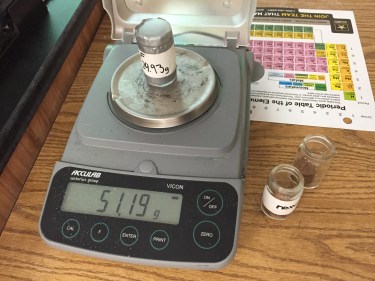
We continued the mass and change sequence from the Modeling Instruction chemistry curriculum. My plan was to get through both sugar and Alka Seltzer dissolving in water, but I wasn’t thinking when I grabbed beakers this morning and ended up with way more mass than the balances could handle. I ended up having my students do a lot of math, which many found overwhelming, especially since they had to add some blanks to the handout I’d made. If I’d been thinking, I would have pulled out some lightweight plastic cups to replace the beakers. Tomorrow, I’ll use those for the Alka Seltzer lab.

Day 4: Concept Inventories Galore!

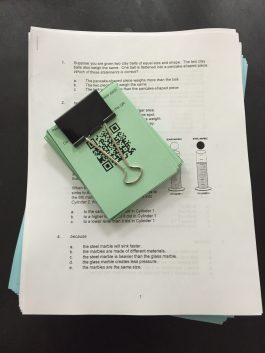
Today, all of my classes took some kind of concept inventory. Physics and AP Physics took the FCI while Chemistry Essentials took the CCI. The other Physics teacher and I talked about giving the FCI on day 1, but I’m glad we waited since it gave me a chance to start establishing a classroom culture before I gave students something I knew they’d get low scores on. Waiting also meant I could use the first few days to set the tone for what my classes should look like.

concept inventories.jpg

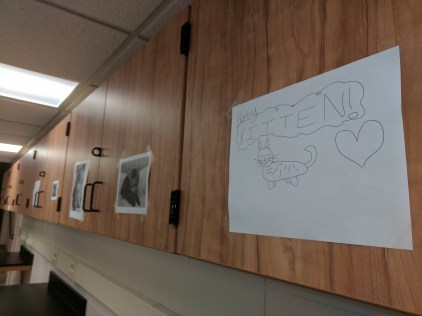
On a side note, I hid a line in my syllabus this year asking students to find or draw me a kitten picture once they’ve read it. As the pictures come in, I’m posting them in my room without comment. So far, I’m up to 5 kittens, which is a better response rate than last year!

kittens2

Day 3: Motion Detectors, Board Meeting, & Burning

AP Physics: Motion Detectors

This concept development sequence comes from conversations with Michael Lerner, Kelly O’Shea, and the rest of the Physics! PLC!

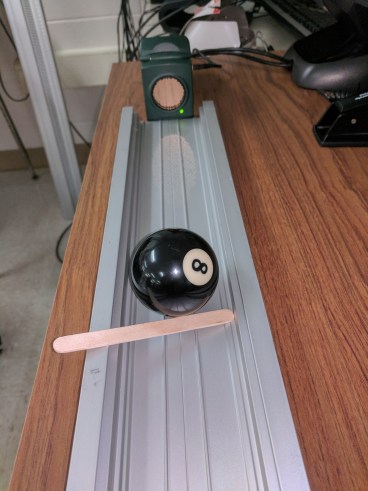
One of the tasks I gave students yesterday was to sketch a momentum vs. time graph for getting a bowling ball moving, then reversing its direction. There was a lot of disagreement about what that graph should look like, so today we had some brief discussion about how the momentum vs. time graph should compare to the velocity vs. time graph, then got out motion detectors and billiard balls to try some of yesterday’s tasks. The discussion afterward lead very nicely into the significance of a negative momentum, as well as the meaning of the slope on a momentum vs. time graph.

billiard.jpg

Physics: Board Meeting

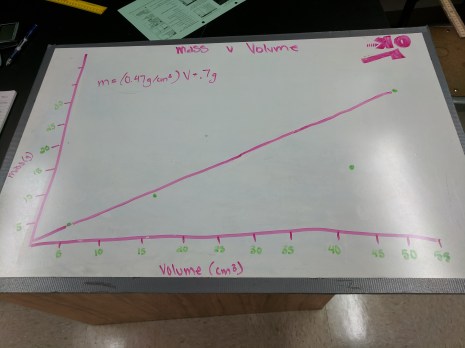
We had a board meeting for the dowel lab, following Casey Rutherford’s Observations, Claims, Evidence structure. Even though all of the dowels were made of the same material, slopes were all over the place, so we had some discussion about how to improve the results next time. A lot of groups just wrote down their calculated volume, rather than the values they measured, which made it difficult to check their calculations, so we discussed the value in recording the measured values.

hour 2 summary.jpg

Chem Essentials: Burning

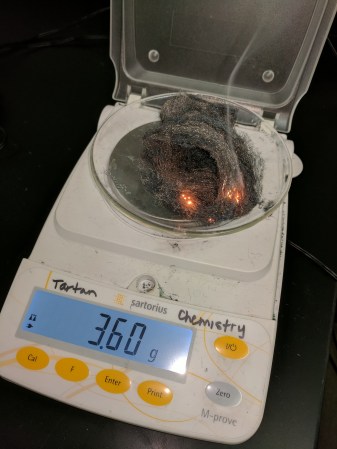
We continued the mass and change experiments, which today included burning steel wool. I needed to do a better job of framing this lab as being about the mass of the steel wool. A lot of groups missed recording the initial mass before they lit the wool, which I could have addressed by checking they had that value before giving them any matches. I also saw a lot of groups blowing on their wool or tossing used matches onto the dish with their wool, which reinforces that they were not thinking about the mass as important here.

steel wool

Day 2: p vs. t Graphs, Graphing, & CER

AP Physics: p vs. t Graphs

This concept development sequence comes from conversations with Michael Lerner, Kelly O’Shea, and the rest of the Physics! PLC!

There was still some debate from yesterday about whether the bowling ball had a constant speed after a tap, so I pulled out the Motion Shot app to make a motion map. Afterwards, students did a variation on the bowling ball lab with combinations of taps to introduce momentum vs. time graphs. I picked a few scenarios to help them get the idea of negative values for force and momentum as well as some to get at the significance of a non-zero intercept on the graph.

Motion_Shot_2017_09_06_09_41_24

Physics: Graphing

Students worked on their graph for the dowel lab, then we talked about “translating” the equation for the line of best fit by adding units and variables appropriate to the quantities they graphed. Students seemed to do well wrapping their heads around that step. Tomorrow, I’m going to have them write the slope as a statement a la Arons.

I’m also thinking about repeating the data collection tomorrow. Students are getting a wide range of slopes and intercepts and, if we’re going to take the time for a unit on experimental design and graphing, I’d like to establish careful practices right off the bat.

Next year, it could be interesting to mess with the calibration of the triple beam balances to give a non-zero intercept. I’m not sure yet if I would do that immediately, or if I would do a second round of data collection with the balances off.

dowel lab

Chemistry Essentials: CER

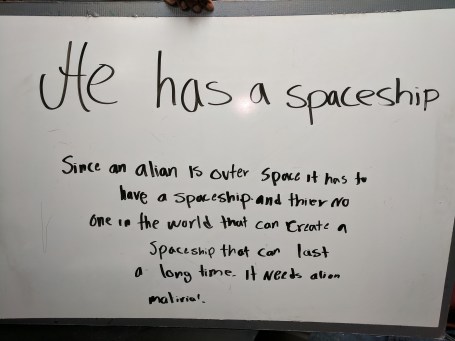
I put a CER at the end of yesterday’s lab, and students seemed pretty thrown by the reasoning piece. Today, I played the “My Dad’s an Alien” commercial and had students identify the kid’s claim and some of her evidence. Then, students got into their groups and had to fill in the reasoning for at least one piece of evidence. A lot of groups looked at why she might see something as evidence (like why the car seems like a spaceship), as well as why the evidence might support the claim. Yesterday, I felt like I was struggling to keep students on track, but today they were very engaged and even enthusiastic about the task. I think today I was much clearer about what they should be doing and what that looks like.

alien cer

Day 1: Bowling Balls, Dowels, & Steel Wool

The first day of school is in the books!

AP Physics: Bowling Balls

This concept development sequence comes from conversations with Michael Lerner, Kelly O’Shea, and the rest of the Physics! PLC!

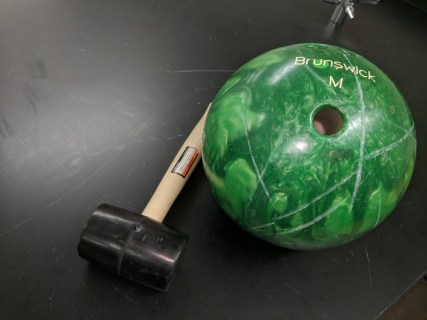
I’m starting the year with momentum, so the first idea I want students to build is the impulse-momentum theorem. Today, we started with a version of Frank Noschese’s bowling ball & mallets activity. For the first time, when I asked students to whiteboard the pattern or rule they’d found, I had multiple groups write out the classic wording of Newton’s 3rd Law. These groups struggled to connect their statement to the lab, but still resisted changing their whiteboard because they knew their statement was true. I think this happened because we don’t have the class culture yet for every student to feel comfortable taking an intellectual risk. Tomorrow, I want to spend some time on the difference between true statements and useful statements to push some of those students away from quoting textbooks.

bowling

Physics: Dowels

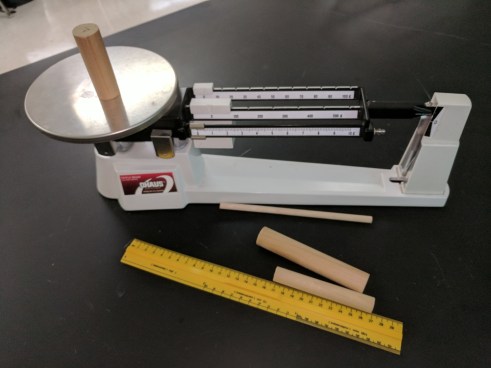
We’re starting the year with a unit on experimental design and graph interpretation based around a series of labs. For the first one, students are graphing mass vs. volume for some dowels. Things went well overall, but I should have spent a little more time on how to find the volume; I just told them to find it, and a lot of groups weren’t ready to make that leap on their own the first day of school.

dowel

Chemistry Essentials: Steel Wool

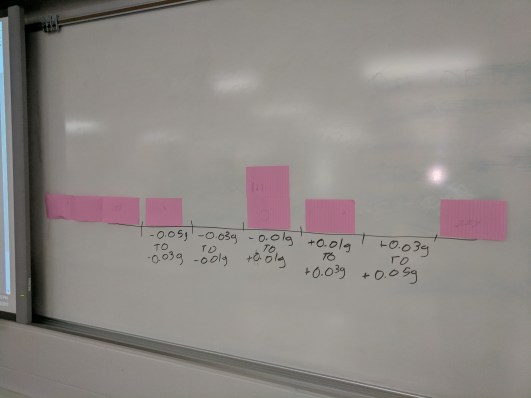
Students started the mass and change lab from the chemistry Modeling Instruction curriculum. To make the histogram, I had each group write their change on a Post-It, then place it in a physical bin matching their value before I transferred the Post-Its to the whiteboard. The balances were acting up, so most groups saw pretty big changes.

chem histo

Day 173: Year End Reflection

Its the last day of school, but I’ve got no students today, so its a good opportunity for me to look back at this year. Plus, after managing to keep up with this blog all year, I couldn’t miss the very last day of school!

Classroom Culture

I’ve written about this before, but this year I was much more intentional about building a classroom culture and getting students to see the value in a student-centered approach. Students were much more willing to take intellectual risks early in the school year and were very positive about the course. I also heard a lot more growth mindset talk from my students. The time I spent on class culture was time well spent.

I was a little worried about culture building in my sections of 9th grade physical science and Chemistry Essentials since I only got 12 weeks with each of those sections, but getting students to buy-in and take risks was much quicker and easier than in my honors-level physics classes. I think a lot of it has to do with each groups prior experiences with school. The students who take physics have typically been very successful in school, so I’m changing the rules of a game they’ve been winning. My chemistry students tend to struggle in school, so the game of school seems broken to them and it can be a relief when a teacher does something different. I had my 9th graders their first trimester of high school, so it seemed natural that my science class was different.

Next year, I want to work on explicitly teaching students how to work collaboratively and building in more individual accountability. I had some lab groups that didn’t really know how to approach a task collaboratively where one person would take the lead while others acted as sponges. Not surprisingly, the students in these groups tended to get lower grades and show less growth on the Classroom Test of Scientific Reasoning. This summer, I’m going to spend some time working on how I can help students build the skills to truly work collaboratively.

Grading

This year I made the switch to standards-based grading (SBG) in my physics class, and I’m very happy with the change. A lot of students talked about how this approach encouraged them to really learn the material and they liked that they were encouraged to go back to what they didn’t understand. I think SBG also helped build the positive, growth-oriented classroom culture I was after.

The big question when I talk to colleagues about SBG is always how to get students to do the daily work. In physics, students figured out pretty quickly that they needed the daily work to prepare for the assessments. In chemistry, I had a lot of students who I never got out of the mindset that not graded means not worth doing; the students who expressed this belief most strongly were also the ones most surprised by what appeared on assessments. While I don’t want to start putting everything students do in the gradebook, giving students more feedback on their daily work could add some value to the daily work in students’ eyes.

I think this is also part of a larger pattern I saw in the course where many students seemed to view individual lessons as completely separate from each other; if each day stands alone, then why should what students do in class on Thursday affect how they do on the assessment Friday? I did some having students write summaries of the lesson and complete a warm-up at the start of the next, but I didn’t do it consistently and I didn’t put the time or effort into making it truly meaningful. If I teach a course like this one again, I need to put in the work to make the summaries and warm-ups more valuable so that the course shifts in the students’ eyes from being a series of isolated lessons to a coherent whole.

Day 168: Final Exam & Radiation Dose

Physics: Final Exam

Today is the last day of school for seniors, so we finished the final exam. For the lab practicals, students completed four stations, one for each of the major topics we covered this trimester. Students worked individually and had about 10 minutes at each station.


Chemistry: Radiation Dose

Students used some information from the Department of Energy to calculate their average dose of radiation in a year, then we took the assessment on nuclear reactions. A little less than a third of my class is seniors; to keep things simple, I decided to excuse those students from the final and make today’s quiz the last entry in their grades.

Day 167: Final Exam & Nuclear Reactions

Physics: Final Exam Part 1

We decided to give two parts to the final exam; a set of lab practicals and the Classroom Test of Scientific Reasoning, which they took as a pre-test way back in September. Half the class worked on each portion today, and tomorrow they’ll switch. I had students submit their answers to the CTSR on a Google Form. Based on the very preliminary results, the class average has gone up about 1.5 points, which I’m pretty happy to see.

IMG_1942

Chemistry: More Nuclear Reactions

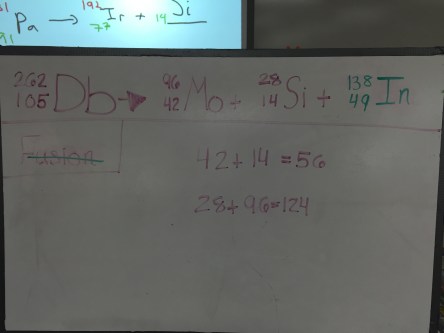
Today, I introduced students to alpha and beta decay, then had them start write nuclear reaction equations based on partial statements.

Day 166: Random Presenter & Mistakes Game

Physics: Random Presenter

I had each lab group whiteboard and present their solution to one of the lab practical stations. I assigned which practical each group would present so I could make sure we saw all four stations. I also, when possible, tried to pick groups that used different approaches, like the two groups in the photo who had to find the mass of some washers using a known mass, a spring, a ruler, and a stopwatch. In one of my classes, I tried rolling a dice to decide who would talk on behalf of the group, and I saw some students who tend to let someone else in their group figure things out really engaging to make sure they knew enough to present if picked. I need to use this strategy more often.


Chemistry: Mistakes Game

Students worked on writing equations for nuclear reactions, then we played the mistakes game with some problems.

IMG_1930

Day 165: Final Review & Isotopes

Physics: Final Review

Students continued working through the lab practicals to review for the final exam. Overall, I’m pretty happy with how the review has been doing, though a lot of groups were confused about what they were being asked to do on the standing waves practical. I need to revise the directions to make it clearer that they should calculate the length of the tube needed to resonate, then use the materials to test it.


Chemistry: Isotopes

Students used what they know about isotopes to determine how many pennies in a sealed container were made before 1982 vs. after. They struggled to make the connection between the lab and what we’ve done so far on isotopes, so I need to make some changes to help students better build that link.

IMG_1916