Day 100: KVL Diagrams, TIPERs, & Formula Writing

Today classes were shortened due to a pep fest.

AP Physics: KVL Diagrams

We had a very brief discussion about the results of the labs from Wednesday and Thursday; students were consistently very successful at picking up on they key patterns I wanted them to see. I also introduced them to Trevor Register’s KVL diagrams. I like to pair that with color-coded current paths on the circuit diagram.

kvl.jpg

Physics: TIPERs

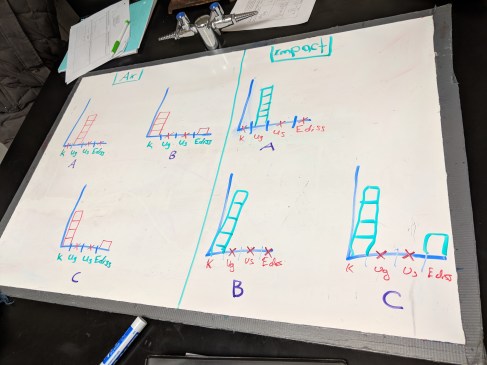
Students worked through some conceptual problems on impulse and momentum, mostly taken from TIPERs to get them thinking about what the equations we have so far really mean. A lot of groups really wanted to start by guessing an answer, then come up with some physics to justify it, rather than the other way around. I’ve been encouraging students to use CER with these types of problem, starting with the evidence and working towards the claim, but I’m tempted to try and talk my department into switching to ERC to make the evidence first more explicit.

Chemistry Essentials: Formula Writing

Playing the mistakes game yesterday seemed to help some students start to make sense of writing chemical formulas, though a lot of students still need more practice. Today, I gave students some formulas and asked them to determine whether they are possible based on what we know about bonding. This seemed to help the concepts click for a few more students.
Day 99: Kirchoff’s Laws, Impulse, & Mistakes Game

AP Physics: Kirchoff’s Laws

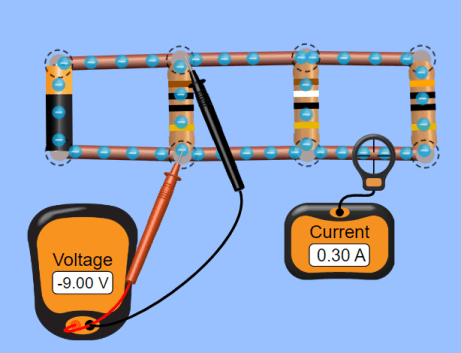
Students used PhET’s circuit construction kit to look for patterns in the current and potential difference in both series and parallel circuits. I usually do the PhET version before the real-world version we started yesterday, but testing season makes it tricky to reserve a computer lab right now. I overheard some students making good connections to their work yesterday and noticing the key things I wanted them to notice.

circuit kit parallel

Physics: Impulse

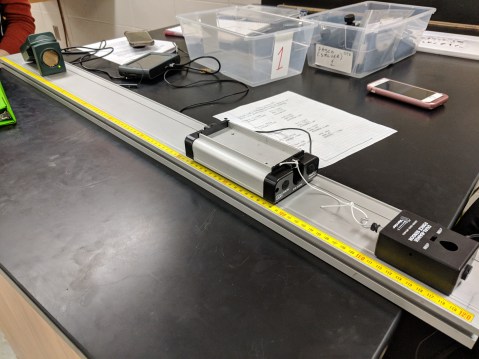
Students re-did the impulse lab from earlier this week. This time, I spent more time discussing with them why we care about the change in velocity, rather than the velocity at a specific moment. Students were more visibly attentive when I walked through how to get the change in velocity on a LabQuest than they were earlier in the week; I think it helped that they knew we were re-doing the lab because their earlier results came out poorly. I also had groups assign someone to plot their data as it was collected, which had them thinking about whether their results make sense throughout the lab. One section got beautiful results, while the other still had slopes all over the place; I’m not quite sure what happened in the second section.

Maker:S,Date:2017-10-21,Ver:6,Lens:Kan03,Act:Lar02,E-ve

Maker:S,Date:2017-10-21,Ver:6,Lens:Kan03,Act:Lar02,E-ve

Chemistry Essentials: Mistakes Game

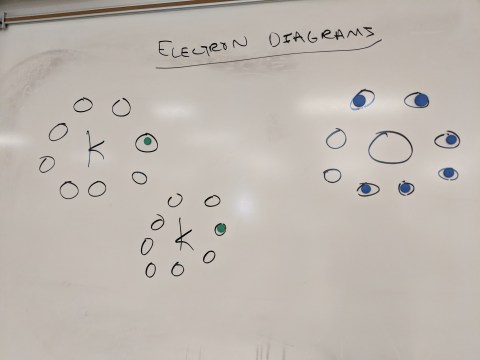
Students whiteboarded yesterday’s problems using the Mistakes Game. The students who are using the electron diagrams as a thinking tool are pretty quickly getting the hang of things.

electron diagra.jpg

Day 98: Kirchoff’s Laws, Board Meeting, & Chemical Formulas

AP Physics: Kirchoff’s Laws

Students started working on a lab for Kirchoff’s Laws. They measured the current and voltage at different points in the circuit to start looking for patterns. I overheard some good discussion about how the results connect to the Ohm’s Law equation we got earlier this week.

kirchoff.jpg

Physics: Board Meeting

Students whiteboarded their results for the impulse lab, but the slopes of their graphs were way off from what I expected. A lot of groups admitted that once they got their hands on the equipment, they ignored that we were interested in the change in velocity, rather than just the maximum or the minimum. I need to think about how to adjust pre-lab discussions in this course to keep students focused on the key ideas. We were able to get some qualitative ideas about impulse in place from the results, but I decided to have students collect data again tomorrow to get a quantitative understanding.

impulse board.jpg

Chemistry Essentials: Chemical Formulas

Students started writing chemical formulas given the name of the compound and the charges. I got out some beans for students to use as manipulative versions of Lewis dot structures, which helped a lot of students get beyond “flop and drop” when figuring out subscripts. Some students did get thrown by switching between electron diagrams and particle diagrams, so I need to work on keeping the types and purposes of diagrams distinct.

beans.jpg

Day 97: Board Meeting, Impulse, & Valence Electrons

AP Physics: Board Meeting

Today, we had two board meetings. First, we discussed the results of last week’s electric potential difference lab, followed by yesterday’s work on Ohm’s Law. The potential difference discussion went well, but the Ohm’s Law lab was trickier. This is the first lab I did as pretty open inquiry where students were working with three different variables, and a lot of groups struggled to relate all three. Next year, I may go back to having students do two separate experiments. There were also several groups who used the battery’s internal resistance and I think a little more pre-lab discussion could have avoided that.


epd board.jpg

Physics: Impulse

Students tied a cart to a force sensor with an elastic string and collected data for a relationship between the area of the force vs. time graph and the cart’s change in velocity. A lot of students had some trouble with the idea that they were graphing features of the LabQuest graphs, but were able to make sense of what was going on with some support.

impulse lab.jpg

Chemistry Essentials: Valence Electrons

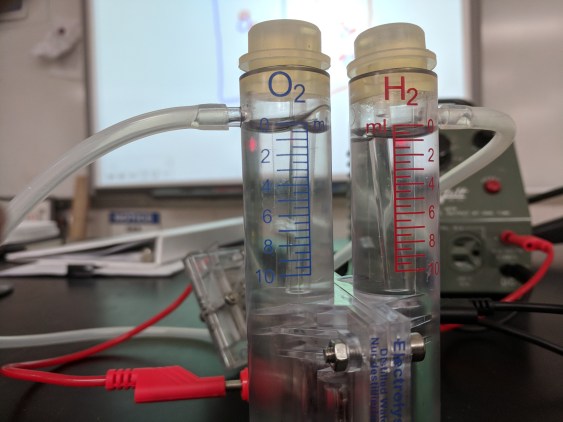
Students sketch Bohr models for selected elements to start identifying patterns in the number of valence electrons. Students seemed pretty successful at making sense of why certain elements have certain charges. I also got out the electrolysis machine to give an example of how we know the ratio of elements in a compound.

IMG_20171102_144642

Day 96: Circuit Basics, Cart Catching, & Chemical Changes

AP Physics: Circuit Basics

Students used the PhET circuit construction kit to start exploring basic circuit properties and develop Ohm’s Law. It was a lot of fun to listen to students as they discovered new features in the simulation and discussed details they noticed.

circuit kit.PNG

Physics: Cart Catching

To introduce momentum, we borrowed the idea of “chalk-smashing ability” used to introduce energy in the PUM curriculum and had students play with how they could make it harder to catch a cart on a dynamics track. I got excited when a couple of groups took advantage of the plunger carts to see how catching the plunger end felt different than catching the other end, which will be a great lead-in to impulse.

cart catch.jpg

Chemistry Essentials: Chemical Changes

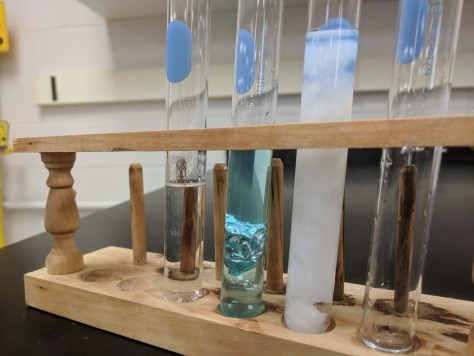
Students did several different chemical reactions to identify signs of chemical changes. There were lots of good observations during the lab.

chem change

Day 95: Electric Potential Difference, Conservation of Energy, & Quiz

AP Physics: Electric Potential Difference

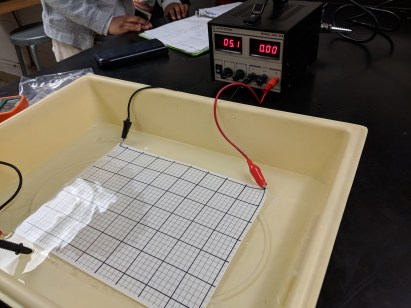
Students did a variation on the lab to map an electric field in a tray of water. Since I just wanted to define electric potential difference, they measured the voltage along a line with the multimeter’s ground probe in a few different positions (my article about this lab was in the January issue of The Physics Teacher). There was a lot of good discussion within lab groups about what negative voltages mean.

epd.jpg

Physics: Conservation of Energy

Before their quiz, students whiteboarded a couple of conservation of energy problems (which I spaced out on taking a picture of). For a lot of students, this reinforced the importance of the meaning-making steps and gave them a boost of confidence before starting the quiz. The downside is there are students who approach the pre-quiz problems as a chance to cram, rather than a warm-up. I’m trying to decide if I’m okay with that trade-off.

Chemistry Essentials: Quiz

Students took their quiz on atomic models and classifying matter. I’ve been working a lot on the class culture and finding ways to connect with students I’ve been clashing with, and it paid off today when, for the first time, I didn’t have to police students staying quiet after they finished their quiz.

Day 94: Whiteboarding, Bouncy Ball Energy, & Classifying Matter

AP Physics: Whiteboarding

Students whiteboarded their answers to yesterday’s problems. There were a couple of meaty ones on the worksheet, so I had all groups whiteboard the same problem and then we had several consensus-building conversations.

quantization.jpg

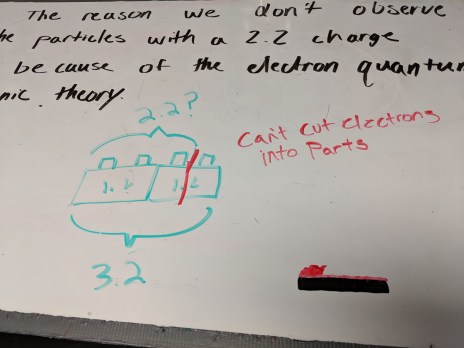
A visual for quantization of charge

Physics: Bouncy Ball Energy

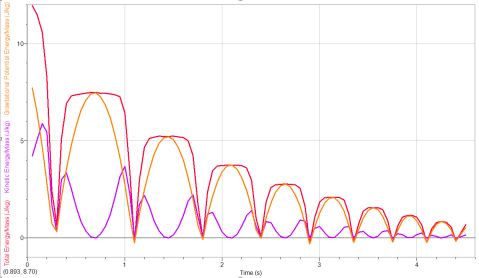
We wrapped up figuring out where a bouncy ball dissipates energy. As part of the follow-up, we dropped a kickball under a motion detector (thanks to Brian Frank for the idea!) to produce energy vs. time graphs and confirm the results from students’ video analysis.

kickball e-t graphs.PNG

Chemistry Essentials: Classifying Matter

Students worked on a worksheet to connect particle diagrams to the vocabulary for classifying matter that we introduced yesterday. I also was able to have really good individual interactions with a couple of students I’ve been butting heads with a lot, which helped make the whole classroom feel more relaxed and positive. I’ve been getting overwhelmed in chemistry a lot this year and have not done a good job of making time to talk to students about things besides chem, and I can’t underestimate the value of those conversations.

Day 93: Coulomb’s Law, Dissipated Energy, & Compounds

AP Physics: Coulomb’s Law

Students worked on some problems using Coulomb’s Law. I was surprised at how challenging a lot of students found a problem that deals with the quantization of charge, but there were a lot of great conversations as students worked through that one.

Physics: Dissipated Energy

We moved into the video analysis portion of determining where a bouncy ball dissipates energy (my article about this activity was published in the January issue of The Science Teacher). Before they got their bouncy ball, groups had to tell me what specific measurements they would use from the video analysis; the groups that completed the worksheet from the past few days were very successful while the groups that left big portions of the worksheet blank really struggled. I had one group get really excited watching their video when they noticed the bouncy ball got less blurry at the top of each bounce since it showed the bouncy ball really does briefly stop at the top.

Maker:S,Date:2017-10-21,Ver:6,Lens:Kan03,Act:Lar02,E-ve

Chemistry Essentials: Compounds
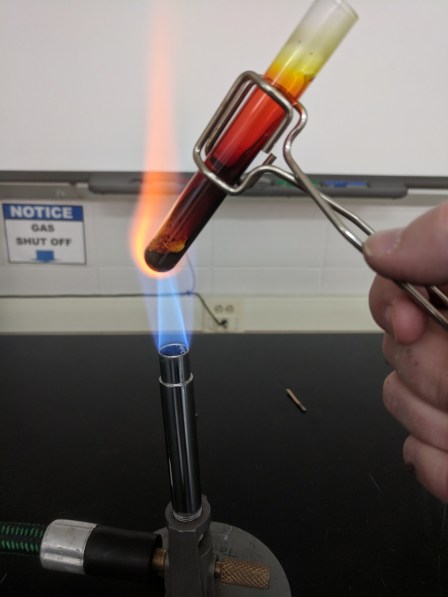
Students observed iron and sulfur, eventually heating it in a test tube to make iron sulfide. They were very into burning the iron and sulfur. Afterward, I used their observations in the lab to introduce vocab for pure substances, mixtures, and compounds.

chem change

Day 92: Board Meeting, Dissipated Energy, & Mistakes Game

AP Physics: Board Meeting
Students whiteboarded their results from a Pivot Interactives activity on Coulomb’s Law. There was some debate over whether inverse or inverse-square was the right linearization; I usually don’t have students sketch their points on their whiteboards, but I think that would have been helpful today. Students did a nice job connecting their results to Newton’s Laws and their knowledge from chemistry.

force charge lab.jpg

This group ran out of space for their linearization, but I found their set of graphs very satisfying.

Physics: Dissipated Energy

We continued prep for determining which interaction causes a bouncy ball to dissipate energy (my article about this activity was published in the January issue of The Science Teacher) by whiteboarding key points of yesterday’s work. Today really seemed to help a lot of students see the connections between the energy bar charts, free-body diagrams, and velocity vs. time graphs, which is exactly what I was going for.

bouncy lol.jpg

Chemistry Essentials: Mistakes Game

We used the mistakes game to go over yesterday’s problems. There was some great discussion, but it was very tough to keep students from breaking into side conversations. Next time, I should spend a little more time making sure behavior expectations are explicit as possible and helping students see the value in those expectations. There were also some students who were extremely engaged and clearly developed a lot of confidence in sketching Borh models today, which was awesome.

Day 91: Coulomb’s Law, Bouncy Balls, & Bohr Model

AP Physics: Coulomb’s Law

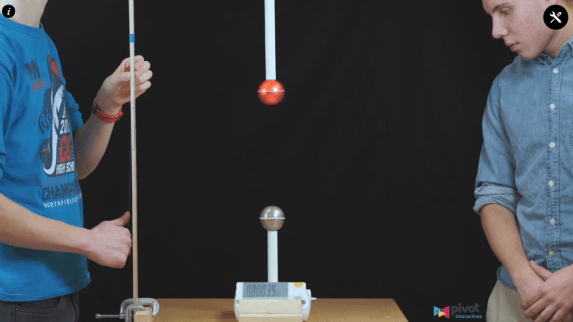
Students worked on a Pivot Interactives activity to find a relationship between the force between two charged spheres and the distance between them. A few students started wondering about the limits of the model since they recognized an infinite force doesn’t make sense, which lead to some good discussion about what it would take to make the distance zero.

pivot force dist.PNG

Physics: Bouncy Balls

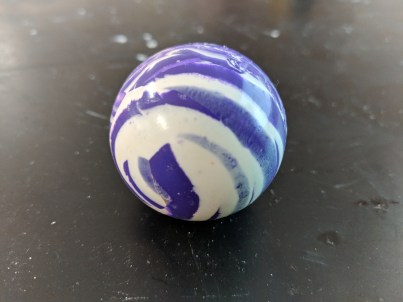
Students started working a lab to determine what interaction is dissipating energy for a bouncy ball (my article about this activity was published in the January issue of The Science Teacher). Today, students worked on sketching representations of the bouncy ball’s motion, including energy bar charts, free-body diagrams, and velocity vs. time graphs for each possible explanation in order to identify useful evidence they can get from video analysis of the bouncy ball. To scaffold this process, I had students sketch the representations on a worksheet today rather than going straight to whiteboards.

bouncy ball.jpg

Chemistry Essentials: Bohr Model

We talked about the results of last week’s simulation to find the links between the Bohr model and the periodic table, then students worked on a worksheet sketching Bohr models from the periodic table. I skipped over revisiting static electricity (which the Modeling Chemistry curriculum calls for) to help establish the concept of charge, but I think next time I’d like to make time for it.