Day 60: v-t Graphs & Marshmallow Debrief

AP Physics: v-t Graphs

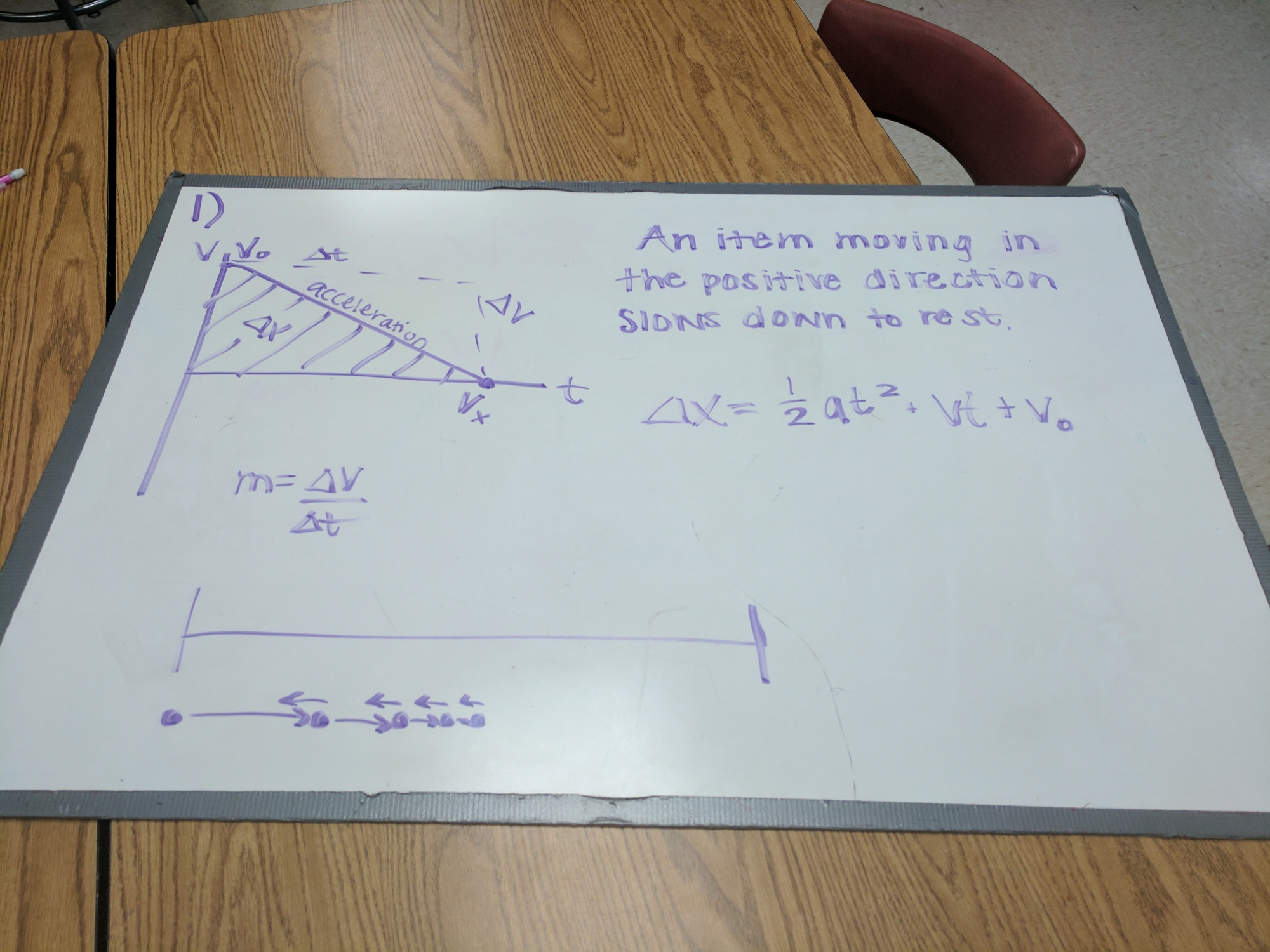
We are starting projectile motion, so today I did a refresher on velocity vs. time graphs. I gave students a few graphs and asked them to annotate the graphs and translate to some other representations. A few of my students got to talking about how their written descriptions of the motion today compare to what they did when we first started constant acceleration, even pointing to particular words and phrases they’ve changed, and the specific change in understanding driving that.

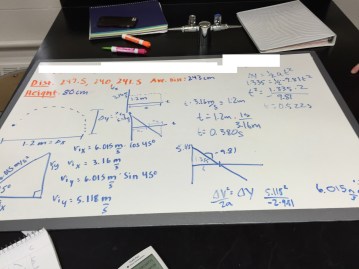
At the end of the hour, I’d planned to go over a few problems on the board to limit how much time this took. When I asked for requests, my students asked if they could whiteboard their solutions instead, so I happily had them do a gallery walk. Have I mentioned lately that my students are awesome?

Physical Science: Marshmallow Debrief

We discussed yesterday’s Marshmallow Challenge. Students recognized many of the growth mindset themes, like the value in learning from failed attempts or the fact that multiple approaches are valuable. We also discussed some things that effective groups do. I want to revisit this discussion later in the tri for students to reflect on how well their group is working.

Day 59: Reviewing Final & Marshmallow Challenge

Today was the start of a new trimester and, in the excitement, I forgot to take pictures today.

AP Physics: Reviewing Final

I wanted students to go over some problems from last week’s final exam. For one of the problems, I picked a really strong solution, as well as a few that were representative of the most common mistakes, and gave them a scoring guide to assign points. Students said this really helped them get a clear understanding of what exactly is expected, as well as to think about why the wrong answers were wrong. A lot of students realized they’d made mistakes because they did not read carefully, so I need to work on integrating some reading strategies for complex problems.

Physical Science: Marshmallow Challenge

Our 9th grade science sequence is two trimesters of earth science and one trimester of physics. This year, physics is in the middle, so today started our physical science trimester. In spite of this being a full-year course, only 3 of my 35 students had earth science with me last trimester.

Today, we did Tom Wujec’s Marshmallow Challenge, where teams build a tower out of spaghetti, string, and tape with a marshmallow on top. I really like that the TED talk and other resources make it easy to use this to talk about growth mindset, effective collaboration, and other ideas that I want to place as important right away. I also really like having students do something the very first day of class, since it drives home the message that they will need to be active in this class.

Day 58: Tri 1 Reflections

Today is the second day of final exams, so today I’m taking some time to look back on how I think the trimester went.


image

Some students did a few minutes of power-posing to prep for their physics final

Physical Science

This year, I decided to change my order of topics to start with a unit on energy. Part of the appeal is its very natural to address the other topics in the course (motion, forces, sound, light, electricity, and magnetism) in terms of the energy. My students became very skilled at applying what they knew so far to new situations and, for the first time, I saw my students connecting ideas across topics, rather than treating each unit as a set of separate, unrelated ideas. I ended up really happy with how the new sequence worked.

The other big change I made to course content was taking out the majority of the calculations. In the past, students have been able to memorize how to use the formulas, but don’t get the relationships. By getting rid of the days spent learning and practicing the formulas, I was able to give students more time developing their conceptual understanding. Not surprisingly, they not only understood the concepts better, but they actually got the relationships that are summarized in the formulas. I know at least one of the other physical science teachers is interested in taking a similar approach, so I’m hoping this will be the norm in physical science.

Since the changes I made to the course content forced me to rethink most of my materials, it was a very natural time to shift from periodic inquiry labs to a truly inquiry-based approach. My 9th graders loved this approach and were fearless about sharing ideas, blurting out questions, and exploring whatever I put in front of them. They embraced ambiguity and mistakes much more easily than my seniors typically do, so I had to put very little effort in to culture building. The time I spent re-working my lessons paid huge dividends in student engagement and understanding.

Physics

The big change I made this year was the shift to standards-based grading. I’m much more confident in the grades I’m assigning to students this year, given how many students have shown growth over the course of a trimester. Just like last year, I had some students who struggled with constant acceleration continue to work on those skills, then absolutely shine by the time we got to projectile motion. Unlike last year, those students’ grades now reflect that they mastered constant acceleration, even if it wasn’t by the date of the original assessment. My only complaint is how many students waited until the end of the term to complete retakes; it not only was stressful for both my students and I to juggle that many retakes, but many of the students who waited just got further and further behind as we built on previous concepts to develop new ones. 2nd trimester, I’m going to have a strict limit on how many retakes a student may do per week and make sure I remind them of it regularly.

This fall, I also paid much more attention to culture building than I did last year. I introduced this as a course about process, not content, and periodically shared some of why I take this approach. I also had students play the mistakes game within the first week to start normalizing mistakes as part of the learning process. At this point in the year, my students seem much more comfortable with the structure of the class than last year’s group. When I used a very traditional curriculum, the culture could build very naturally, but now that I’m intentionally making students confused and uncomfortable almost daily, I need to be very conscious of giving students a sense of safety in my classroom.
Day 57: Final Exams

Today and tomorrow are final exams for first trimester, so both my classes are testing in 90 minute blocks.

Physical Science

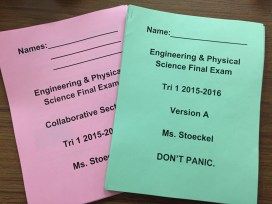
I made my final a two-stage collaborative exam. Students start with an individual portion that includes conceptual questions for all of the learning targets we’ve done this trimester. Once everyone was done, I put them in assigned groups of three for the collaborative portion, which includes fewer, but generally a little more conceptually challenging, questions. The collaborative portion counts for 25% of their final exam grade.

There are two big reasons I like the two stage collaborative exams. First, from a practical standpoint, they provide a way for students to get immediate feedback; many students figure out mistakes they made in the individual portion as they work on the group portion. Since I won’t be teaching any of these students next trimester, it will be tough for me to give them any feedback on their finals beyond a score. Second, the course is structured to be very collaborative, with students spending most of their time working in groups and discussing ideas with each other. It makes for an odd dichotomy when students are encouraged to rely on each other and discuss points of confusion when it comes to everything but the final, so the two-stage collaborative exam feels more in-line with the rest of the course.

I was also pleased by how many students recognized the reference to Hitchhiker’s Guide to the Galaxy I’d put on the cover, though I did get chided for coming up short of 42 questions.

IMG_1493

Physics

After the other physics teacher and I talked about the final, we agreed to take an approach he’s used in the past and use the final as one last retake opportunity. The final includes questions for each learning target for the course, and students are expected to complete every question. Based on their performance, their score for a given target can go up one level, down one level, or stay the same. Our goal is to base grades on where students are at now, rather than where they were in September.

Most students reacted positively to this approach and are feeling very confident since the Modeling Instruction curriculum does a really nice job of spiraling and linking content, so students never get a chance to be “done” with a concept or skill. A few students have let me know that they see the final as making their earlier quizzes and retakes worthless. That tells me I need to work on improving the feedback I put on the quizzes and on teaching my students how to effectively use their quizzes as a learning tool.

Day 56: Final Review

Final exams start tomorrow, so both classes were reviewing.

Physical Science

Yesterday, students wrote questions for each of the learning targets from this trimester. Last night, I picked some of the questions they’d written to make a Jeopardy-style review game.

Physics

Each group put a problem from the review assignment on a whiteboard and presented it to the class. One of the best discussions happened when a group had a few unintentional mistakes on their whiteboard, which lead to a lot of great conversation about what the answers should be. It was also great to see the progress students have made at communicating what they did by showing their work clearly.

IMG_1488

Day 55: Final Review

Final exams start on Wednesday, so both classes did some form of final review.

Physical Science

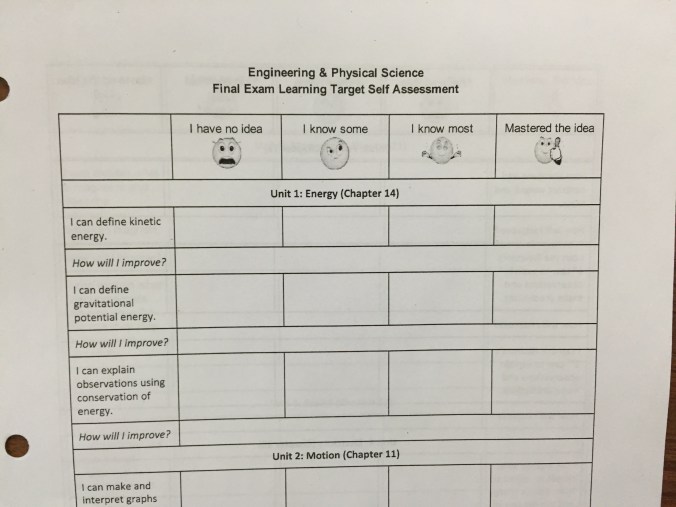
Students started by doing a short self-assessment on each of the learning targets from this trimester and we talked about how that could help them plan their studying. Next, I had each group come up with at least one possible test question for each learning target. I challenged students to come up with higher-level questions, even when the learning target is a simple one. Since AVID strategies are implemented pretty widely in the building, students were already familiar with Costa’s levels of questioning and provided a decent scaffold for students to make sure they were writing challenging questions. Students submitted their questions to a Google Form, which I’ll use to put together a review game for tomorrow. Having each group do one question per target turned out to be too much, so next year I will ask for one question per unit.

IMG_1485

Learning Target Self-Assessment Form

Physics

Students worked on a final review packet that goes back over all of the learning targets from this trimester. Tomorrow, I’ll have students whiteboard their solutions to the final review.

Day 54: Refraction & Final Review

Physical Science: Refraction

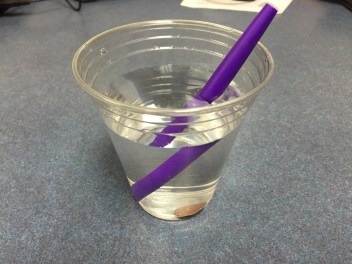
Students stuck pens, pennies, and other assorted objects into cups of water to develop some ideas about refraction. Students were very quick to connect their observations in the lab to their experiences from outside the classroom. The couple of students who’ve been bow or spear fishing were especially excited.IMG_1470

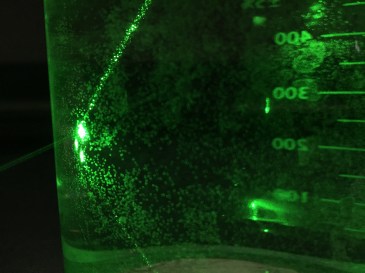
Students also made some observations of a laser pointer shining into a tank, aided by some creamer in the water and chalk dust in the air. It made a huge impression on these students when I used the chalk dust and laser pointer to show reflection yesterday, so they were thrilled to see it was still out today.

One particularly observant student noticed they could see three bright dots when the beam hit the side of the thank. We talked a bit about it, even though the students have only pretty rudimentary tools for talking about the behavior of light, and they decided that the center spot was the light reaching the outside edge of the glass while the outer spots was the light hitting the inside edge of the glass. Given the way this course skims the surface of each topic, I was pleased with their conclusion.

IMG_1458

Physics: Final Review

Students took their last quiz of the trimester, covering projectiles, then started working on their final review. The review is mostly a packet of their quizzes from this trimester.

Day 53: Reflection & Projectiles Practical

Physical Science: Reflection

Students used reflectors (like this one) to explore reflection. I gave them some very general questions and directed them to collect evidence that would allow them to answer the questions. Students had some trouble getting started, but did a nice job overall.

Physics: Projectile Practical

Yesterday, each group was given a distance from a projectile launcher and had to calculate how high above the ground the projectile should be. Today, students placed embroidery hoops at their predicted height and we fired the launcher.

nofaces

Day 52: Color & Projectile Practical

Physical Science: Color

Students used colored filters, felt, and light sources to find patterns in what determines what color they see. By the end of the hour, students were able to use what they saw in the lab to accurately explain their observations in the filters puzzle video.

IMG_1435

Physics: Projectiles Practical

Students began a lab practical for projectile motion. First, we fired a projectile launcher horizontally and measured the range and starting height to determine the launch speed. Then, each group got a different distance from the launcher and calculated how high off the ground the projectile will be at that point if the launcher is fired at an angle of 45 degrees. Tomorrow, each group will place an embroidery hoop at their given distance and calculated height.

IMG_1445

Day 51: Color Intro & Collaborative Problem Solving

Physical Science: Color Intro

For the first half of the period today, my students presented their research projects on different energy sources. Once that was finished, we started on color. I started by having students watch a short video that I blatantly copied from Frank Noschese that shows red ink and red light through both red and blue filters. I like the video because I can show all my students at once and I like having my own version so students can look at the clock and paper I used in the video to verify I wasn’t using some kind of trickery. I asked students to record their observations from the video, then try to come up with a hypothesis to explain their observations. This lead nicely into a lab where students look at things through filter paddles. Once students finish the lab, we’ll revisit the video to see how their explanation has changed.

Physics: Collaborative Problem Solving

I took a problem from Casey Rutherford’s projectile motion packet about a block given a push up a ramp with friction, then allowed to fly off the end of the ramp to become a projectile. One of the things I love about this problem is it requires to students to use just about everything from the trimester. 2nd hour, students did whiteboard speed dating, but I put a couple of goal-less problems first so students didn’t have much time to work on it, but were intrigued enough by the problem that they asked to continue next week. 4th hour, I decided to start with that problem. I had students work in groups using the roles from the University of Minnesota’s Cooperative Group Problem Solving protocol. It took most of the hour, but students were consistently successful and even my top students were challenged. It was great to see the obvious pride when students finally got the correct answer.

IMG_1421