Day 105: Dissipated Energy & Building

AP Physics: Dissipated Energy

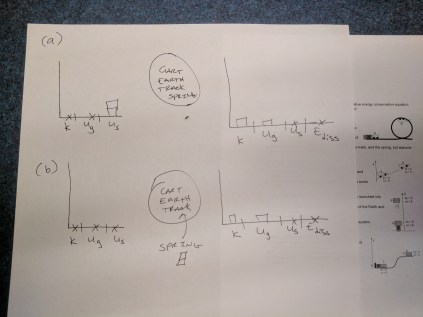
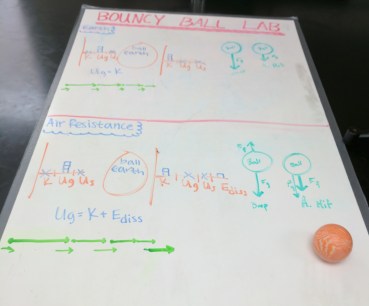
Students analyzed video of their bouncy balls and collected evidence to argue whether the energy is primarily dissipated by air resistance or by the impact with the table. There was a nice variety of approaches and I was pleased by how many students went back to the fact that we neglected air resistance during projectile motion to make a prediction about whether it should matter here.

pos-time-graph

Physical Science: Building

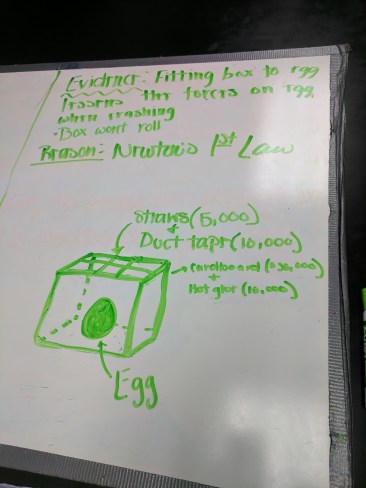
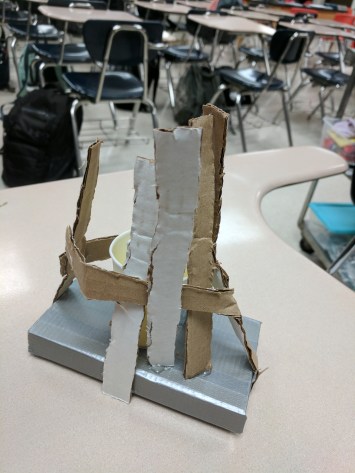
Students worked on building their cargo carriers based on yesterday’s designs. To help keep the focus on the science behind their designs, I stopped by each group and used a dice to pick someone to tell me how Newton’s Laws support their design decisions. For the first time, I had several tables where students were hoping they would be the one picked because they were excited to talk about their group’s work, which was fantastic!
carrier

Day 104: Missing Energy & Designs

AP Physics: Missing Energy

After watching a bouncy ball to see it loses mechanical energy, I tasked students with determining whether the energy is mostly dissipated during an impact with the table or mostly dissipated by air resistance. Today, they recorded video of the bouncy ball, then whiteboarded some representations for each explanation to get ideas about what could make good evidence. This is the first year I’ve done this activity where almost no groups think air resistance is the biggest factor. Students had a lot of great dialogue about forces and the motion of the bouncy ball as they worked on the representations.

bb

Physical Science: First-Round Designs

Students worked on their first design for a cargo carrier that will protect an egg in a head-on crash. I don’t want this project to become just building, so I had students fill in a graphic organizer version of a CER, replacing the claim with their design idea and using the evidence and reasoning to explain why they think their idea will work. Tomorrow, I’ll help them make those explanations deeper by talking to each group while they build.

plan

Day 103: Energy Practical & Explanations

AP Physics: Energy Practical

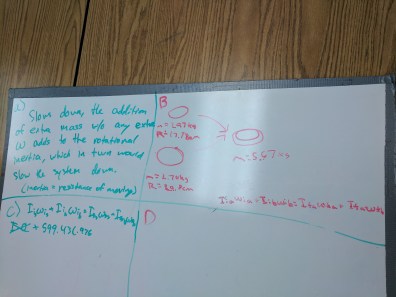
I tried a new lab practical for energy in an effort to integrate rotation and spiral back to some old ideas. Back in December, students measured the launch velocity of a marble, then predicted where it would hit the floor. Today, I had them use conservation of energy, including rotational kinetic energy, to find the launch velocity of their marble, then predict where it would hit the floor. I saw a lot of students pull out their old work, including their lab from December, to help remind themselves how to do the projectile portion of the problem, which is exactly what I hoped they would do. I overheard several students talking about how much they liked looking at an old problem through a new lens, as well as seeing how old ideas fit with the new ones.

practical.jpg

Physical Science: Explanations

Students practiced making predictions and writing explanations using Newton’s Laws. I showed students some videos and clips, including one from Smarter Every Day and an animation of the Mars Pathfinder landing, then had them write an explanation individually, followed by a revised explanation with their whole group. I was struggling more than usual to keep my students focused, but part of the problem might have been the English test next hour and the pep fest this afternoon. I’ve got some demos I’m planning to have students write explanations of as warm-ups, and I probably would have been better off using the demos today, then using the videos as warm-ups.

newton

Day 99: LOL Diagrams & Motion Detector

AP Physics: LOL Diagrams

Students went from bar charts to full LOL diagrams today. I am really coming to appreciate one of the worksheets from the Modeling Instruction curriculum that has students make LOL diagrams using several different systems for the same scenario, which really nicely illustrates why identifying your system matters. Students took to this easily enough that I think bar charts and LOL diagrams are a spot where I can pick up the pace a little next year.

lol

Physical Science: Motion Detector Lab

Students walked in front of the motion detector to reproduce the graphs they worked on Friday. Since we ran out of time on free fall day, I also showed a clip of Brian Cox when he visited a giant vacuum chamber to drop a bowling ball and feathers.


Day 98: Mistakes Game & Motion Detector Lab

AP Physics: Mistakes Game

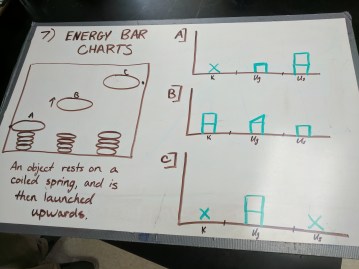
Students played the mistakes game with energy bar charts. My 2nd hour had a sub, so I’m not sure how things went. My meeting got done early, so I made it in time for my 4th hour class. This group is usually quieter during discussions, and they were much more nervous about doing the mistakes game without me since they were not confident they would get the right answers, but I was able to sit back while my students ran the show.

wb.jpg

Physical Science: Motion Detector Lab

Students worked on describing motion based on position vs. time graphs. On Monday, we’ll get out the motion detector to check their descriptions. They had a sub, so I’ll find out then how things went.

Day 96: Angular Momentum & Average Velocity

Today, I was chaperoning a field trip so I missed most of my classes.

AP Physics: Angular Momentum Quiz

Students took a quiz on angular momentum, then worked on finishing yesterday’s lab. One of the problems is based on a story that before jumping a motorcycle over the Snake River Canyon, Evel Knievel said his biggest fear was accidentally hitting the brakes in mid-air. I was back in time for 4th hour, so I showed students a demo of the problem using an RC motorcycle.

Physical Science: Average Velocity

Students worked on some problems interpreting position vs. time graphs. One of the questions asks them to invent average velocity by coming up with multiple ways to define the average velocity, then use each approach to make a prediction and decide which definition is the most useful.

Day 95: More Energy & Sledding Problem

AP Physics: More Energy

I split the class in half with some groups doing a lab for elastic energy and others doing a lab for kinetic energy. The groups looking at elastic energy looked for a relationship between how much a spring launcher is compressed and the maximum height above the table the launched cart reaches. The groups doing kinetic energy looked for a relationship between the starting height of a cart above the table and the speed at the bottom of the track.

phys lab.jpg

Physical Science: Sledding Problem

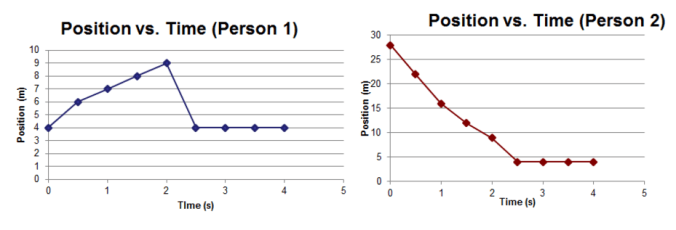
I gave students two position vs. time graphs that I said describe two people sledding, and had them do some interpretation. Students started by describing the motion of each sledder, then identifying where they collided. Finally, each group prepared a CER for who’s fault the collision is, which we then used for a short philosophical chairs where students made their case to the rest of the class. This lead nicely into a brief discussion of assumptions and they role they play in generating an explanation or a claim in science.

The sledding story made the coordinate system tricky for students. I wish I’d spent time discussing the descriptions of the motion so we could make sense of them moving in opposite directions.

sledding-graphs

Day 94: Intro to Energy & Motion Graphs

AP Physics: Intro to Energy

Students picked a height to raise their cart above the table, then made a rough force vs. displacement graph and repeated for additional angles. We compared the areas of the graphs, then defined that area as the change in gravitational potential energy. The biggest hangup is that students are so used to graphing their data that I have trouble getting across that I want a description of an individual run, instead. I might try some additional discussion prior to the lab next time.

As a side note, it was interesting to watch what looked like some gender dynamics in one of my classes. All but one of my all-male groups picked a fairly high point to raise their carts to, then used very steep angles, getting their tracks nearly vertical. The one all-female group in the class picked the lowest point they could, then did very shallow angles. I also had one mixed-gender group, and they picked both a height and angles right in the middle.


Physical Science: Motion Graphs

We finished whiteboarding results from the video analysis, following each up with a similar case on the motion detector. I should have broken up the discussion a bit more, which reinforces what I was already thinking about with going low-tech for constant velocity, then introducing video for constant acceleration. I also had students move away from their lab tables for the group discussion, and talked a bit about why I was doing it, and students were much more focused on the whole-class discussion this time.

Day 93: Whiteboards & More Whiteboards

AP Physics: Whiteboarding Angular Momentum

Thanks to a reminder from Dan Burns, I kicked class off with a clip from The Simpsons where Principal Skinner uses conservation of angular momentum to save Ralph. Afterwards, students whiteboarded and discussed yesterday’s problems. I focused on the conceptual problems, and I was pleased by how many students opted to use tools like SOS diagrams to guide their thinking, whether or not the problems asked for them. I also had some groups use analogies to linear momentum to answer questions since they found it easier to visualize. I got really excited when a couple of groups used Newton’s 3rd Law to solve one of the problems, though I didn’t think to take a photo of their boards.12th.jpg

Physical Science: Whiteboarding Motion Graphs

Students whiteboarded their video analysis results for constant velocity. This was the first time I’ve had them talking about graphs, and they made a lot of great observations. After the discussion, we used Logger Pro to look at a constant speed buggy in front of a motion detector and refine some some of the things we saw in the video analysis; after seeing me change the axes on the v vs. t graph from the motion detector, most groups looked at the scale on their v vs. t graphs and decided they should be horizontal lines. It was also fun to see the expressions on some faces when I found the slope of the buggy’s x vs. t graph and they saw it was the speed.

9th

Day 92: Angular Momentum & Motion Graphs

AP Physics: Angular Momentum

Students took a  quiz on conservation of momentum, then we finished yesterday’s discussion to introduce the idea of angular momentum. I showed them a Direct Measurement Video of two people on carts pushing off each other, followed by one of a rotating iPod to get a clear analogy for conservation of angular momentum. I think this would be worth taking the time to make a more student-centered discussion with students whiteboarding explanations next time around.ipod-rotates

Physical Science: Motion Graphs

Students used Vernier Video Physics to do some simple video analysis of a mini hover disk and start looking at position vs. time and velocity vs. time graphs. I had them stay in Video Physics to view the graphs, but students are struggling to make sense of their graphs for constant velocity with the auto scale. I’m debating how I want to change it for next year. I’m leaning towards spending 1-2 days doing constant velocity with a low-tech, breadcrumb approach. I’d probably have students calculate the speed over each interval to make a velocity vs. time graph. Then, we can switch over to video analysis for constant acceleration.

ramp