Day 48: Experimental Error & TIPERs Projectiles

Physical Science: Experimental Error

Students calculated the speed of sound based on the data they collected yesterday, then compared that to the expected result. Students found the speed using five different tuning forks, so we had some discussion about what it meant for those two different speeds to be close enough to be considered the same, which lead to some good conversation about experimental errors and why the values varied.

Physics: TIPERs Projectile Questions

I picked some questions out of TIPERs to help get my students thinking conceptually about projectiles. I was surprised at how many students struggled with a certain question where a ball is thrown upwards at two different speeds, and a student in the problem predicts that the faster projectile will reach the highest point first. Once I prompted students to sketch velocity vs. time graphs, the question ended up being pretty easy. It was a good reminder for my students to look at what tools they have, even when the problem isn’t about a calculation.

IMG_1405

The faster object reaches its highest point in more time!

Today’s quiz on projectiles launched horizontally also reminded me why I love standards-based grading. Several students have been really working on solving problems with constant velocity and constant acceleration, and finally showed mastery when they applied those skills to projectiles today. I loved being able to give them credit for all the skills they showed, not just the big idea on today’s quiz.
Day 47: Speed of Sound & Projectiles Practical

Physical Science: Speed of Sound

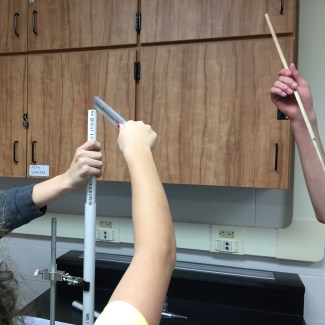
Students worked on the classic speed of sound lab using a closed resonance tube. Since this is one of the first labs my 9th graders do that has an accepted value, it provides a great opportunity for discussion on experimental error, which will happen once students finish the lab tomorrow.

IMG_1377

Physics: Projectiles Practical

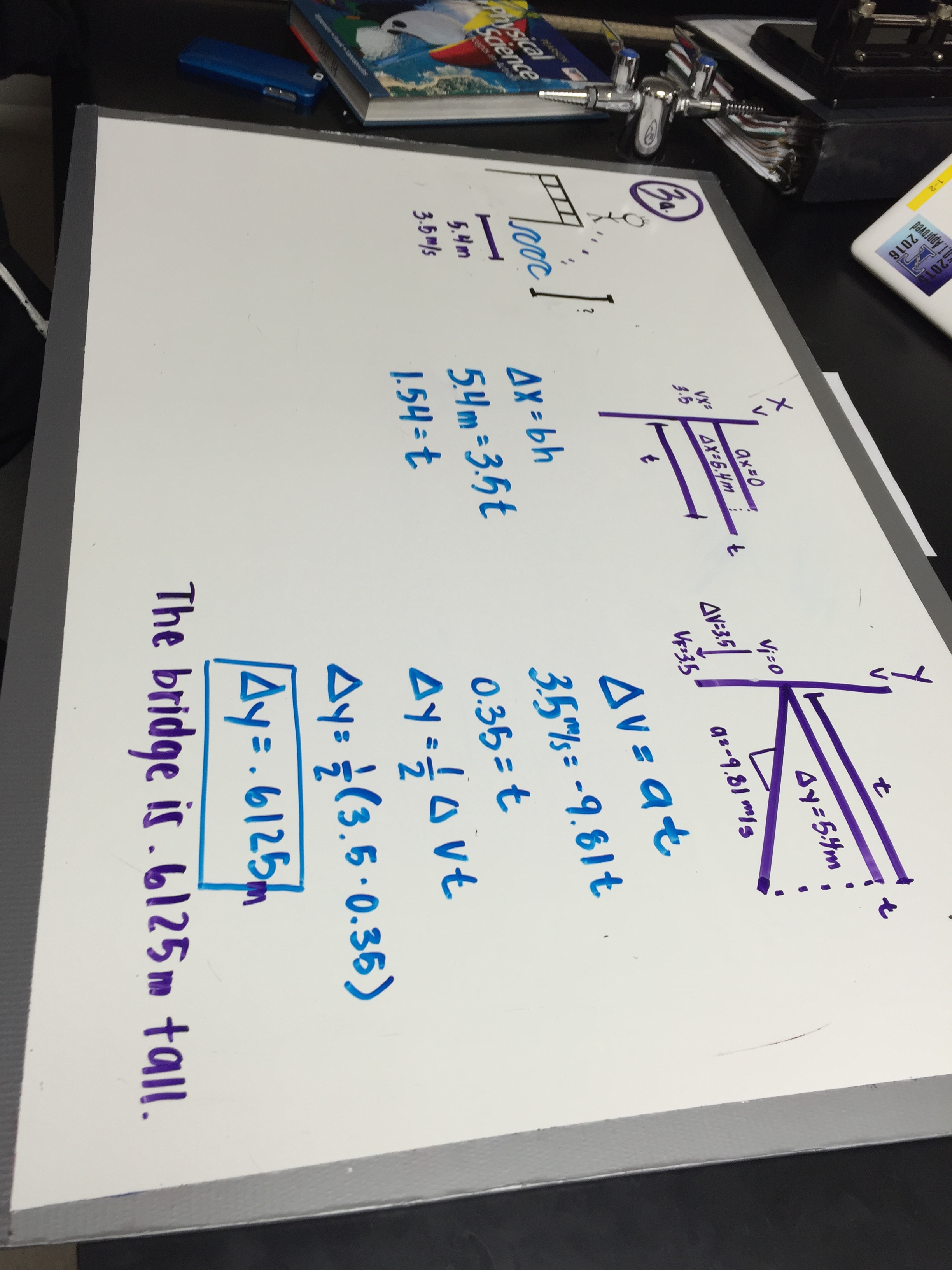
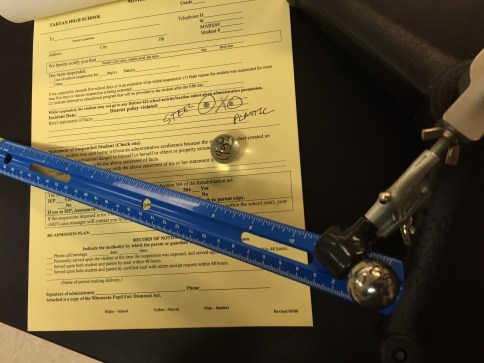
Students did a lab practical for projectile motion where they had to predict where on the ground a marble would land after being sent down a short ramp. In the past, I’ve used a cup, but most students hit the side rather than landing in it, so this year I used the school’s retired referral forms as carbon paper. I also pulled a jerk physics teacher move. After students got a successful prediction, I gave them a marble with a different mass and had them predict where the new marble would land without allowing them to make any new measurements. Most groups had to wrestle with it for a while and even try some calculations before realizing it should land in the same spot. I decided I need to keep this extra challenge in the practical when one student victoriously declared “Misconception changed!” after hitting their prediction with the new mass.

IMG_1393

Day 46: Standing Waves & Mistakes Game

Physical Science: Standing Waves

Students made standing waves on snakey springs and looked for the pattern in how many wavelengths could fit. The lab went a lot faster than I expected, so we also had some qualitative discussion about “Keep in Time” from Direct Measurement Videos to introduce the idea that sound has a speed.

IMG_1368

Physics: Mistakes Game

Students whiteboarded yesterday’s problems for Kelly O’Shea’s Mistakes Game. Students are getting better at making meaningful mistakes and at asking good questions to reveal those mistakes.

IMG_1370 (1)

Day 45: Exploring Sound & Projectile Calculations

Physical Science: Exploring Sound

Students did a lab to start exploring some of the properties of sound waves. They were very impressed by the tuning forks and a lot of groups went beyond the questions I’d posed and came up with more things to explore. One thing that drives a lot of people nuts about 9th graders is their lack of inhibitions, but I’ve come to love that uninhibitedness in this class because it means they don’t hesitate to share their excitement over an interesting observation, ask a crazy question, or do an extra experiment.

IMG_1365

Physics: Projectile Calculations

Now that students know what the velocity vs. time graphs look like for a projectile, they dove into some problems. I’m continuing having them use graphical solutions a’la Kelly O’Shea where students solve from velocity vs. time graphs, rather than getting the kinematic equations. Compared to when I’ve given students the equations, students are much more aware of how projectile motion connects to the earlier constant velocity and constant acceleration models, and therefore less freaked out by motion in two dimensions.

Day 44: Introducing Sound & Video Analysis

I was out for a field trip today, so no photos.

Physical Science: Introducing Sound

Students did some reading on sound waves today and started connecting it to what they’ve learned so far about waves in general.

Physics: Projectile Video Analysis

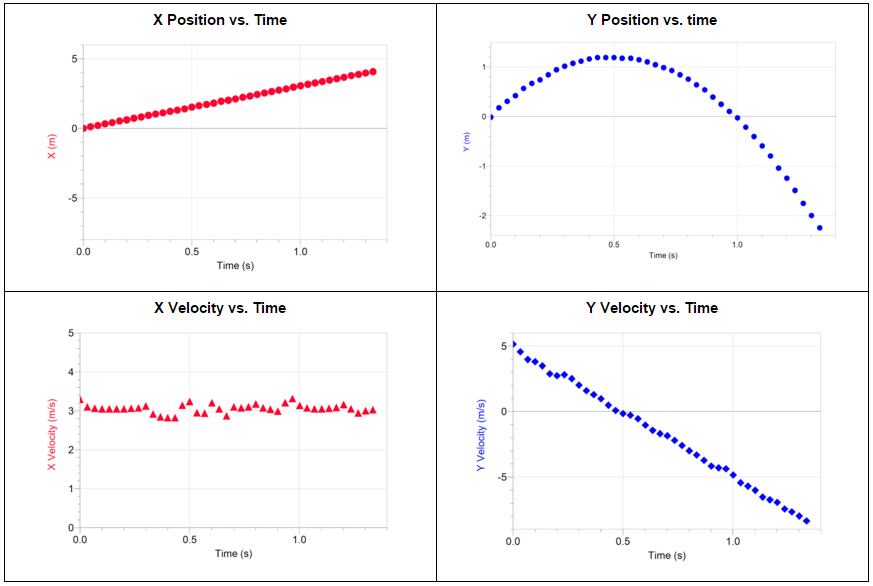
Students recorded videos of projectiles being thrown at different angles, then did some video analysis to see how that affects how high and how far the projectile travels.

Day 43: Snakey Springs & Video Analysis

Physical Science: Snakey Springs

After getting a few vocabulary terms for waves, students got out the snakey springs to start looking for qualitative relationships between wavelength, frequency, and amplitude. I was surprised at how impressed students were when they realized a wave reflects off the end of the snakey spring; as I make the course more inquiry based, I’m reminded how easy it is to assume students have certain experiences or background knowledge they just don’t have.

IMG_1350

Physics: Video Analysis

Our awesome tech guy got Logger Pro working on the netbook cart, so today I introduced students to doing video analysis. As a class, we walked through analyzing a video of a tennis ball tossed straight up in the air so students would have some idea of what the results should look like. Tomorrow, they’ll record and analyze their own videos.

Day 42: Energy Position Project & Projectile Motion

Physical Science: Energy Position Project

Students started a research project on different energy sources. As part of the project, students have to develop a support an opinion on their energy source. At the end of next week, students will give a presentation to the rest of the class on their energy source.

Physics: Projectile Motion

We finally got Logger Pro installed on a netbook cart for students to use, so I had grand plans of teaching my students to use Logger Pro’s video analysis so they could generate position vs. time and velocity vs. time graphs of videos they’d recorded. But I made the mistake of not testing the netbooks before class and found out the hard way that, while everything works just fine on the school’s desktop computers, our netbooks use an old version of Quicktime, which means no viewing videos in Logger Pro.

In my second hour, I had students record some video tossing softballs and tennis balls at different angles. For my fourth hour, I used my prep to do some analysis of one of Vernier’s sample videos and gave my students the graphs and some conceptual questions. Our tech guy spent the afternoon updating Quicktime on the netbook cart, so I’ll probably have my students do some video analysis tomorrow.

Projectile Graphs

Day 23: Design Testing & Free Fall Practical

Physical Science: Design Testing

Today, all of my students were early and anxious for class to start. They knew that we’d be loading up their designs with eggs, then sending them down ramps to see how they did. At the end of the hour, we had a brief, but good, discussion about what it could mean to have the “best” design and the limits of the single test we used. This discussion will provide some good groundwork for our second round of designing and building.

Physics: Free Fall Practical

Students had two tasks today. For both tasks, I assigned students roles from the University of Minnesota’s cooperative group problem-solving process. First, they did a practical on free fall. Each group was given a time, and had to place tape on a strip of acrylic so that a photogate would measure the time they drew when they dropped their acrylic.

One group's solution to the practical

One group’s solution to the practical

Once groups had tested their result, they worked on XKCD’s Substitute Problem. While most groups decided to chug through the algebra, there was one that used Desmos to find the intersection of the position vs. time graphs.

One group's solution to the sub problem

One group’s solution to the sub problem

Day 22: Building & Speed Dating

Physical Science: Building

Students worked on constructing their prototypes for the design challenge. As they worked, I visited each group to ask a random student to explain their design, especially the reasoning in their decisions. Students did a nice job of connecting their decisions to their knowledge of Newton’s Laws and energy. They also did a nice job of trying to anticipate the needs of our imaginary customer.


Physics: Speed Dating

I gave students use Kelly O’Shea’s whiteboard speed dating to tackle a goalless free fall problem. My PLC is working on how to develop our students’ mathematical communication, so I was thrilled to see the strides my students made once they knew a peer would have to follow their work. Students were also very positive and left class much more confident.

Day 21: Designing & Free Fall

Physical Science: Initial Designs

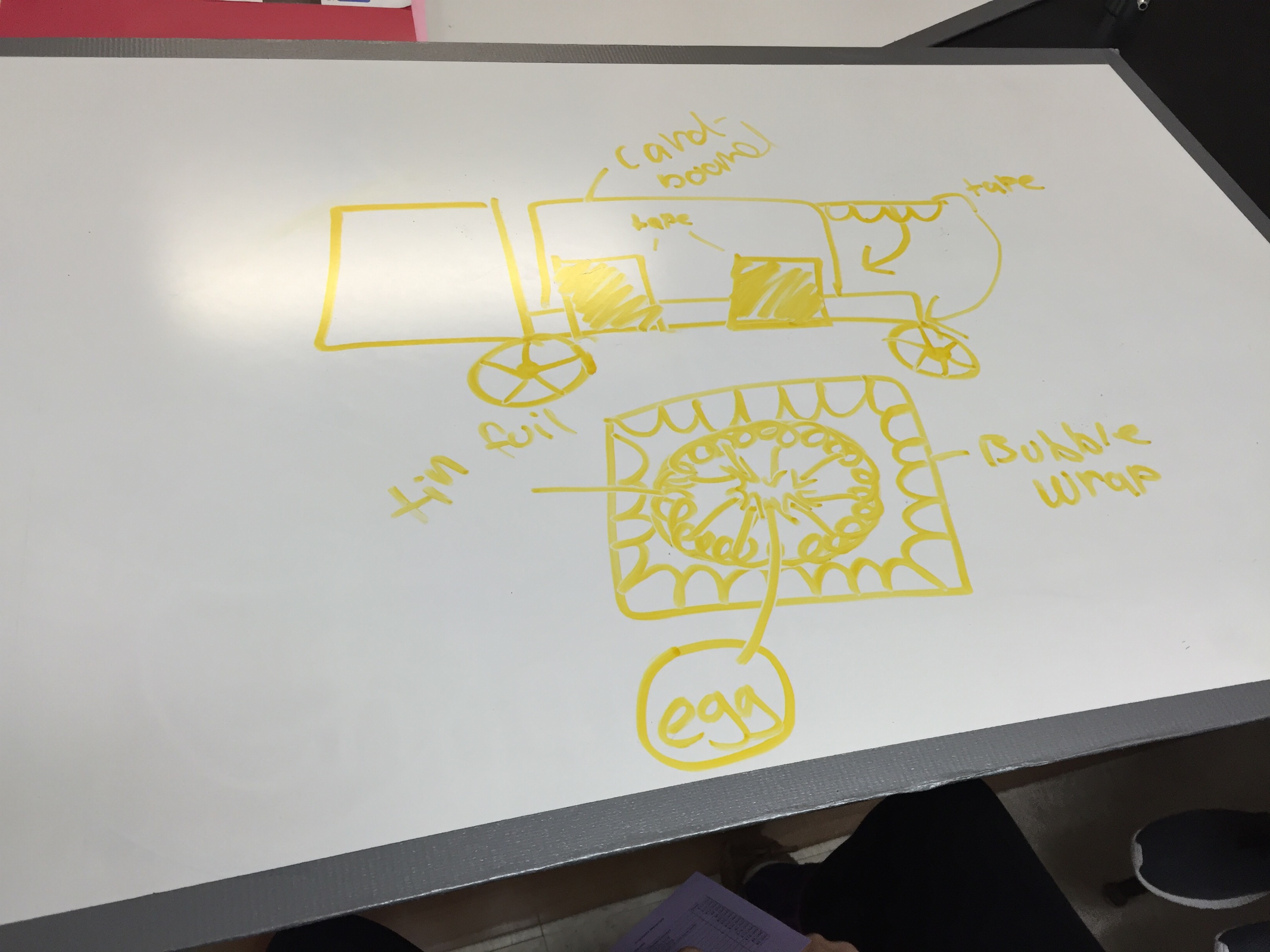
Now that students have a basic knowledge of Newton’s 1st and 2nd Laws, they went to the drawing board to develop ideas for a design challenge where they’ll need to keep an egg safe in a head-on collision. Students had to include a justification, based on Newton’s Laws, for why they think their design will work, which lead to some good debate and physics talk within groups.


Physics: Free Fall

Students worked on some free fall calculations in groups. They are gradually getting better at using velocity vs. time graphs as problem solving tools. One of my favorite moments was when a student, who had just spent around 30 minutes working through the first problem, read the second and declared it exactly the same, in spite of some superficial differences that usually confuse students.  When I asked what she meant, the student explained how she knew the same model would apply and proceeded to point out all the underlying physics that stayed the same as a result. She was thinking like a scientist and didn’t even realize it!