Day 2: Buggies & Coriolis Lab

Day 2 and I already forgot to take photos!

AP Physics: Buggies

We finished collecting data and graphing in the buggy lab. Every group produced two graphs: one with a full-speed buggy moving forward from 0; one with some other set-up. When I gave some groups half-speed buggies, I was pleased to see their first instinct was to make some observations before collecting any data. Here’s some of the things they noticed besides the speed:

  • “This one doesn’t light up.”
  • “This one is a lot quieter than the first one.”
  • “The wheels turn a lot slower on this one.”

Earth Science: Coriolis Lab

Students finished making observations on the Coriolis Effect lab, then wrote some rules to describe an object on a spinning surface. We also talked a little about the underlying skills, namely making observations and looking for patters to make a rule.

Day 1: Buggies & Coriolis

AP Physics: Buggies

Students started collecting data on the buggy lab today. Some groups ended up collecting several trials of the buggy traveling for the same amount of time, so their graph would only have one point. I’ll need to clarify that tomorrow.

img_2149

Science 9: Coriolis Effect

Students got into the lab long enough to start predicting the path of a marble on a spinning table. Tomorrow, we’ll actually use the tables to see what happens.

Day 80: Projectile Launchers & Return to Stoich

Physics: Projectile Launchers

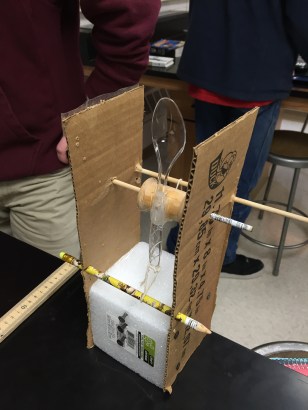
Students tested the final versions of their projectile launchers today. I picked random target distances in three different ranges, and groups had to pick one target to try and hit. I really enjoyed seeing the creativity in the materials students used. On group built a basic launcher out of K’Nex and decided to take a slushie break as they tried to come up with something to hold the ping pong ball, only to realize the lids from their slushies were the perfect size and shape. They also decided an adjustable height would make it easier to hit the target and came up with attaching the launcher to a music stand.

While students applied a lot of good data analysis to the project, the connections to energy and projectile motion weren’t as strong as I’d like, which I think has a lot to do with the way I broke up the project. I tried to squeeze energy into the two weeks between the start of tri 2 and winter break, and the project ended up bleeding into electrostatics. Next year, I may try starting the project with projectile motion, then working the redesign into the energy unit. There will be some administrative challenges, since the project will be split across two terms and a lot of students switch class periods, but I think it will pay off with students seeing a stronger connection to the physics content.
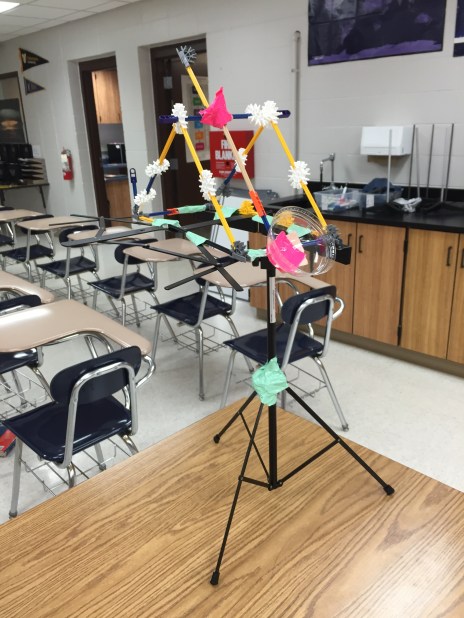
IMG_1595

Music stand, K’Nex, and a slushie lid

Chemistry: Return to Stoich

The next unit covers percent yield and limiting reagents, but scores were low enough on the assessment I gave before winter break that I want to revisit stoichiometry before we try any percent yield problems. Today, students started a lab to predict masses for an imaginary reaction using nuts, bolts, and washers in place of actual atoms. I wanted to give them something they could manipulate and measure very directly to get some conceptual understanding of stoich before we try any more problems. I wrote the lab with the intention of helping students work piece by piece through the process and questions frequently rely on information from a previous answer. A few groups, I think in an effort to be collaborative, tried to divide and conquer, and the students working on the later portions of the lab found they were stuck. Before we finish the lab next week, I’m planning to have a conversation with them about the shortfalls of the divide and conquer strategy and to come up with some more effective collaboration strategies.

IMG_1599

Day 70: Projectile Launchers & Reaction Types

Physics: Projectile Launchers

After a quiz, students continued to work on testing and refining their projectile launchers. In spite of the fact that its the last day before break, both of my classes were focused and working right up until the bell!IMG_1552

Chemistry: Reaction Types

After a quiz on molar mass, students did a jigsaw on the types of chemical reactions. Each group used the textbook to make a whiteboard with some key points about their reaction type, then students used the whiteboards to make themselves a quick reference on the reaction types.

Day 69: Projectile Launchers & More Stoich

Physics: Projectile Launchers

Instead of writing a lab report on an energy lab, I’m having students build projectile launchers that convert gravitational potential energy into kinetic energy. Today, students brought in their prototypes and had some time to test how well their prototype worked, as well as collect data on how at least two different variables affect the range of their launcher. When we do the final tests of the launchers, groups will need to hit a target at a randomly selected distance, though groups can chose between a small, medium, and long range. The launchers ranged from very simple, like a paper ramp with a meter stick spine, to more complicated, like the full-blown trebucet.

Chemistry: More Stoich

My plan had been to give students 15 minutes or so to work on the last two problems from Friday’s worksheet, then have them write an example problem where they would include a written description of the steps along with their work, but nearly all of my students needed the whole hour to finish Friday’s problems. Most of them were really focused on the steps they needed to follow and, not surprisingly, students are overwhelmed by how many steps there are and losing track of a lot of details. Next time, I need to start with some activities to help students to better connect the concepts to the process. I might do something with the nuts, bolts, and washers I used to introduce molar mass to make things more concrete at the start.

Day 53: Reflection & Projectiles Practical

Physical Science: Reflection

Students used reflectors (like this one) to explore reflection. I gave them some very general questions and directed them to collect evidence that would allow them to answer the questions. Students had some trouble getting started, but did a nice job overall.

Physics: Projectile Practical

Yesterday, each group was given a distance from a projectile launcher and had to calculate how high above the ground the projectile should be. Today, students placed embroidery hoops at their predicted height and we fired the launcher.

nofaces

Day 52: Color & Projectile Practical

Physical Science: Color

Students used colored filters, felt, and light sources to find patterns in what determines what color they see. By the end of the hour, students were able to use what they saw in the lab to accurately explain their observations in the filters puzzle video.

IMG_1435

Physics: Projectiles Practical

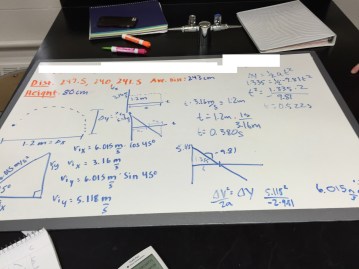
Students began a lab practical for projectile motion. First, we fired a projectile launcher horizontally and measured the range and starting height to determine the launch speed. Then, each group got a different distance from the launcher and calculated how high off the ground the projectile will be at that point if the launcher is fired at an angle of 45 degrees. Tomorrow, each group will place an embroidery hoop at their given distance and calculated height.

IMG_1445

Day 51: Color Intro & Collaborative Problem Solving

Physical Science: Color Intro

For the first half of the period today, my students presented their research projects on different energy sources. Once that was finished, we started on color. I started by having students watch a short video that I blatantly copied from Frank Noschese that shows red ink and red light through both red and blue filters. I like the video because I can show all my students at once and I like having my own version so students can look at the clock and paper I used in the video to verify I wasn’t using some kind of trickery. I asked students to record their observations from the video, then try to come up with a hypothesis to explain their observations. This lead nicely into a lab where students look at things through filter paddles. Once students finish the lab, we’ll revisit the video to see how their explanation has changed.

Physics: Collaborative Problem Solving

I took a problem from Casey Rutherford’s projectile motion packet about a block given a push up a ramp with friction, then allowed to fly off the end of the ramp to become a projectile. One of the things I love about this problem is it requires to students to use just about everything from the trimester. 2nd hour, students did whiteboard speed dating, but I put a couple of goal-less problems first so students didn’t have much time to work on it, but were intrigued enough by the problem that they asked to continue next week. 4th hour, I decided to start with that problem. I had students work in groups using the roles from the University of Minnesota’s Cooperative Group Problem Solving protocol. It took most of the hour, but students were consistently successful and even my top students were challenged. It was great to see the obvious pride when students finally got the correct answer.

IMG_1421

Day 50: EM Spectrum & Projectiles

Physical Science: EM Spectrum

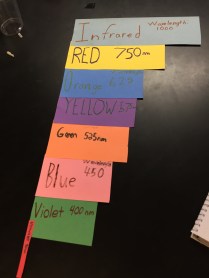
Students made a scale model of infrared through ultraviolet light where the length of the paper represented the wavelength of each type of light. I also had students do the calculations for how long a strip of paper would be needed to represent some other EM waves, including radio waves and gamma rays, just to give them a sense of the range the EM spectrum covers.

IMG_1415

One group decided to turn their model into a Stroop test

Physics: Projectile Problems

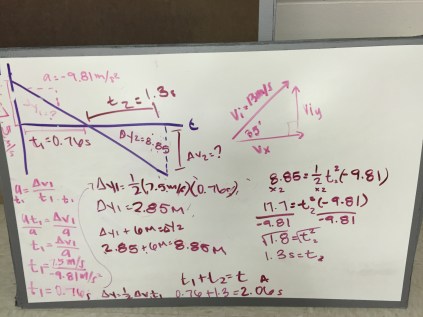
Students whiteboarded yesterday’s projectile problems. I’m really pleased by the way my students are not only solving the problems successfully, but gaining confidence on some challenging material.

IMG_1417

Day 49: Light Intro & Projectile Problems

Physical Science: Light Intro

After a short quiz on sound and some discussion over final exams, I did some notes to define the term “electromagnetic spectrum”, reviewed scientific notation, and gave students the speed of light. The class was really fascinated by the speed of light and were eager to spend some time throwing out questions about the implications of light having a speed like “Does that mean some of the stars we see are already dead?” I gave the class some room to discuss what they thought about these questions, which prompted even more questions, which was great! The discussion went long enough that the students didn’t get to the lab, but I was okay with it since students were doing a lot of great thinking.

Physics: Projectile Problems

Students worked on calculations for projectiles launched at angles.I’m still having students use velocity vs. time graphs, rather than the standard equations, and students did really well with some challenging problems today. Tomorrow, we’ll whiteboard the problems.

IMG_1411