Day 55: Toilet Paper Drop & Galaxy Sorting

AP Physics: Toilet Paper

Students started a lab practical I got from Frank Noschese’s blog. Students were given a height they will drop one toilet paper roll from and are tasked with figuring out where to drop an unrolling toilet paper roll so it hits the ground at the same time. I’m trying to emphasize the ways that students are using forces and constant acceleration in the practical to make sure this is doubling as a review for the final exam.

tp

Earth Science: Galaxy Sorting

Students were given pictures of a dozen galaxies and tasked with putting them into categories and naming each category. Most groups came up with something pretty close to the three official categories. I can’t decide if I’m happy about that. On the upside, my students are very comfortable with the vocabulary. On the downside, the fact that so many groups got similar results tells me there was limited thinking required.
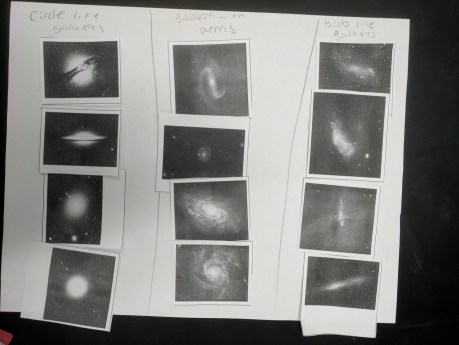
galaxy-sort

Day 22: Wrap-Up & Review

AP Physics: Lots of Wrap-Up

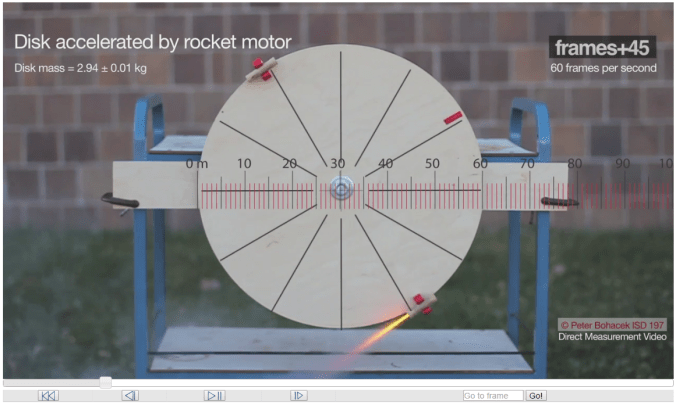
Today was a lot of wrapping things up. We started by whiteboarding both the accelerated disk and free fall Direct Measurement Videos with some brief discussions about each. At this point, I was just trying to get students to recognize the parallels between angular acceleration and linear acceleration, so that didn’t feel too rushed. The discussion on free fall did skip over some important points, so I’ll be revisiting that topic next week. This is the first year I’ve included uncertainty in my class, and I could tell during the discussion that my students are starting to internalize those concepts, which added some nice layers to the discussion.

We also took some time to try and finish the lab practical we started Monday. Students are rolling a steel marble down a ramp with the goal of landing it in a tumble buggy driving by. Today, I threw them for a loop by adding that they need to pull off the same thing with glass and acrylic marbles, but the only new measurements they can take are mass. With the time for discussions, only a few groups got to test, so I’ll be making some adjustments next week to make sure students have a chance to finish.


Earth Science: Review

Students have another quiz tomorrow, so I repeated my review activity from last time. Students worked in groups to write a few questions for each learning target, then periodically traded whiteboards with another table to try and answer another group’s questions. This time, students were coming up with some deeper questions, which was great to see.

Day 21: Angular Acceleration & Satellite Data

AP Physics: Angular Acceleration

This year, I’m embedding circular motion concepts as we wrap up their linear motion analogues, so today students took their first look at angular acceleration. Students used a Direct Measurement Video to plot angle vs. time for a disk with a rocket motor attached. Students were quick to notice their graph looked a lot like position vs. time for an object with linear acceleration, and were able to extrapolate a lot from there.

rotating disk.PNG

Earth Science: Satellite Data

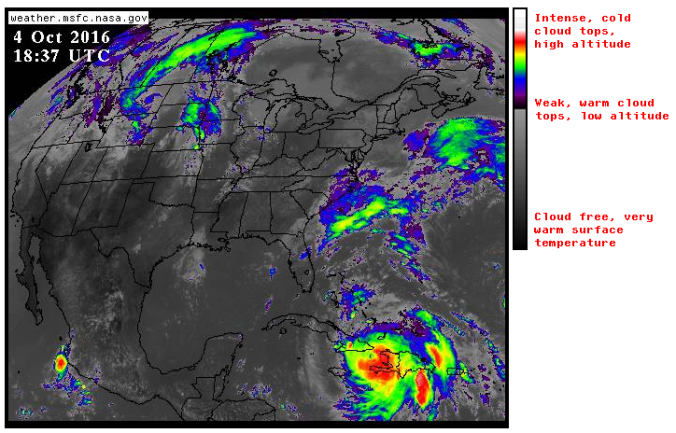
Students looked at some images of cloud cover produced by NASA’s GOES satellite to make some claims about the cloud cover and associated weather in a few areas of North America. I didn’t use my evidence-based reasoning graphic organizer today, and I don’t think its a coincidence that many students just stated their claims without any evidence. I need to keep being explicit about what good reasoning looks like and stay on students to keep including that in answers.

goes-infrared

Day 20: Lab Practical & Clouds

AP Physics: Lab Practical

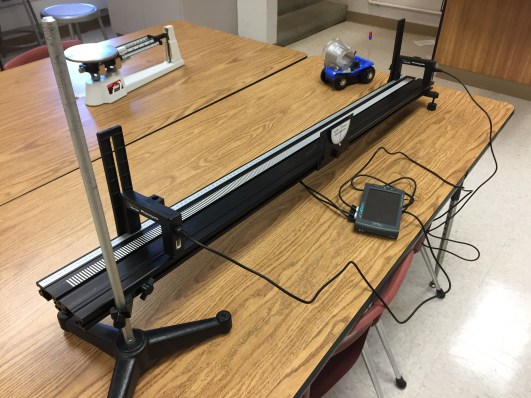
We started working on a constant acceleration lab practical today. A marble will roll down a track while a constant speed buggy drives past. Given the starting point of one, students need to find the starting position of the other such that the marble will land in a cup taped to the buggy. I had a couple of administrative things to deal with at the start of class, so we only got to collect the data students need to complete the calculation. I’ve got a computer lab reserved tomorrow, so we’ll test their calculations on Wednesday.

img_2265

Earth Science: Clouds

Students were introduced to the different types of clouds today. I added some questions to focus on patterns in the names of the cloud types. Students were pretty successful at picking out the key roots and prefixes that show up in cloud names and reasoning out what they must mean.

Day 19: Free Fall & Humidity

AP Physics: Free Fall

Students worked on plotting position vs. time using a Direct Measurement Video of five different spheres in free fall. This is the first year I’ve had students use uncertainty, and I’m finding I really like how it shapes conversations. A lot of students were looking for specific times in the video, then estimating the position of the sphere at those times, but a quick conversation about the large uncertainty that produces in position quickly got them to see the value in switching their approach.

five objects.PNG

Earth Science: Humidity Analogy

Students worked through some questions using beakers of water as an analogy for air at different temperatures and how that impacts humidity. It was pretty tricky for many students to predict what should happen to the water level when a given amount was moved to a larger or smaller beaker, so I think I’d like to get out actual beakers and water the next time I do this activity to make it a little more concrete. They did seem to get the analogy and were able to make some good predictions about humidity and dew points by the end of the hour.

Day 18: Group Roles & Relative Humidity

AP Physics: Group Roles

I assigned students to groups for the day, rather than letting them choose their usual groups, to get them talking to some new people. To help with that, I randomly assigned them to roles I borrowed from the University of Minnesota’s Physics Education Research group. We also talked a little about some of the ways race and gender affect group dynamics, and how group roles can be a way to combat that. In their groups, students whiteboarded their solution to yesterday’s Equation Jeopardy problem, which lead to some great discussions about the physical meaning of terms in the equation. Afterwards, I tasked each group with finding at least two different solutions to the XKCD substitute problem. A few students grumbled that finding two solutions meant they had to try something besides their preferred approach, but also realized that was probably the point 🙂


Earth Science: Relative Humidity

Students used hygrometers to measure the relative humidity of the classroom, then spent some time looking for patterns in the chart used for reading a hygrometer to look for patterns. Once they were looking for those patterns, my students were more off-task than usual. I think part of the problem is they were having more trouble than I expected interpreting the chart, but I also think I need to revisit expectations for when students are in the lab.

Day 17: Assessment Reflection & Movie Day

I’m spending the day at a district strategic planning session, so my students have a sub.

AP Physics: Quiz & Problems

Students took their quiz on constant acceleration. Our math teachers have been integrating reflection into their assessments and seeing some good things as a result, so I decided to steal the idea. On the first quiz, most students rated themselves lower than the score I gave, so it will be interesting to see what happens this time. After the quiz, students tackled some acceleration problems using graphical solutions, including a goal-less problem and what Etkina calls Equation Jeopardy, where students are given an equation, and have to come up with a scenario that fits.img_2249

Earth Science: Movie Day

The curriculum in my building calls for a video on Mt. Everest as part of the unit on the atmosphere, which is a perfect fit for a sub day.

Day 16: Annotating Graphs & Solar Collectors

AP Physics: Annotating Graphs

The bulk of the class period was spent annotating velocity time graphs and writing equations based on them. I’ve become a big fan of graphical problem solving, but find students need some practice just going from a graph to equations before they’re ready to go from word problem to graph to equations. For the first time, I had some students who really wanted to stick with x, y, and m as variables, rather than using the physics terms. Once we spent a few minutes really talking about the physical meaning of the graph characteristics, they were more willing to budge. Next time I introduce annotating, I need to do a better job of emphasizing the meaning up front.

img_2245

Earth Science: Testing Solar Collectors

Students tested their solar collectors by measuring the temperature change in front of a lamp. Several groups had pretty small temperature changes, so I need to consider either having students place their collectors closer to the lamp or doing a test longer than the 5 minutes I used today. I had them connect back to the science one more time by proposing some ways to improve their design and justifying their proposal with some science.

img_2241


Day 15: Mistakes Game & Solar Collectors

AP Physics: Mistakes Game

We played the mistakes game using problems translating between representations for constant acceleration. While I didn’t have to say much and there were some great questions asked, it ended up being a few people in each section who asked most of the questions. The students are pretty good about trying to call on new people, but I want to think about how to encourage more people to raise their hands or offer something during those discussions.

img_2236

Earth Science: Solar Collectors

To apply what students learned this week, they started a short engineering design challenge to design solar collectors. I had them start by coming up with some ideas individually, then working as a group on a whiteboard to come up with a group design. At both stages, I had students fill out an evidence-based reasoning template my team developed at EngrTEAMS a few years ago to scaffold them to make connections between the science and their ideas.


Day 14: Board Meeting & CER

AP Physics: Board Meeting

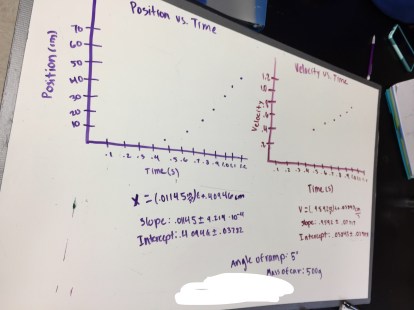
We had our board meeting on the ramp lab. This time, I had students do a gallery walk of the whiteboards prior to the discussion to give them a chance to take a close look at all of the whiteboards. That preview gave students the opportunity to make some more detailed observations, which added nicely to the discussion.

img_2232

Earth Science: Writing CERs

Both Wednesday and Thursday, we ran out of time to do any wrap-up on the labs, so that was our focus today. Students wrote CERs for both of the labs. This was a good opportunity to think about what makes good reasoning, since we were using lamps, beakers, sand, and thermometers to make statements about Earth’s atmosphere.