Day 98: Mistakes Game & Motion Detector Lab

AP Physics: Mistakes Game

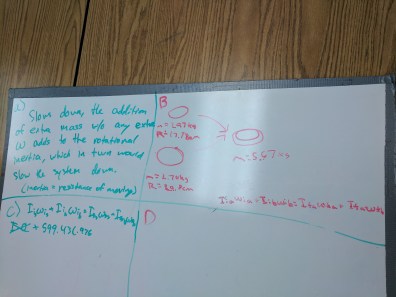
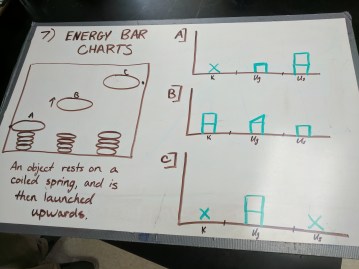
Students played the mistakes game with energy bar charts. My 2nd hour had a sub, so I’m not sure how things went. My meeting got done early, so I made it in time for my 4th hour class. This group is usually quieter during discussions, and they were much more nervous about doing the mistakes game without me since they were not confident they would get the right answers, but I was able to sit back while my students ran the show.

wb.jpg

Physical Science: Motion Detector Lab

Students worked on describing motion based on position vs. time graphs. On Monday, we’ll get out the motion detector to check their descriptions. They had a sub, so I’ll find out then how things went.

Day 97: Energy & Free Fall

AP Physics: Energy

We had a board meeting on the two energy labs from this week. The kinetic energy groups tended to get very nice results; I had them check their model with multiple cart masses and ramp angles, and they saw the results were consistent. I had the elastic energy groups use multiple springs, but they didn’t see as clear a difference between the slopes as I would have liked. I’m wondering if the results would be less muddy if I had them plot gravitational potential energy on one axis rather than just plotting height. I shortchanged some of the pre-lab discussion, and I think that lead to students forgetting to do things like measure the cart’s starting height or measure both the starting and ending height from the same end of the cart.
kinetic.jpg

Physical Science: Free Fall

I got out washers, manila folders, and a few other things and tasked students with determining what affects the time an object takes to fall. In the pre-lab discussion, a student suggested the fluid an object falls through could affect the time, so next year I might make sure I have graduated cylinders and some different liquids available. I offered to grab materials if a group wanted to try that, but I think asking me to get stuff felt like an extra hurdle.

free-fall

Day 96: Angular Momentum & Average Velocity

Today, I was chaperoning a field trip so I missed most of my classes.

AP Physics: Angular Momentum Quiz

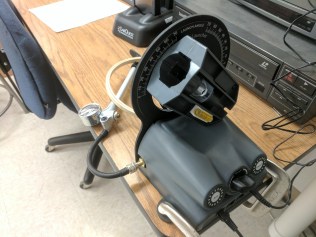
Students took a quiz on angular momentum, then worked on finishing yesterday’s lab. One of the problems is based on a story that before jumping a motorcycle over the Snake River Canyon, Evel Knievel said his biggest fear was accidentally hitting the brakes in mid-air. I was back in time for 4th hour, so I showed students a demo of the problem using an RC motorcycle.

Physical Science: Average Velocity

Students worked on some problems interpreting position vs. time graphs. One of the questions asks them to invent average velocity by coming up with multiple ways to define the average velocity, then use each approach to make a prediction and decide which definition is the most useful.

Day 95: More Energy & Sledding Problem

AP Physics: More Energy

I split the class in half with some groups doing a lab for elastic energy and others doing a lab for kinetic energy. The groups looking at elastic energy looked for a relationship between how much a spring launcher is compressed and the maximum height above the table the launched cart reaches. The groups doing kinetic energy looked for a relationship between the starting height of a cart above the table and the speed at the bottom of the track.

phys lab.jpg

Physical Science: Sledding Problem

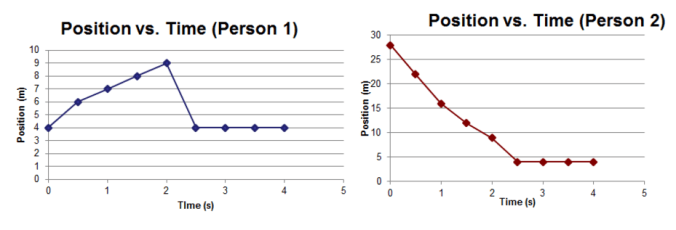
I gave students two position vs. time graphs that I said describe two people sledding, and had them do some interpretation. Students started by describing the motion of each sledder, then identifying where they collided. Finally, each group prepared a CER for who’s fault the collision is, which we then used for a short philosophical chairs where students made their case to the rest of the class. This lead nicely into a brief discussion of assumptions and they role they play in generating an explanation or a claim in science.

The sledding story made the coordinate system tricky for students. I wish I’d spent time discussing the descriptions of the motion so we could make sense of them moving in opposite directions.

sledding-graphs

Day 94: Intro to Energy & Motion Graphs

AP Physics: Intro to Energy

Students picked a height to raise their cart above the table, then made a rough force vs. displacement graph and repeated for additional angles. We compared the areas of the graphs, then defined that area as the change in gravitational potential energy. The biggest hangup is that students are so used to graphing their data that I have trouble getting across that I want a description of an individual run, instead. I might try some additional discussion prior to the lab next time.

As a side note, it was interesting to watch what looked like some gender dynamics in one of my classes. All but one of my all-male groups picked a fairly high point to raise their carts to, then used very steep angles, getting their tracks nearly vertical. The one all-female group in the class picked the lowest point they could, then did very shallow angles. I also had one mixed-gender group, and they picked both a height and angles right in the middle.


Physical Science: Motion Graphs

We finished whiteboarding results from the video analysis, following each up with a similar case on the motion detector. I should have broken up the discussion a bit more, which reinforces what I was already thinking about with going low-tech for constant velocity, then introducing video for constant acceleration. I also had students move away from their lab tables for the group discussion, and talked a bit about why I was doing it, and students were much more focused on the whole-class discussion this time.
Day 93: Whiteboards & More Whiteboards

AP Physics: Whiteboarding Angular Momentum

Thanks to a reminder from Dan Burns, I kicked class off with a clip from The Simpsons where Principal Skinner uses conservation of angular momentum to save Ralph. Afterwards, students whiteboarded and discussed yesterday’s problems. I focused on the conceptual problems, and I was pleased by how many students opted to use tools like SOS diagrams to guide their thinking, whether or not the problems asked for them. I also had some groups use analogies to linear momentum to answer questions since they found it easier to visualize. I got really excited when a couple of groups used Newton’s 3rd Law to solve one of the problems, though I didn’t think to take a photo of their boards.12th.jpg

Physical Science: Whiteboarding Motion Graphs

Students whiteboarded their video analysis results for constant velocity. This was the first time I’ve had them talking about graphs, and they made a lot of great observations. After the discussion, we used Logger Pro to look at a constant speed buggy in front of a motion detector and refine some some of the things we saw in the video analysis; after seeing me change the axes on the v vs. t graph from the motion detector, most groups looked at the scale on their v vs. t graphs and decided they should be horizontal lines. It was also fun to see the expressions on some faces when I found the slope of the buggy’s x vs. t graph and they saw it was the speed.

9th

Day 92: Angular Momentum & Motion Graphs

AP Physics: Angular Momentum

Students took a  quiz on conservation of momentum, then we finished yesterday’s discussion to introduce the idea of angular momentum. I showed them a Direct Measurement Video of two people on carts pushing off each other, followed by one of a rotating iPod to get a clear analogy for conservation of angular momentum. I think this would be worth taking the time to make a more student-centered discussion with students whiteboarding explanations next time around.ipod-rotates

Physical Science: Motion Graphs

Students used Vernier Video Physics to do some simple video analysis of a mini hover disk and start looking at position vs. time and velocity vs. time graphs. I had them stay in Video Physics to view the graphs, but students are struggling to make sense of their graphs for constant velocity with the auto scale. I’m debating how I want to change it for next year. I’m leaning towards spending 1-2 days doing constant velocity with a low-tech, breadcrumb approach. I’d probably have students calculate the speed over each interval to make a velocity vs. time graph. Then, we can switch over to video analysis for constant acceleration.

ramp

Day 79: Whiteboarding & Snakey Springs

I spaced out and didn’t take any pictures today.

AP Physics: Whiteboarding

Students worked on whiteboarding elements of the two problems they worked on yesterday. One of the problems involved a block that slides up a ramp and became a projectile; students were either nailing the projectile portion, or completely lost. With an AP test looming, I need to remember to keep spiraling those old concepts back.

Physical Science: Snakey Springs

Students made standing waves and looked for a pattern in how many wavelengths “fit” on the spring. I found a lot of groups missed some of the standing waves, so we made a list as a class of the number of wavelengths they could make a standing wave with and students quickly recognized the pattern.

We also talked a little bit about assessments. After the magnetism quiz yesterday, a lot of students told me they thought it hadn’t gone well, but the most vocal students had perfect scores and the class average was 85%. After talking to students, I think this is related to my challenges engaging students this tri. The earth science assessments they took 1st tri put a lot of emphasis on factual recall, so the reasoning questions I shoot for are big shift for students. I need to think about how I can make it less intimidating to face a new scenario and need to take some time to think on the test.

Day 70: Hoop Practical & Circuits

AP Physics: Hoop Practical

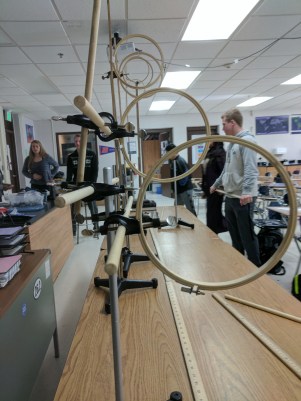
We finished up a lab practical on angled projectiles. Each group had a different distance from the launcher and figured out how high above the ground to place a hoop. In both classes, some groups had to shift their hoop to one side or the other, but eventually managed to get the projectile though all the hoops. I also had some goal-less problems to try and shift students away from needing to be able to picture the full solution to be able to progress. The problems mostly got ignored, because it was more exciting to watch the parabola of hoops come together and it took most of the hour to get all the hoops in place.practical

Physical Science: Series vs. Parallel Circuits

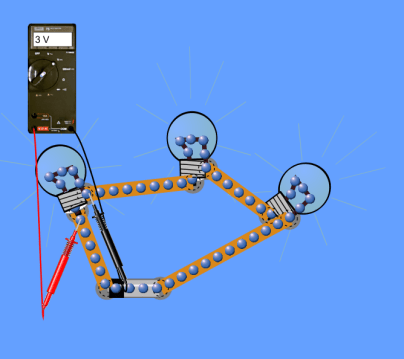
Students used the PhET circuit construction kit again, this time using a lab on series and parallel I modified from Eugenia Etkina’s PUM curriculum. I think students  were getting the big ideas, but its very tough to circulate with a full class in the computer lab, so I feel a little blind. Last year, I was able to do the PhET sims on netbooks in the classroom, so it was easy for me to listen i on student conversations and pull them together at the end of the hour to discuss some big ideas. Next year, I might re-work my calendar to make time for a day in the classroom so my students and I have a chance to make sure they are on track.

circuit

Day 69: Angled Projectile Practical & Ohm’s Law

AP Physics: Angled Projectile Practical

We wrapped up yesterday’s mistakes game, then started a lab practical. Each group got a different distance from the launcher, and needs to determine how high off the ground to place a hoop so that the projectile will travel through it. Tomorrow, we’ll setup the hoops so students can see the results. In both this practical and the problems we’ve been doing, I’ve found some of my strongest students get stuck. They usually know what they’re doing, but don’t see their way to the answer yet. I need to keep reminding my students that they can play with the pieces, even if they don’t know what the full picture will look like yet. I might look for a good goal-less problem to combine with the practical tomorrow to help push them towards thinking about what else they can do, rather than what the answer must be.

launcher

Physical Science: Ohm’s Law

I’ve found I really like having students use PhET’s circuit construction kit before we get out the batteries and bulbs, so today we went to the computer lab to find a relationship between current, voltage, and resistance. I left the directions fairly open so that students would be designing their own experiments. Since I don’t talk much about units in this course, the simulations ammeter felt like a black box to a lot of the students. I was really intrigued by one student who measured current by counting how many blue dots passed a selected point in one minute, which connects really nicely to the definition of current as the flow of electric charge.ohms-law