Day 3: Motion Detectors, Board Meeting, & Burning

AP Physics: Motion Detectors

This concept development sequence comes from conversations with Michael Lerner, Kelly O’Shea, and the rest of the Physics! PLC!

One of the tasks I gave students yesterday was to sketch a momentum vs. time graph for getting a bowling ball moving, then reversing its direction. There was a lot of disagreement about what that graph should look like, so today we had some brief discussion about how the momentum vs. time graph should compare to the velocity vs. time graph, then got out motion detectors and billiard balls to try some of yesterday’s tasks. The discussion afterward lead very nicely into the significance of a negative momentum, as well as the meaning of the slope on a momentum vs. time graph.
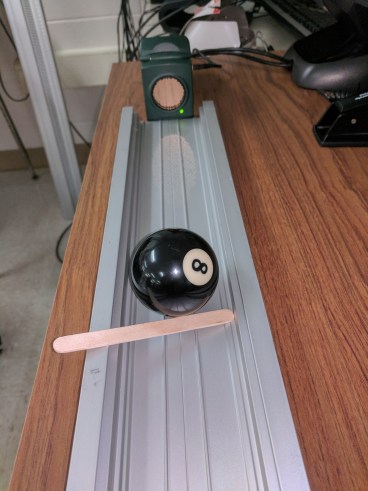
billiard.jpg

Physics: Board Meeting

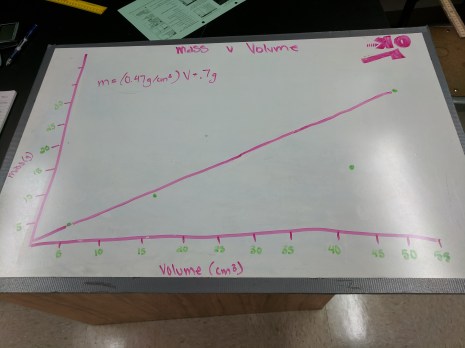
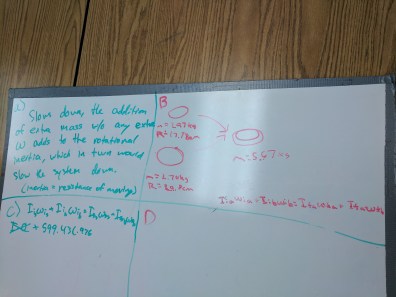
We had a board meeting for the dowel lab, following Casey Rutherford’s Observations, Claims, Evidence structure. Even though all of the dowels were made of the same material, slopes were all over the place, so we had some discussion about how to improve the results next time. A lot of groups just wrote down their calculated volume, rather than the values they measured, which made it difficult to check their calculations, so we discussed the value in recording the measured values.

hour 2 summary.jpg

Chem Essentials: Burning

We continued the mass and change experiments, which today included burning steel wool. I needed to do a better job of framing this lab as being about the mass of the steel wool. A lot of groups missed recording the initial mass before they lit the wool, which I could have addressed by checking they had that value before giving them any matches. I also saw a lot of groups blowing on their wool or tossing used matches onto the dish with their wool, which reinforces that they were not thinking about the mass as important here.
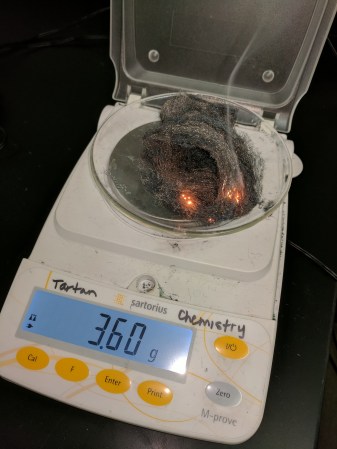
steel wool

Day 2: p vs. t Graphs, Graphing, & CER

AP Physics: p vs. t Graphs

This concept development sequence comes from conversations with Michael Lerner, Kelly O’Shea, and the rest of the Physics! PLC!

There was still some debate from yesterday about whether the bowling ball had a constant speed after a tap, so I pulled out the Motion Shot app to make a motion map. Afterwards, students did a variation on the bowling ball lab with combinations of taps to introduce momentum vs. time graphs. I picked a few scenarios to help them get the idea of negative values for force and momentum as well as some to get at the significance of a non-zero intercept on the graph.

Motion_Shot_2017_09_06_09_41_24

Physics: Graphing

Students worked on their graph for the dowel lab, then we talked about “translating” the equation for the line of best fit by adding units and variables appropriate to the quantities they graphed. Students seemed to do well wrapping their heads around that step. Tomorrow, I’m going to have them write the slope as a statement a la Arons.

I’m also thinking about repeating the data collection tomorrow. Students are getting a wide range of slopes and intercepts and, if we’re going to take the time for a unit on experimental design and graphing, I’d like to establish careful practices right off the bat.

Next year, it could be interesting to mess with the calibration of the triple beam balances to give a non-zero intercept. I’m not sure yet if I would do that immediately, or if I would do a second round of data collection with the balances off.

dowel lab

Chemistry Essentials: CER

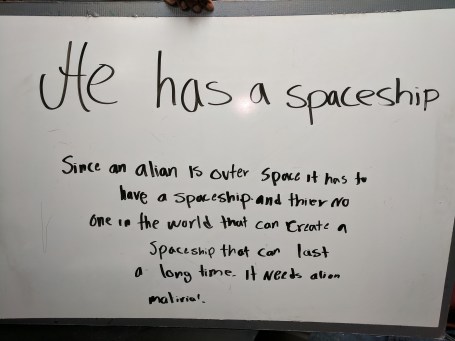
I put a CER at the end of yesterday’s lab, and students seemed pretty thrown by the reasoning piece. Today, I played the “My Dad’s an Alien” commercial and had students identify the kid’s claim and some of her evidence. Then, students got into their groups and had to fill in the reasoning for at least one piece of evidence. A lot of groups looked at why she might see something as evidence (like why the car seems like a spaceship), as well as why the evidence might support the claim. Yesterday, I felt like I was struggling to keep students on track, but today they were very engaged and even enthusiastic about the task. I think today I was much clearer about what they should be doing and what that looks like.

alien cer

Day 1: Bowling Balls, Dowels, & Steel Wool

The first day of school is in the books!

AP Physics: Bowling Balls

This concept development sequence comes from conversations with Michael Lerner, Kelly O’Shea, and the rest of the Physics! PLC!

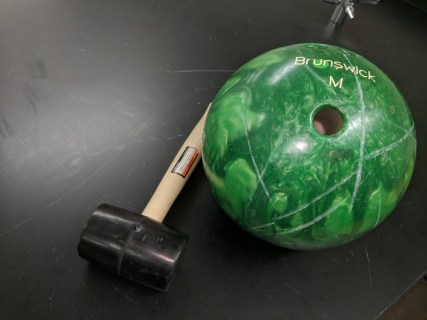
I’m starting the year with momentum, so the first idea I want students to build is the impulse-momentum theorem. Today, we started with a version of Frank Noschese’s bowling ball & mallets activity. For the first time, when I asked students to whiteboard the pattern or rule they’d found, I had multiple groups write out the classic wording of Newton’s 3rd Law. These groups struggled to connect their statement to the lab, but still resisted changing their whiteboard because they knew their statement was true. I think this happened because we don’t have the class culture yet for every student to feel comfortable taking an intellectual risk. Tomorrow, I want to spend some time on the difference between true statements and useful statements to push some of those students away from quoting textbooks.

bowling

Physics: Dowels

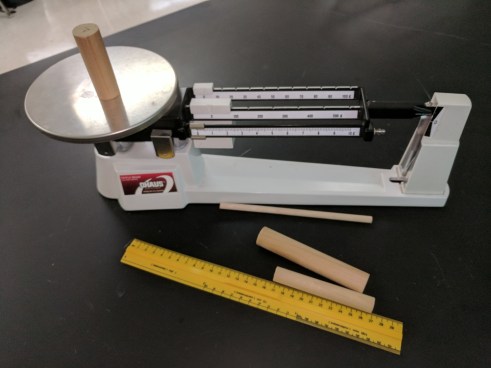
We’re starting the year with a unit on experimental design and graph interpretation based around a series of labs. For the first one, students are graphing mass vs. volume for some dowels. Things went well overall, but I should have spent a little more time on how to find the volume; I just told them to find it, and a lot of groups weren’t ready to make that leap on their own the first day of school.

dowel

Chemistry Essentials: Steel Wool

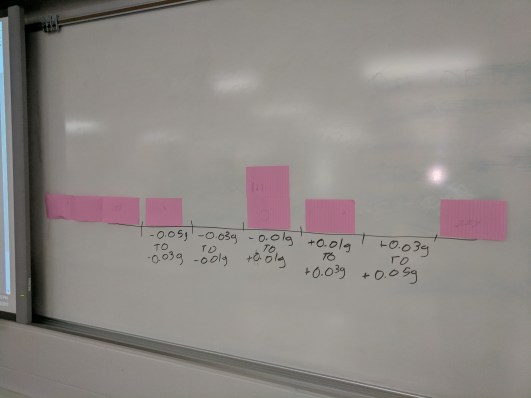
Students started the mass and change lab from the chemistry Modeling Instruction curriculum. To make the histogram, I had each group write their change on a Post-It, then place it in a physical bin matching their value before I transferred the Post-Its to the whiteboard. The balances were acting up, so most groups saw pretty big changes.

chem histo

Day 141: Center of Mass & Epicenters

AP Physics: Center of Mass

I started class a center of mass demo that I think I first saw from Dan Burns. I balanced a dynamics track on a block and placed a couple of carts in the center, then asked students to predict what should happen when the carts launched. Afterward, students prepared whiteboards with their solutions for the free-response problems we’ve been working on this week.


Earth Science: Epicenter

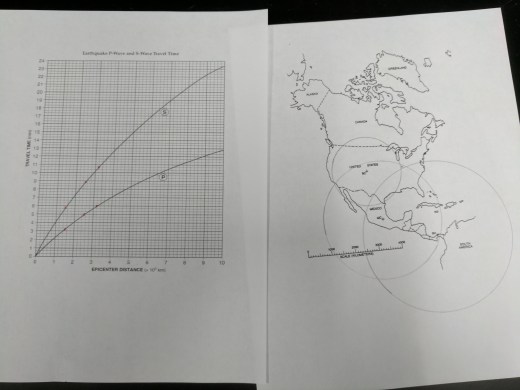
Students used some simulated seismographs and a travel time curve to locate the epicenter of an earthquake. A lot of students struggled with reading the travel time curve, so I need to do a better job of scaffolding it next time. The seismographs had time marked with the number of minutes after an arbitrary zero, which made it difficult for students to separate the arrival time of the waves from the actual travel time; next time, it would be better to use seismographs with actual timestamps. I also would like to have students spend some time interpreting the travel time curve before trying to combine it with seismograph data.

epicenter

Day 108: Collision Types & Building Again

AP Physics: Collision Types

We whiteboarded the results of Friday’s Direct Measurement Videos to get to the definitions of elastic and inelastic collisions. A lot of groups tried to answer purely conceptually, in spite of some quantitative questions on the activity. I think these groups were treating each question as separate, rather than thinking about how one answer could help them with the next piece of the activity. I want to make better use of lab notebooks (most likely starting next year) as a reflective tool, which I think might help students see more connections between problems.

ap-wb

Physical Science: Building Again

Students worked on their second round of building. I upped the cost of paper cups, which were the most popular material on the first go around, which lead to a little more variety in egg holders. I also did another round of visiting each group and asking them to explain their design choices using Newton’s Laws, and I can tell students are getting more confident with this skill.

eps-cx

Day 107: Collisions & Test Design

AP Physics: Collisions

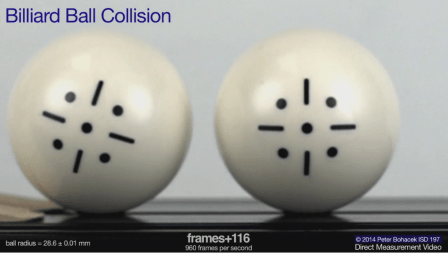
Students use a pair of Direct Measurement Videos, one of a collision between two billiard balls and one of a heavy disk tossed onto a cart, to explore changes in momentum and kinetic energy in the collisions. I haven’t done as much with uncertainty as I’d like, so I was very pleased with how clearly students were talking about it to decide if their values were “close enough.” I had students sketch momentum SOS and energy LOL diagrams, but students weren’t paying as much attention as I’d hoped to whether there were any dissipative forces present, so next year I want to do a better job of getting students into that habit. I was thrilled, however, when a student used some proportional reasoning to convince herself that you cannot conserve momentum and keep a constant kinetic energy when the objects are moving together after the collision. I was also pleased by how many students were interested in trying to explain the billiard ball that just spins in place right after the collision.

billiard balls.PNG

Physical Science: Test Design

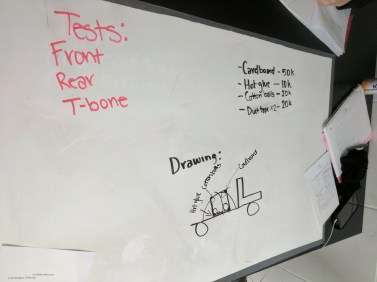
Students began working on designing a second iteration of their cargo carriers. To encourage new designs, I increased the cost of paper cups (the most popular component on the first round) and shuffled groups. We also talked about the limits of testing just the front-end collisions, and tasked students with coming up with their own tests for this round. The discussion was a little trickier this year than in the past; we dramatically upgraded the trucks the cargo carrier attaches to this year and the old trucks would pretty reliably tip over or roll off the side of the ramp at least once per class, which gave a nice tangible example of the test’s limits. That didn’t happen at all this time, so next year I might take off the rails we put on the side of the ramps to try to encourage some failed tests.

design.jpg

Day 96: Angular Momentum & Average Velocity

Today, I was chaperoning a field trip so I missed most of my classes.

AP Physics: Angular Momentum Quiz

Students took a quiz on angular momentum, then worked on finishing yesterday’s lab. One of the problems is based on a story that before jumping a motorcycle over the Snake River Canyon, Evel Knievel said his biggest fear was accidentally hitting the brakes in mid-air. I was back in time for 4th hour, so I showed students a demo of the problem using an RC motorcycle.

Physical Science: Average Velocity

Students worked on some problems interpreting position vs. time graphs. One of the questions asks them to invent average velocity by coming up with multiple ways to define the average velocity, then use each approach to make a prediction and decide which definition is the most useful.

Day 93: Whiteboards & More Whiteboards

AP Physics: Whiteboarding Angular Momentum

Thanks to a reminder from Dan Burns, I kicked class off with a clip from The Simpsons where Principal Skinner uses conservation of angular momentum to save Ralph. Afterwards, students whiteboarded and discussed yesterday’s problems. I focused on the conceptual problems, and I was pleased by how many students opted to use tools like SOS diagrams to guide their thinking, whether or not the problems asked for them. I also had some groups use analogies to linear momentum to answer questions since they found it easier to visualize. I got really excited when a couple of groups used Newton’s 3rd Law to solve one of the problems, though I didn’t think to take a photo of their boards.12th.jpg

Physical Science: Whiteboarding Motion Graphs

Students whiteboarded their video analysis results for constant velocity. This was the first time I’ve had them talking about graphs, and they made a lot of great observations. After the discussion, we used Logger Pro to look at a constant speed buggy in front of a motion detector and refine some some of the things we saw in the video analysis; after seeing me change the axes on the v vs. t graph from the motion detector, most groups looked at the scale on their v vs. t graphs and decided they should be horizontal lines. It was also fun to see the expressions on some faces when I found the slope of the buggy’s x vs. t graph and they saw it was the speed.

9th

Day 92: Angular Momentum & Motion Graphs

AP Physics: Angular Momentum

Students took a  quiz on conservation of momentum, then we finished yesterday’s discussion to introduce the idea of angular momentum. I showed them a Direct Measurement Video of two people on carts pushing off each other, followed by one of a rotating iPod to get a clear analogy for conservation of angular momentum. I think this would be worth taking the time to make a more student-centered discussion with students whiteboarding explanations next time around.ipod-rotates

Physical Science: Motion Graphs

Students used Vernier Video Physics to do some simple video analysis of a mini hover disk and start looking at position vs. time and velocity vs. time graphs. I had them stay in Video Physics to view the graphs, but students are struggling to make sense of their graphs for constant velocity with the auto scale. I’m debating how I want to change it for next year. I’m leaning towards spending 1-2 days doing constant velocity with a low-tech, breadcrumb approach. I’d probably have students calculate the speed over each interval to make a velocity vs. time graph. Then, we can switch over to video analysis for constant acceleration.

ramp

Day 91: Whiteboarding & Engineering

AP Physics: Whiteboarding

Students whiteboarded some problems from Friday and yesterday’s Direct Measurement Video. There was some good discussion about a problem about a collision between a Hummer and a VW Bug, comparing the force, the change in momentum, and the acceleration of each. A lot of students did some really good wrestling with the conceptual distinctions between those ideas. There was also some good discussion about whether momentum is conserved when an object starts rotating. All the groups that said rotation takes some momentum had a calculation, while the groups who said rotation does not impact conservation of momentum used a few different approaches, which gave a nice opportunity to talk not only about uncertainty, but the value of multiple lines of evidence.

Physical Science: Engineering

I decided to expand the big engineering project we have this trimester to include both motion and forces, so today we introduced the project. We spent some time talking about what engineers do, and I was very excited that collaborate was the first thing a student mentioned. We also did some problem scoping, where I gave students a fictitious memo from our “client” and had them use the information to describe the problem, the criteria for success, and the constraints we’ll have to work within, as well as start brainstorming some of the science knowledge they will need for the project. I’ve tended to skip problem scoping, since a fake client feels cheesy to me, but it was interesting to see students really analyze the fairly short text of the memo; it was also interesting that students are thinking about the constraints as reasonable client requests instead of arbitrary obstacles I imposed (at least for now).

engineers