Day 107: Experimental Design, Conservation of Momentum, & Particle Diagrams

I had a sub for half the day today.

AP Physics: Experimental Design

Students worked on an experimental design problem off the 2017 AP Physics 1 exam, then did their choice of problems from a packet involving multiple models.

Physics: Conservation of Momentum

Students started working on some problems using conservation of momentum. In the hour I was here for, students were much more confident than I’ve seen them on new problem types all year, which was exciting. When I talked to groups, a lot of them were using connections to energy conservation to think through the problems.

Chemistry Essentials: Particle Diagrams

Students reviewed sketching particle diagrams. A lot of students have struggled with these this year and tend to loose track of what a particle diagram is intended to represent, so I want to make sure they get one more shot before the final

Day 106: Model Summaries, Collisions, & Gas Laws Review

AP Physics: Model Summaries

To help review for the final, students whiteboarded model summaries for the mechanics topics we’ve done so far. I just asked for key diagram types, along with relevant annotations, and key equations. For the first time, I saw a lot of groups including pieces of the force models, including free-body diagrams, system schema, and Newton’s 2nd Law, in summaries for other models. I’m excited that students are seeing and valuing the connections between different models.

Physics: Collisions

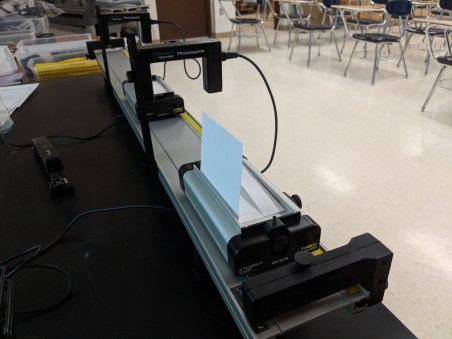
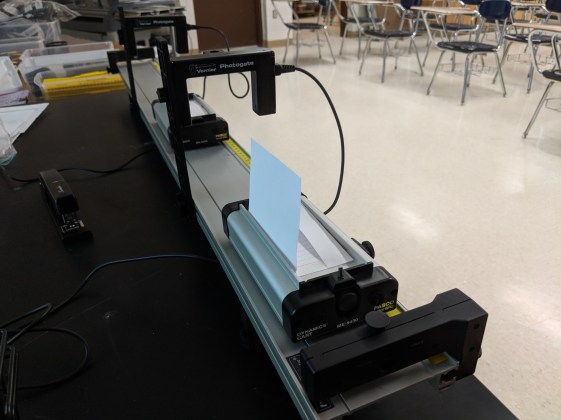
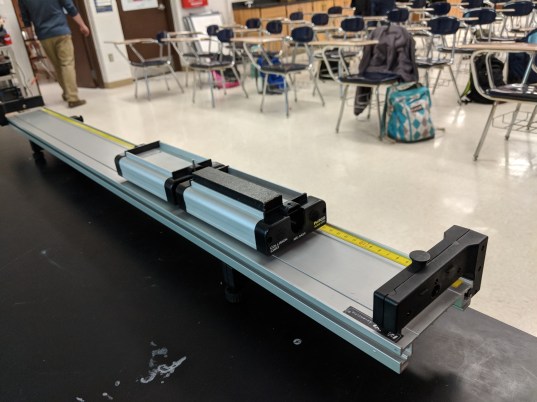
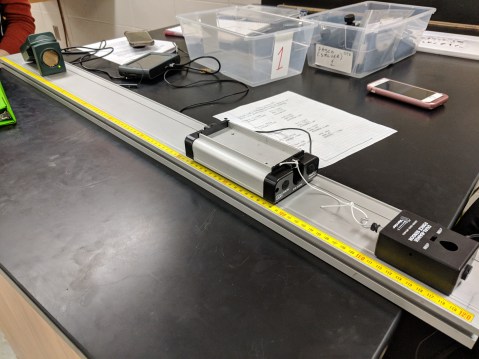
Students continued the cart collisions lab from the Modeling Instruction materials. A lot of groups struggled with interpreting the graphs produced by the photogates, which has been pretty common this year. The classic graph matching lab always seems to help students make sense of what the motion detectors are recording; I’m wondering if it would be worthwhile to have a lab that’s essentially play with photogates next year.

Maker:S,Date:2017-10-21,Ver:6,Lens:Kan03,Act:Lar02,E-Y

Chemistry Essentials: Vacuum Chamber

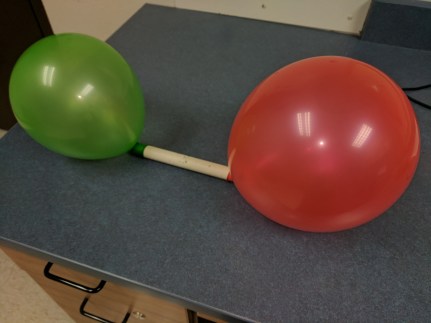
I got out the vacuum chamber and a few other demos, including balloons linked by a pipe, to revisit gas laws and pressure today. Sticking with pretty hands-on review seems to be helping a few students stay engaged as we approach the final exam.
balloons

Day 105: Multiple Models, Collisions, & Density Review

AP Physics: Multiple Models

With finals next week, students started working on some problems that require them to use multiple models simultaneously. We also spent some time talking through strategies for these kinds of problems; my students are a little more resistant than usual to sketching diagrams, so I made sure to emphasize the value of that step.

Physics: Collisions

Students started working on a lab with colliding carts to get at conservation of momentum. The lab is going more slowly than I’d hoped, which has me nervous about whether students will be ready to assess on this topic by the end of the week.

collisions.jpg

Chemistry Essentials: Density Review

I have a little more time for review than normal in this class, so I decided to use some potential labs I skipped over this tri. Today, to review density, I had several unknown liquids students had to identify by making a mass vs. volume graph. I had them write their own procedure, which I haven’t done in a while, and students needed a lot more pre-lab discussion to be ready for that.

I’m also starting to struggle more to keep students on task during the lab and to keep them from having side conversations during whole-class instruction. I’ve seen it before with this course; I think a lot of students see it as settled whether they will pass or fail the course once final review begins and get off track as a result.

Day 104: Plickers, Explosions, & Quiz

AP Physics: Plickers

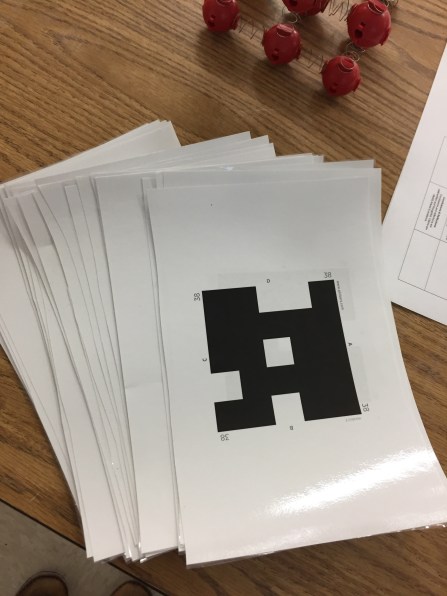
After a quiz, we used Plickers for some multiple choice practice. We happened to do several that involved the slope or area of different graph types, and it was clear from the conversations that a lot of students were having trouble keeping them all straight, so we spent some time looking at how to work backwards from the formula sheet to get what a slope or area represents.

img_2398

Physics: Explosions

Students took a quiz on impulse, then worked on analyzing their data for the cart explosion lab. Linearization has been a struggle in this course this year, but it seems to be clicking for a lot of students, which is good since plotting ratios means there’s a lot to think through.

One class brought up their anxieties about a drill we’re planning in conjunction with the local police department, which lead into a discussion about their fears about school shootings in general. With the drill already making students nervous, I’m going to need to carefully monitor the mood in my classes and make a concerted effort to make students feel as safe as possible.

Maker:S,Date:2017-10-21,Ver:6,Lens:Kan03,Act:Lar02,E-Y

Chemistry Essentials: Quiz

Today’s formula writing quiz took the full hour, which was much longer than I expected. I had a lot of students come up to me during the quiz to ask questions that indicated they were struggling to differentiate the different types of diagrams as well as the meaning of subscripts and superscripts on atomic symbols. I need to think about what kinds of scaffolds I can provide to help students develop those skills; one option may be to have students help name the diagram types, rather than using a standard name.

Day 103: Mystery Circuits, Explosions, & Formula Relay

AP Physics: Mystery Circuits

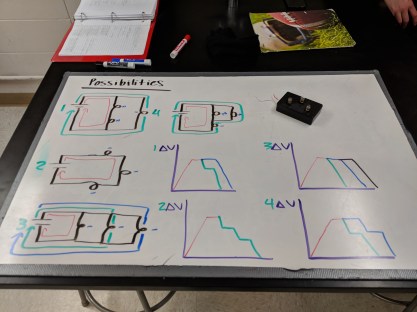
Students did a lab practical from The Physics Teacher to figure out how three light bulbs were wired together without opening the boxes. I did a little extra front-loading by asking students to sketch circuit paths and KVL diagrams, which set them up nicely to figure out what was going on in their box. A lot of students are disappointed that this is effectively the end of our circuit unit; its too bad I can’t direct my students towards the electronics courses in the IT department since they are seniors.

mystery circuit.jpg

Physics: Cart Explosions

Students started collecting data on a series of cart explosions to introduce conservation of momentum by plotting the ratio of the cart masses vs. the ratio of the distance each traveled in order to hit the end stops simultaneously. I didn’t overhear any groups anticipating where to start their carts, which is unusual for this lab, but some groups were able to make limited predictions with a little prompting.

explosion.jpg

Chemistry Essentials: Formula Relay

Students did some more formula writing practice. Today, I had them work on whiteboards and required them to rotate who did the writing. A lot of my groups have fallen into a pattern where one or two people do most of the intellectual heavy lifting, and it was clearly challenging for them to have to articulate what to do instead taking the marker. There were also some students who have been relatively passive during group activities who seemed like they started to get the hang of formula writing, which is exactly what I hoped.

Day 102: Whiteboarding

AP Physics: Circuits Whiteboarding

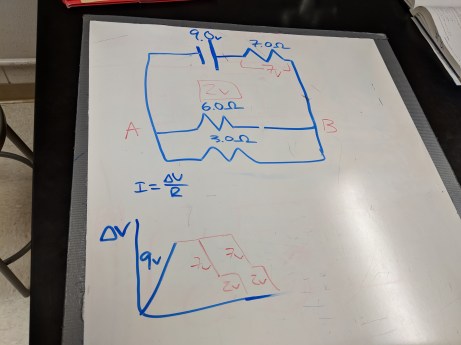
Students whiteboarded yesterday’s problems on circuits. Students are recognizing the value of sketching circuit paths and KVL diagrams more quickly than some of the other diagrams this year. My students say its because the value of the diagrams is very obvious, but I think its a factor that they’ve come around to the value of other diagrams in the class.

circuit wb.jpg

Physics: Impulse Whiteboarding

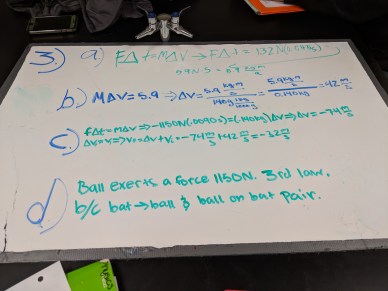
Students whiteboarded yesterday’s problems. A lot of students referred back to last week’s paradigm lab on impulse and Friday’s qualitative problems, which was fantastic. I also had some students who couldn’t remember doing either the lab or problems and struggled quite a bit today as a result; I need to keep working on helping these students see the value in being an active participant in their lab group.

impulse (1).jpg

Chemistry Essentials: Formula Writing Whiteboarding

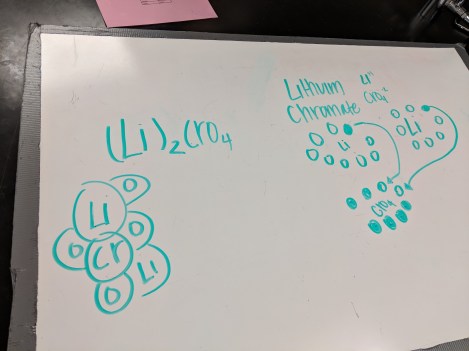
Students whiteboarded yesterday’s problems naming formulas with polyatomic ions. Each day, things are clicking for a few more students. One of the big keys is understanding the relationship between the charge and the electron diagram. At this point, I’m leaving it up to students whether to sketch the electron diagram, but many are choosing to sketch it because they find it helpful.

IMG_20180221_142216.jpg

Day 101: Circuits, Quantitative Impulse, & Polyatomic Formulas

I had a sub today, so no photos.

AP Physics: Circuits

Students started working problems using Kirchoff’s Laws. Since our post-lab discussion was cut pretty short, I put a suggestion on Google Classroom to try building some of the problems in PhET’s circuit construction kit; I’ll be curious to hear whether any students tried that.

Physics: Quantitative Impulse

Students started solving problems using the equations for momentum and impulse.

Chemistry Essentials: Polyatomic Formulas

Students translated between names and formulas for compounds that include polyatomic ions. That is usually a tricky shift in this course, so I’ll be making sure we go over the worksheet carefully on Wednesday.

Day 100: KVL Diagrams, TIPERs, & Formula Writing

Today classes were shortened due to a pep fest.

AP Physics: KVL Diagrams

We had a very brief discussion about the results of the labs from Wednesday and Thursday; students were consistently very successful at picking up on they key patterns I wanted them to see. I also introduced them to Trevor Register’s KVL diagrams. I like to pair that with color-coded current paths on the circuit diagram.

kvl.jpg

Physics: TIPERs

Students worked through some conceptual problems on impulse and momentum, mostly taken from TIPERs to get them thinking about what the equations we have so far really mean. A lot of groups really wanted to start by guessing an answer, then come up with some physics to justify it, rather than the other way around. I’ve been encouraging students to use CER with these types of problem, starting with the evidence and working towards the claim, but I’m tempted to try and talk my department into switching to ERC to make the evidence first more explicit.

Chemistry Essentials: Formula Writing

Playing the mistakes game yesterday seemed to help some students start to make sense of writing chemical formulas, though a lot of students still need more practice. Today, I gave students some formulas and asked them to determine whether they are possible based on what we know about bonding. This seemed to help the concepts click for a few more students.

Day 99: Kirchoff’s Laws, Impulse, & Mistakes Game

AP Physics: Kirchoff’s Laws

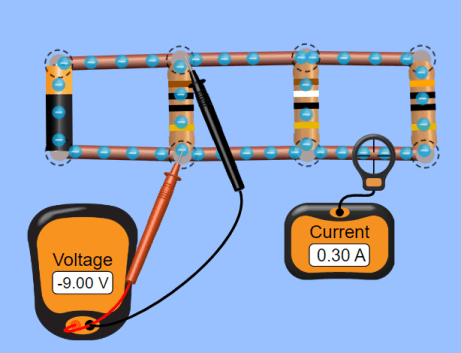
Students used PhET’s circuit construction kit to look for patterns in the current and potential difference in both series and parallel circuits. I usually do the PhET version before the real-world version we started yesterday, but testing season makes it tricky to reserve a computer lab right now. I overheard some students making good connections to their work yesterday and noticing the key things I wanted them to notice.

circuit kit parallel

Physics: Impulse

Students re-did the impulse lab from earlier this week. This time, I spent more time discussing with them why we care about the change in velocity, rather than the velocity at a specific moment. Students were more visibly attentive when I walked through how to get the change in velocity on a LabQuest than they were earlier in the week; I think it helped that they knew we were re-doing the lab because their earlier results came out poorly. I also had groups assign someone to plot their data as it was collected, which had them thinking about whether their results make sense throughout the lab. One section got beautiful results, while the other still had slopes all over the place; I’m not quite sure what happened in the second section.

Maker:S,Date:2017-10-21,Ver:6,Lens:Kan03,Act:Lar02,E-ve

Maker:S,Date:2017-10-21,Ver:6,Lens:Kan03,Act:Lar02,E-ve

Chemistry Essentials: Mistakes Game

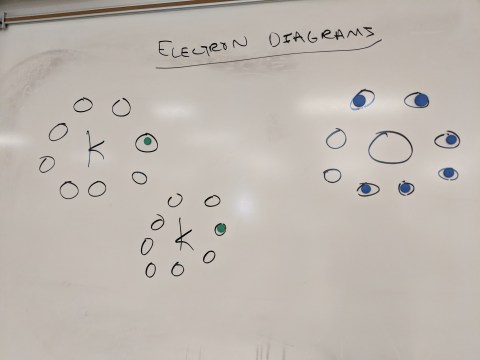
Students whiteboarded yesterday’s problems using the Mistakes Game. The students who are using the electron diagrams as a thinking tool are pretty quickly getting the hang of things.

electron diagra.jpg

Day 97: Board Meeting, Impulse, & Valence Electrons

AP Physics: Board Meeting

Today, we had two board meetings. First, we discussed the results of last week’s electric potential difference lab, followed by yesterday’s work on Ohm’s Law. The potential difference discussion went well, but the Ohm’s Law lab was trickier. This is the first lab I did as pretty open inquiry where students were working with three different variables, and a lot of groups struggled to relate all three. Next year, I may go back to having students do two separate experiments. There were also several groups who used the battery’s internal resistance and I think a little more pre-lab discussion could have avoided that.


epd board.jpg

Physics: Impulse

Students tied a cart to a force sensor with an elastic string and collected data for a relationship between the area of the force vs. time graph and the cart’s change in velocity. A lot of students had some trouble with the idea that they were graphing features of the LabQuest graphs, but were able to make sense of what was going on with some support.

impulse lab.jpg

Chemistry Essentials: Valence Electrons

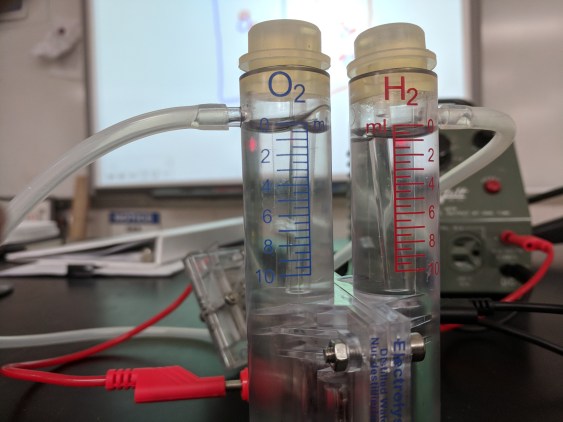
Students sketch Bohr models for selected elements to start identifying patterns in the number of valence electrons. Students seemed pretty successful at making sense of why certain elements have certain charges. I also got out the electrolysis machine to give an example of how we know the ratio of elements in a compound.

IMG_20171102_144642