Day 35: Assessment, Board Meeting, & Two Truths and a Lie

AP Physics 1: Assessment

After wrapping up yesterday’s whiteboards, students took their quiz on impulse and momentum conservation in collisions. One of the things I love about giving this assessment is a lot of students felt much more confident than on the assessment on impulse of a single object, in spite of it being the same material in a more complex situation. Its a great opportunity for students to see their growth so far.

Physics: Board Meeting

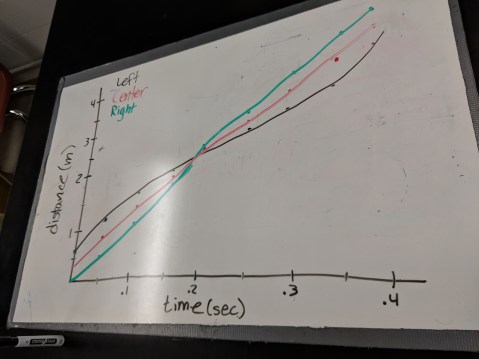
We had the board meeting for the spring force lab. I’ve been hitting “for every” statements about the slope much harder and more consistently this year than in the past, and I’m seeing students with a much stronger conceptual understanding of what their slopes represent, which is fantastic.
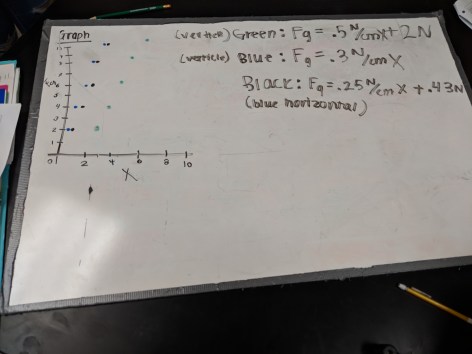
spring wb

Chemistry Essentials: Two Truths & a Lie

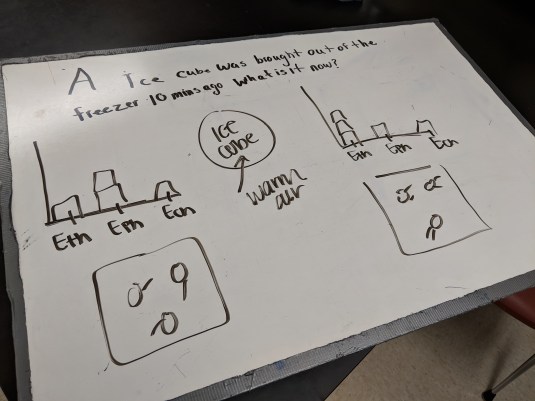
After going over some key periodic trends and how to read a periodic table, I used a variation on a community-building activity that we frequently use in homeroom called “Two Truths and a Lie”. Each group came up with two accurate statements, and one wrong statement. Groups then traded whiteboards and had to correct the wrong statement. A lot of groups had some good discussion and seemed to get more comfortable reading their periodic table, which was the goal.
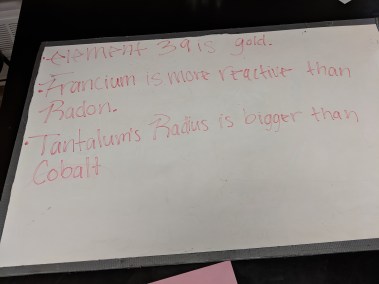
w truths

Day 34: Mistakes Whiteboarding, Spring Force, & Card Sort

AP Physics 1: Mistakes Whiteboarding

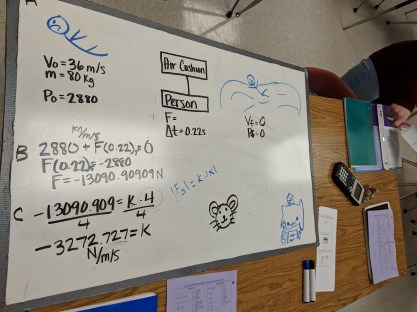
Students did mistakes whiteboarding using yesterday’s problems. To keep us from getting bogged down in algebra, I had students put their mistake in the diagrams or annotations, then we focused the discussion on getting those parts right and I posted final answers to the class website. Dropping a negative sign was a very popular mistake today, but a lot of students have been making that error, so it was a good one to work on.

ap mistake.jpg

Physics: Spring Force

Students finished data collection for the spring force lab. I like to have students collect data for the spring both when it is vertical and when it is horizontal to get the idea that the orientation of the spring does not affect its spring constant.

horiz spring.jpg

Chemistry Essentials: Card Sort

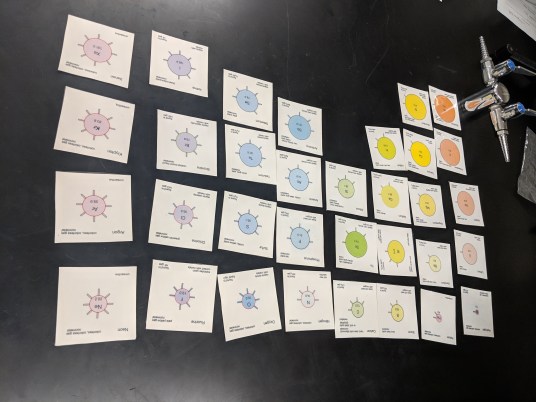
Students worked on a card sort based on how Mendeleev worked out his periodic table. I skipped having students do a gallery walk of how other groups sorted their cards before seeing a periodic table, and I wish I’d taken the time to do so since I think it would have gotten students thinking about other ways to sort.

chem card sort.jpg

Day 33: Problems, Board Meeting, & Assessment

AP Physics 1: Problems

Students worked on some conservation of momentum problems, including Michael Lerner‘s watermelon on wheels, that require them to be flexible about the system they are using. A lot of groups went straight for a whiteboard once the work time started, which lead to some great discussion and collaboration on the problems.

Physics: Board Meeting

We had a board meeting for yesterday’s force of gravity lab. This was actually the first traditional formula students got from a lab this year. During the discussion, I could tell my students are getting much better at making “for every” statements about the slope and describing the meaning of the intercept.

force of gravity wb.jpg

Chemistry Essentials: Assessment

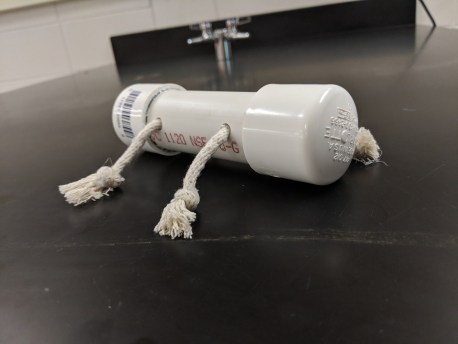
Students took their quiz on phase changes. One problem talked about a generic chemical, rather than something specific, which threw several students off. It was a good reminder to keep problems firmly rooted in real situations. Afterward, we revisited the mystery tubes from the first day of class as preparation to start talking about the periodic table and atomic models.

mystery tube

Day 32: Board Meetings, Gravity, Invented Problems

AP Physics: Board Meetings

Students whiteboarded their results for the collisions lab and the center of mass video analysis from last week. Between the two labs, I think students started to see why it might be useful to switch between systems when thinking about momentum.

com wb.jpg

Physics: Force of Gravity

Students worked on a lab finding the relationship between mass and the force of gravity. Whiteboards are ready and looking good for a board meeting tomorrow!

gravity lab

Chemistry Essentials: Invented Problems

To review phase changes, I had students write their own problems and exchange whiteboards with another group. There were a few groups that had some good conversation as they were writing their problems and there was some good cross-group conversation when comparing answers after working another group’s problem.

chem wb.jpg

Day 31: Collisions & Whiteboarding

AP Physics 1: Collisions

I’m doing things a little out of sequence to work around computer access, so we went back to the collisions lab from Monday. Today the data collection went a lot faster than Monday, which is not surprising since Monday was their first time using photogates.

collisions.jpg

Physics: Whiteboarding

We wrapped up going over some free-body diagram problems. My 1st hour had enough time to start yesterday, so they did mistakes whiteboarding. My 6th hour was a little more crunched, so I picked some of the trickiest problems and assigned two groups to each one. Then, the pairs of group met up to come to a consensus on the answer before we moved into a gallery walk of all the assigned problems.

fbd.jpg

Chemistry Essentials: Mistakes Whiteboarding

Students did mistakes whiteboarding for yesterday’s phase change bar chart problems. This class is still pretty quiet, but they are gradually getting better at speaking up during this activity.

chem.jpg

Day 30: Center of Mass, Whiteboarding, & Energy Bar Charts

AP Physics 1: Center of Mass

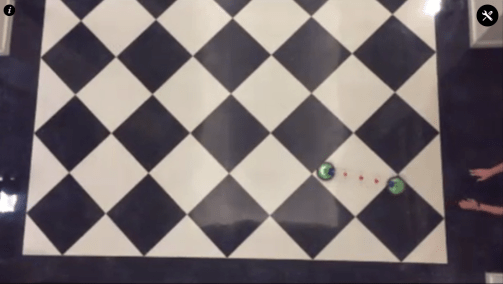
Students worked on a video analysis of two air pucks attached by a rod from the article by Taylor Kaar, Linda Pollack, Michael Lerner, and Robert Engles in The Physics Teacher. In the past, I’ve used LoggerPro, but there have been delays on getting it installed on student computers, so I took advantage of the video upload feature in Pivot Interactives. Pivot has a ruler with an adjustable length to get measurements to scale, but it was tricky to find a nice alignment, so students ended up skipping scaling the ruler and coming up with a conversion factor, instead.

2body.PNG

Physics: Whiteboarding

Students whiteboarded some problems on drawing free body diagrams. In my 1st hour, we did mistakes whiteboarding; I was a little disappointed that no groups put a forward force on the objects moving forward, but not a lot of students made that mistake while they were working on the problems in the first place. My 6th hour is a little behind, so they mostly worked on the problems today and will do some abbreviated whiteboarding tomorrow.

Chemistry Essentials: Energy Bar Charts

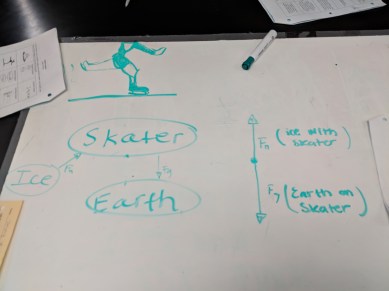
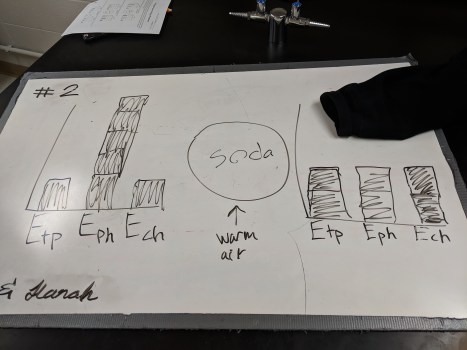
Students worked on some LOL diagrams for energy transformations during phase changes. They had some trouble with the system flow part of the diagram, mostly because they are getting tripped up by the idea that it needs to list specific objects.

Day 29: Collisions, Card Sort Part 2, & Board Meeting

AP Physics 1: Collisions

Students started working on a lab to compare the momentum before and after a collision between two carts. This was their first time using photogates, so the first data point took some time, but then students were able to get data pretty quickly. One student pointed out I’d posted “spoiler alert” instead of a learning target, so we took a few minutes to talk about why I don’t always want to post a learning target at the beginning of a new lab.

spoilet

Physics: Cart Sort Part 2

We did some whiteboarding Kelly O’Shea’s balanced forces card sort. Students seem to be doing well with what each representation shows. Students are having some trouble with the direction of the normal force, so I took some inspiration from Joe Cossette and did a quick demo where I put a balance on a board, then slowly lifted one end.

Chemistry Essentials: Board Meeting

We whiteboarded the results of last week’s lauric acid phase change lab. Students pretty readily recognized the flat sections of their graphs that occurred during a phase change. I haven’t spent a lot of time setting up the concept of energy in this class, so I think they had some trouble with the idea that the water baths were still changing the energy of the lauric acid when the temperature wasn’t changing, but I think we’ll get there.

lauric

Day 28: Assessment, Card Sort, & Phase Changes

AP Physics 1: Assessment

Students to a quiz on free-body diagrams and momentum, which ended up taking a much bigger chunk of the hour than I’d hoped. In one of my classes, students are starting to ask for reading strategies for deciphering problems, which is great. I tend to get a lot of students who are very strong readers, so I usually wait until there is a problem on an assessment that a lot of students clearly got wrong because of reading to ensure students see a need for reading strategies, but since my students are self-aware enough to realize they could use some new strategies before its an issue, I’m happy to start in on those strategies early.

Physics: Card Sort

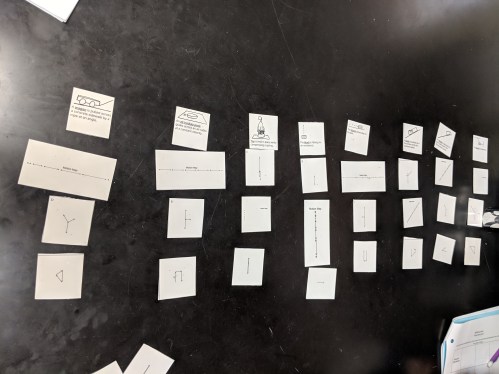
Students did a balanced forces card sort from Kelly O’Shea, with a lot of influence from Richard Wright, though I left out the system schema that Michael Lerner added. Before the card sort, I spent some time talking about system schema and free-body diagrams, but left my students to figure out the vector addition diagrams in the card sort. In my 1st hour, this went really well; there were great conversations, and my students seem to really get vector addition diagrams. In my 6th hour, things were much rougher; they tend to be less focused (its like they’ve had five classes before mine or something) and I could tell they hadn’t gotten as much out of yesterday’s interaction stations, which made it very tough to build on today. In general, I think I need to do a better job of adjusting to my 6th hour.

card sort (1).jpg

Chemistry Essentials: Phase Changes 

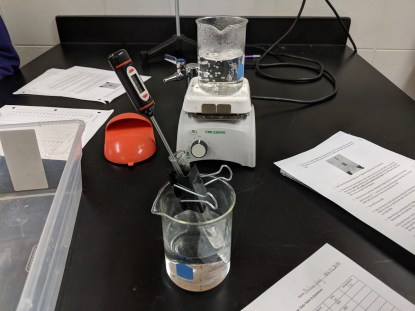
Students collected temperature and time data for lauric acid as it went from solid to liquid and back again. The data collection requires constant stirring and recording the temperature every 20 seconds, but the graph comes out really nice.

lauric acid

Day 27: Problems, Interaction Stations, & States of Matter

I had a sub today.

AP Physics 1: Problems

It was a little tricky figuring out what I could leave for students to work on. I ended up giving them some additional problems on impulse and quantitative force diagrams. I ended up giving them their first taste of a goal-less problem and I’m looking forward to seeing what they do.

Physics: Interaction Stations

I usually avoid leaving anything equipment intensive when I have a sub, but we had Brian Frank’s interaction stations on deck for today. The other physics teacher and I try to stay within a day or so of each other, so we set the stations up in his room, then his classes and mine will switch places the hours I have physics.

Chemistry Essentials: States of Matter

Plan A was for my co-teacher to introduce phase changes by having students do a lab making a temperature vs. time graph for lauric acid as it melts and re-freezes. Then, on Tuesday, we found out a fire drill was scheduled for the start of this hour. Since a lot of students in the class really struggle with transitions and with changes to the routine, a sub, plus a fire drill, plus a lab just seemed like a disaster. I ended up putting together a reading assignment from the textbook introducing the three states of matter we’ll be working with.

Day 26: Problems, Bowling Balls, & Assessment

AP Physics 1: Problems

Students worked on a mix of problems on impulse and on using formulas for types of forces. During the second part of class, students whiteboarded problems for a gallery walk.

ap wb

Physics: Bowling Balls

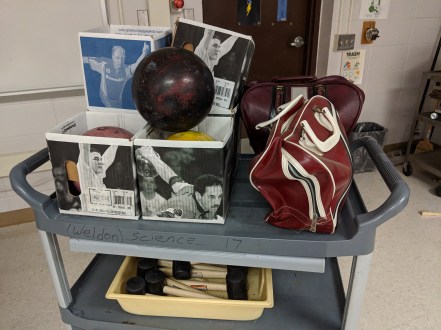
Today was bowling ball day! Students worked through Frank Noschese’s bowling ball and mallet activity.  After getting a class rule so far for taps and bowling ball motion, a few students commented it reminded them a lot of Newton’s 1st Law from 9th grade physical science. Imagine that!

bowling balls.jpg

Chemistry Essentials: Assessment

Students took their gas laws quiz today. Last year, I was pretty good about planning some kind of activity for after the assessment. About half my students take the assessments in a pull-out setting and many of them need more time than the students who stay in the classroom, so I did a lot of nature of science-type activities with students in the classroom while pull out students finished their assessments. I’ve been dropping the ball on that and need to get back into that routine. The students who stayed in the classroom weren’t getting into trouble when they finished, but I’d prefer to have something worthwhile for them to do.