Day 22: Building & Speed Dating

Physical Science: Building

Students worked on constructing their prototypes for the design challenge. As they worked, I visited each group to ask a random student to explain their design, especially the reasoning in their decisions. Students did a nice job of connecting their decisions to their knowledge of Newton’s Laws and energy. They also did a nice job of trying to anticipate the needs of our imaginary customer.


Physics: Speed Dating

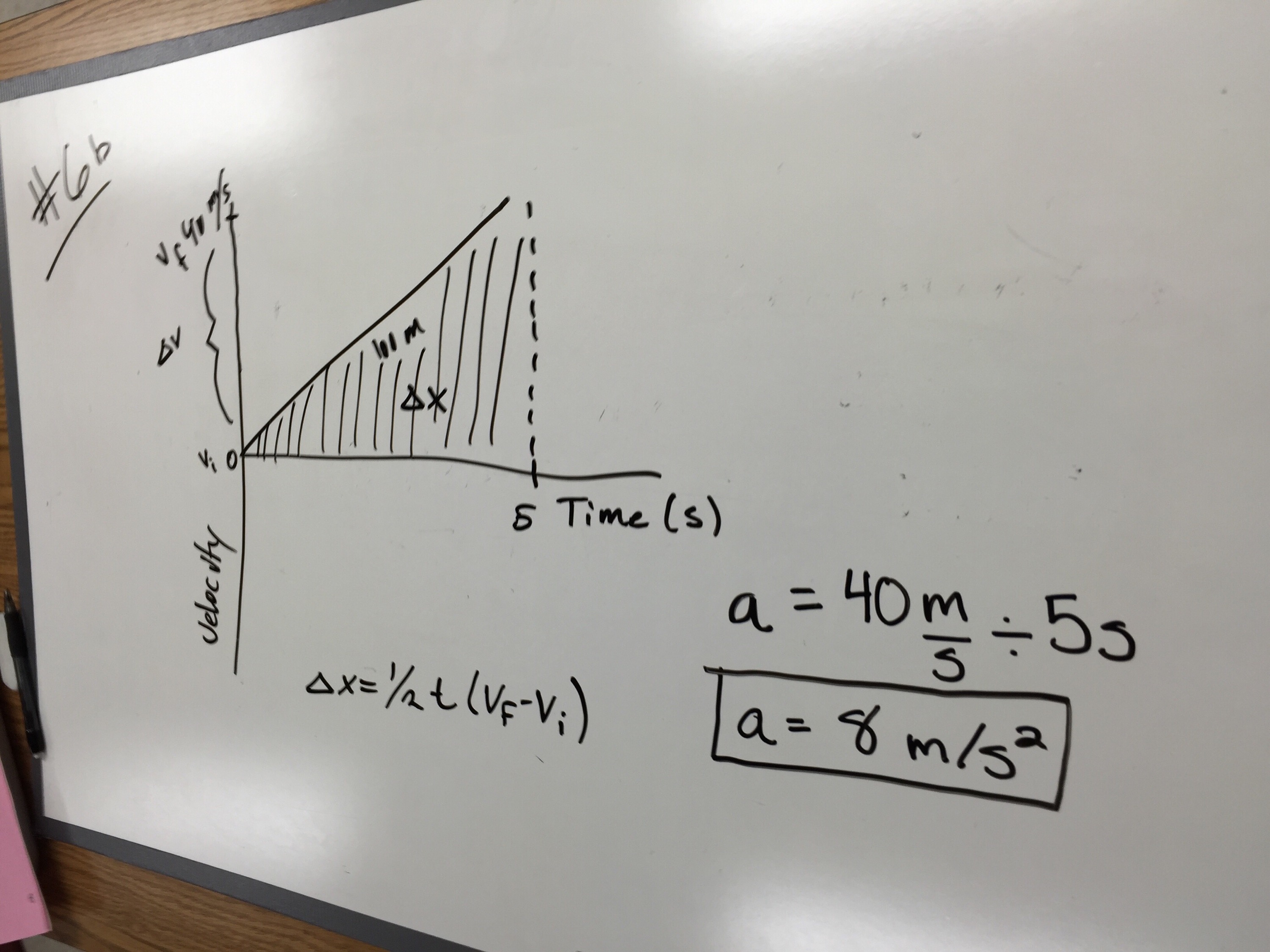
I gave students use Kelly O’Shea’s whiteboard speed dating to tackle a goalless free fall problem. My PLC is working on how to develop our students’ mathematical communication, so I was thrilled to see the strides my students made once they knew a peer would have to follow their work. Students were also very positive and left class much more confident.

Day 20: Board Meeting & Free Fall

Physical Science: Newton’s Laws Board Meeting

Students finished collecting data, then we had a short board meeting to agree on the qualitative relationships in Newton’s 2nd Law.

Physics: Free Fall

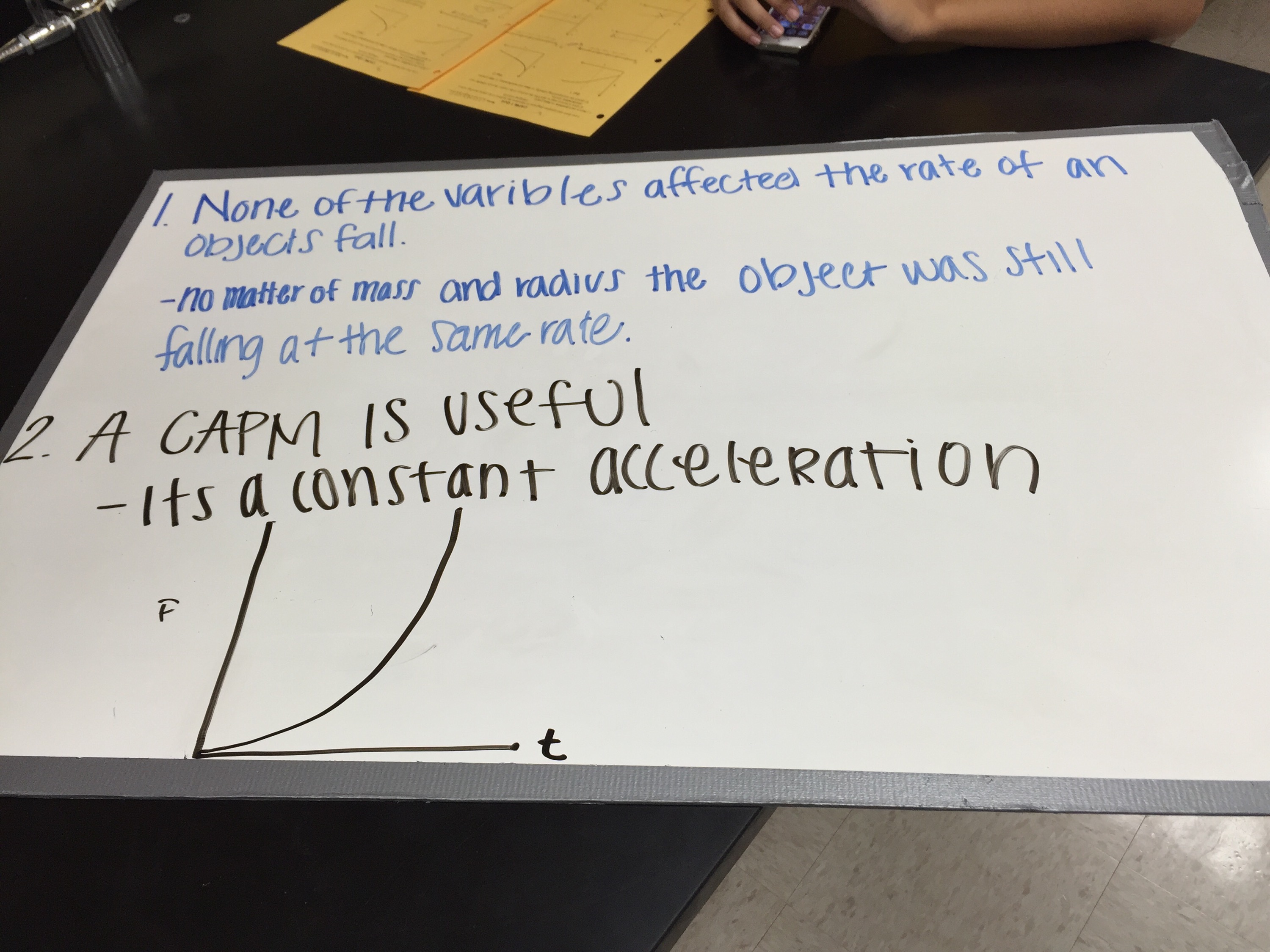
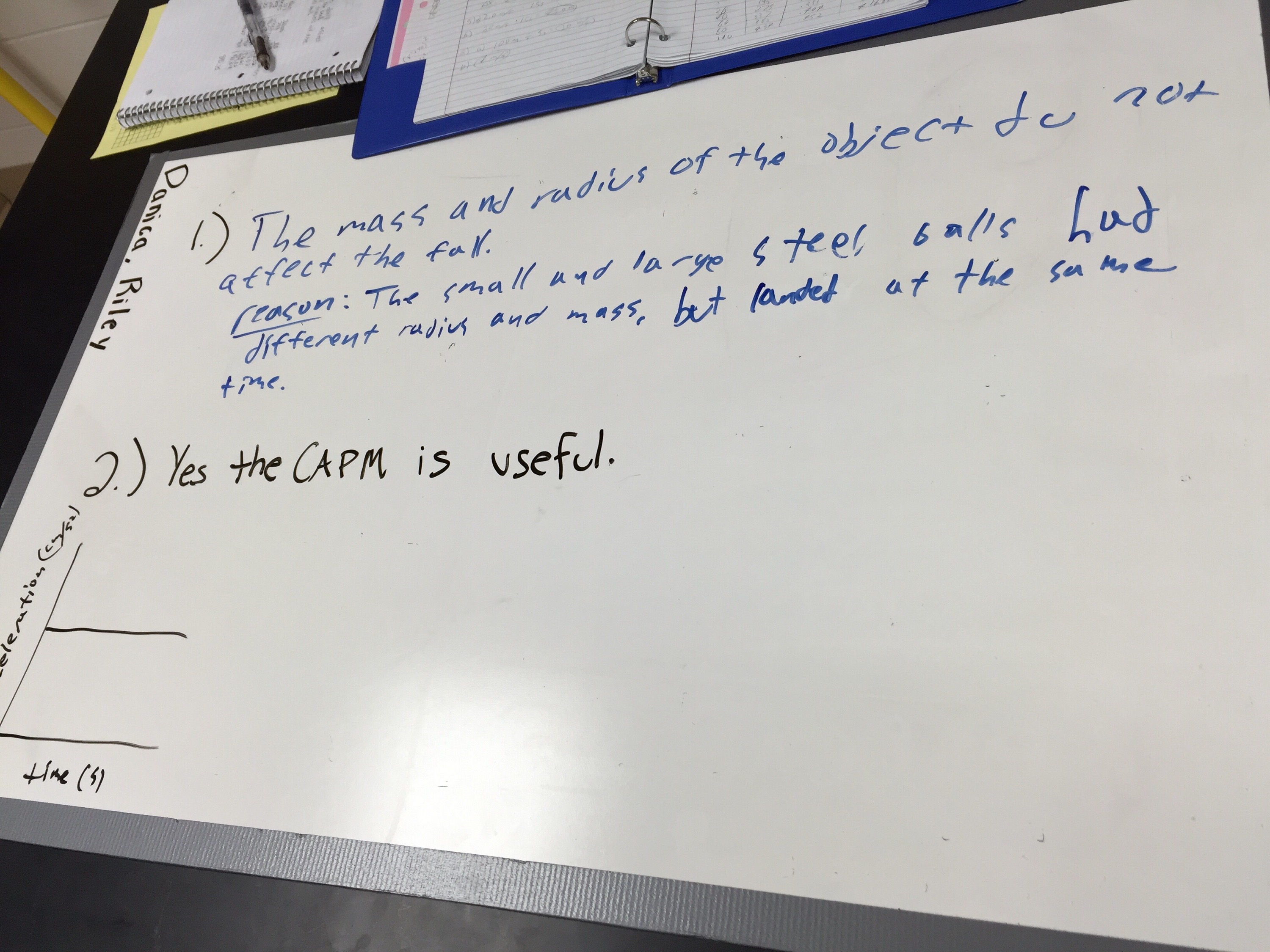
Students white boarded answers to a few qualitative questions about last week’s Direct Measurement Video. I emphasized having them provide evidence to support their answers, which lead to some good conversations, both in groups and in the whole class, about what makes “good” evidence. Different groups looked at different combinations of falling objects, which lead to some good disagreement about whether all objects fell at the same rate. My favorite moment was when I asked whether using the same acceleration for all objects is useful and a student quickly responded with “It depends” which lead to some good talk about uncertainty.

Day 17: Weight & Acceleration Practical

Physical Science: Weight

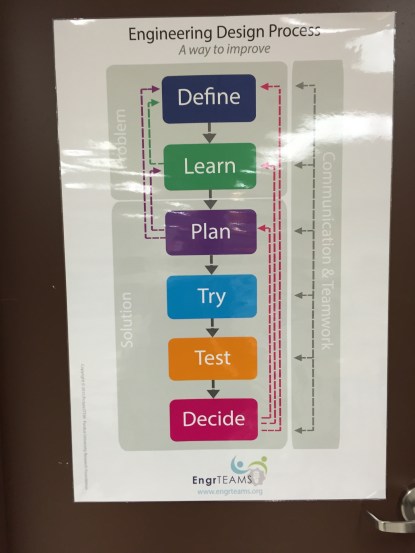
Today began with some talk about the engineering design process developed by EngrTEAMS. In particular, we placed ourselves in the “Learn” phase since students agreed they need some new science to understand crashes. I introduced forces as a tool for understanding crashes, and we dove in to a lab where students used spring scales to measure the weight of several hanging masses, then graphed the results. Tomorrow, we’ll get to the idea that the slope is the strength of gravity.
Since the lab is fairly straightforward, I had the chance to do one-on-one conferences with a few students who currently have low grades to make an action plan. I’m taking an “SBG-ish” approach in the course, which means I enter unit tests in the gradebook, rather than standards, but the tests are nearly all of the grade and I allow retakes to replace the initial score. I really liked that this freed me to talk with students about missing skills and understandings, rather than a long list of missing assignments. The students also seemed much more positive about these conferences than in the past.

Physics: Acceleration Practical

For most of the hour, students started working on a lab practical where they will roll a marble down a ramp so that it lands in a tumble buggy as it drives past. As a class, we collected the data students need to get the speed of the buggy and the acceleration of the marble, then students drew a random starting position for either the marble or buggy. I introduced the practical very clumsily in my first class, so I’ll need to do some clean up and clarification when we get back to the practical on Friday.

The first part of the lesson was finishing yesterday’s whiteboard presentations and produced one of my favorite moments of the day. When preparing their whiteboard yesterday, one group made the very common mistake of using v = d/t to find the final velocity of an accelerating object. In their quick conversation, they realized their answer didn’t make sense with the other values and were able to correct it. That group was brave enough to share that mistake, as well as how they caught it, when they presented the problem.

Day 16: Engineering Design Challenge & Communicating Solutions

Physical Science: Engineering Design Challenge

We teach forces using a project-based unit centered on an engineering desig challenge. Today, I introduced the challenge: students must make a cargo carrier that attaches to a truck will keep an egg intact in a head on collision. We spent some time today brainstorming what the customer may be interested in and what kind of background knowledge will be necessary for the task.


Physics: Comminicating Solutions

We spent some time on the importance of communication in science and connected that to what it means to show your work clearly in physics. From there, students whiteboarded the problems they worked on yesterday with clear communication in mind. This lead students to bemoan the lack of color choices in my marker bin.

Day 8: First Quiz & Mistakes Game

Physical Science: First Quiz

Students took their first quiz today. I’ve decided to move away from big unit tests in favor of short, frequent assessments. We now have a school-wide policy requiring at least one retake opportunity on all assessments, so I tried to really focus on providing feedback, not grades on the quizzes. It made me feel really optimistic, and I hope my students can find some of the same optimism.

Physics: Mistakes Game

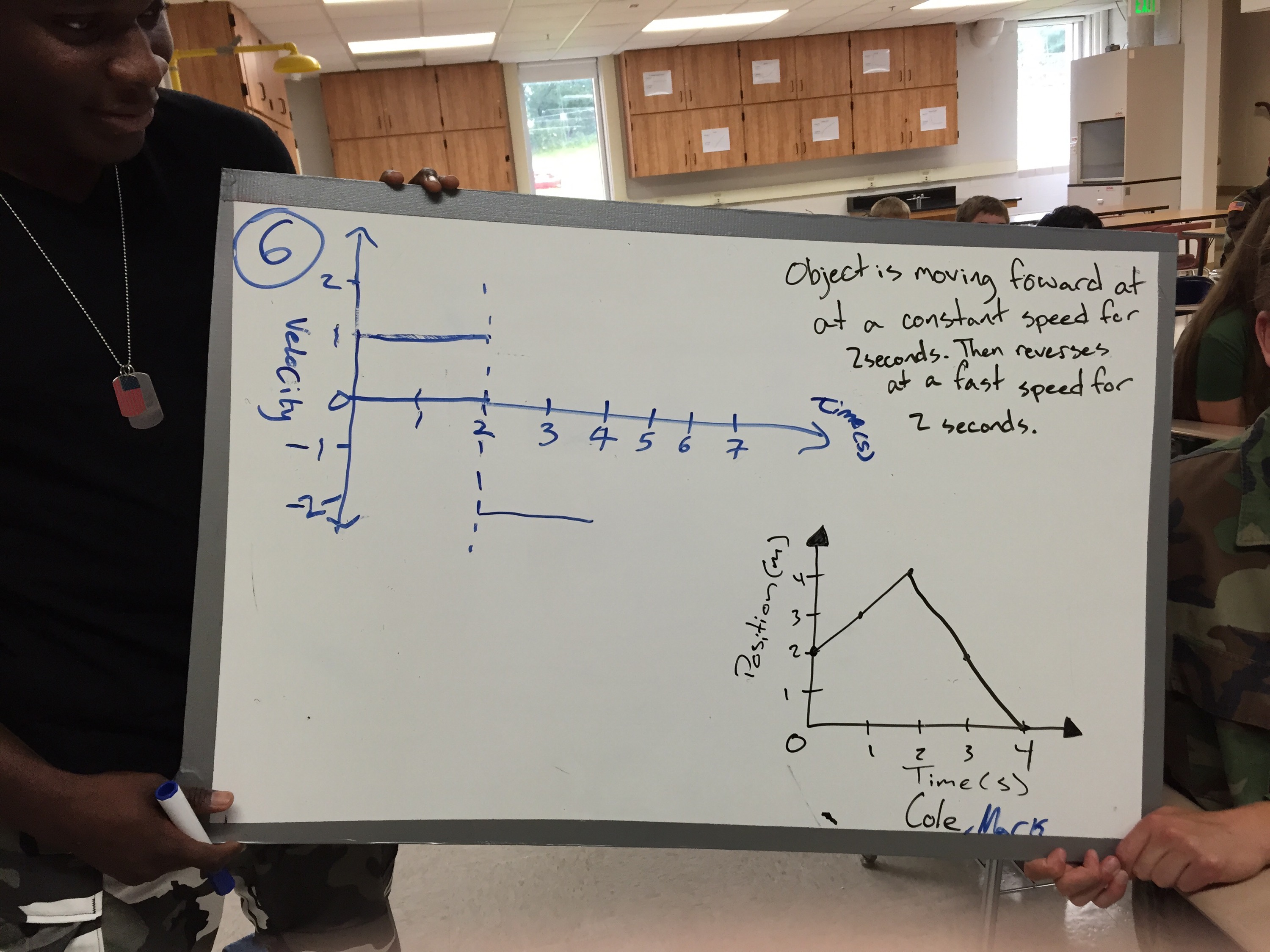
Students played Kelly O’Shea’s mistakes game using some representations of constant velocity. Students got into it and the mistakes they picked showed a lot of common errors. One group got creative with units; the problem didn’t specify, so they decided to use liters per second, explaining that the object was traveling over a body of water with a constant depth. There’s some room to improve on the questions students were asking, but I had a lot of students very willing to speak up and I’m sure they’ll rise to the challenge if I make it a priority.  

Day 6: More Bar Charts & Dueling Buggies

Physical Science: More Energy Bar Charts

I started by putting students into new groups. Since we were going to spend the class period revisiting things they had done previously, I wanted students to work with new people to get a new perspective. We took some time to go over the energy bar charts students had made on Friday. Each group whiteboarded one problem, then presented to the class. Next, we revisited the PhET skate park activity from yesterday. Students shared their predictions for what the bar charts would look like in various scenarios, then came to a group consensus before we used the simulation to actually test their predictions.

IMG_1155

Physics: Dueling Buggies

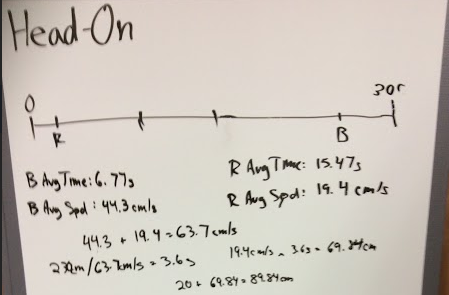
Today was Dueling Buggies! I’ve been emphasizing position vs. time graphs, so I wasn’t surprised that a lot of students went that direction. There were a lot of other interesting solutions, though. One of my favorites was a group who added the speeds of the two buggies, then divided the initial distance between the buggies by the combined speed to get the collision time, which allowed them to find the position. I was pleased to see that students were intrigued by the variety of solutions, and several wanted to talk to groups who’d done things differently after they turned in their whiteboards. Students also readily recognized that every group had a useful approach since every group made an accurate prediction.

whiteboard2