Day 62: Mistakes Game & Balancing Reactions

Physics: Mistakes Game

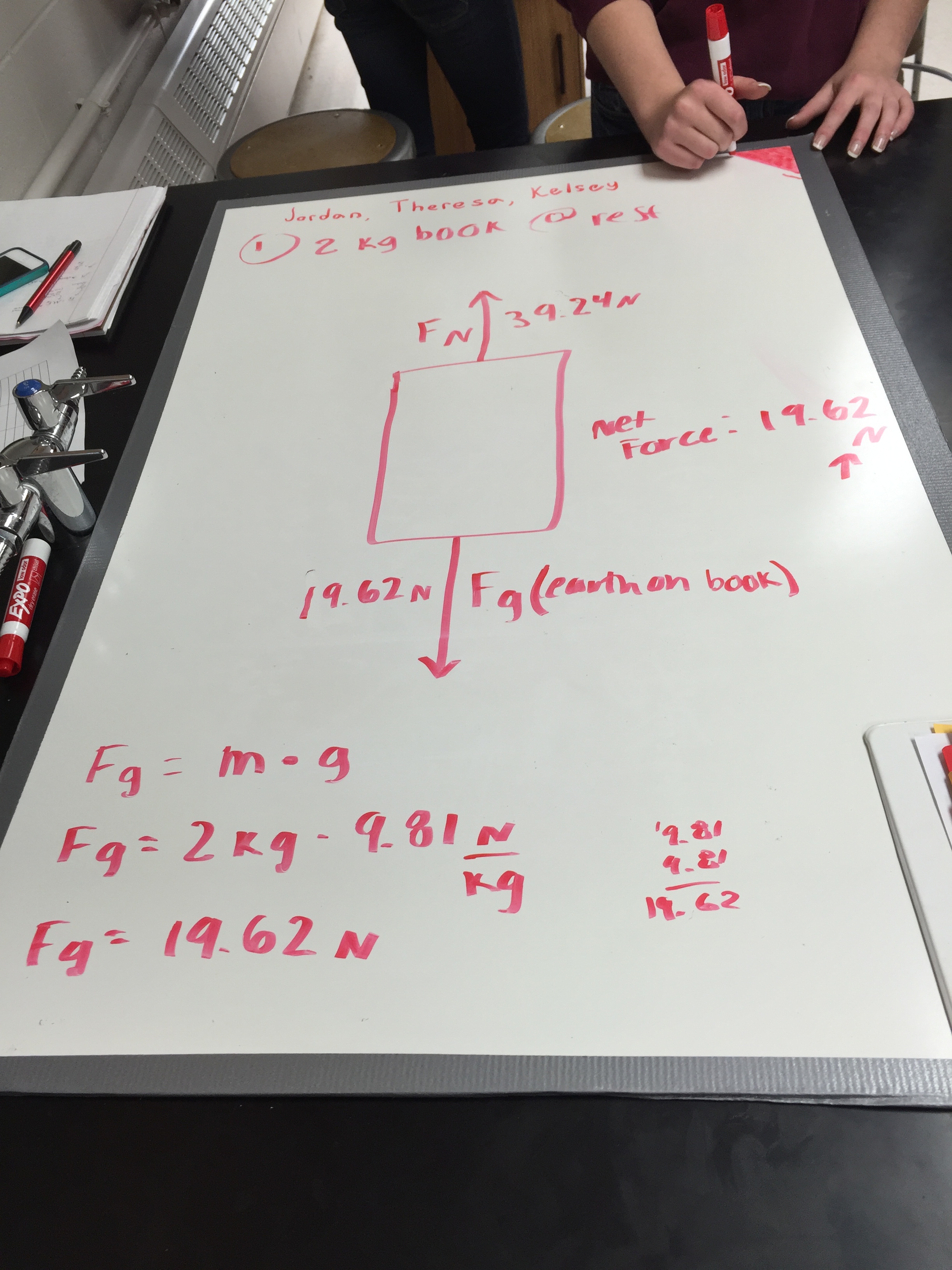
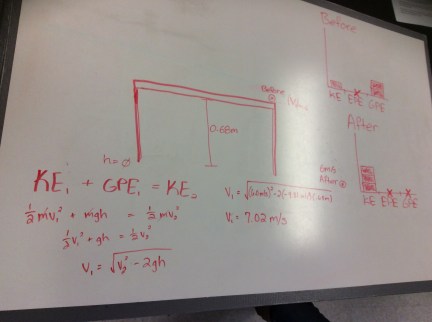
We played the mistakes game with yesterday’s conservation of energy problems. For students who had the other physics teacher last trimester, this was their first experience with the mistakes game. I was pleased with the way the students I had last tri took the lead, helping their peers come up with interesting mistakes and modeling good questions.
IMG_0317

The mistake is a subtle sign error, but lead to some great discussion about determining whether an answer is reasonable.

Chemistry: Intro to Balancing Chemical Equations

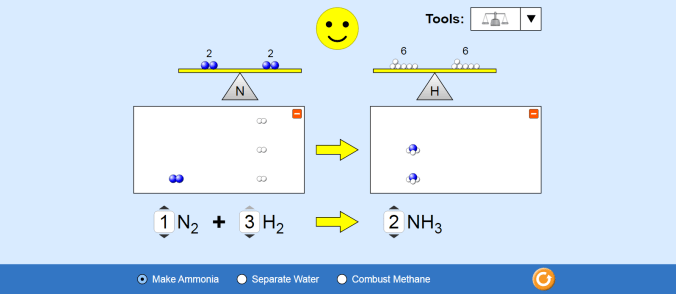
I took advantage of the visuals in PhET’s Balancing Chemical Equations sim to introduce my students to this process. I had them start by playing in the introduction to figure out what the different representations tell them about the chemical equation. After students had some time to play, we came back together. My students were able to articulate pretty clearly what it means for a reaction to be balanced, and what it has to do with conservation of mass. Students then spent some time testing their understanding by playing the game built into the simulation. Based on the conversations I overheard as they played, students were getting a much better understanding of not just how to balance chemical equations, but what all those numbers in the equation mean. I was also pleased to see the confidence my students gained while playing the game. I think a lot of them have started to assume they don’t understand things in the classroom, so seeing that immediate, consistently positive feedback from the game helped them see the way they’re thinking about these reactions really is useful.
phet balancing

Day 56: Final Review

Final exams start tomorrow, so both classes were reviewing.

Physical Science

Yesterday, students wrote questions for each of the learning targets from this trimester. Last night, I picked some of the questions they’d written to make a Jeopardy-style review game.

Physics

Each group put a problem from the review assignment on a whiteboard and presented it to the class. One of the best discussions happened when a group had a few unintentional mistakes on their whiteboard, which lead to a lot of great conversation about what the answers should be. It was also great to see the progress students have made at communicating what they did by showing their work clearly.

IMG_1488

Day 51: Color Intro & Collaborative Problem Solving

Physical Science: Color Intro

For the first half of the period today, my students presented their research projects on different energy sources. Once that was finished, we started on color. I started by having students watch a short video that I blatantly copied from Frank Noschese that shows red ink and red light through both red and blue filters. I like the video because I can show all my students at once and I like having my own version so students can look at the clock and paper I used in the video to verify I wasn’t using some kind of trickery. I asked students to record their observations from the video, then try to come up with a hypothesis to explain their observations. This lead nicely into a lab where students look at things through filter paddles. Once students finish the lab, we’ll revisit the video to see how their explanation has changed.

Physics: Collaborative Problem Solving

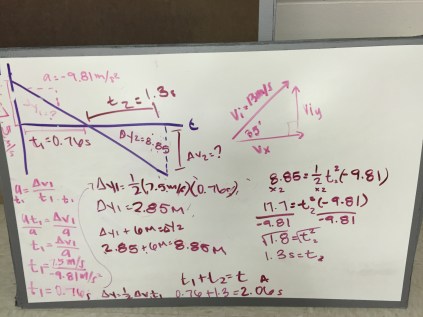
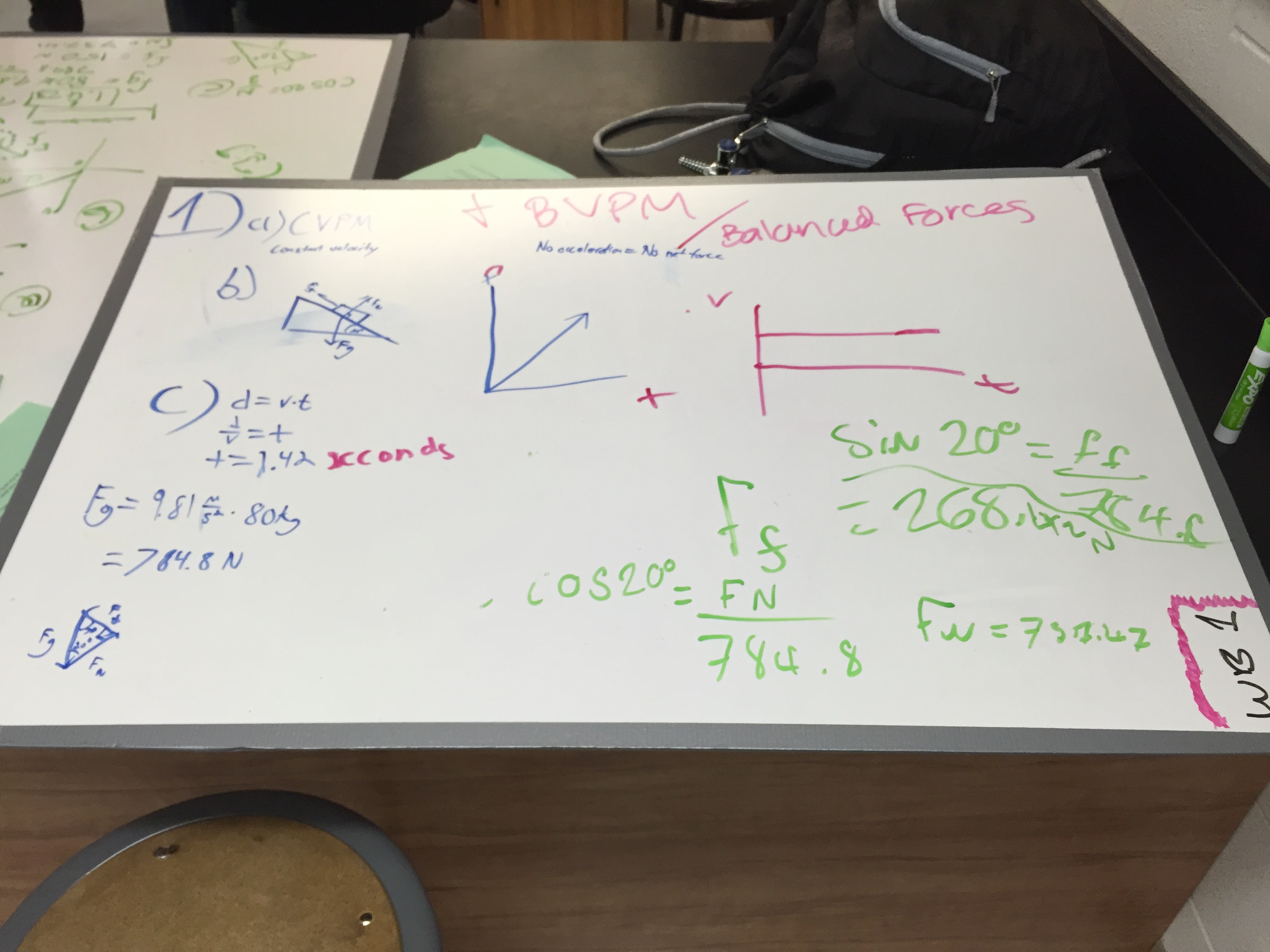
I took a problem from Casey Rutherford’s projectile motion packet about a block given a push up a ramp with friction, then allowed to fly off the end of the ramp to become a projectile. One of the things I love about this problem is it requires to students to use just about everything from the trimester. 2nd hour, students did whiteboard speed dating, but I put a couple of goal-less problems first so students didn’t have much time to work on it, but were intrigued enough by the problem that they asked to continue next week. 4th hour, I decided to start with that problem. I had students work in groups using the roles from the University of Minnesota’s Cooperative Group Problem Solving protocol. It took most of the hour, but students were consistently successful and even my top students were challenged. It was great to see the obvious pride when students finally got the correct answer.

IMG_1421

Day 50: EM Spectrum & Projectiles

Physical Science: EM Spectrum

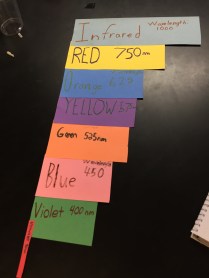
Students made a scale model of infrared through ultraviolet light where the length of the paper represented the wavelength of each type of light. I also had students do the calculations for how long a strip of paper would be needed to represent some other EM waves, including radio waves and gamma rays, just to give them a sense of the range the EM spectrum covers.

IMG_1415

One group decided to turn their model into a Stroop test

Physics: Projectile Problems

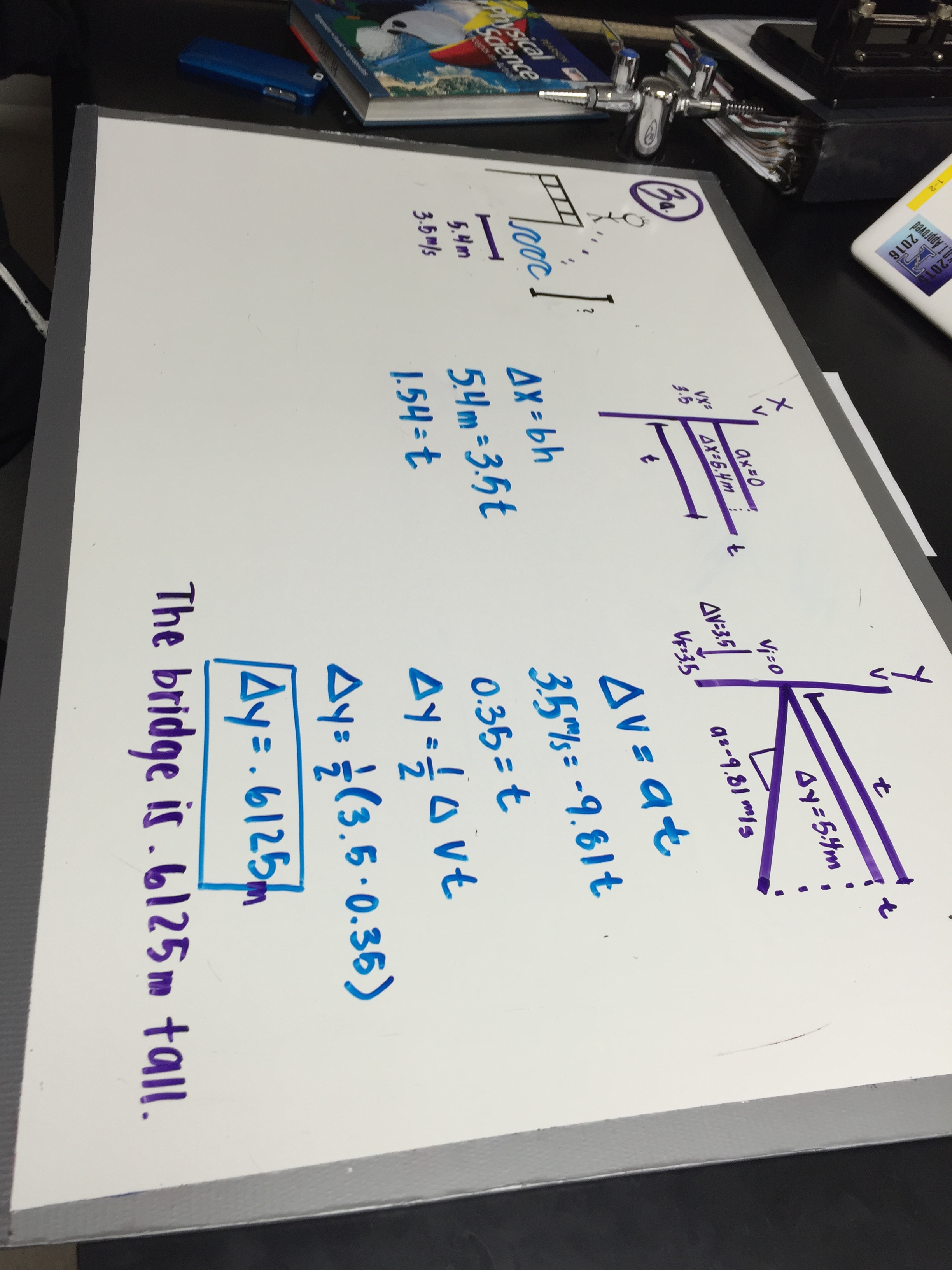
Students whiteboarded yesterday’s projectile problems. I’m really pleased by the way my students are not only solving the problems successfully, but gaining confidence on some challenging material.

IMG_1417

Day 48: Experimental Error & TIPERs Projectiles

Physical Science: Experimental Error

Students calculated the speed of sound based on the data they collected yesterday, then compared that to the expected result. Students found the speed using five different tuning forks, so we had some discussion about what it meant for those two different speeds to be close enough to be considered the same, which lead to some good conversation about experimental errors and why the values varied.

Physics: TIPERs Projectile Questions

I picked some questions out of TIPERs to help get my students thinking conceptually about projectiles. I was surprised at how many students struggled with a certain question where a ball is thrown upwards at two different speeds, and a student in the problem predicts that the faster projectile will reach the highest point first. Once I prompted students to sketch velocity vs. time graphs, the question ended up being pretty easy. It was a good reminder for my students to look at what tools they have, even when the problem isn’t about a calculation.

IMG_1405

The faster object reaches its highest point in more time!

Today’s quiz on projectiles launched horizontally also reminded me why I love standards-based grading. Several students have been really working on solving problems with constant velocity and constant acceleration, and finally showed mastery when they applied those skills to projectiles today. I loved being able to give them credit for all the skills they showed, not just the big idea on today’s quiz.

Day 46: Standing Waves & Mistakes Game

Physical Science: Standing Waves

Students made standing waves on snakey springs and looked for the pattern in how many wavelengths could fit. The lab went a lot faster than I expected, so we also had some qualitative discussion about “Keep in Time” from Direct Measurement Videos to introduce the idea that sound has a speed.

IMG_1368

Physics: Mistakes Game

Students whiteboarded yesterday’s problems for Kelly O’Shea’s Mistakes Game. Students are getting better at making meaningful mistakes and at asking good questions to reveal those mistakes.

IMG_1370 (1)

Day 40: Electromagnets & Mistakes Game

Physical Science: Electromagnets

Students built electromagnets and designed experiments to test the effect changing the number of coils has on the strength of the magnet. I also pulled out my homemade speaker for students to try out.

Physics: Mistakes Game

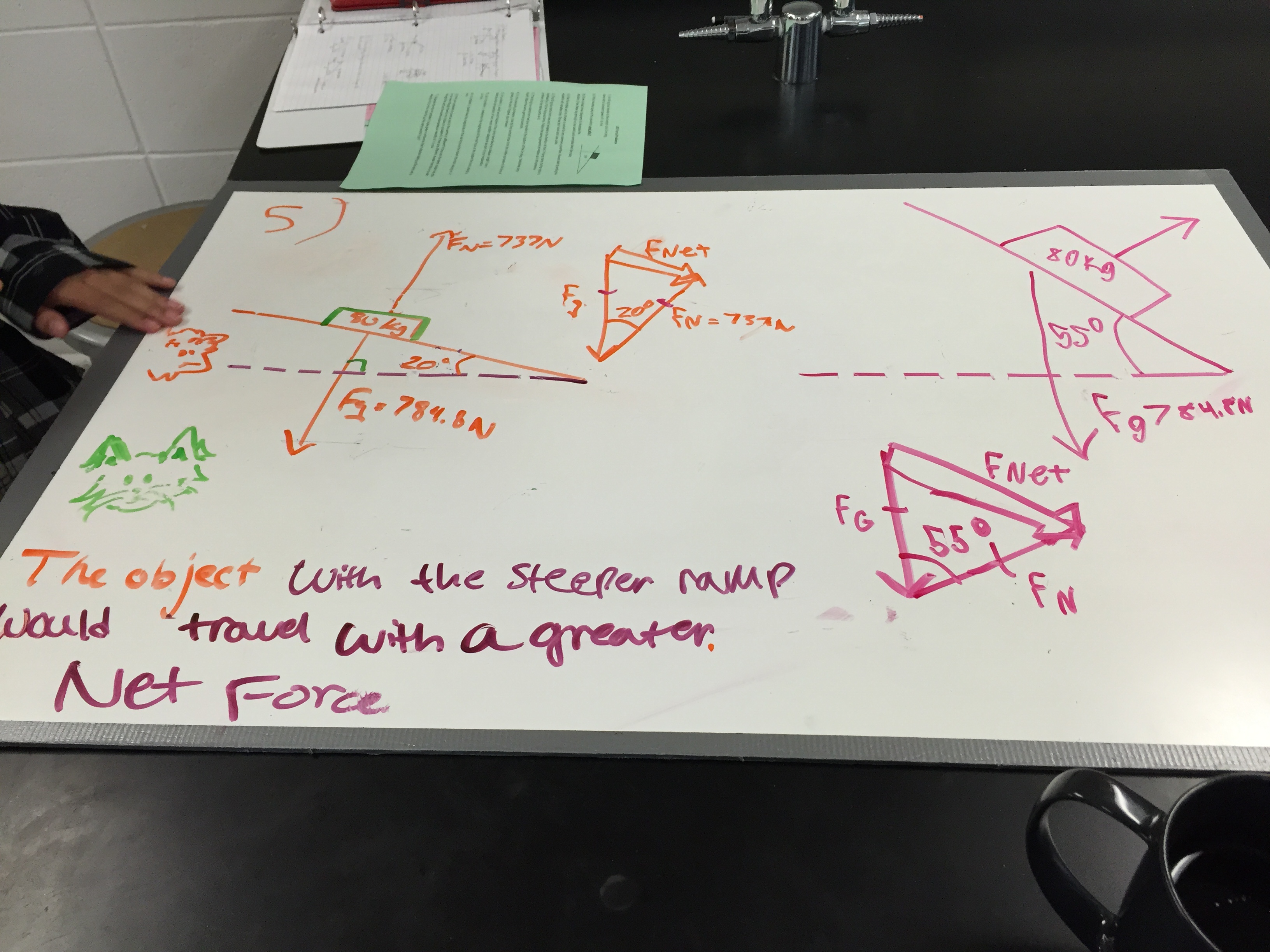
Students played the mistakes game with the diagrams for solving force problems. Once my students have their diagrams, they can get through the problems pretty easily, so I wanted them to focus on drawing and interpreting those diagrams.

IMG_1342

Day 39: Magnetic Fields & 2D Forces

Physical Science: Magnetic Fields

My students have gotten really good at looking at new content in terms of energy, so I put together an assignment to compare topographic maps as a measure of gravitational potential to magnetic field lines as a measure of magnetic potential. The assignment needs some revisions, but I like the basic premise and my students definitely understand magnetic field lines much better than my students have in the past.

Physics: 2D Forces

A lot of students were on a field trip yesterday, so we used whiteboard speed dating to go over yesterday’s problems. Based on what I saw and heard, students have these problems down better than they give themselves credit for. I’m thinking about how I can adjust my plans tomorrow to help students feel more confident with the material without resorting to me doing an example at the board.

IMG_1340 (1)

Day 30: Static Electricity & Mistakes Game

Physical Science: Static Electricity

Students did a lab with pith balls and charged rods to begin exploring static electricity. The lab is much more directed than I’d like, but my students have gotten so used to more open-ended labs that they were quick to latch onto interesting observations and were eager to go beyond the directions to try to make sense of their observations. My students are awesome.

IMG_1314

Physics: Mistakes Game

We played the Mistakes Game with some problems students worked on yesterday. Students have been embracing this approach to whiteboarding problems and are good about using their own actual mistakes when they make the whiteboards. My favorite moments, however, are when someone points out an unintentional mistake. The group presenting will usually admit it was unintentional and the rest of the class will happily discuss it without judgement. They’ve really embraced mistakes as an important and valuable part of the learning process. Its worth saying again that my students are awesome.

IMG_1315

Day 23: Design Testing & Free Fall Practical

Physical Science: Design Testing

Today, all of my students were early and anxious for class to start. They knew that we’d be loading up their designs with eggs, then sending them down ramps to see how they did. At the end of the hour, we had a brief, but good, discussion about what it could mean to have the “best” design and the limits of the single test we used. This discussion will provide some good groundwork for our second round of designing and building.

Physics: Free Fall Practical

Students had two tasks today. For both tasks, I assigned students roles from the University of Minnesota’s cooperative group problem-solving process. First, they did a practical on free fall. Each group was given a time, and had to place tape on a strip of acrylic so that a photogate would measure the time they drew when they dropped their acrylic.

One group's solution to the practical

One group’s solution to the practical

Once groups had tested their result, they worked on XKCD’s Substitute Problem. While most groups decided to chug through the algebra, there was one that used Desmos to find the intersection of the position vs. time graphs.

One group's solution to the sub problem

One group’s solution to the sub problem