Day 132: Closed Pipes & Percent Yield

Physics: Closed Pipes

Students whiteboarded their results from yesterday’s lab and we discussed the results. Afterward, students started working on finding a relationship between wavelength and the length of an air column needed for a standing wave, using the speed of sound from the video to get the wavelength of a tuning fork.

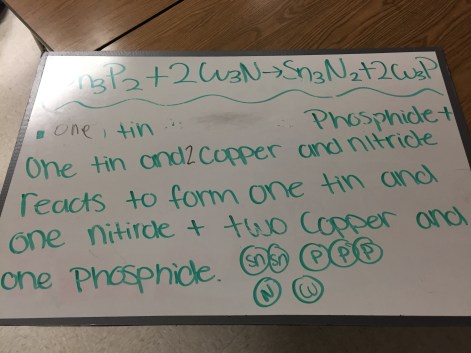
Chemistry: Percent Yield

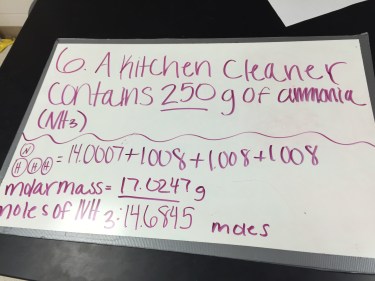
I introduced the concept of percent yield and students started working through some problems. They also took a quiz on stoichiometry, which didn’t go as well as I hoped. Looking at their work, I think a lot of students lost track of what all the different numbers mean, so I’m tweaking some lessons for later this week to try and get back to the physical meaning of the numbers they are using.

Day 131: Speed of Sound & Speed Dating

Physics: Speed of Sound

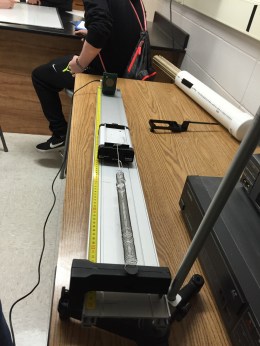
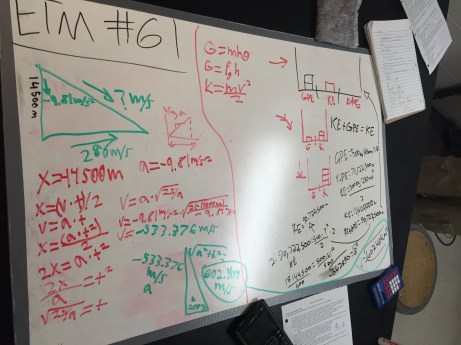
After some time playing with the wave generator to confirm Thursday’s lab results, students used a Direct Measurement Video to produce a position vs. time graph and find the speed of sound. Tomorrow, they’ll put that speed to use in closed pipe resonators.

speed of sound DMV.PNG


Chemistry: Speed Dating

Students needed just a little more practice to firm up their stoichiometry skills, so we did some whiteboard speed dating with problems similar to what will be on tomorrow’s quiz. I was really pleased at the number of groups who were really talking through problems , taking turns with the marker, and taking other steps to ensure that both students really understood what was going on.

Day 129: Wave Superposition & Stoich

Physics: Wave Superposition

We spent some time discussing the observations students had made about wave superposition yesterday. There was some good debate about whether pulses were reflecting off each other or passing through each other. Students then practiced sketching superpositions based on the original waves.

IMG_1788

Chemistry: Stoich

We spent some time discussing the lab students did yesterday and really focused on how they knew when and what to multiply or divide. We also spent some time explicitly discussing what the hardware represented and how what they were doing was similar to a chemical reaction. Afterwards, I gave students some more traditional problems using actual chemical reactions.

IMG_1785

Day 127: Wave Equation & Molar Mass

Physics: Wave Equation

Students used snakey springs data for a relationship between wavelength and frequency and made graphs. I’d hoped to share the graphs today, but there just wasn’t enough time. They spent a lot longer than last year’s students figuring out how to measure the wavelength. Last year, the weather was nice enough to do the lab outside, and a lot of groups found ways to use their spring’s shadow to mark key points on the ground. Today, we had snow, so were stuck doing the lab inside. Students were quick to recognize, based on the units, that the slope of their linearized graph was the speed of the wave.

Chemistry: Molar Mass Practice

Students worked on some practice molar mass problems, then whiteboarded solutions for a gallery walk. A lot of students initially struggled going from a measured mass to a number of moles, but when I asked students to think back to the lab they did a few days ago and tell me how they would figure out how many bolts I had if all they knew was the mass, things clicked pretty quickly.

IMG_1782

Day 125: Mistakes Game & Molar Mass

Physics: Mistakes Game

Students whiteboarded yesterday’s problems including at least one mistake. Its been a little while since I last had students do this, and a lot of students were excited to do it again.

IMG_1771

Since everything we’ve done so far has been vertical springs, I sent up a ramp with a cart attatched to a spring so we could look at position vs. time graphs compare the period at different angles as a way to see how “changing gravity” affects the spring’s period. In spite of having the equation, a lot of students expected gravity to matter because they thought there had to be a force to de-compress, not recognizing that the spring could exert that force since we’ve mostly looked at stretching springs.

IMG_1770

Chemistry: Molar Mass Introduction

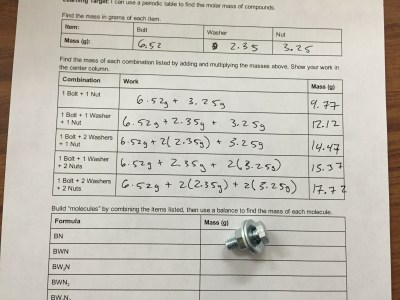
Students got the mass of individual nuts, bolts, and washers, then predicted the masses of various combinations. Compared to last trimester, I took some extra time debriefing after the lab and tried to be very explicit that the hardware was being used to represent individual atoms, since we can’t observe individual atoms directly.

IMG_1768

Day 124: Spring Problems & Mistakes Game

Physics: Spring Problems

Students worked through a Modeling Instruction worksheet using forces and energy to analyze the motion of a spring. The worksheet has students define h = 0 in a way that gives a negative gravitational potential energy at one extreme of the spring’s oscillation, and my students struggled with what a negative potential means. Both for cases like this and for negative electric potential differences, I need to adjust my energy unit to include some scenarios with negative energies.

Chemistry: Mistakes Game

Students whiteboarded yesterday’s problems balancing chemical equations, including intentional mistakes to help spur discussion. A lot of students were gone yesterday for a blood drive, and this seemed to help them get caught up. Tomorrow, they’ll be taking a quiz on balancing, so I took some time during class to do a practice problem under quiz-like conditions. Last tri, the chemistry students who did poorly in the class tended to have trouble self-assessing and would equate having an answer with understanding the problem, even when the answer was just copied from a classmate. I have some students who look like they could go down the same path this tri and, after the practice quiz, they were interested in how to improve their understanding before tomorrow’s quiz. While this is a step in the right direction, my real challenge is to help these students self-assess much earlier in hopes of helping them shift their habits in my class.

Day 121: Pendulums & Quiz

Today was the last day of classes before spring break.

Physics: Pendulums

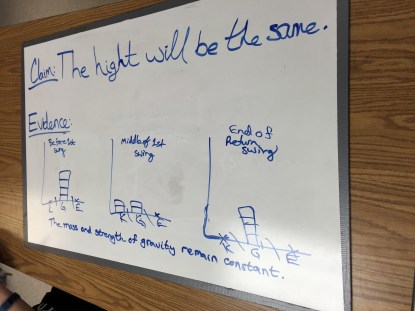
Before their quiz, I had students make predictions about a few different pendulums. First, they predicted how the maximum height on the return swing should compare to the starting height, then they made some predictions about a pendulum that uses a magnet to pick up a steel sphere at its lowest point, and finally we used a hover disc on a tilted table as a pendulum and students made predictions about what happens when the table’s angle changes.

IMG_1747

Chemistry: Quiz

Students took their first assessment of the course on representing reactions.

Day 120: Pendulum Motion Graphs & Mistakes Game

Physics: Pendulum Motion Graphs

Students whiteboarded their answers to yesterday’s worksheet. They did a nice job of using energy bar charts and free body diagrams to make predictions about what the position vs. time, velocity vs. time, and acceleration vs. time graphs should look like. We put a pendulum in front of a motion detector to get a look at the actual graphs and used both the formula and the graphs to determine the period of the pendulum.

Chemistry: Mistakes Game

Students whiteboarded their solutions to yesterday’s problem, including at least one intentional mistake. I ended up splitting each problem between groups, so one group did the statement, one did a diagram of the reactants, and one did a diagram of the products. I wish I’d had each group do a whole problem, then just limited how many present, since multiple representations gives room for richer mistakes.

IMG_1740

A partially corrected whiteboard

Day 114: Gallery Walk

Tomorrow is the start of final exams, so both classes today went over their final review assignments. I decided to go with a gallery walk, with each group preparing a whiteboard for a different problem. Then, one member of each group stayed put to answer questions while the others moved around the room to check out the other whiteboards. Especially in my largest class, I really like that the gallery walk gets more students involved in the conversation. A few students decided to play the “reverse mistakes game” during the gallery walk by pretending to hold a misconception as they asked questions at a whiteboard.

IMG_1730

This group asked if they could try their problem with both constant acceleration and energy transfer.


Day 112: Final Review

We’re down to three class periods before finals (possibly two, if the basketball team makes the state tournament). In both of my courses, we started the final review. While both reviews were pretty similar, it was interesting to contrast how my two classes approached it. In physics, students were quick to grab whiteboards to collaborate on and pull out old quizzes and other work to jog their memory. I also saw a lot of students jumping around in the assignment, looking for the problems and questions they found most challenging to use those as a starting point. In chemistry, we talked about strategies to prioritize what to work on, but most students took a very linear approach and only a few pulled out work from earlier in the term. I saw much more variation in how students approached working together. Two students in particular did a really nice job of bouncing ideas off each other and challenging the other one’s thinking, but other groups “worked together” by agreeing to divide up who would do what portions of the review. No one opted to use a whiteboard for brainstorming and collaborating; when I asked some students about it, they saw it as extra work since they would have to transfer their work onto their paper.IMG_1713

Contrasting these classes really reinforced for me how important it is to work with students in this chemistry course on how to be a student. In physics, I have some of the top students in the school and they come to me expecting that they need to understand the daily work to do well on assessments and knowing that having the right answer down is very different from understanding how to answer the question. Many of my chemistry students don’t see that connection between assessments and what happens day-to-day, so don’t value the daily work as much. I need to keep working on making the value of daily work explicit to my students. There are a few who’ve bought into the idea that what they do today influences how their test will go, and they tell me chemistry is one of their highest grades. My challenge for next tri is to get more students to that point.