This was our second week of virtual instruction. We are slated to be back in person on Monday.
Physics: Impulse Problems
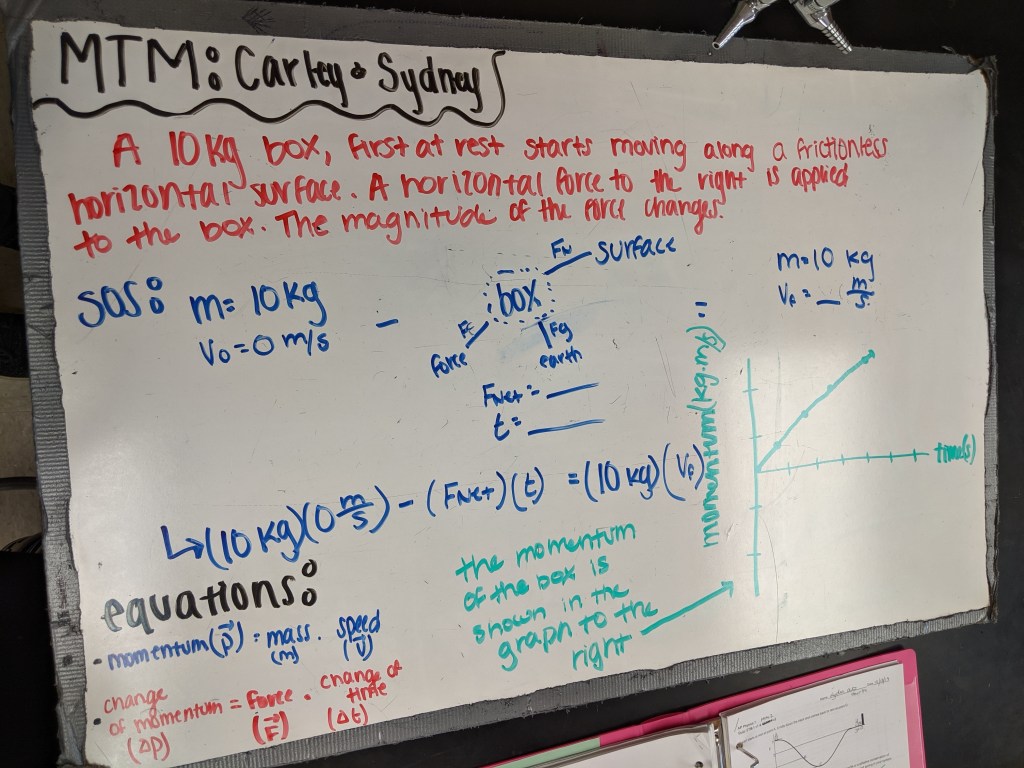
Students worked on problems using the impulse-momentum theorem. I noticed that a lot of students were struggling to retain new information much more than usual, which made the problems relatively challenging. I’m sure some of it is a lot of students are less focused right now than in the classroom (at least some of them for very good reasons, like helping take care of younger siblings that are also at home), but I it’s also a factor that I didn’t make much effort to encourage student-to-student discussion and I did more providing new information than usual, rather than simply stepping in to put language or standard formulas to things students had already said. I’m not beating myself up for it since those things are difficult online in the best of circumstances, and I was doing it with minimal time to prepare and no prior experience teaching high school online. But it is a good reminder that the time I spend on those things in the classroom is important. While we have done versions of everything we normally do before the impulse quiz, I’ll be taking a few days next week to have some in-person discussions before we assess for the first time.
AP Physics: Conservation of Energy Problems
Right before my school switched to remote instruction, my students started working some problems using conservation of energy. We didn’t get a chance to whiteboard or discuss the problems, so we revisited them this week. My students had some good conversation using Jamboards and a discussion forum and seem to be doing pretty well with conservation of energy problems. I still want to do some in-person whiteboarding before we assess to get a better sense of where students are at since there are a few who’ve shared they are having some of the same trouble focusing I saw in Physics. I’ve got some problems from the AP Physics 1 workbook that I think will be good for this purpose.
Around mid-day last Friday, we found out enough staff were out (almost all with COVID) that we would be remote this week. Monday was an asynchronous day so that teachers could post an assignment, then spend the rest of the day planning for the rest of the week. The rest of the week was synchronous following our usual bell schedule. We were required to have some synchronous instruction at the start of each hour, but were encouraged to make the rest of the hour something that students could do away from Zoom. In both my courses, I stuck to activities that should be doable in class time, but made them due at midnight rather than the end of class. I got really positive feedback from students since that gave them the option to take a break from their screen and do their physics later, especially for my classes in the middle of the day. That also meant I had time to look over their work before school and make some adjustments to the instruction I’d planned for the day. I think being transparent about how student work was informing my instruction also helped with work completion, since it gave students a clear reason to at least attempt the work on the day it was assigned.
Near the end of the school day on Thursday, we found out that next week will be remote, as well. Next week, I want to keep the same general structure since that seemed to work well for both me and for my students, but I want to try and get a little more student-to-student discussion.
Physics: Impulse
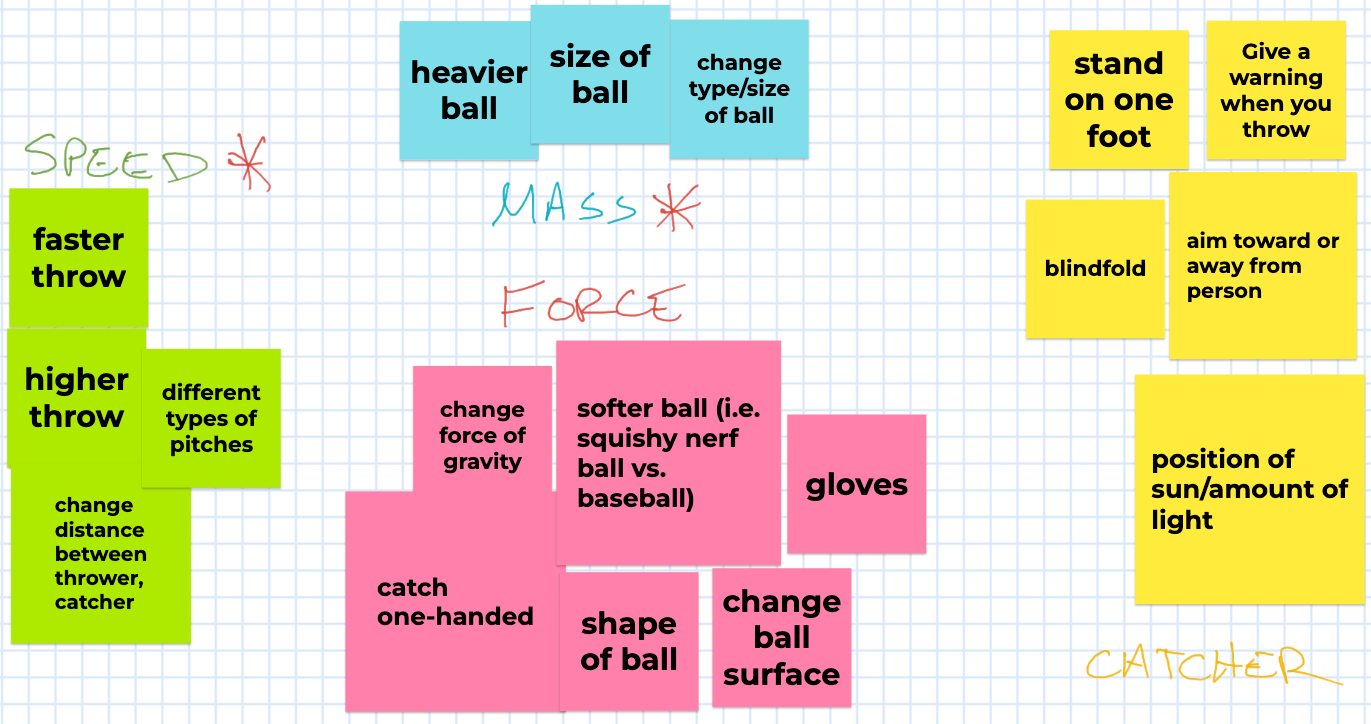
Our plan this week had been to introduce momentum and impulse. We normally start with a cart catching activity, where students find as many ways as possible to make it harder to catch a cart. That translated fairly well to an asynchronous lesson for Monday where we asked students to brainstorm ways they could change how difficult it was to catch a ball during a game of catch. I put all of the responses onto a Jamboard and did some sorting, which lead very nicely into a definition of momentum as well as the idea that force can chance momentum.
The rest of the week we relied heavily on Pivot Interactives (disclaimer: I work for Pivot Interactives writing activities). We started by introducing Newton’s 3rd Law, which we’d decided to save for momentum this year since that’s when students seem to do the most interesting and useful thinking with it, then did an activity where students evaluate two competing claims about what is transferred in a collision between two gliders on an air track. We haven’t done many of those kinds of questions this year, so students needed some support in figuring out what kind of evidence they needed, but it was mostly a matter of keeping them focused on the claim and not overcomplicating what to collect. The bit that got a little rocky is I tried to go from there to the impulse equation, which just didn’t flow naturally. I’ve thought about changing my momentum storyline to start with conservation, then narrow our focus to the individual objects that make up the system to look at impulse. In retrospect, a part of me wishes we’d made the leap when we switched to remote instruction since I think that storyline would have flowed better with the resources available to us, but sticking with the storyline we’d already planned took less thinking and will likely make for a smoother transition when we get back to in-person instruction.
AP Physics 1: Bouncy Ball Energy
As part of my energy unit, I’d planned to do an activity (shameless plug for my article on this activity in The Science Teacher) where students use video analysis to decide whether a bouncy ball dissipates energy primarily due to air resistance or due to the impact when it bounces. The hard part of this activity is prior to the video analysis, I have students do some whiteboarding where they sketch representations including LOL diagrams, free-body diagrams, and velocity vs. time graphs for the bouncy ball-Earth system first assuming only air resistance dissipates energy, then assuming only the impact dissipates energy. I ended up using a version of this activity I wrote for Pivot Interactives that replaces that whiteboarding with multiple choice questions. I have struggled this year with helping my students effectively use diagrams as thinking tools, so I think having them choose from a set of diagrams was a useful scaffold. I had the questions set to autograde, which made it easy for students to progress asynchronously, but I think some good discussion could have happened if I’d turned off autograding and instead had students use our synchronous time to discuss their answers and come to a consensus.
This week has felt a little weird. Coming back from break, we’d gotten some messages to be ready to shift to virtual learning and all week the number of students and staff out went up, so everyone felt like we were in limbo. Near the end of my teaching day today, we got word that next week will be remote.
Physics: Values & Beliefs About Physics Learning
We started this week with a version of the values and beliefs lesson from Kelly O’Shea. There wasn’t as much discussion within groups as I was hoping (and it probably didn’t help that I was giving groups more space than usual to try and reduce my COVID exposure), but students had some great insights and really interesting things to say on the individual reflections I had them complete. One thing I felt like was missing in how I implemented this was some conversations about the costs and benefits of different views of physics and physics learning. One of the last things I had students do in their groups was pick some values or beliefs they think we should aspire to, and a lot of groups said we should aspire to do a better job of valuing memorizing facts and equations. I wonder if giving more space to why certain values and beliefs are or are not given a space in a particular classroom would have helped with some conversation about why they see memorizing as important and whether that is compatible with our classroom.
After two days of that, we spent the rest of the week on some problems about pushing cardboard boxes based on problems in Matt Greenwolfe’s More Models in Modeling materials. My goal was to refresh students on velocity vs. time graphs and free-body diagrams before we dive into momentum. There was a lot of great discussion, with lots of animated arguments. I was also really pleased at how often I could have students simply add a diagram, such as a system schema, to identify and fix their mistakes. I still need to work on how to facilitate a good whole class discussion with these problems, but I think part of the issue is I approach these problems with what I call consensus-building discussions, where I have every group whiteboard the same problem, then we try to resolve differences, but I don’t do this type of discussion very often so students don’t have much practice with it.
AP Physics 1: Energy
This week, we focused on going from LOL diagrams to doing calculations with conservation of energy. We started by doing a lab to find the equation for spring potential energy, which gives us all of the major energy types, then did a card sort that included equations based on just the types of energy and equations based on measurable quantities like velocity, mass, and height. The card sort made for a very nice bridge between the two types of mathematical representations.
I think last week is the first time I missed a post on this blog. The end of my grad school semester plus the usual challenges of the Thanksgiving to winter break stretch got the best of me.
Physics: Unbalanced Forces
Last week, we did a paradigm lab for unbalanced forces. I was really dreading the classic half-Atwood machine, so tried a lab Kelly O’Shea suggested. We set up a ramp, then used a string to connect a cart to a force sensor. Next, I cut the string and students observed that the cart accelerated down the ramp. Students were able to reason out that the tension in the string before it was cut must match how unbalanced the forces on the cart are after the string is cut. Students also were quick to recognize that we could change the tension in the string by changing the angle of the ramp. Students then went and collected data to find a relationship between the size of the unbalanced force and the acceleration of the cart. Compared to the half-Atwood, students had a much clearer conceptual understanding of the lab and the data was much cleaner, so I will be sticking with this approach.
This week, we introduced problems by starting with a card sort where students matched a situation to the motion map, free-body diagram, and vector addition diagram. The acceleration arrows on the motion maps seemed to help students with thinking about the direction of the net force, though a lot of students needed some prompting to use the motion maps. I think that is because they haven’t been a very meaningful sensemaking tool in my class before now. If I want students to be ready to use them with unbalanced forces, I need to give some thought to how I’m going to push students to make meaning from motion maps when they are first introduced.
AP Physics 1: Conservation of Momentum & LOL Diagrams
Last week, we worked on conservation of momentum. I introduced momentum bar charts so we could do some problems from the College Board’s AP Physics 1 workbook. They seemed to really help students, so I wish I’d introduced them much earlier. Students ended up not making much connection between the problems we’d done earlier and the momentum bar charts, so I think I needed to introduce the bar charts right off the bat. The quiz didn’t go as well as I would have liked, but next week’s quiz will include a retake. I’m thinking about what I want to build into class next week as a way to address the gaps I saw on the quiz.
This week, we’ve been focused on energy bar charts and LOL diagrams. We did a lab I’ve done in the past where students raise a cart to the same height above the table using ramps of different angles to see the force vs. distance graph always has the same area. After that, I defined the major forms of energy we’ll be dealing with and students practiced drawing energy bar charts, including for situations where they switch between systems. These are coming really easily to my students and we had some great discussions using mistakes whiteboarding on some bar chart problems. The big challenge will be helping my students revisit these ideas after break.
We are almost at the end of the trimester! Both classes wrapped up a topic, then started reviewing for the final.
Physics: Constant Acceleration & Balanced Forces
Students worked on a packet of problems. One nice thing is many students were working more independently than usual, so it was easier for me to give more intensive support to students who’ve been struggling. It was really great to see how many students had moments where something we’ve been working on finally clicked.
AP Physics 1: Model Summaries
We started the final review with model summaries, where each group takes a model from so far this year and prepares a whiteboard with the major representations including graphs, diagrams, and equations. My students didn’t have as strong a positive response this year as in the past, and I think that is probably related to some conversations I had this week where students weren’t aware that this class is organized by models. This tells me I need to get more intentional about using that language if I want students to think in terms of what models we have.
This week was mostly about working problems using the constant acceleration model, which I have students do almost entirely from velocity vs. time graphs. We started with some problems I got from Kelly O’Shea where students are given some velocity vs. time graphs they annotate and write area equations for. Next, we shifted to word problems. I was blown away by how easy these problems were for students. Doing calculations with the constant velocity model had been very challenging for a lot of students, but something really clicked this week. Students were even including units on all of their work with almost no prompting and showing their work really clearly. I’m not sure what it was, but it was nice to have a week where students were nailing what I gave them!
AP Physics: Force Equations
We did labs to find the equations for the force of gravity and for spring force. Most years, my students are most comfortable with mathematical representations and it’s a challenge to get them comfortable with other representations, but this year my students are defaulting to other representations in some really cool ways. At this point in the year, when I have groups make a graph on a whiteboard, they usually default to including an equation for the line of best fit whether or not I ask for it. Instead, my students this year have been writing “for every” statements about their slope unprompted. For example, on the force of gravity lab, every group wrote some variation of “The force goes up 10 N for every 1 kg” on their own. That tells me that my students find the “for every” statements useful and intuitive, which is a great place to be developing physics knowledge from.
This week we did a lot of practicing with constant acceleration diagrams. The highlight was doing mistakes whiteboarding. Based on a recent conversation with Kelly O’Shea, I was much more explicit that the role of the group presenting is merely to facilitate the discussion while the role of the rest of us is to help them get to the right answer. In two of my classes, this seemed to be really freeing for a lot of groups as they presented, and lots of students were quick to ask their peers to justify changes to the whiteboard when they were presenting. There was also some fantastic back and forth where the students who weren’t presenting disagreed about what to change on a whiteboard and had exactly the kind of discussion I’m after with mistakes whiteboarding. In my third section, the discussion was still pretty rough, so I need to give more thought to how I can support them in having deeper student-to-student discussions.
AP Physics 1: Free-Body Diagrams
This week we focused on drawing system schema and free-body diagrams. I was reminded how much I love framing forces in terms of interactions and the discussion that comes out of even the very basic free-body diagram problem set in the Modeling Instruction materials. I love that on a problem about a skater sliding across frictionless ice at a constant velocity, I get to hear students internalize Newton’s 1st Law as they wrestle with what interaction could be giving the skater a forward force. This year, my students also got into Newton’s 3rd Law during the discussion as one student pointed out the ice is pushed downward by the skater’s foot, so the class wrestled with how that impacts the normal force before agreeing that same interaction pushes the skater up and the ice down. We also did Kelly O’Shea’s force diagrams card sort, which I use as students’ first introduction to vector addition diagrams. I was really pleased by how easily they connected the vector addition diagrams to the free-body diagrams and by how they started contrasting balanced and unbalanced force scenarios with minimal input from me.
This year has felt unusually draining so far, but my students are doing some great work in my class and reminding me why this job is worth it.
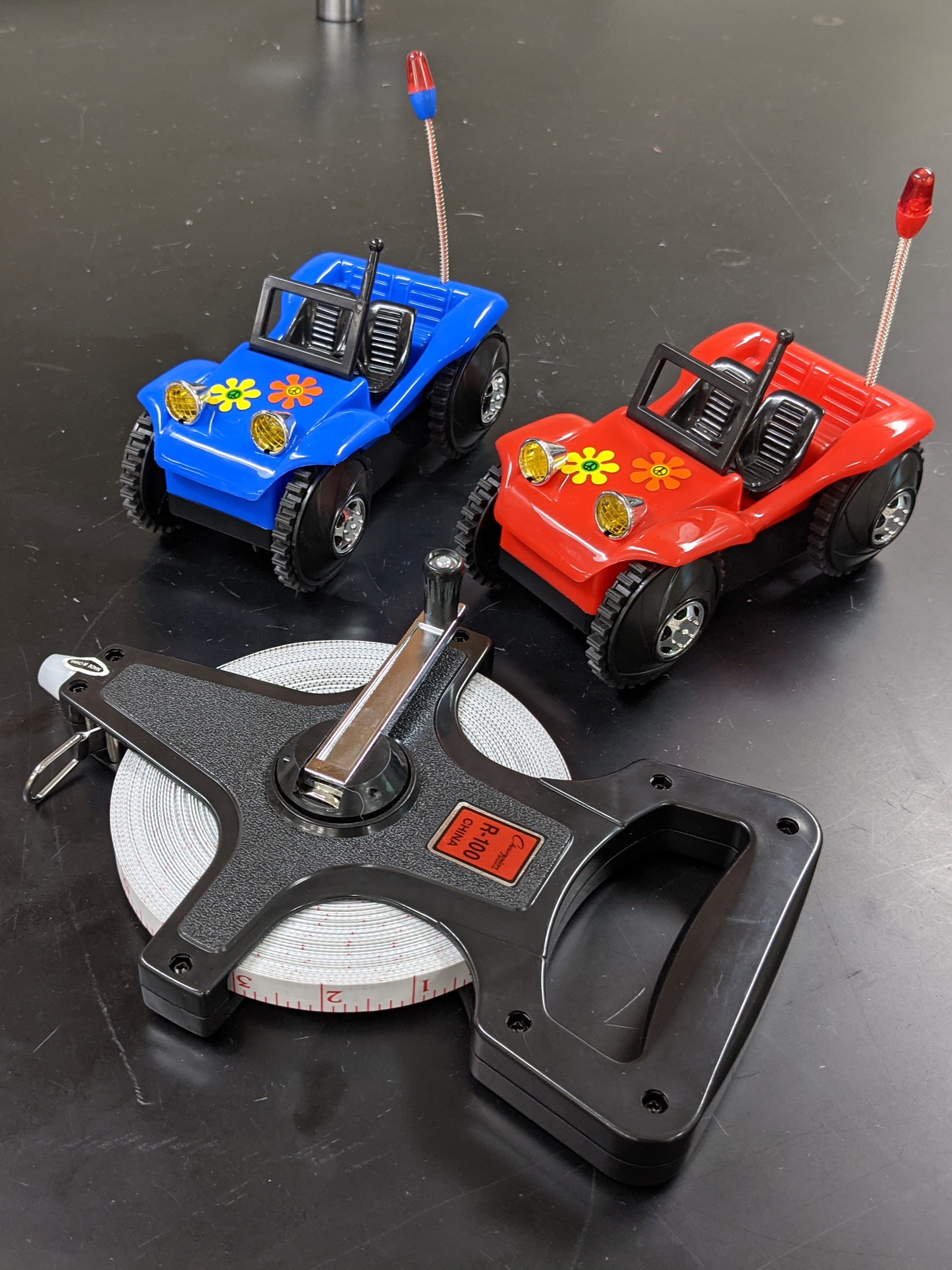
For the second week in a row, students did a lot of problems on paper and whiteboards. This week, the focus was on using constant velocity representations for calculations. I like the way we gradually add complexity to the model and students definetly need time to practice and discuss, but this has felt like a long stretch where students are doing mostly one kind of activity. I think next year I want to look at our storyline for the unit to see if we can break up the problems a bit with the dueling buggies lab practical, video analysis, and other activities that have a different feel. We also added more problems to our packet a few years ago, so students first work through what we consider the core problems, which includes problems where students are working out how to apply what they found in the lab to the written problems. We found students often didn’t have a lot of confidence after just these problems, so we added a second problem set to the constant velocity packets that are mostly about practicing what students have already figured out. I’m wondering if there are ways we could approach the early problems differently to help students build more confidence and how we could reimagine the second set of problems to focus more on lab practical types of activity.
AP Physics 1
This week was all about constant acceleration representations. We purchased some motion encoder systems last spring, so I used them to have students do a lot more exploring the graphs for ramps than I normally do. My students are getting direction on position vs. time and velocity vs. time graphs much more easily than my students usually do, and I think the tracks are helping a lot. It is still challenging for some students to visualize what is happening to the slope of a position vs. time graph to predict what the velocity vs. time graph will look like, but their struggles are pretty consistent with what I see at this point in the year, so I trust that they will get it down.
I also have a single, very small section and, while I’m sad that more students aren’t taking AP Physics 1, I am really enjoying how cohesive this class is. During mistakes whiteboarding, the students presenting have been admitting unintentional mistakes and the students not presenting have been asking questions about things they don’t understand but don’t think are mistakes, both of which are signs of the kind of class culture I strive for.
This week, both of my classes spent a lot of time working problems to practice translating between different representations of constant velocity. In Physics, velocity vs. time graphs seemed to either click immediately for students, or to be a big struggle. Usually, I have a lot more students with an experience somewhere in between. Regardless, by the end of the week even the students who found velocity vs. time graphs really challenging were getting the hang of them. In my AP Physics 1 class, most students seemed to be in a place where the velocity vs. time graphs were clicking pretty quickly.
AP Physics 1 also was able to do the dueling buggies lab practical. We had some great conversation about the sources of uncertainty in their predictions. Each group took a different approach, but got the same predictions for where the collision would happen, which is always fantastic. I’m also starting to see more of my students’ personalities in this class, which is making this class a lot of fun. AP is a lot smaller than my Physics classes, so I’m not surprised that is starting to feel like a cohesive class sooner than Physics.
This week, I also had a lot more conversations than usual with students who said they “aren’t a science person” or “aren’t good at science”. I suspect some of it is rooted in all the challenges of what science classes looked like last year, but that doesn’t make it any less important for me to address. I’ve been slow to start discussions of what skills groups needed to complete a task, but I need to make sure I’m making time for those. I also found myself telling students if their answers were right a lot more than usual in order to help them get some immediate confidence to keep them moving forward on problems, but the downside is it really limits the discussion students have once one of them knows they have the right answer. I need to figure out how I’m going to balance the need to keep the door open for student discussion with how I’m going to help students feel more confident in my classroom.
Next week are trimester 2 final exams, so after wrapping up our last topic of the term, both my courses started reviewing for the final exam.
AP Physics 1: Model Summaries & AP Classroom
I’m generally skeptical of typical final review activities, but I really like starting with model summaries. I gave each group one of the major models from so far this year and asked them to prepare a whiteboard with the key diagrams, equations, and other representations for their model. A lot of groups found it helpful to start by coming up with a scenario where the model would be useful. Students really responded to the idea that a model is a toolkit, and the model summary is a reminder of the tools in that toolkit.
After the model summaries, I had students go on AP Classroom, where I’d unlocked multiple choice problems from each of the topics we’ve done so far and asked students to pick a topic to complete. Students liked choosing what they wanted to review, but really wanted a chance to whiteboard and discuss the problems. We ran out of time for any whiteboarding, but I’m glad that my students see the value in discussion.
Physics: Final Review Packet
Monday through Thursday we worked on wrapping up energy, then I handed out a fairly standard final review packet. While working through the packet is helping students to feel more confident goin g in to the final, it reminds me that we have a lot of room for improvement in spiraling content and helping students draw connections between models in this course. That said, students had a much easier time with some of the old problems than in past years, which suggests we’re moving in the right direction.


 stoeckel180