Day 44: Central Forces & Orbit Wrap-Up

AP Physics: Central Forces

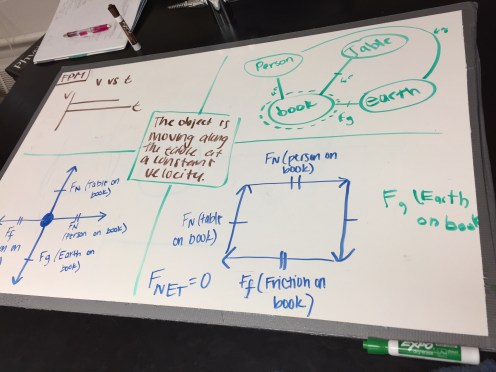
Students whiteboarded their results from Monday’s activity. In the computer lab, there was a lot of debate about what forces were acting on the weight, so I had students include an FBD for the weight on their whiteboards, which lead to some fantastic discussion in my second hour. Students had strong opinions on whether or not there should be a force to balance the tension and were quick to offer an argument one way or another. Even better, a number of students who are usually quiet during whole-class discussions put ideas and arguments out there. Along the way, students connected this back to the bowling ball lab, where one of their tasks was to get the bowling ball to travel in a circle using a rubber mallet. This was the first time I really felt like I got to just sit and listen while my students figured out something important together, and it was fantastic. As the class came to a consensus, one student captured his take with the “mind blown” gesture and sound effect.img_2473

Earth Science: Orbit Wrap-Up

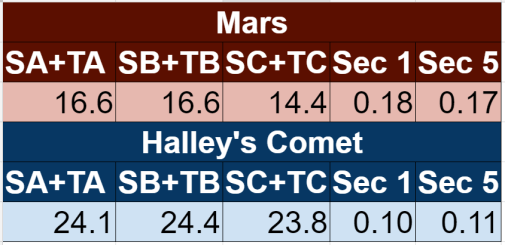
Students took a few minutes for students to finish their measurements for the look at the orbit of Halley’s Comet, and we discussed the results. Interestingly, when we looked at the total distance to the focal points, the class averages for Halley’s Comet was better than the class averages for Mars. When I played with the data on my prep, I saw that one group got dramatically different results from the rest of the class. Tomorrow, I’d like to take some time to look at that with my students to get at the idea of outliers and how to handle them in science.
comet-results

Day 39: Assumptions & Moon Landscapes

AP Physics: Assumptions
Some of my students are losing track of the tools they have for problems involving forces, so we started by whiteboarding as many different representations for a simple force problem as we could and then making a list of what we have in our forces toolkit. From there, students worked on some TIPERs problems. I had students answer each problem using a CER, but turned it into a CAER by asking them to state and justify key assumptions before diving into the evidence. We had some good conversation about what makes something an assumption rather than evidence or a claim. We will definitely need to revisit this as the year goes on, but I liked hearing my students start by articulating what they had to just agree is true before digging into the rest of the problem.

img_2451

Earth Science: Moon Landscapes

Students looked at a topographic map of an area of the Moon. They made some good observations and inferences about the craters formed, but students have had limited exposure to topographic maps so far and, as a result, had trouble connecting the map to what the would physically see. Next time, I think I’ll start by having them look at an actual image of the Moon, then transition to a topographic map of the same area.

Day 38: Pushing Blocks & Kepler’s 2nd Law

AP Physics: Pushing Blocks

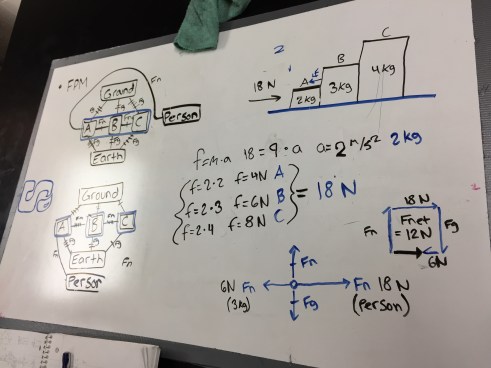
Students worked on a problem I’ve come to really like where three blocks of different masses are being pushed along by a certain force. Based on some of the struggles a few groups were having, I think it would be worthwhile to pause sometime soon to do a model summary. I loved the moment when students figured out how to use the 3rd Law to think about the normal forces between each pair of blocks. The best thing I overheard, though, was a student who said “You need to convince me you’re right! If you can explain your idea and your evidence, then I’ll believe you.”

img_2438

Earth Science: Kepler’s 2nd Law

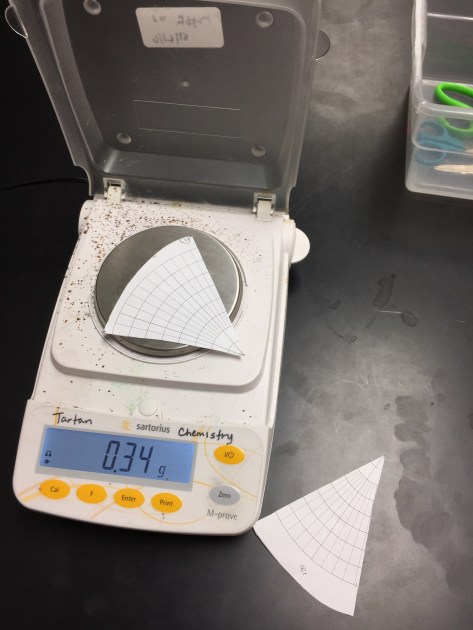
Students plotted the position of Mars along its orbit, then cut out some wedges that represent the same amount of time. We used the mass as a stand-in for area to show that an orbiting object sweeps out the same area in the same amount of time. We got really nice results; the class average for the mass was within 0.01 g for the two wedges. I think students lost track of what they were plotting, however, so I need to think about how I can reinforce what the numbers they are plotting has to do with the actual path of Mars.

img_2436

Day 26: Defining Systems & Topography

AP Physics: Defining Systems

We played the mistakes game with yesterday’s free-body diagrams. In both my hours, there was some great discussion about a problem with a skydiver attached to a parachute and whether the upward force should be a tension force from the straps of the parachute or a normal force from the air on the parachute, which lead beautifully into the importance of defining your system.

IMG_2328.JPG

Earth Science: Topography & Wind

As the next stage of their project to plan a wind farm, students built a simple “topography” using textbooks and used simple flags to make observations about how that impacted wind speeds. Afterwards, students tried placing a turbine at some of the locations where they’d left flags and measuring the current produced.

img_2324

Day 22: Wrap-Up & Review

AP Physics: Lots of Wrap-Up

Today was a lot of wrapping things up. We started by whiteboarding both the accelerated disk and free fall Direct Measurement Videos with some brief discussions about each. At this point, I was just trying to get students to recognize the parallels between angular acceleration and linear acceleration, so that didn’t feel too rushed. The discussion on free fall did skip over some important points, so I’ll be revisiting that topic next week. This is the first year I’ve included uncertainty in my class, and I could tell during the discussion that my students are starting to internalize those concepts, which added some nice layers to the discussion.

We also took some time to try and finish the lab practical we started Monday. Students are rolling a steel marble down a ramp with the goal of landing it in a tumble buggy driving by. Today, I threw them for a loop by adding that they need to pull off the same thing with glass and acrylic marbles, but the only new measurements they can take are mass. With the time for discussions, only a few groups got to test, so I’ll be making some adjustments next week to make sure students have a chance to finish.


Earth Science: Review

Students have another quiz tomorrow, so I repeated my review activity from last time. Students worked in groups to write a few questions for each learning target, then periodically traded whiteboards with another table to try and answer another group’s questions. This time, students were coming up with some deeper questions, which was great to see.

Day 15: Mistakes Game & Solar Collectors

AP Physics: Mistakes Game

We played the mistakes game using problems translating between representations for constant acceleration. While I didn’t have to say much and there were some great questions asked, it ended up being a few people in each section who asked most of the questions. The students are pretty good about trying to call on new people, but I want to think about how to encourage more people to raise their hands or offer something during those discussions.

img_2236

Earth Science: Solar Collectors

To apply what students learned this week, they started a short engineering design challenge to design solar collectors. I had them start by coming up with some ideas individually, then working as a group on a whiteboard to come up with a group design. At both stages, I had students fill out an evidence-based reasoning template my team developed at EngrTEAMS a few years ago to scaffold them to make connections between the science and their ideas.


Day 5: Lab Group Contracts & Branches of Earth Science

AP Physics: Lab Group Contracts & Mistakes Game

We started by talking about some of the skills that highly effective lab groups tend to demonstrate. From there, I asked each lab group to write a short contract for themselves they could use to help develop those skills and hold each other accountable. Most of the contracts are fairly broad or vague, I think because I was vague about what I wanted, but groups had some good conversations about their strengths and weaknesses. My favorite item is the group that agreed to “criticize everything.”

After that, students got their first taste of the Mistakes Game. I started by using a recent cooking disaster to discuss the value of examining mistakes, rather than ideal solutions, then introduced the mistakes game. Students readily embraced this approach; I spoke less and heard better questions than much later in the year last year.

img_2177

Earth Science: Branches of Earth Science

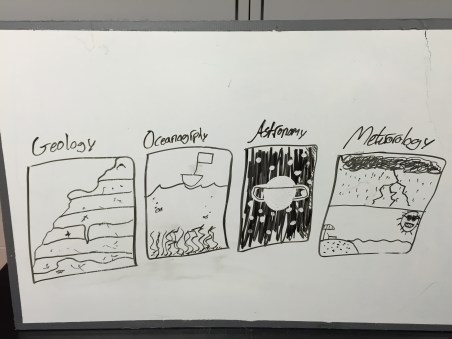
Students attempted to answer the question “what is earth science?” I asked each group to make a visual representation of their answer, including something to indicate the four main branches of the field. Students worried about their artistic abilities at first, but ended up getting into it. I had them use whiteboards, and it was great to see groups really talk to each other instead of each disappearing into their own papers.

img_2176


Day 166: Random Presenter & Mistakes Game

Physics: Random Presenter

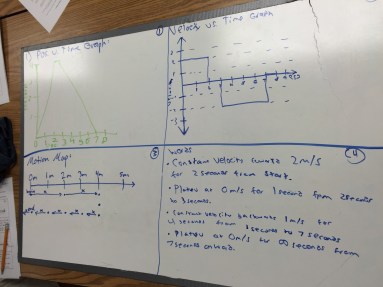
I had each lab group whiteboard and present their solution to one of the lab practical stations. I assigned which practical each group would present so I could make sure we saw all four stations. I also, when possible, tried to pick groups that used different approaches, like the two groups in the photo who had to find the mass of some washers using a known mass, a spring, a ruler, and a stopwatch. In one of my classes, I tried rolling a dice to decide who would talk on behalf of the group, and I saw some students who tend to let someone else in their group figure things out really engaging to make sure they knew enough to present if picked. I need to use this strategy more often.


Chemistry: Mistakes Game

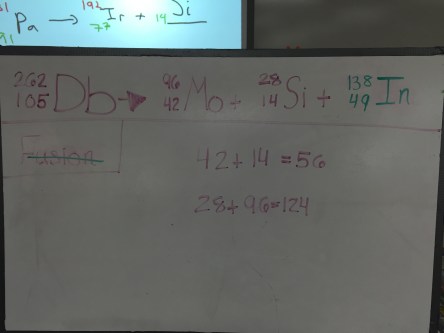
Students worked on writing equations for nuclear reactions, then we played the mistakes game with some problems.

IMG_1930

Day 164: Senior Skip Day & Half Life Whiteboarding

Physics: Senior Skip Day

Today was the unofficial senior skip day, so I had less than a third of my students in class. I normally limit students to two reassessments per week, but gave students who were in class today an opportunity to do some additional reassessments. A few came to my class just to take advantage of that. A couple of students who were in school so they could play in a baseball game this weekend asked if they could work on the final review.

Chemistry: Half Life Whiteboarding

Only a few of my students in chemistry are seniors, so we continued as usual. Students finished the problems from yesterday and whiteboarded their solutions. I got some pushback from a few students who were very vocal about their opinion that if the seniors are gone, they shouldn’t have to work on chemistry. This may make the last week of school tough since seniors are dismissed a week early, so I need to start thinking about how I will keep my juniors motivated.

IMG_1905

Day 162: Snell’s Law & Half Life

Physics: Snell’s Law

I got out the refraction dishes and showed students how to use them to find a refracted angle. Then, I asked them to get me a graph where the slope is the index of refraction of water. This is the first time I asked students to start with an equation (in this case, Snell’s law) and pick their axes to get a certain value as the slope, but they were pretty successful.

IMG_1899

Chemistry: Half Life

Students measured the “decay” of pennies by shaking them up, then setting aside any that came up tails. Each group make a graph of pennies remaining vs. half lives and submitted their results via a Google Form so we could produce a graph of the class average. Tomorrow, we’ll use that to have some conversations about randomness.