Day 43: v-t Graphs, Board Meeting, & Chemical Change

AP Physics: v-t Graphs

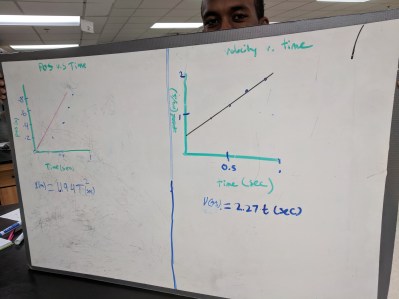
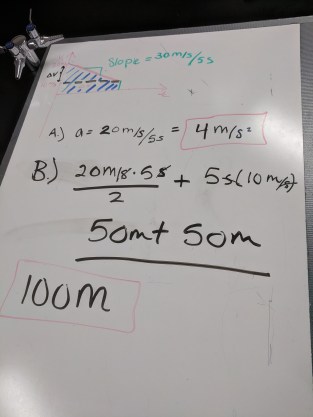
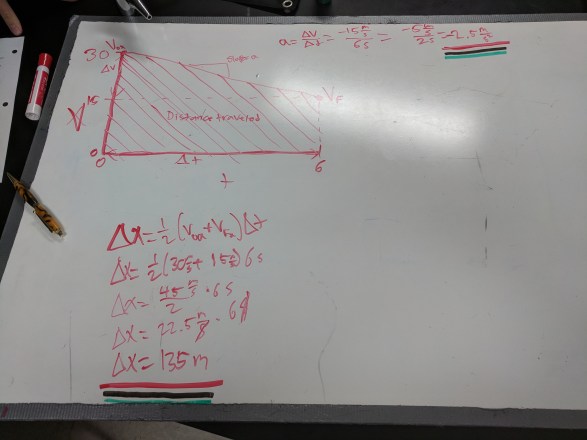
Students took their first stab at solving problems for objects with a constant acceleration using velocity vs. time graphs. Groups were consistently getting the problems down pretty quickly, so we did a gallery walk of solutions for these problems rather than a full whiteboarding session. My students with some calculus knowledge are getting genuinely excited about the connections between physics and calc, which is a lot of fun. I also had some students think week talking about how momentum vs. time graphs fit with what we’re doing now, which has me really excited to start the Newton’s 2nd Law lab next week.
graph soln.jpg

Physics: Board Meeting

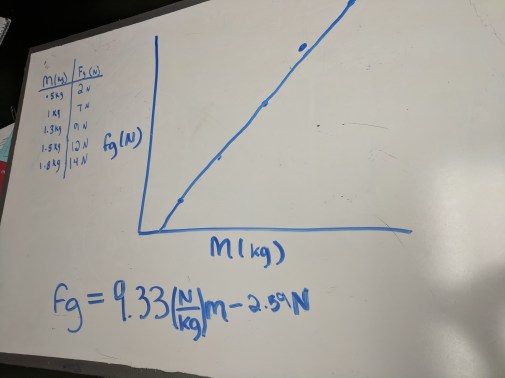
Students whiteboarded the results of the force of gravity lab. The results were pretty good and I had some students speaking up who are usually quiet during whole-class discussions. I’m also seeing students get more confident finding the line of best fit and translating y=mx+b into “physics”.
fg lab.jpg

Chemistry Essentials: Chemical Change

Students did a lab observing several chemical reactions to recognize signs of chemical change. One of the reactions produced a precipitate, and it was interesting that a lot of students were not convinced the precipitate was a solid since it was a fairly fine powder.

chem change.jpg

Day 42: Mistakes, Force of Gravity, & Periodic Trends

AP Physics: Mistakes

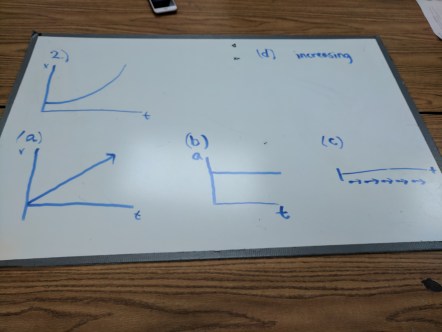
Since my students are pretty confident on motion graphs, we went straight to mistakes whiteboarding with some stacks of motion graphs. Students were pretty successful at coming up with interesting mistakes. In addition, during the presentations there was a lot of joking around and students were very willing to own unintentional mistakes, which was great to see.

mistake

Physics: Force of Gravity

Students collected data for a relationship between mass and the force of gravity. One of my classes was able to get their graphs and linear regressions done, and were more successful than I expected at “translating” their line of best fit into physics by adding units to the slope and intercept and replacing x and y with appropriate variables.

gravity lab

Chemistry Essentials: Periodic Trends

Today, I handed out periodic tables and students worked on marking them up based on some of the patterns and trends we’ve been talking about the past few days. Yesterday, several students noticed that the sodium card said it reacts strongly with water. Since many also recognized sodium is in table salt, they weren’t entirely convinced it would react with water, so I got out the pure sodium today to drop a piece into some water. I got a small flame during class, which really blew their minds.


Day 41: Board Meeting, Mistakes Game, & Periodic Table

AP Physics: Board Meeting

We had the board meeting for last week’s ramp lab. Students were pretty successful at picking out the key concepts, though the results were a little messier than usual, which made it tough to compare results for different angles and cart masses. Next year, it may be worth having each group do two angles or two masses. I’ll also take more time to introduce students to the photogates. The students in calculus had some great reactions when they realized the slope of the position vs. time2 was half the slope of the velocity vs. time graph.

Physics: Mistakes Game

Students played the whiteboard mistakes game with Friday’s free-body diagram problems. Lots of groups had great conversations about the forces on an object already moving and the language of interactions, including many of the ideas from the interaction stations, really helped them convince each other whether or not there should be a force. I also took a few minutes prior to presenting any whiteboards to talk about what it looks like to get something out of this when you’re not presenting, and saw a lot more students than usual with their own work out.

IMG_20171106_131548.jpg

Board with intentional mistake for a ball at the peak of a throw

Chemistry Essentials: Periodic Table

We revisited Friday’s card sort. When I looked over students’ work from Friday, it looked like many of them got stuck on the word “pattern” in the directions because they were looking for something that was all the same, rather than a trend. Today, I had them get out actual periodic tables to use as a guide to set out the cards. From there, it was much easier to scaffold students to identifying interesting trends. Students were also really interested in things like how we discover new elements, or how they get named.

card sort 2.jpg

Day 39: Ramp Whiteboards, FBDs, & Electrolysis

AP Physics: Ramp Whiteboards

Since a recent quiz used a free-response problem from the AP Physics exam, I gave students part of the hour to use the scoring guide to review their work. Students seemed to like seeing the level of detail the College Board is after.

Afterward, students prepared whiteboards for the ramp lab we’ve been working on. I made some changes to my approach and can tell I need to do a little more work on helping students interpret the graphs and data tables from the photogates. Overall, results are looking pretty good.

ramp wb

Physics: Free-Body Diagrams

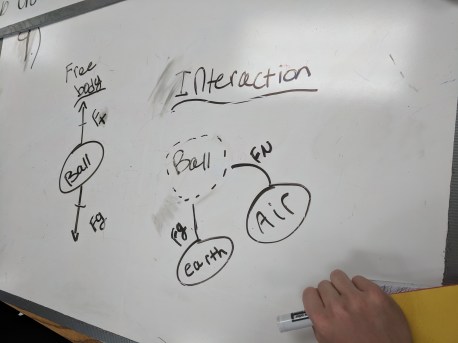
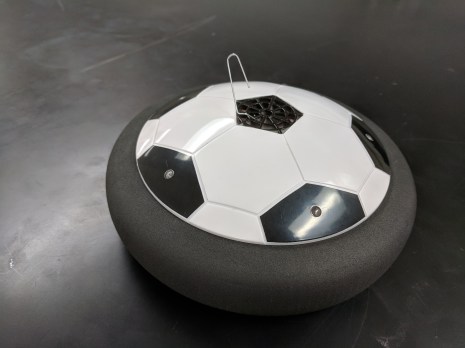
We discussed some of the interaction stations to get to the point of defining a few key types of forces. Afterward, I introduced them to interaction diagrams and free-body diagrams using the hover puck in an activity adapted from Kelly O’Shea. For the puck traveling at a constant velocity, one of my hours had some really good small group discussion about whether there is a forward force on the puck, though neither class got to a whole group discussion today.IMG_20171102_144515

Chemistry Essentials: Electrolysis

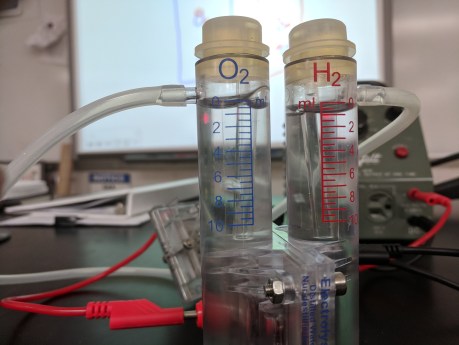
We did a gallery walk to go over yesterday’s problems. I also showed students an electrolysis apparatus to have some conversation about how we know water is two hydrogens and an oxygen.

IMG_20171102_144642

Day 32: Whiteboarding Galore

Between having a sub on Wednesday and no school on Thursday or Friday, today was all about getting my classes back on track.

AP Physics: Conservation of Momentum Problems

Students whiteboarded the conservation of momentum problems from last Tuesday. Many of the problems require students to shift between thinking about the system as a whole and thinking about individual objects, and interaction diagrams (or system schema) proved to be incredibly powerful tools. The first year I used the Modeling Instruction curriculum, I didn’t quite get them and, as a result, my students never really saw the value, but my students and I are now huge fans.

interaction.jpg

Physics: Constant Acceleration Problems

On Wednesday, I left my students some problems that included several that started with graphs they’d already sketched and annotated. My students admitted that they made very little progress on Wednesday, partly because they got confused and shut down. This has been pretty common with my students this year, so we spent some time discussing alternative strategies for when they are stuck. Afterward, students whiteboarded the problems for a gallery walk. They are making good progress on connecting the features of the graph to the physical meaning it represents.

phys graph soln.jpg

Chemistry Essentials: Phase Change Bar Charts

On Wednesday, students watched a short video lecture where I talked about the results of Tuesday’s phase change lab and introduced energy bar charts. While students got nice graphs from the lab, they were confused by the video lecture, so we spent most of the hour discussing it. It turns out the main issue is we haven’t spent much time on what the particles are doing during a phase change, so they weren’t willing to accept that explanation for the constant temperature in the lab without some additional convincing. I fired up a PhET simulation, which seemed to fill in some of the necessary gaps and allowed students to take a much more successful second shot at Wednesday’s bar chart problems.

phase change phet.PNG

Day 30: Problems, Annotating Graphs, & Boiling Ice

AP Physics: Problems

Students worked on some conservation of momentum problems. When students asked for help, I could tell pretty quickly who had sketched interaction diagrams. Especially now that I’m embedding center of mass, they have become an incredibly powerful tool. I also demonstrated exploding carts on a balanced track and was pleased at how easily students used the center of mass of the system to explain why it stayed balanced, even when the carts had different masses.


Physics: Annotating Graphs

Students whiteboarded their solutions to yesterday’s problems. I’m pleased to see a lot of students starting to make sense of the physical meaning of the graphs. I was surprised by some students who struggled to differentiate between initial velocity and maximum velocity, but I think they were able to clear up their confusion by the end of the hour.

graph soln

Chemistry Essentials: Boiling Ice

Students recorded temperatures as ice melted and eventually boiled. A lot of students where quick to say their results didn’t make sense when they saw minimal temperature changes during the phase changes, which was great.

ice melting.jpg

Day 28: Conservation of Momentum, Mistakes Game, & Measurement

AP Physics: Collisions

After their quiz, students wrapped up the data collection on the collisions lab. Things went very smoothly, and a lot of groups have already commented on the pattern in their momentums.  This is one of the times I love having quantitative uncertainty in the course, because students are independently deciding whether their momentums are close or effectively equal.

Physics: Mistakes Game

Students played the mistakes game with stacks of kinematic graphs. In class discussions, I’ve been struggling to get students to speak up and it is usually one or two students who do most of the talking after lots of long silences. Today, one of those students asked a question about the a vs. t graph, a member of the group presenting said, without any shame or fear, “We don’t really understand those graphs, so we just drew something.” All of the sudden, the whole class was animated and students who are normally quiet, even in small groups, were jumping in with fantastic questions. It was a fantastic way to end the week with that class.

phys wb.jpg

Chemistry Essentials: Measurement

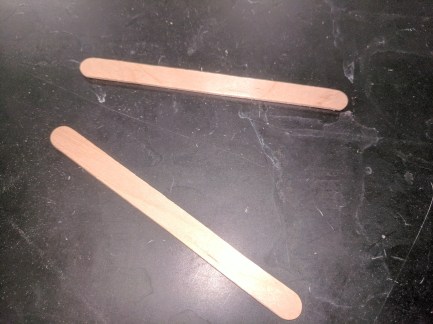
When I gave some notes on temperature scales yesterday, I had a student ask whether Kelvin is a more accurate scale than Fahrenheit and several others questioned it when I said 98.6 rounds to 100. I’m really excited about the thinking about measurement this shows, so I decided to lean in and do a Modeling Instruction measurement lab I’d skipped during the first unit. I had students measure the lab tables with popsicle sticks, gradually adding marks to make them more accurate. Next time, I think I will have them measure a bigger mix of objects, including some shorter than their tool.

pop sticks.jpg

Day 22: 3rd Law, Video Physics, & Thermal Expansion

AP Physics: 3rd Law

Students predicted which cart would experience a larger force for several different collisions, then we got out the force sensors and hoop springs to find out. In one of my classes, the computer was acting up, so we relied on the hoop springs and slow motion video. Fortunately, students found the video very convincing and even described watching the hoop springs compress as satisfying.

collision lab f-t graph

Physics: Video Physics

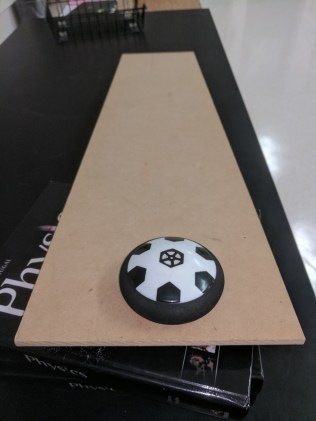
We started constant acceleration today. Students used photogates with a cart on a ramp during the first unit, so I decided to have students analyze hover disks on a ramp using Video Physics.  I’m hoping that some of the features, like seeing the points in the video, will help students connect the representations we’re using to their physical meaning.

hover

Chemistry Essentials: Thermal Expansion

I did a few demos of thermal expansion, and had students complete particle diagrams of each one. Students seem to be getting the big ideas, and I’m seeing students naturally improving how they represent key elements of their particle diagrams as time goes on. One student called me on falling into pretty teacher-centered habits during the whiteboard discussions; I have a tendency to talk to much the first time I teach a lesson, and this is my first time through Chemistry Essentials A, so that’s happening a lot. I need to spend a little more time during my lesson planning making sure I clarify the goal of each discussion and planning out some open-ended questions so I can give students more of the reigns.

chem wb

Day 20: Force Diagrams, v-t Graphs, & Diffusion

AP Physics: Force Diagrams

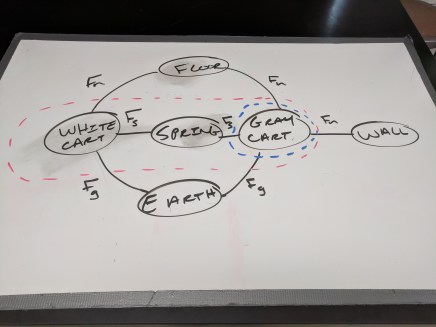
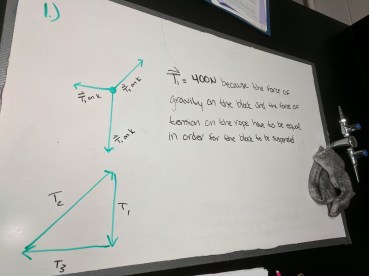
We went over the force problems from last week. I skipped having them whiteboard all of the trig and algebra, and just had students whiteboard the diagrams and some selected reasoning. There was some good debate on whether the normal force should equal gravity on some of the problems, and the vector addition diagrams were a great tool for reasoning that through.

vad wb

Physics: v-t Graphs

Students whiteboarded their solutions to Friday’s constant velocity problems. The problems were a lot more challenging than I expected. One big struggle for a lot of groups was making sense of what the problem was asking. The other big struggle was connecting strategies and ideas from one problem to the next one. For example, after using the area of a velocity vs. time graph to find displacement on the first problem, many students struggled to find the displacement from a v-t graph on the second problem. This tells me students were following a procedure without understanding why, so I need to think about how to step back and get that idea across.

vt wb

Chemistry Essentials: Diffusion

Students whiteboarded particle diagrams for perfume dispersing through the classroom and food coloring dispersing through water. In both cases, students made a lot of great observations prior to whiteboarding and had a lot of good foundation on their whiteboards.

diffusion.jpg

Day 17: Vector Addition, Motion Detectors, & Water Displacement

AP Physics: Vector Addition Diagrams

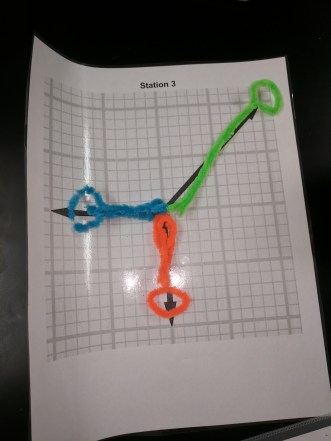
Students worked through an activity from Casey Rutherford to introduce vector addition diagrams. A few groups started thinking about how they could use trig and other math to do calculations with the shapes they made; one group even came up with the idea of components, which was awesome!

vad

Physics: Motion Detectors

For the first half of class, we did the mistakes game for yesterday’s problems. Based on the mistakes several groups decided to make and the discussion that followed, I realized that a lot of students are drawing their velocity vs. time graphs to look like the motion maps.

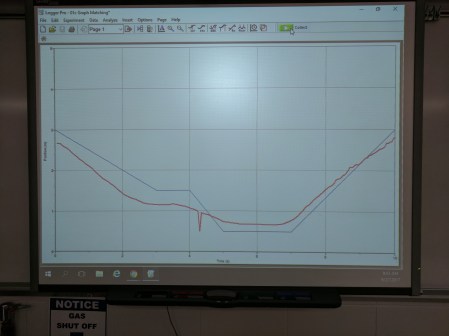
After finishing the problems, we got out the motion detector and focused on what the time axis means. Watching the graph form live seemed to help some of the students who’ve been sketching graphs that look like motion maps.

motion detector

Chemistry Essentials: Water Displacement

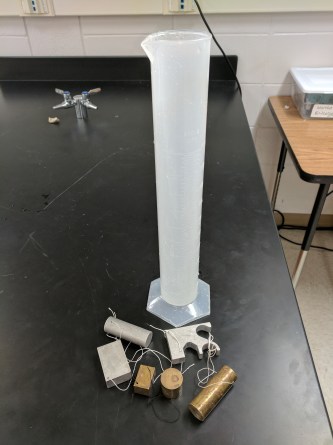
Students used displacement of water to find the volume and density of aluminum and brass blocks. I collected results to put on a class graph, and it was interesting to ask students to predict the shape of the graph. A lot of students expect the graph to have no pattern since the blocks are all different shapes. I may need to have them do some particle diagrams tomorrow to help compare.

density