Day 68: Whiteboarding, Problem Practice, & Whiteboarding

AP Physics: Energy Predictions

Students whiteboarded drafts of their answer to which interaction dissipates a bouncy ball’s energy. One of the things I like about this activity is every group agreed the table is where most of the energy is dissipated, but there was a variety of evidence cited that gave some good opportunities for discussion. Afterward, I showed a thermal video of a weighted tennis ball and we played with the happy/sad balls and seismic accelerator.

Physics: More Problem Practice

Students got some additional practice with unbalanced forces in 2D. It was one more day than I think was truly necessary for their understanding, but confidence has been a big struggle this year and it seemed to help a lot of them feel like they can do the problems.

Chemistry Essentials: Mistakes Game

I did the mistakes game with yesterday’s problems, and it was very rocky. I think it wasn’t ideal timing to introduce whiteboarding since tomorrow is our last day before break and a lot of students are very restless. I’m also really struggling in Chemistry Essentials, more than when I’ve taught it in past years, to get students focused on chemistry during chemistry.

chem mistake.jpg

Day 67: Video Analysis, Speed Dating, & Density

AP Physics: Video Analysis

Students continued working to determine whether a bouncy ball dissipates most of its energy from impact or from air resistance (I’ll have an article about this activity in the January issue of The Science Teacher). Today, students used LoggerPro to analyze the videos they made yesterday and collect evidence. There were a lot of great conversations about connections between energy and motion, which is exactly what I’m after with this activity. Most students had a draft of a CER about where the energy was dissipated by the time they left class.


Physics: Speed Dating

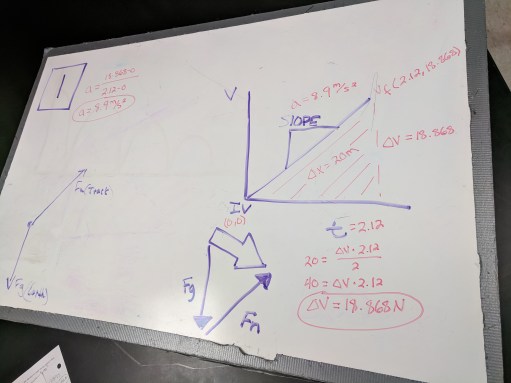
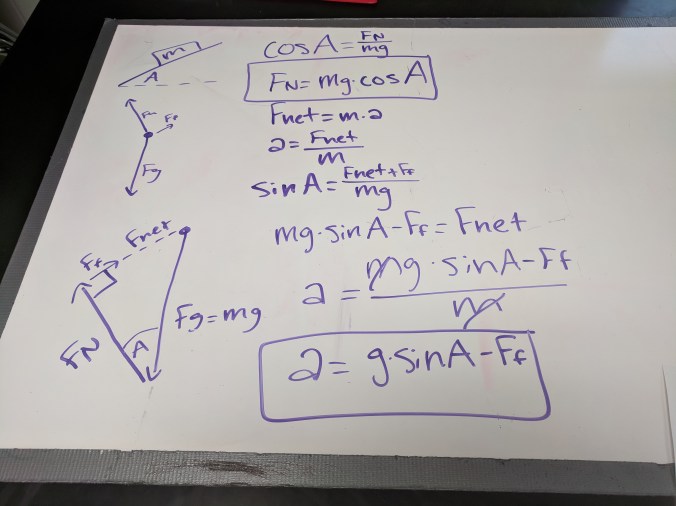
As part of my effort to focus on lowering the social stakes in my class, I had students do some whiteboard speed dating to go over yesterday’s goal-less problems. There were a lot of great conversations; the best part was how many students I heard asking “How do you know?”. My 1st hour in particular did a great job of finding and correcting mistakes in each others’ work. I also am continuing to talk about my pedagogical choices more than usual, which seems to be helping students go along with what I’m asking and hold each other accountable for participating. Particularly in my 1st

speed dating.jpg

The units got fixed on the next rotation, but I forgot to snap a new photo

Chemistry Essentials: Density

We discussed the results of yesterday’s lab to get to a definition of density. I skipped doing a true board meeting because, with break looming, I was worried about time, but students didn’t have as solid a mental model of density as I would have liked when they were working on the worksheet. It was a good reminder that pedagogical shortcuts have their cost.

Day 66: Missing Energy, Goal-Less Problems, & Mass vs. Volume

AP Physics: Missing Energy

Students started working on an activity to determine whether a bouncy ball mostly dissipates energy due to air resistance or due to the impact with a table (I’ll have an article on this activity in the January issue of The Science Teacher). Today, students worked on sketching LOL diagrams and velocity vs. time graphs for each explanation, which lead to some good conversations about the connections between energy and motion. Each group also recorded a video of a bouncy ball that they’ll analyze in LoggerPro tomorrow.

Physics: Goal-Less Problems

Students worked on some goal-less problems for Newton’s 2nd Law in two dimensions. I was very explicit with my students that I use them to make it okay to start a problem without knowing where you are going. We also spent some time discussing key steps students should take (like deciding whether the forces are balanced or unbalanced, drawing and annotating diagrams, etc) which helped a lot of students see where to start.

Chemistry Essentials: Mass vs. Volume

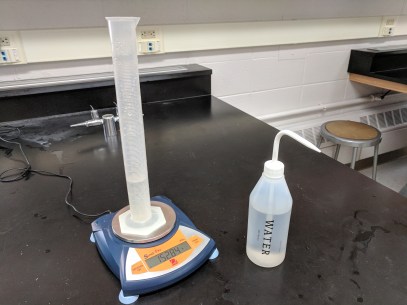
Students worked on finding a relationship between the volume of water and its mass. I had students design their own procedure for the lab and I think they could have used more pre-lab discussion; I usually keep the pre-lab pretty short in favor of doing a lot of coaching lab groups, but the class is bigger than usual this year and I was spread pretty thin, which in turn fed some classroom management issues. I’ll need to keep that in mind for future labs.mass vol.jpg

Day 64: LOL Diagrams, Elevators, & Volume

AP Physics: LOL Diagrams

We did the mistakes game again today (which my AP students now think of as standard whiteboarding in physics) for some problems with conservation of energy calculations. To avoid getting bogged down in the algebra, where most of my students are pretty strong, I had them put their mistake in the LOL diagram or writing the conservation of energy equation. Most groups worked on an accurate solution before they made their mistake, and one group did a nice job of setting up an equation for a problem where 10% of a baseball’s energy is dissipated before it reaches the peak of its path.

lol neat approach.jpg

Physics: Elevators

Students whiteboarded their work on Casey Rutherford’s elevator situations worksheet. A lot of students struggled conceptually with the direction of the net force, but seemed to resolve that by the end of the hour. I’m trying to lower the social risk of whiteboarding to get more engagement, so I gave each problem to two different groups, then had them meet and come to a consensus on a solution. Afterward, students did a gallery walk of all the whiteboards. We also discussed a video I made of a balance on an elevator to reinforce the worksheet.


Chemistry Essentials: Volume

Students filled geometric solids with water to find a relationship between the volume and the amount of water they could hold. I need to put some thought into how I introduce the lab; in particular, I don’t think my students have much concept of why this relationship is worth looking at. I know I can make use of that as we move into density, but I’m not sure how to frame the lab so they see a purpose in it up front.

solids.jpg

Day 61: Bar Charts, Mistakes Game, & Burning

AP Physics: Bar Charts

We discussed the results of yesterday’s lab in order to define kinetic energy, then I showed them the derivation for elastic potential energy. Since we’d already defined change in potential energy as the area of a force vs. displacement graph, I think I could have put that derivation on students. Afterward, I introduced students to LOL diagrams and set them to work sketching bar charts.

Physics: Mistakes Game

I love Kelly O’Shea’s mistakes game, but I’ve been having trouble getting my physics students comfortable talking as a whole class, so I decided to try lowering the stakes. I had them prep whiteboards as usual, but then they presented to another group, rather than the whole class. There were a lot of great conversations between groups and students were much more comfortable speaking up. Afterward, I gave students time to do a gallery walk of the post-discussion boards.

mistake wb.jpg

Chemistry Essentials: Burning

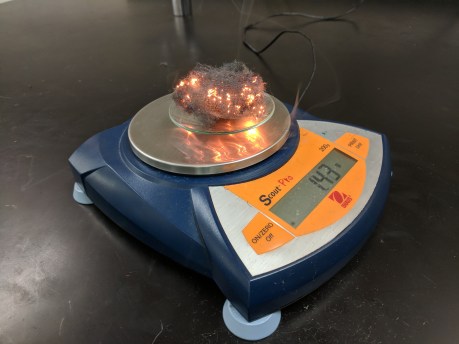
Students burned steel wool on a balance to observe the change in mass. Afterward, we used Post-It notes to make histograms of the change in mass from both yesterday’s labs and the burning. Last trimester, I skipped the class histograms, but I think the helped this group to meaningfully interpret their results. I also got excited when a student brought up conservation of mass before I did, which I don’t manage as often as I’d like in this course.

burn.jpg

Day 52: UBFPM Practical, CAPM Problems, & Lewis Dot Beans

AP Physics: UBFPM Practical

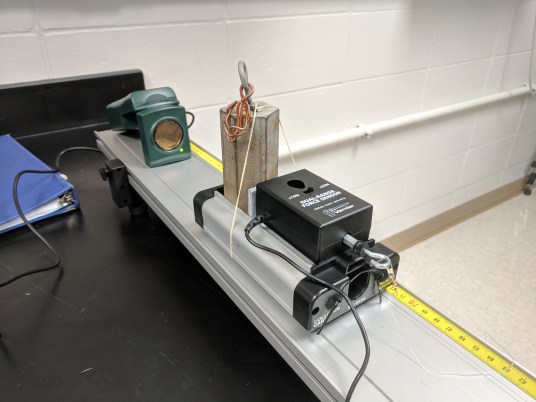
Students were tasked with finding the inertial mass of a lump of metal. While I left it open, students pretty quickly settled in to following the steps from their 2nd Law lab. In one of my classes, a lot of groups initially used the unknown mass to provide the force on their half-Atwoods setup, which has me thinking they were losing track of the significance of the measured quantities; I skipped over having them do an interaction diagram and free-body diagram on the original lab, which I’m betting would have helped.

ubfpm practucal.jpg

Physics: CAPM Problems

Students used whiteboards to revisit an earlier quiz on CAMP problems. I had them go through piece by piece, rotating who had the marker for each step. That seemed to help students feel a lot more confident on the problems. Tomorrow we’ll see if they can do them independently.

capm prob

Chemistry Essentials: Lewis Dot Beans

Yesterday, when we worked on formula writing, students were losing track of what the various numbers represented. One of the other chemistry teachers suggested I try Lewis dot structures with a manipulative, so today students used beans to check their answers to yesterday’s problems.

lewis dot beans

Day 50: Whiteboarding, Problems, & Bonding

AP Physics: Whiteboarding

Students whiteboarded their problems from the last few days. I tried to keep the focus on the diagrams and initial setup, since there’s where the physics is. With the end of the term looming and students doing pretty well with these, I had them do a gallery walk rather than taking the time for a more involved whole class discussion.

Physics: Problems

Students started using vector addition diagrams to solve problems with balanced forces in 2D. I saw a lot of groups working much more effectively together than a few weeks ago and students were doing a nice job of playing around with strategies to find their way to an answer.

Chemistry Essentials: Bonding

Now that students have some ideas about the structure of an atom and periodic trends, students used cards similar to puzzle pieces (that I forgot to take a picture of) to explore bonding. Students seemed to be getting a lot of ideas in place about which elements are more likely to give up electrons and why the atomic ratios are what they are.

Day 47: Board Meeting, Whiteboarding, & Atomic Models

AP Physics: Board Meeting

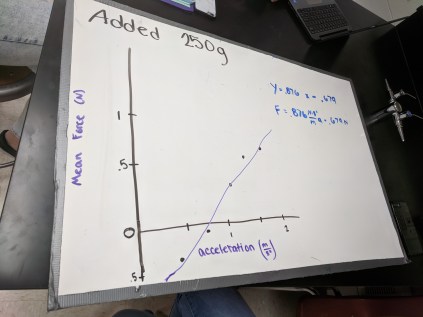
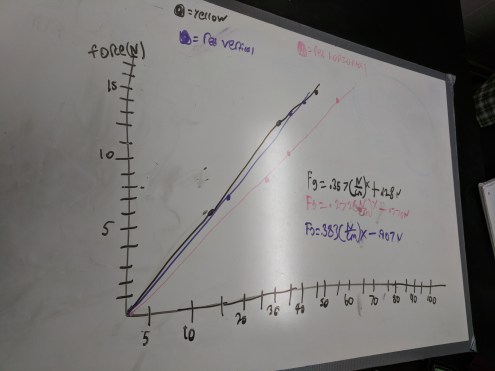
Students whiteboarded their results from yesterday’s lab. I forgot to remind my 2nd hour to zero their force sensors yesterday, which made for a good opportunity to talk about what the intercept means. They were initially bothered by the units on the slope of their graph, but the units of N/(m/s2) became really valuable when we made a “for every” statement about the slope; interestingly, a lot of students phrased their “for every” statement in terms of how the acceleration changes for every 1 N of force, even though that required inverting their slope. I thought about having students plot acceleration on the vertical axis, especially since the College Board’s formula sheet gives a = F/m, but I think the mass pops out more nicely when force is on the vertical. I may still flip the axes next year since acceleration on the vertical would fit better with how they talk about the graph.

fma lab.jpg

Physics: Whiteboarding

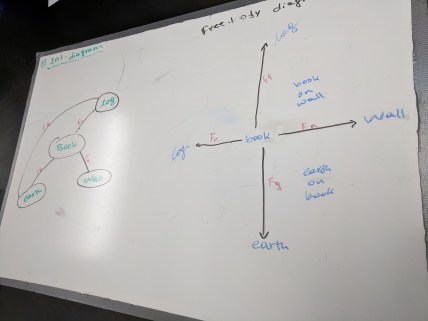
Students whiteboarded their answers to last Friday’s problems. We spent a long time on a problem about using a log to hold a book against the wall, and there was a lot of great discussion about what that force should be and why, as well as whether there should be any horizontal forces. I think a lot of students don’t see that discussion as productive, but I heard a lot of great physics talk.

log prob.jpg

Chemistry Essentials: Atomic Models

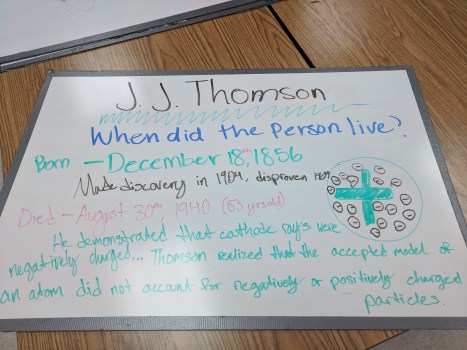
Students shared the information on the atomic models they looked at yesterday. They were surprised by the gap between Democritus and Dalton and were also very interested in the personal stories. I tend to skip past those, since most of the people the state standards call for are white guys, but its probably worth having some reminders in my class that science is done by people who live in a particular place at a particular time. Maybe next time, I’ll do a little more background research to try to come up with some other names, especially women and people of color.

Day 46: 2nd Law Lab, Board Meeting, & Atomic Models

AP Physics: 2nd Law Lab

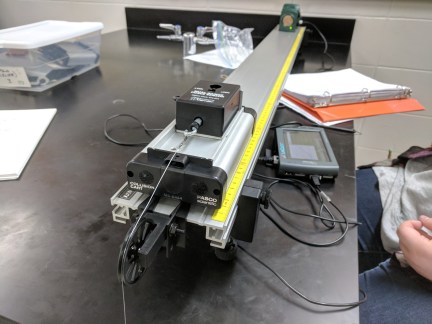
Students started collecting data for a relationship between force and acceleration. A few students took out their formula sheet to get a preview of what the equation should be; it was interesting to listen to their conversation on what they expected the graph to look like and whether their data was consistent with the equation they expect to need.

f a

Physics: Board Meeting

Students whiteboarded their results for the spring lab. They are getting better at “translating” lines of best fit into physics by selecting meaningful variables and putting units on slope and intercept. It was also clear in the discussion that students are gradually making more connections between the graphs and the reality of the lab. When discussing the intercepts, there was a great moment where a student speculated whether gravity could be contributing to the intercept, which lead nicely into comparing the vertical and horizontal springs.

spring graph

Chemistry Essentials: Atomic Models

Students worked on a jigsaw for the history of atomic models. This was a nice opportunity to talk about what we mean by a model in science since we are looking at how models of the atom evolved over time. I asked groups to name some of the evidence used to support each atomic model, and students had a lot of trouble with that. I think part of the issue is a lot of students are still shaky on what makes something evidence and part of it is there’s a lot of background knowledge required to make sense of the evidence used in many of the atomic models.

thompson.jpg

Day 44: Practical, Spring Force, & Vocab Review

AP Physics: CAPM Practical

Students figured out where to start a buggy so that a marble rolling down a ramp would land in it. Some groups had some trouble translating their strategies for yesterday’s problems to this lab practical, which has been pretty common this year. However, once students got going, there was a lot of success!

Physics: Spring Force

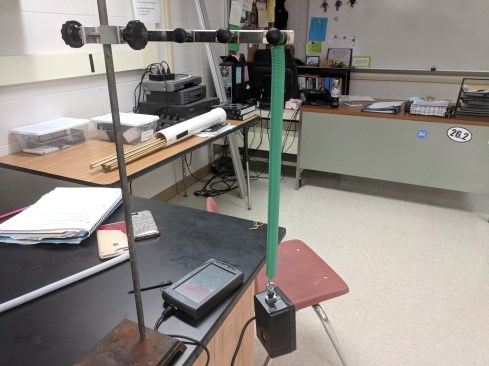
Students worked through the spring force lab I’d previously done with my AP Physics classes. We used force sensors to stretch the spring instead of spring scales or hanging masses so that students could pick one of their springs to also stretch horizontally. From what I saw in notebooks, results are coming out pretty nicely.

spring.jpg

Chemistry Essentials: Vocab Review

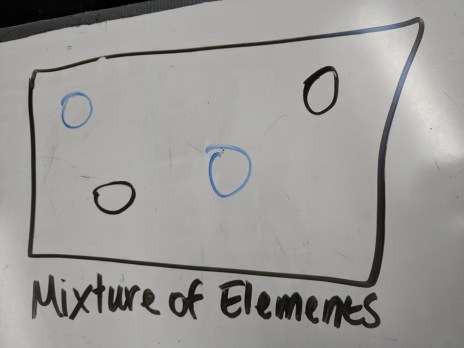
This unit has had more vocabulary and factual knowledge than many of the others, so we took some time to review key terms and reinforce connections between the different ideas.

chem vocab.jpg