Day 70: Projectile Launchers & Reaction Types

Physics: Projectile Launchers

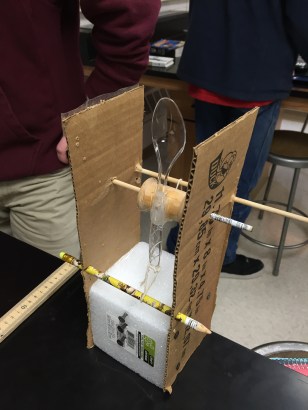
After a quiz, students continued to work on testing and refining their projectile launchers. In spite of the fact that its the last day before break, both of my classes were focused and working right up until the bell!IMG_1552

Chemistry: Reaction Types

After a quiz on molar mass, students did a jigsaw on the types of chemical reactions. Each group used the textbook to make a whiteboard with some key points about their reaction type, then students used the whiteboards to make themselves a quick reference on the reaction types.

Day 69: Projectile Launchers & More Stoich

Physics: Projectile Launchers

Instead of writing a lab report on an energy lab, I’m having students build projectile launchers that convert gravitational potential energy into kinetic energy. Today, students brought in their prototypes and had some time to test how well their prototype worked, as well as collect data on how at least two different variables affect the range of their launcher. When we do the final tests of the launchers, groups will need to hit a target at a randomly selected distance, though groups can chose between a small, medium, and long range. The launchers ranged from very simple, like a paper ramp with a meter stick spine, to more complicated, like the full-blown trebucet.

Chemistry: More Stoich

My plan had been to give students 15 minutes or so to work on the last two problems from Friday’s worksheet, then have them write an example problem where they would include a written description of the steps along with their work, but nearly all of my students needed the whole hour to finish Friday’s problems. Most of them were really focused on the steps they needed to follow and, not surprisingly, students are overwhelmed by how many steps there are and losing track of a lot of details. Next time, I need to start with some activities to help students to better connect the concepts to the process. I might do something with the nuts, bolts, and washers I used to introduce molar mass to make things more concrete at the start.

Day 68: Work & Stoich

Physics: Work

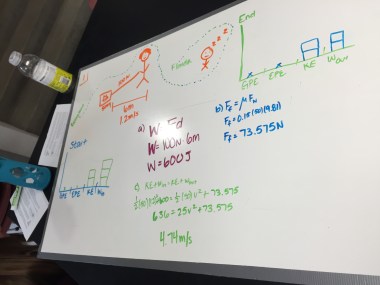
Students did some problems where the energy of the system is changing. The other physics teacher and I skipped having students define their system due to time constraints, but some of the mistakes I’m seeing could be fixed by having students take that step, so I will be going back to the full LOL diagrams next year.

IMG_1539

Chemistry: Stoich

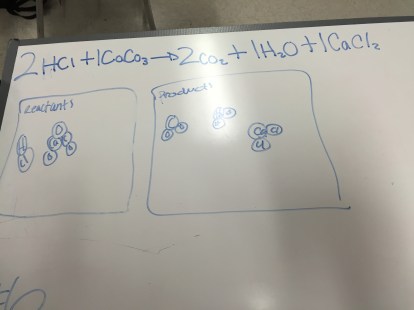
Students did some problems calculating theoretical yield for chemical reactions. When we first started balancing chemical equations, I required students to sketch a diagram of the atoms involved to emphasize that the atoms are just being rearranged. Today, I left it up to students whether they wanted to include the sketch or not, and it drove home for me how important concrete, conceptual tools are when nearly every student still drew the diagrams.

Day 67: Work & Molar Mass

Physics: Work

Students picked a specific height above the lab table and calculated how much energy a dynamics cart would have at that point. Then, they set up ramps at three different angles and sketched force vs. displacement graphs to represent pulling the cart up the ramp to the height above the table they picked earlier. Finally, they calculated the area of the force vs. displacement graphs. This lead nicely to a definition of work as the cart’s change in energy and the area of a force vs. displacement graph.


Chemistry: Molar Mass

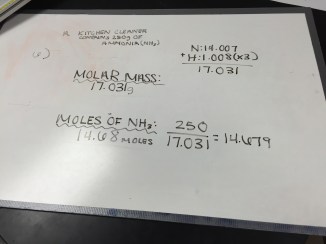
Students worked on some word problems using molar mass. While no diagrams made it onto whiteboards, a lot of students sketched molecules the same way they’d done when balancing equations to help determine when they needed to multiply a mass from the periodic table.

IMG_1532

Day 64: Energy Practical & Mistakes Game

Physics: Energy Practical

Students were given an elastic string to hang from the ceiling. Students had to find k for their string, then figure out how high above the ground to hold an action figure attached to the end so that, when they dropped it, the figure would just barely hit the ground. In the past, I’ve used a bucket of water and we go by the sound (“splash, but no thud”). This year, the other physics teacher suggested using a force plate and looking for a small spike in the force vs. time graph. While students like the splashing, the force plate is a lot easier to move around, and makes it possible to capture slow-motion video.

Chemistry: Mistakes Game

To go over Friday’s practice problems for balancing chemical equations, I had them do the mistakes game. Students focused on making their error an inconsistency in their representations of the reaction. I appreciated how willing my students were to try something new; they seemed to especially appreciate the safety inherent in the mistakes game.

IMG_1513

Day 63: Astroblaster & Balancing Equations

Physics: Astroblaster

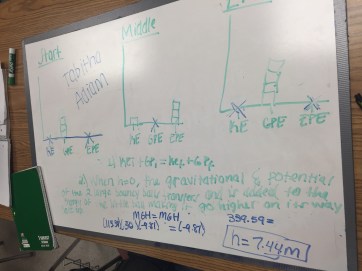
After a quiz, students made some observations of the Astro Blaster and used conservation of energy to explain what they saw. Students also worked through some conservation of energy questions out of TIPERs.

IMG_1512

Chemistry: Balancing Chemical Equations

Students used what they found in the simulation yesterday to practice balancing chemical equations. I took a page from the Modeling Chemistry curriculum and had students sketch the molecules in the reaction, which turned out to be a really effective tool to make balancing a much more concrete process.

Day 62: Mistakes Game & Balancing Reactions

Physics: Mistakes Game

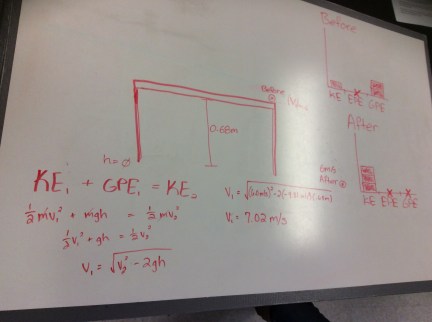
We played the mistakes game with yesterday’s conservation of energy problems. For students who had the other physics teacher last trimester, this was their first experience with the mistakes game. I was pleased with the way the students I had last tri took the lead, helping their peers come up with interesting mistakes and modeling good questions.

IMG_0317

The mistake is a subtle sign error, but lead to some great discussion about determining whether an answer is reasonable.

Chemistry: Intro to Balancing Chemical Equations

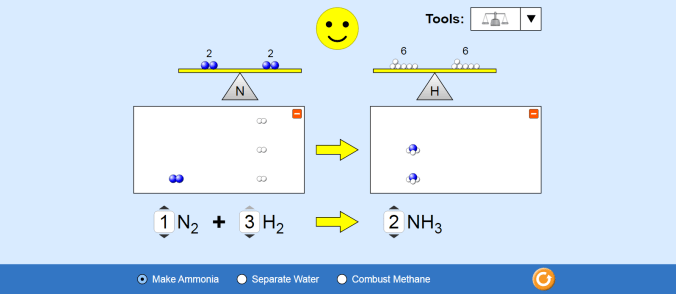
I took advantage of the visuals in PhET’s Balancing Chemical Equations sim to introduce my students to this process. I had them start by playing in the introduction to figure out what the different representations tell them about the chemical equation. After students had some time to play, we came back together. My students were able to articulate pretty clearly what it means for a reaction to be balanced, and what it has to do with conservation of mass. Students then spent some time testing their understanding by playing the game built into the simulation. Based on the conversations I overheard as they played, students were getting a much better understanding of not just how to balance chemical equations, but what all those numbers in the equation mean. I was also pleased to see the confidence my students gained while playing the game. I think a lot of them have started to assume they don’t understand things in the classroom, so seeing that immediate, consistently positive feedback from the game helped them see the way they’re thinking about these reactions really is useful.

phet balancing

Day 56: Final Review

Final exams start tomorrow, so both classes were reviewing.

Physical Science

Yesterday, students wrote questions for each of the learning targets from this trimester. Last night, I picked some of the questions they’d written to make a Jeopardy-style review game.

Physics

Each group put a problem from the review assignment on a whiteboard and presented it to the class. One of the best discussions happened when a group had a few unintentional mistakes on their whiteboard, which lead to a lot of great conversation about what the answers should be. It was also great to see the progress students have made at communicating what they did by showing their work clearly.

IMG_1488

Day 55: Final Review

Final exams start on Wednesday, so both classes did some form of final review.

Physical Science

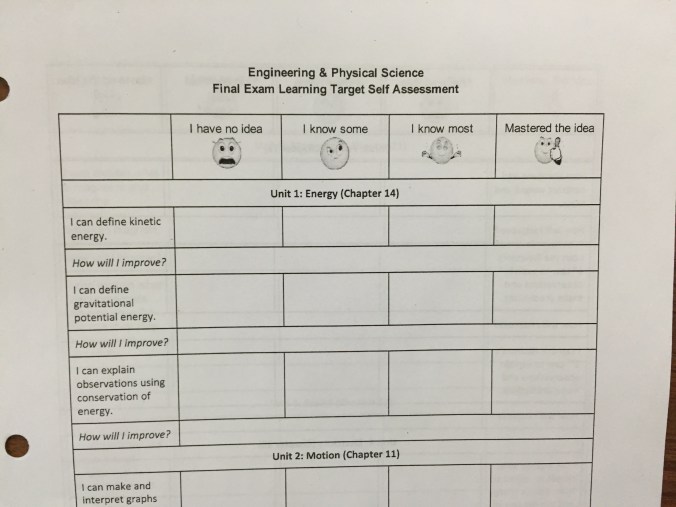
Students started by doing a short self-assessment on each of the learning targets from this trimester and we talked about how that could help them plan their studying. Next, I had each group come up with at least one possible test question for each learning target. I challenged students to come up with higher-level questions, even when the learning target is a simple one. Since AVID strategies are implemented pretty widely in the building, students were already familiar with Costa’s levels of questioning and provided a decent scaffold for students to make sure they were writing challenging questions. Students submitted their questions to a Google Form, which I’ll use to put together a review game for tomorrow. Having each group do one question per target turned out to be too much, so next year I will ask for one question per unit.

IMG_1485

Learning Target Self-Assessment Form

Physics

Students worked on a final review packet that goes back over all of the learning targets from this trimester. Tomorrow, I’ll have students whiteboard their solutions to the final review.

Day 54: Refraction & Final Review

Physical Science: Refraction

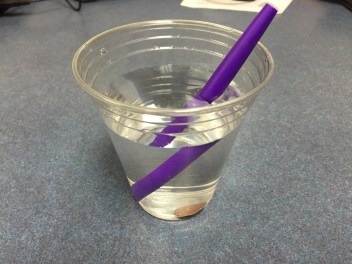
Students stuck pens, pennies, and other assorted objects into cups of water to develop some ideas about refraction. Students were very quick to connect their observations in the lab to their experiences from outside the classroom. The couple of students who’ve been bow or spear fishing were especially excited.IMG_1470
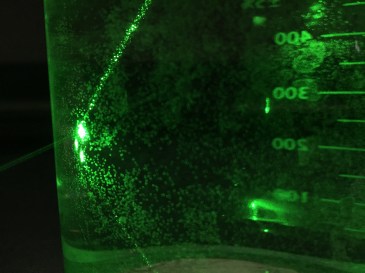
Students also made some observations of a laser pointer shining into a tank, aided by some creamer in the water and chalk dust in the air. It made a huge impression on these students when I used the chalk dust and laser pointer to show reflection yesterday, so they were thrilled to see it was still out today.

One particularly observant student noticed they could see three bright dots when the beam hit the side of the thank. We talked a bit about it, even though the students have only pretty rudimentary tools for talking about the behavior of light, and they decided that the center spot was the light reaching the outside edge of the glass while the outer spots was the light hitting the inside edge of the glass. Given the way this course skims the surface of each topic, I was pleased with their conclusion.
IMG_1458

Physics: Final Review

Students took their last quiz of the trimester, covering projectiles, then started working on their final review. The review is mostly a packet of their quizzes from this trimester.