Day 145: Review, Whiteboarding, & Legos

AP Physics: Review

A lot of my students will be taking the AP Chem exam on Monday, so it was the last time the whole class was together before Tuesday’s AP Physics 1 exam. One class asked if we could spend the whole hour on multiple choice, so we worked through a bunch of problems I’d loaded into Plickers. My other section asked for more time to work on the 2017 free response problems, so they got into small groups for that after 20 minutes of multiple choice practice.

Physics: Whiteboarding

Students whiteboarded some of the problems we’ve been working on prior to taking a quiz. A few students have started talking in terms of patterns for the number of notes and anti-nodes which is great. Students are also seeing the diagrams as a tool in ways they have not with previous types of diagrams.
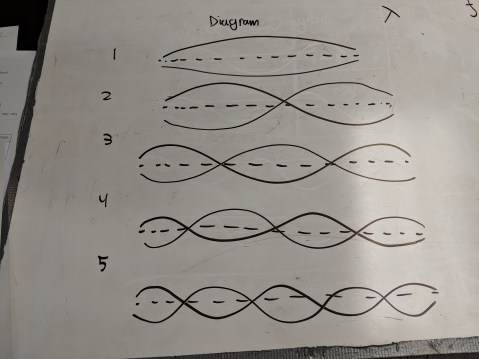
wave diagrams.jpg

Chemistry Essentials: Lego Reaction Types

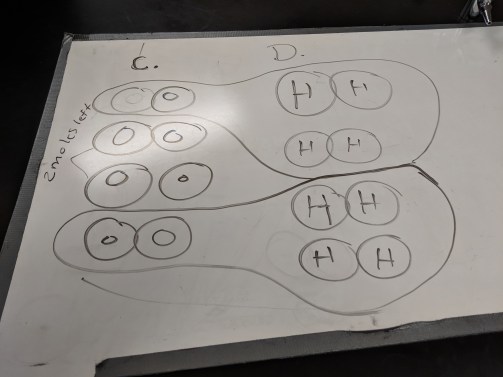
Students used Legos to represent ions in chemical reactions to get a better understanding of the different reaction types. Manipulating the blocks seemed to help students get a sense of how the ions are rearranging in a chemical reaction and tie some meaning to the terms from yesterday. I’m wondering if this lab could be reworked to start the unit and motivate the language, rather than simply being an opportunity to practice the terms.
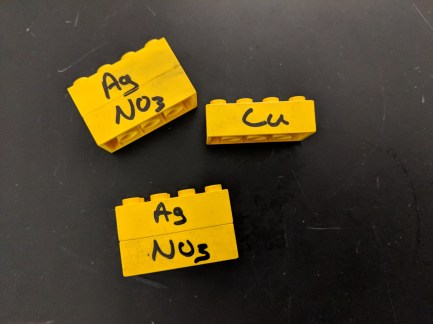
lego.jpg

Day 143: Mistakes Game, Wave Whiteboarding, & Assessment

AP Physics: Mistakes Game

Students put the finishing touches on their whiteboards from yesterday, then presented to the class for the mistakes game.  I gave students copies of the scoring guides to use during the discussion today. They were quieter than usual during board meetings, mostly because the whiteboard for a full free-response problem felt a little overwhelming.

IMG_20180502_121406.jpg

Physics: Wave Whiteboarding

Students whiteboarded yesterday’s problems. A lot of students were having trouble visualizing the standing waves, but sketching multiple wavelengths and marking the notes and anti-nodes seemed to help a lot of students.

stand wave wb.jpg

Chemistry Essentials: Quiz

Students took their limiting reactants quiz. I picked a problem where the numbers work out pretty nicely, and, glancing over the quizzes, it looks like the students who sketched particle diagrams nailed the problem.

Day 142: Mistakes Game, Standing Waves, & Lab Results

AP Physics: Mistakes Game

We spent about 15 minutes using Plickers to discuss some multiple choice from the practice test students took last week, then started working on the 2016 free response. Students started prepping whiteboards that we’ll use for the mistakes game tomorrow. Most groups got to the point where they felt they had a good solution on their whiteboard, so will need a few minutes tomorrow to add a mistake.

ap fr mistake.jpg

Physics: Standing Waves

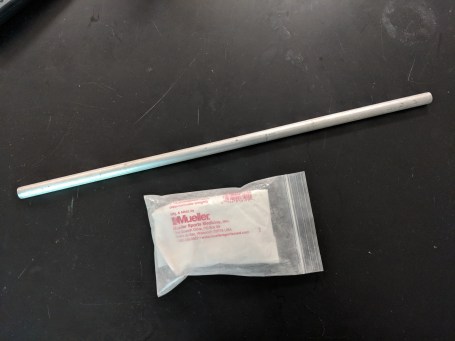
We got out the singing rod to reason out what must be the pattern for standing waves on a resonator free to vibrate at both ends, then students started working on some problems. A lot of students struggled to relate wavelength to the length of the resonator, in part because many of them were looking for a specific equation rather than using the diagrams the worksheet asked for as a reasoning tool. I need to think about how I can help students see the value of their diagrams tomorrow.

singing rod.jpg

Chemistry Essentials: Lab Wrap-Up

The copper from yesterday’s lab needed some time to dry, so today students got the mass and worked on their calculations. A lot of groups had balled up their aluminum foil yesterday, which lead to some big chunks of unreacted foil, even for groups where it should have been the limiting reactant. This ended up being a great opportunity for students to use a particle model for chemical reactions to think through why that happened.

dried cu.jpg

Day 140: Post-Test & Speed Dating

AP Physics & Physics: Post Test

Both of my physics classes took the FCI post-test. Not surprisingly, the scores in my AP class were much higher, but there was significant growth from the majority of the students in both courses.

Chemistry Essentials: Speed Dating

Students did some whiteboard speed dating on limiting reactant problems. The speed dating had mixed results; there were a lot of mistakes finding the molar mass, and most students weren’t comfortable changing the previous group’s work. This did lead into some good discussion on the value of showing your work and what clear work looks like. I also ended up working an example, which several students had requested at the start of the hour, but after the speed dating, I was able to address specific issues and challenges and students were more engaged than I think they would have been early on.

Day 139: Free Response, Standing Waves, & Whiteboarding

AP Physics: Free Response

We are starting to review proper for the AP Physics 1 exam. Today, I gave students the 2015 free response and asked each group to sign up for a problem they will become the experts on. There was lots of good discussion about reading carefully and parsing what the question is really asking.

Physics: Standing Waves

We got out the wave generator and a strobe light to get a few more ideas in place about standing waves. The strobe light helped a lot with talking about the particle motion since it became possible to track the movement of the string.

Maker:S,Date:2017-10-21,Ver:6,Lens:Kan03,Act:Lar02,E-Y

Chemistry Essentials: Whiteboarding

We spent some time whiteboarding yesterday’s problems. We spent a lot of time on the first problem, which had nice whole number mole ratios, so we could look at how the particle diagrams show what math needs to be done.

chem limit.jpg

Day 137: Toilet Paper Practical, Snakey Springs, & Limiting Reactant Hardware

AP Physics: Toilet Paper

Students finished working on the lab practical we started yesterday. Students did a lot of connecting ideas, which was great. I added a question asking students to calculate the final velocity of their unrolling roll using the velocity time graph and using energy, which I’m hoping to use to introduce rotational kinetic energy tomorrow.

Physics: Snakey Springs

My plan was to whiteboard yesterday’s lab, but most groups had either a linear or quadratic relationship between wavelength and frequency; a lot of students seemed distracted during yesterday’s pre-lab discussion, and I should have taken the time to bring their focus back rather than plowing ahead. We took a few minutes to talk about whether the graphs groups have make sense, then revisited the pre-lab discussion and re-did the data collection. I’ve had some other labs this tri we needed to re-do because of poor results, so I need to think about how to do a better job of making sure the lab goes well the first time around.

Maker:S,Date:2017-10-21,Ver:6,Lens:Kan03,Act:Lar02,E-Y

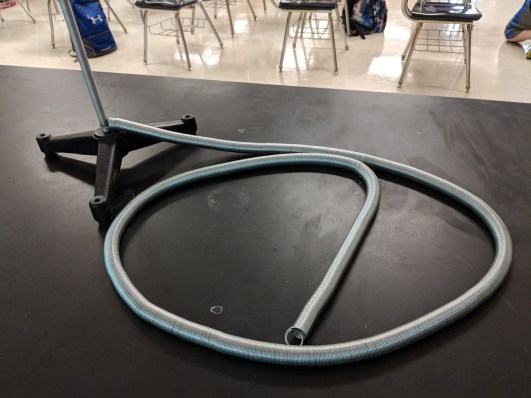
Turns out my heavy ring stands work well for holding one end of a snakey spring

Chemistry Essentials: Limiting Reactants Hardware

We revisited the nuts, bolts, and washers and the “reaction” used to introduce stoichiometry to explore more with limiting reactants. I had a few students who were bothered that there isn’t a simple rule they can always use to immediately identify the limiting reactant, but they were still able to see the kinds of approaches I wanted them to.

Maker:S,Date:2017-10-21,Ver:6,Lens:Kan03,Act:Lar02,E-Y

Day 136: Toilet Paper, Snakey Springs, & Limiting Reactants

AP Physics: Toilet Paper

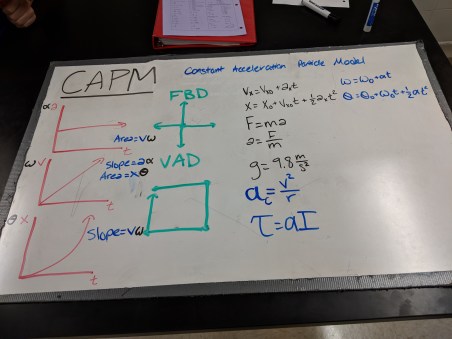
I started by having students whiteboard some model summaries. I started with linear motion, then asked students to add the angular version of each representation. This seemed to help students draw connections between linear and angular motion. Afterward, students started working on a lab practical to predict where to start an unrolling roll of toilet paper so it hits the ground at the same time as a toilet paper roll dropped from a given height.

Maker:S,Date:2017-10-21,Ver:6,Lens:Kan03,Act:Lar02,E-Y

Physics: Snakey Springs

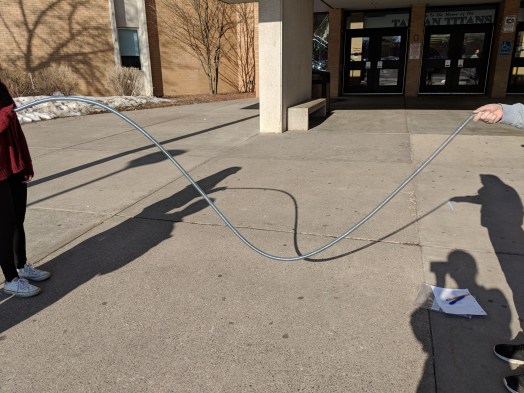
To introduce waves, students played around with snakey springs to look for ways to change the behavior of the waves and get some data for a relationship between wavelength and frequency. Today was one of the first days it was 60 degrees all day and there wasn’t much snow on the ground, so I took the lab outside and a lot of students used sidewalk chalk to help with their measurements. There were also some good observations of the shadows; one group making cycloid waves noticed their shadow looked the same as the shadow for 2D waves.

snakey.jpg

Chemistry Essentials: Limiting Reatants

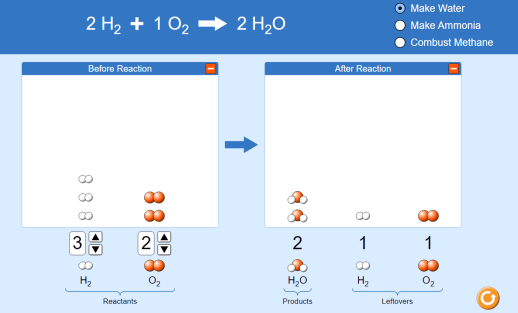
Students used a PhET simulation to start building some ideas about limiting reactants. The class was much rowdier than usual; the class meets the last period of the day, and I think the nice weather was making a lot of them restless. The concrete visualizations did seem to help a lot of students start making sense of limiting reactants.

limiting ract.PNG

Day 135: Whiteboarding

AP Physics: Angular Momentum

Students whiteboarded yesterday’s problems. There was a lot of good discussion; I think rotation is starting to click for a lot of students. I also did a few demos, including one with an RC motorcycle inspired by a Evel Knievel statement prior to a jump over the Snake River Canyon that his biggest fear was accidentally letting go of the gas while in mid-air.


Physics: Oscillating Particle Whiteboarding

Students whiteboarded yesterday’s problems. The connections between the math and the big ideas seem to be clicking for a lot of students. One of the questions we discussed is whether the angle of a ramp should affect the period of a cart oscillating on a spring, so I set up the demonstration.

Chemistry Essentials: Percent Yield 

I kept the whiteboarding pretty short since a quiz on percent yield was also on deck for today and the para working with the class had let me know that students had done very well with the problems. We targeted a couple of trouble spots, like a problem where a lot of students dropped a decimal point yesterday, leading to over 800% yield. I was really pleased that students recognized why that was not a reasonable answer, even if they had trouble finding the error.

Day 134: Problems Galore

I had a sub today, so no pictures. All three of my classes worked on problems.

AP Physics: Angular Momentum

I gave students some angular momentum problems. Its been a while since we hit linear momentum hard, so I’ll be curious to see how it went shaking the dust off and translating to angular scenarios. I also threw in some torque problems; on the last quiz, a lot of students weren’t sure what an extended free-body diagram is, so that is something I needed to make sure to revisit.

Physics: Springs & Pendulums

Students did some problems using the equations for the period of a spring and period of a pendulum. Earlier this week, some students were having trouble distinguishing the two formulas, but I think the lab practicals helped. I’m hoping that shows up in how the problems went.

Chemistry Essentials: Percent Yield

Students did some percent yield problems. They look very similar to the stoichiometry problems we’ve been doing, with a step added at the end to calculate percent yield. When I got to school for parent-teacher conferences, I was able to connect with my sub and the para who supports the class, and both told me the problems went very well for the majority of students; they are seeing the connections between what we’ve done previously and the new material. The para also reminded me I need to crack down on students showing their work; a lot of students are frustrated because looking back at their old work isn’t helpful, but they don’t yet see that writing out their work would change that.

Day 133: Board Meeting, Pendulum Practical, & Percent Yield

AP Physics: Board Meeting

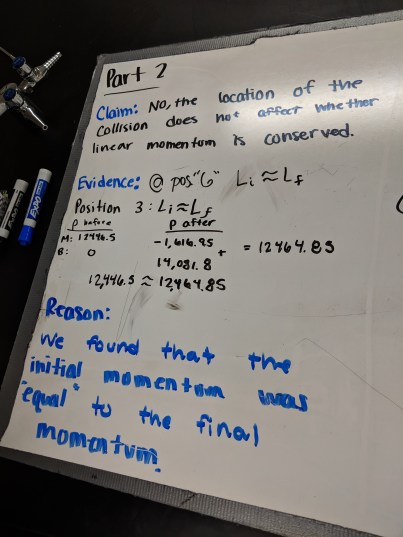
Students whiteboarded their results from yesterday’s Pivot Interactives activity. Students spent a lot of their time yesterday on whether the location of the collision affects whether linear momentum was conserved, but had a lot of interesting approaches and good discussion about that question. For the portions of the activity specific to angular momentum, I ended up much more teacher-directed than I like since I will be out tomorrow and am feeling the time crunch of the looming AP exam.

Maker:S,Date:2017-10-21,Ver:6,Lens:Kan03,Act:Lar02,E-Y

Physics: Pendulum Practical

Students finished yesterday’s practical, then were tasked with finding the period of a pendulum without using a ruler or meterstick. Not surprisingly, most students declared the pendulum practical was much easier than the spring one.

Maker:S,Date:2017-10-21,Ver:6,Lens:Kan03,Act:Lar02,E-Y

Chemistry Essentials: Percent Yield

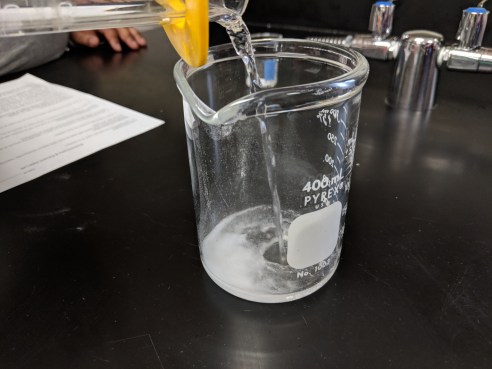
Students predicted how much carbon dioxide should be produced in a reaction between baking soda and hydrochloric acid, then found the percent yield by measuring how much mass was “lost” during their reaction. I like that this lab circles back to conservation of mass to measure the mass of gas produced, but a lot of students had trouble connecting the lab to the stoichiometry problems we’ve done, so I need to think about how the layout and wording of the lab may be making those connections more difficult.

chem yield lab.jpg