Day 19: Newton’s 2nd Law & Constant Acceleration Practical

Physical Science: Newton’s 2nd Law

Students began collecting data for Newton’s 2nd Law using the classic modified Atwood’s machine. This is the first time students have done an open-ended lab with quantitative data, and I enjoyed watching groups tweak their experiment to get good data.

IMG_1204

This group added mass to slow their cart down, then added the golf ball to prevent it from sliding around in case that impacted the motion.

Physics: Constant Acceleration Practical

Students finished the practical started on Wednesday. After we collected data as a class to determine the speed of a tumble buggy and the acceleration of a marble on a ramp, each group got a starting position for either the marble or the buggy. Groups then had to figure out where to start the other so that, when released at the same time, the marble would land in a cup on top of the buggy.

Day 17: Weight & Acceleration Practical

Physical Science: Weight

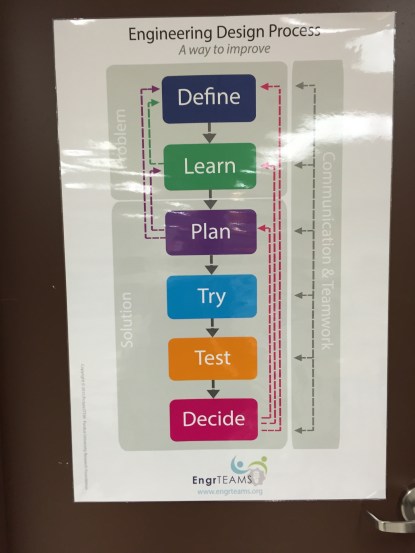
Today began with some talk about the engineering design process developed by EngrTEAMS. In particular, we placed ourselves in the “Learn” phase since students agreed they need some new science to understand crashes. I introduced forces as a tool for understanding crashes, and we dove in to a lab where students used spring scales to measure the weight of several hanging masses, then graphed the results. Tomorrow, we’ll get to the idea that the slope is the strength of gravity.
Since the lab is fairly straightforward, I had the chance to do one-on-one conferences with a few students who currently have low grades to make an action plan. I’m taking an “SBG-ish” approach in the course, which means I enter unit tests in the gradebook, rather than standards, but the tests are nearly all of the grade and I allow retakes to replace the initial score. I really liked that this freed me to talk with students about missing skills and understandings, rather than a long list of missing assignments. The students also seemed much more positive about these conferences than in the past.

Physics: Acceleration Practical

For most of the hour, students started working on a lab practical where they will roll a marble down a ramp so that it lands in a tumble buggy as it drives past. As a class, we collected the data students need to get the speed of the buggy and the acceleration of the marble, then students drew a random starting position for either the marble or buggy. I introduced the practical very clumsily in my first class, so I’ll need to do some clean up and clarification when we get back to the practical on Friday.

The first part of the lesson was finishing yesterday’s whiteboard presentations and produced one of my favorite moments of the day. When preparing their whiteboard yesterday, one group made the very common mistake of using v = d/t to find the final velocity of an accelerating object. In their quick conversation, they realized their answer didn’t make sense with the other values and were able to correct it. That group was brave enough to share that mistake, as well as how they caught it, when they presented the problem.

Day 6: More Bar Charts & Dueling Buggies

Physical Science: More Energy Bar Charts

I started by putting students into new groups. Since we were going to spend the class period revisiting things they had done previously, I wanted students to work with new people to get a new perspective. We took some time to go over the energy bar charts students had made on Friday. Each group whiteboarded one problem, then presented to the class. Next, we revisited the PhET skate park activity from yesterday. Students shared their predictions for what the bar charts would look like in various scenarios, then came to a group consensus before we used the simulation to actually test their predictions.

IMG_1155

Physics: Dueling Buggies

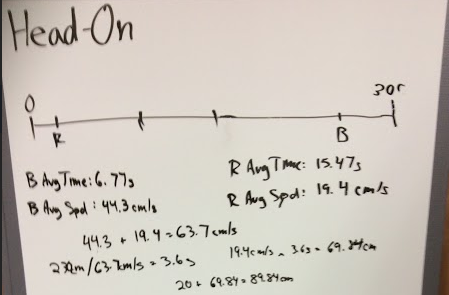
Today was Dueling Buggies! I’ve been emphasizing position vs. time graphs, so I wasn’t surprised that a lot of students went that direction. There were a lot of other interesting solutions, though. One of my favorites was a group who added the speeds of the two buggies, then divided the initial distance between the buggies by the combined speed to get the collision time, which allowed them to find the position. I was pleased to see that students were intrigued by the variety of solutions, and several wanted to talk to groups who’d done things differently after they turned in their whiteboards. Students also readily recognized that every group had a useful approach since every group made an accurate prediction.

whiteboard2