Day 26: Defining Systems & Topography

AP Physics: Defining Systems

We played the mistakes game with yesterday’s free-body diagrams. In both my hours, there was some great discussion about a problem with a skydiver attached to a parachute and whether the upward force should be a tension force from the straps of the parachute or a normal force from the air on the parachute, which lead beautifully into the importance of defining your system.

IMG_2328.JPG

Earth Science: Topography & Wind

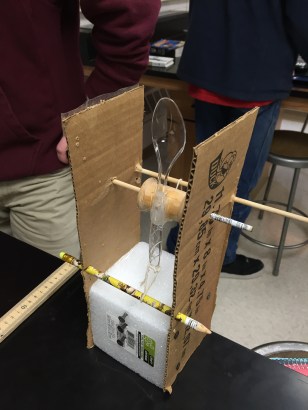
As the next stage of their project to plan a wind farm, students built a simple “topography” using textbooks and used simple flags to make observations about how that impacted wind speeds. Afterwards, students tried placing a turbine at some of the locations where they’d left flags and measuring the current produced.

img_2324

Day 24: Bowling Balls & Problem Scoping

AP Physics: Bowling Balls

Students did a lab I borrowed from Frank Noschese hitting bowling balls with rubber mallets to look for a relationship between force and acceleration. I really like the conversations that happen when students are working out how to get a bowling ball to move at a constant velocity. When one group was wondering how to check, we ended up pulling out the Motion Shot app to make a motion map. Another group decided they needed to use gentle forward taps to maintain the constant velocity combined with even gentler backwards taps to counteract the forward ones; as they made their taps gentler and gentler, they eventually realized they could do away with them entirely. My 4th hour also got very excited about balancing things on their bowling balls.


Earth Science: Problem Scoping

On Thursday, students only had time to answer the problem scoping questions individually. Today, I had them answer the questions with their lab groups using a different colored pencil to differentiate individual ideas from group ideas. After that, we discussed as a class what kinds of things students will need to know for the engineering design challenge, which lead nicely into introducing and previewing the learning targets for the unit.

Day 23: Test & Problem Scoping

AP Physics: Test

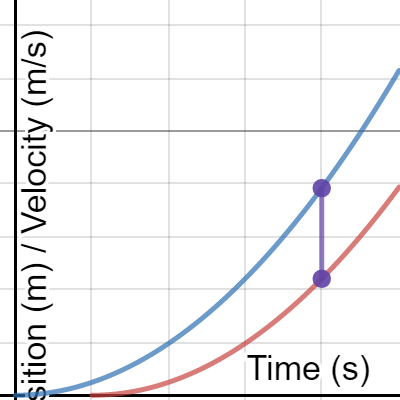
I use standards-based grading and this year, I’m giving each student two scores on each standard. What I’m calling the tier 1 score is from an assessment similar to what I gave in honors physics and the tier 2 score is from a full-period test with problems modeled on the AP Physics 1 exam. Today was the first tier 2 test. I’m not very focused today, so I spent too much time playing with a solution I made in Desmos to one of the multiple choice problems.

Earth Science: Problem Scoping

We’re starting a unit on wind that includes an engineering design challenge to plan a wind farm, so I decided to take a project-based learning approach to this unit. Today, I introduced the design challenge using a problem scoping process I picked up at EngrTEAMS. Students read a short memo from our “client”, then wrote individual answers to some questions about the specifics of the design challenge. We ran out of time for students to meet with their groups, so on Monday, they’ll share those answers in their groups and record a group answer in their notebook alongside the individual answers.

Day 16: Annotating Graphs & Solar Collectors

AP Physics: Annotating Graphs

The bulk of the class period was spent annotating velocity time graphs and writing equations based on them. I’ve become a big fan of graphical problem solving, but find students need some practice just going from a graph to equations before they’re ready to go from word problem to graph to equations. For the first time, I had some students who really wanted to stick with x, y, and m as variables, rather than using the physics terms. Once we spent a few minutes really talking about the physical meaning of the graph characteristics, they were more willing to budge. Next time I introduce annotating, I need to do a better job of emphasizing the meaning up front.

img_2245

Earth Science: Testing Solar Collectors

Students tested their solar collectors by measuring the temperature change in front of a lamp. Several groups had pretty small temperature changes, so I need to consider either having students place their collectors closer to the lamp or doing a test longer than the 5 minutes I used today. I had them connect back to the science one more time by proposing some ways to improve their design and justifying their proposal with some science.

img_2241


Day 15: Mistakes Game & Solar Collectors

AP Physics: Mistakes Game

We played the mistakes game using problems translating between representations for constant acceleration. While I didn’t have to say much and there were some great questions asked, it ended up being a few people in each section who asked most of the questions. The students are pretty good about trying to call on new people, but I want to think about how to encourage more people to raise their hands or offer something during those discussions.

img_2236

Earth Science: Solar Collectors

To apply what students learned this week, they started a short engineering design challenge to design solar collectors. I had them start by coming up with some ideas individually, then working as a group on a whiteboard to come up with a group design. At both stages, I had students fill out an evidence-based reasoning template my team developed at EngrTEAMS a few years ago to scaffold them to make connections between the science and their ideas.


Day 80: Projectile Launchers & Return to Stoich

Physics: Projectile Launchers

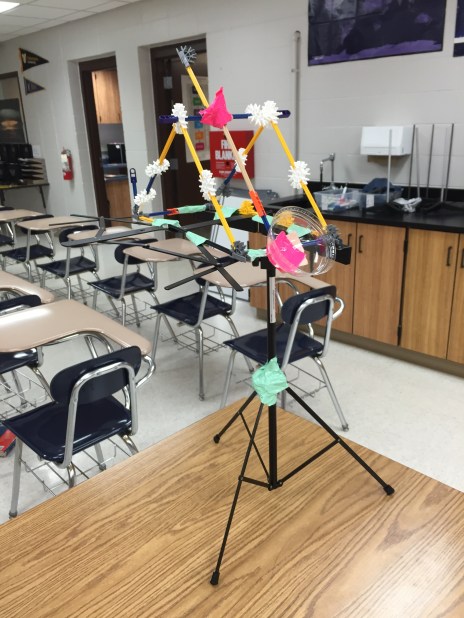
Students tested the final versions of their projectile launchers today. I picked random target distances in three different ranges, and groups had to pick one target to try and hit. I really enjoyed seeing the creativity in the materials students used. On group built a basic launcher out of K’Nex and decided to take a slushie break as they tried to come up with something to hold the ping pong ball, only to realize the lids from their slushies were the perfect size and shape. They also decided an adjustable height would make it easier to hit the target and came up with attaching the launcher to a music stand.

While students applied a lot of good data analysis to the project, the connections to energy and projectile motion weren’t as strong as I’d like, which I think has a lot to do with the way I broke up the project. I tried to squeeze energy into the two weeks between the start of tri 2 and winter break, and the project ended up bleeding into electrostatics. Next year, I may try starting the project with projectile motion, then working the redesign into the energy unit. There will be some administrative challenges, since the project will be split across two terms and a lot of students switch class periods, but I think it will pay off with students seeing a stronger connection to the physics content.
IMG_1595

Music stand, K’Nex, and a slushie lid

Chemistry: Return to Stoich

The next unit covers percent yield and limiting reagents, but scores were low enough on the assessment I gave before winter break that I want to revisit stoichiometry before we try any percent yield problems. Today, students started a lab to predict masses for an imaginary reaction using nuts, bolts, and washers in place of actual atoms. I wanted to give them something they could manipulate and measure very directly to get some conceptual understanding of stoich before we try any more problems. I wrote the lab with the intention of helping students work piece by piece through the process and questions frequently rely on information from a previous answer. A few groups, I think in an effort to be collaborative, tried to divide and conquer, and the students working on the later portions of the lab found they were stuck. Before we finish the lab next week, I’m planning to have a conversation with them about the shortfalls of the divide and conquer strategy and to come up with some more effective collaboration strategies.

IMG_1599

Day 70: Projectile Launchers & Reaction Types

Physics: Projectile Launchers

After a quiz, students continued to work on testing and refining their projectile launchers. In spite of the fact that its the last day before break, both of my classes were focused and working right up until the bell!IMG_1552

Chemistry: Reaction Types

After a quiz on molar mass, students did a jigsaw on the types of chemical reactions. Each group used the textbook to make a whiteboard with some key points about their reaction type, then students used the whiteboards to make themselves a quick reference on the reaction types.

Day 69: Projectile Launchers & More Stoich

Physics: Projectile Launchers

Instead of writing a lab report on an energy lab, I’m having students build projectile launchers that convert gravitational potential energy into kinetic energy. Today, students brought in their prototypes and had some time to test how well their prototype worked, as well as collect data on how at least two different variables affect the range of their launcher. When we do the final tests of the launchers, groups will need to hit a target at a randomly selected distance, though groups can chose between a small, medium, and long range. The launchers ranged from very simple, like a paper ramp with a meter stick spine, to more complicated, like the full-blown trebucet.

Chemistry: More Stoich

My plan had been to give students 15 minutes or so to work on the last two problems from Friday’s worksheet, then have them write an example problem where they would include a written description of the steps along with their work, but nearly all of my students needed the whole hour to finish Friday’s problems. Most of them were really focused on the steps they needed to follow and, not surprisingly, students are overwhelmed by how many steps there are and losing track of a lot of details. Next time, I need to start with some activities to help students to better connect the concepts to the process. I might do something with the nuts, bolts, and washers I used to introduce molar mass to make things more concrete at the start.

Day 34: Presentations & Newton’s 2nd Law

Physical Science: Presentation

Students delivered a presentation on the engineering projects they tested last week. They were asked to provide an overview of their design, their thinking behind it, and the results of their testing, linking back to Newton’s Laws to explain why things did (or didn’t) work. The presentation is meant to convince the project’s imaginary customer to develop their design into an actual product. I need to keep revising how I approach the presentation. I’d like to use it as an assessment over Newton’s Laws, and students make some great connections between the project and the science content, but as soon as they get to the presentation, those connections seem to disappear.

Physics: Newton’s 2nd Law

Students finished data collection and graphing for their Newton’s 2nd Law lab. The netbook cart I reserved actually worked, which meant students saw the advantages of graphing in the classroom. Several groups had a point that looked like an outlier, and their question was usually “Can we grab a track to check that point?” rather than “Can we ignore that point?” I like the first question a lot better.

Day 29: Presentations & Problems

I spent the day at a college fair with a group of seniors, so my students were left with a sub today.

Physical Science: Presentations

Students worked on a “sales pitch” for their engineering projects. Next week, they’ll present them to the rest of the class.

Physics: Quiz & Problems

Students took a quiz today. On the last quiz, a lot of students knew what they were doing, but hadn’t shown their work as clearly as I’d like. One of the things I love about standards-based grading is there’s always another chance, so I can be a jerk. I docked students on the last quiz if they didn’t clearly show their work, but put another problem for the same standard on today’s quiz to make sure everyone gets another shot.

After the quiz, students worked on some problems. Tomorrow, we’ll whiteboard.