Day 27: Elevators & Turbine Interference

AP Physics: Elevators

I showed students a video I made riding the elevator with a balance and asked them to determine whether the elevator was going up or going down and support their answer with free-body diagrams. I was pleased with how many groups started their conversation with “What’s our system?” I could tell from the conversations that a lot of students are still not entirely solid on the idea that an acceleration can be in the opposite direction of the motion, but thinking about the bowling ball lab from a few days ago seems to be helping. Next year, I want to do a better job of using the change in velocity arrows that show up in Etkina to help solidify the direction of acceleration.


Earth Science: Turbine Interference

In the next step towards designing a wind farm, students experimented with several turbines, comparing the amperage produced with different arrangements. This lab got my students asking some great questions that had me wishing that the trimester on physics came first rather than second this year. A lot wanted to know why the last turbine in a line wasn’t spinning, which is easy to explain with conservation of energy. A few others wanted to know what’s inside the turbine, which fits great with the build-a-motor lab we do in 9th grade physics. When we work on next year’s schedule, I’ll make sure to advocate for physics-earth-earth rather than this year’s earth-physics-earth sequence.
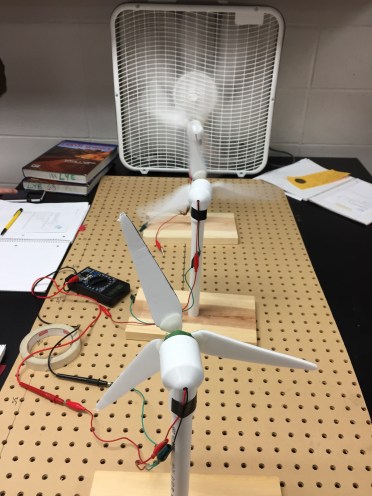
img_2336

Day 21: Angular Acceleration & Satellite Data

AP Physics: Angular Acceleration

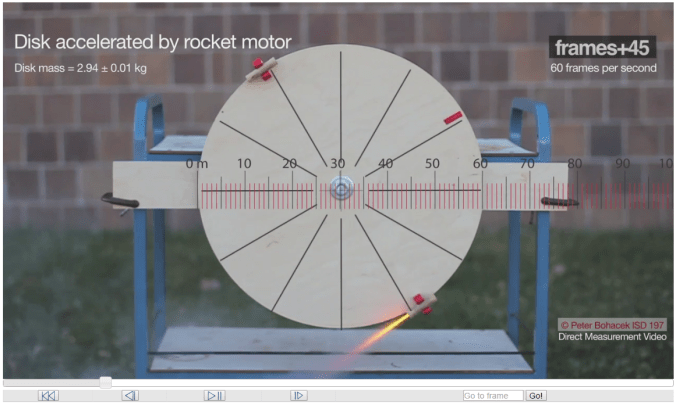
This year, I’m embedding circular motion concepts as we wrap up their linear motion analogues, so today students took their first look at angular acceleration. Students used a Direct Measurement Video to plot angle vs. time for a disk with a rocket motor attached. Students were quick to notice their graph looked a lot like position vs. time for an object with linear acceleration, and were able to extrapolate a lot from there.

rotating disk.PNG

Earth Science: Satellite Data

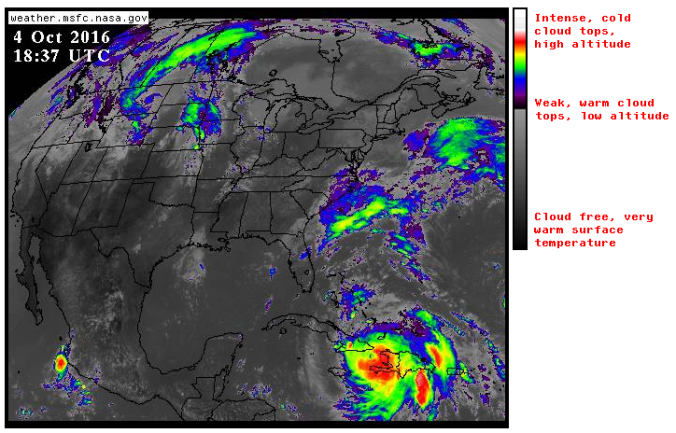
Students looked at some images of cloud cover produced by NASA’s GOES satellite to make some claims about the cloud cover and associated weather in a few areas of North America. I didn’t use my evidence-based reasoning graphic organizer today, and I don’t think its a coincidence that many students just stated their claims without any evidence. I need to keep being explicit about what good reasoning looks like and stay on students to keep including that in answers.

goes-infrared

Day 15: Mistakes Game & Solar Collectors

AP Physics: Mistakes Game

We played the mistakes game using problems translating between representations for constant acceleration. While I didn’t have to say much and there were some great questions asked, it ended up being a few people in each section who asked most of the questions. The students are pretty good about trying to call on new people, but I want to think about how to encourage more people to raise their hands or offer something during those discussions.

img_2236

Earth Science: Solar Collectors

To apply what students learned this week, they started a short engineering design challenge to design solar collectors. I had them start by coming up with some ideas individually, then working as a group on a whiteboard to come up with a group design. At both stages, I had students fill out an evidence-based reasoning template my team developed at EngrTEAMS a few years ago to scaffold them to make connections between the science and their ideas.


Day 14: Board Meeting & CER

AP Physics: Board Meeting

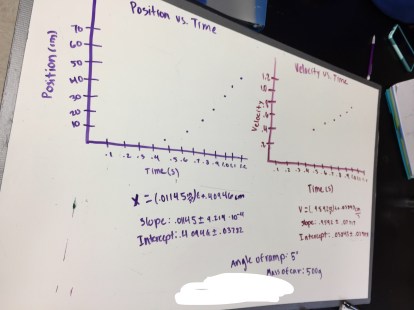
We had our board meeting on the ramp lab. This time, I had students do a gallery walk of the whiteboards prior to the discussion to give them a chance to take a close look at all of the whiteboards. That preview gave students the opportunity to make some more detailed observations, which added nicely to the discussion.

img_2232

Earth Science: Writing CERs

Both Wednesday and Thursday, we ran out of time to do any wrap-up on the labs, so that was our focus today. Students wrote CERs for both of the labs. This was a good opportunity to think about what makes good reasoning, since we were using lamps, beakers, sand, and thermometers to make statements about Earth’s atmosphere.

Day 7: Angular Velocity & Currents

AP Physics: Angular Velocity

I’ve decided to try embedding circular motion with kinematics, rather than introducing it as a separate unit, so today I introduced constant angular velocity. Students used a Direct Measurement Video of a rotating disk to plot both angle vs. time and distance vs. time for dots at different radii. I also introduced them to doing calculations in a spreadsheet since some of the number crunching they needed to do could be repetitive. Spreadsheets, high speed video, and some new physics was a lot to take in at once, so I gave more structure than usual, and my students rolled with it well.

rotating-disk-dmv

Earth Science: Currents

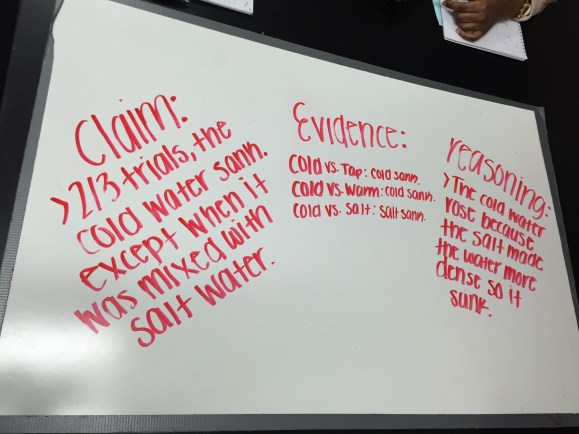
Students prepped whiteboards with their conclusions to yesterday’s lab using the claim-evidence-reasoning framework. Students seemed excited to share their work with the class. Afterward, we made some connections to ocean currents.

IMG_2184.JPG

Day 121: Pendulums & Quiz

Today was the last day of classes before spring break.

Physics: Pendulums

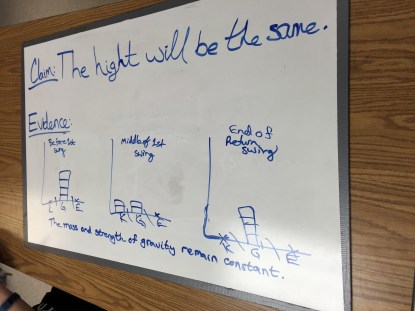
Before their quiz, I had students make predictions about a few different pendulums. First, they predicted how the maximum height on the return swing should compare to the starting height, then they made some predictions about a pendulum that uses a magnet to pick up a steel sphere at its lowest point, and finally we used a hover disc on a tilted table as a pendulum and students made predictions about what happens when the table’s angle changes.

IMG_1747

Chemistry: Quiz

Students took their first assessment of the course on representing reactions.

Day 89: Cost Effectiveness of Light Bulbs & Vocab Intro

Physics: Cost Effectiveness of Light Bulbs

After a brief introduction to electric power, I tasked students with figuring out which of several light bulbs is the most cost effective. I provided them with the cost and estimated lifetime for each bulb and the current rate the local electric company is charging, along with some Kill-A-Watts they could use to take some measurements.

Chemistry: Reversible Reactions

After a quiz on limiting reactants, students used the textbook to start defining reversible reaction and equilibrium.

Day 9: Constant Velocity & First Quiz

Today was homecoming, so classes were shorter than usual and students were more energetic than usual, but we still got some science done!

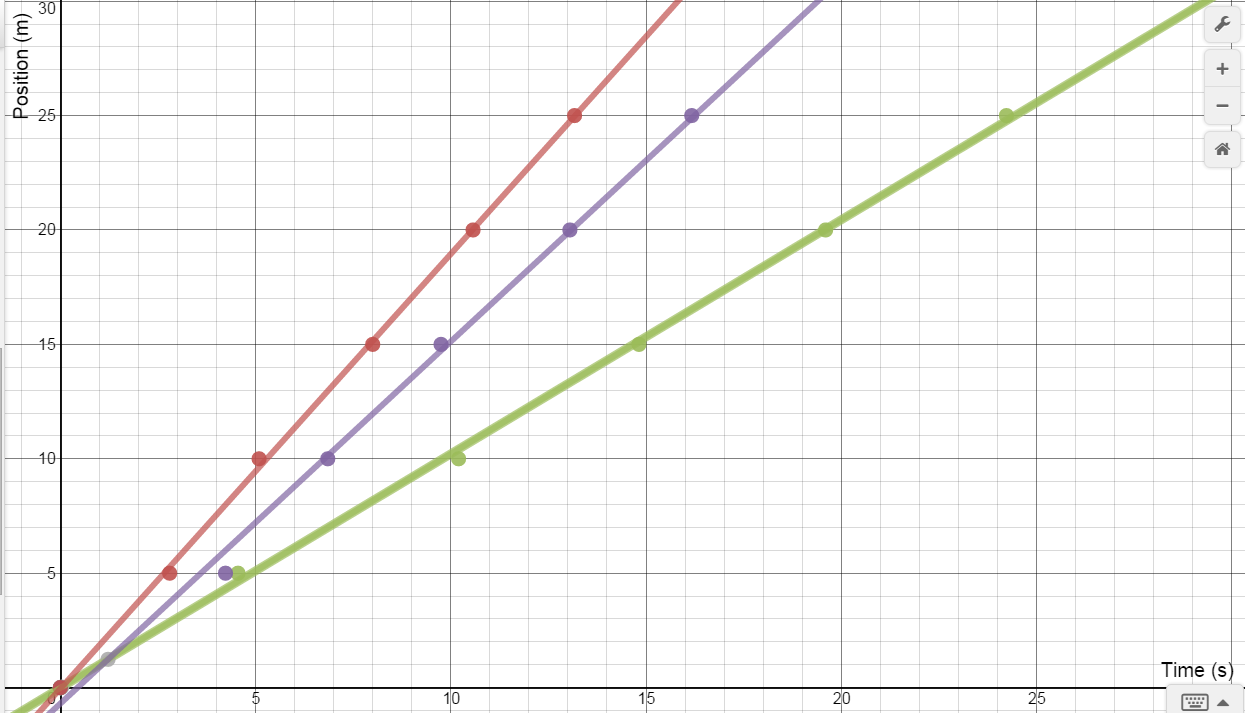
Physical Science: Constant Velocity Graphs

To introduce constant velocity, three students walked down the hall at different speeds while timers measured how long it took them to reach set points. Most students opted to make their graphs in Desmos. On Monday, we’ll find the equations for the lines to get the significance of the slope.

graph

Physics: First Quiz & Intro to CER

Students took their first quiz of the year. This is my first year using standards-based grading, and I was pleasantly surprised at how fast and easy it was to settle on a grade with only three possible scores, which meant I could focus on providing quality, growth-oriented feedback. After the quiz, students got into small groups to work through some TIPERs questions. I used the questions to introduce the Claim-Evidence-Reasoning framework, which I’m planning use quite a bit this year.