Day 106: Energy & Crashes

AP Physics: Energy

Students whiteboarded CER statements for various energy questions, including their answers to where the bouncy ball loses energy and why the tiny bouncy ball from a seismic accelerator flies off. I really liked that different groups tended to take different approaches, which made for some good sharing of ideas once whiteboards were ready and made students very confident in their responses.

bouncy-wb

Physical Science: Crashes

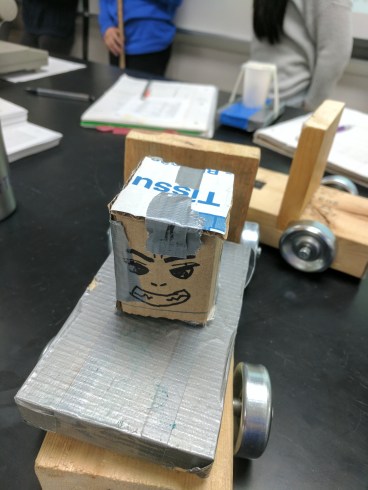
Students attached their cargo carriers to trucks, then sent them down to ramps for head-on collisions. My students usually get pretty animated on this day, which usually includes a lot of bragging about how well they expect their design to do. For some reason, a lot of students in this class were expecting their eggs to break right away, including some students who were filled with confidence yesterday, and the class as a whole was very anxious and nervous. None of the points come from how well the design performs, so it was interesting to see how much tension some students were feeling, anyway.

carrier-1

Day 103: Energy Practical & Explanations

AP Physics: Energy Practical

I tried a new lab practical for energy in an effort to integrate rotation and spiral back to some old ideas. Back in December, students measured the launch velocity of a marble, then predicted where it would hit the floor. Today, I had them use conservation of energy, including rotational kinetic energy, to find the launch velocity of their marble, then predict where it would hit the floor. I saw a lot of students pull out their old work, including their lab from December, to help remind themselves how to do the projectile portion of the problem, which is exactly what I hoped they would do. I overheard several students talking about how much they liked looking at an old problem through a new lens, as well as seeing how old ideas fit with the new ones.

practical.jpg

Physical Science: Explanations

Students practiced making predictions and writing explanations using Newton’s Laws. I showed students some videos and clips, including one from Smarter Every Day and an animation of the Mars Pathfinder landing, then had them write an explanation individually, followed by a revised explanation with their whole group. I was struggling more than usual to keep my students focused, but part of the problem might have been the English test next hour and the pep fest this afternoon. I’ve got some demos I’m planning to have students write explanations of as warm-ups, and I probably would have been better off using the demos today, then using the videos as warm-ups.

newton

Day 95: More Energy & Sledding Problem

AP Physics: More Energy

I split the class in half with some groups doing a lab for elastic energy and others doing a lab for kinetic energy. The groups looking at elastic energy looked for a relationship between how much a spring launcher is compressed and the maximum height above the table the launched cart reaches. The groups doing kinetic energy looked for a relationship between the starting height of a cart above the table and the speed at the bottom of the track.

phys lab.jpg

Physical Science: Sledding Problem

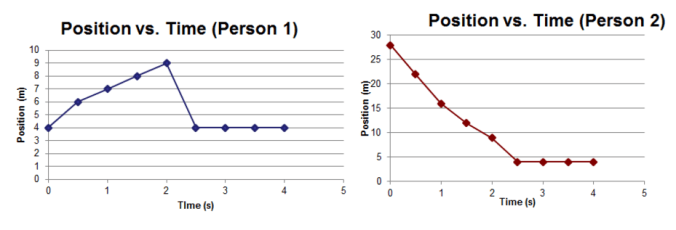
I gave students two position vs. time graphs that I said describe two people sledding, and had them do some interpretation. Students started by describing the motion of each sledder, then identifying where they collided. Finally, each group prepared a CER for who’s fault the collision is, which we then used for a short philosophical chairs where students made their case to the rest of the class. This lead nicely into a brief discussion of assumptions and they role they play in generating an explanation or a claim in science.

The sledding story made the coordinate system tricky for students. I wish I’d spent time discussing the descriptions of the motion so we could make sense of them moving in opposite directions.

sledding-graphs

Day 89: Conservation of Momentum & Refraction

AP Physics: Conservation of Momentum

Students worked on some problems using conservation of momentum. I used some problems that require them to shift how they are define their system, which students found challenging at first, but once they got the hang of it, many seemed to appreciate how shifting their system can make a problem easier.

Physical Science: Refraction

Students did a lab making lots of observations of objects in a clear cup of water. Afterwards, we shifted to making some observations as a whole-class of a laser pointer in a fish tank. Once they summarized the big ideas based on observations, I set up a washer in the bottom of a fish tank and aimed a PVC tube to view the washer. Students predicted where, relative to the tube, they should aim a dowel and a laser pointer in order to hit the washer. I was very pleased at how successful students were at this task; I do wish I’d had them write a CER for this problem since a lot of students struggled to explain their prediction.

Day 88: Collisions & Mirrors

AP Physics: Collisions

Students finished collecting data to compare momentum before and after a collision of two carts, then had just enough time to talk through results. I just gave students a data table from the Modeling Instruction curriculum, but I think my students could have handled something more open-ended as long as I can plan how I will make sure students get a good variety of collisions. I ended up falling into a pretty teacher-centered “discussion” after the lab to limit how much time we spent, but I think we missed out on a really good opportunity to talk about uncertainty and assumptions. Next year, I might have each group do just a few collisions so we spend more time discussing the results.

lab

Physical Science: Mirrors

I gave students three questions about the images formed by a mirror and tasked them with writing a CER for each question. This is the least structured lab I’ve given students so far this year, which made some students nervous, but I was pleased with the results. I had students whiteboard their CERs so we could have some discussion, but I had students stay at their lab tables and a lot of students kept going back to small group discussions. I think this was because I’ve established a very clear routine where the desks are for whole-class discussion and the lab tables are for lab group discussions. Next time, I’ll probably keep the discussion in the lab area, but have students stand up and move away from their tables to get the physical cue that its time to shift focus to the whole class.

Day 77: Friction on Ramps & Energy Sources

AP Physics: Friction on Ramps

Students whiteboarded a few of the questions from yesterday’s activity examining motion graphs for a cart on a ramp. Usually, most of my students rotate their vector addition diagrams so that the legs of any right triangles are parallel to the edges of their paper. Today, I didn’t see any rotated diagrams; I don’t think its a coincidence that today was also the first time I saw students consistently make very strong connections to the physical situation they describe. Now I’ve got a chicken and egg question; did students leave the orientation of their diagrams because they saw the physical meaning, or did they see the physical meaning because they left the orientation?

I also had students write a CER on whether friction is negligible in the data I gave them. I ended up really liking how small the accelerations are; the acceleration when the cart is moving upward is only about 0.05 m/s/s larger than the acceleration when the cart is moving downward, but it works out to a 25% difference, so students had some great conversation about uncertainty and how big a difference is big enough to matter.


Physical Science: Energy Sources

Students signed up for a topic and started researching different energy sources for a short presentation. Minnesota has a standard about comparing and contrasting different energy sources, so I have them research the pros and cons of their energy source. I need to think about what I want to have students do when the are watching presentations at the end of the project.

Next year, I might introduce this project at the start of the electricity unit. I like connecting the energy sources to what students know about electromagnetism, but I think I can maintain that connection if I make the project due after the unit has ended. I always have at least some students without internet access at home, so I try to provide some in-class worktime for the project. Since I do several simulation labs during the electricity unit, I could build in some worktime by encouraging students who finish the lab early to work on their research.

Day 66: Projectile Practical & Seismic Accelerator

AP Physics: Projectile Practical

Students wrapped up a lab practical today, predicting where a horizontally launched marble will hit the floor. Once they pulled it off, I pulled out a lighter marble and asked them to predict where it would hit without taking any new measurements. Last year, most groups spent a fair bit of time debating what should happen and trying lots of different calculations before they figured it out. This year, as soon as I pulled out the lighter marble, every group confidently stated it should hit the same spot and gave beautiful explanations for why. Its clear I’ve done a better job this year of giving students opportunities to confront that misconception.

carbon-paper

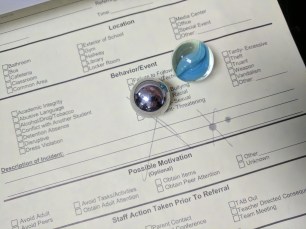
The retired referral forms work well as carbon paper

Physical Science: Seismic Accelerator

I showed students the seismic accelerator and asked them to predict what would happen when I dropped it, presenting their answer as a CER. Groups consistently drew nice bar charts, but, since we haven’t done anything quantitative with energy, it was tough for many students to recognize the tiny bouncy ball should fly above the original height. I like this as a follow-up to the bouncy ball lab, but next year, instead of having them make predictions, it might work better to show them what the seismic accelerator does, then have them draw bar charts and explain why the red ball goes so high.

Day 51: CER & HR Diagrams

AP Physics: CER

Students practiced using the CER format to explain their answers on some TIPERs questions related to centripetal force and torque. Students are overall getting better at answering these kinds of questions, but many of them get stuck putting their process into words when they were able to use a formula to guide their answer. We only discussed one problem as a class, so I’m thinking about using a peer review process to go over some of the others.

IMG_20161121_121032.jpg

Earth Science: HR Diagrams

Students worked on plotting temperature vs. absolute magnitude on a logarithmic grid to produce an H-R diagram. The plotting was much more time-consuming than I expected, partly because it was challenging for students to make sense of the logarithmic scale. I don’t think the time spent graphing did much to support understanding the science, so next year I want to give students a completed H-R diagram, then we can spend time making meaning, rather than making the graph.

Day 49: Extending Torque & Sun Layers

AP Physics: More Torque

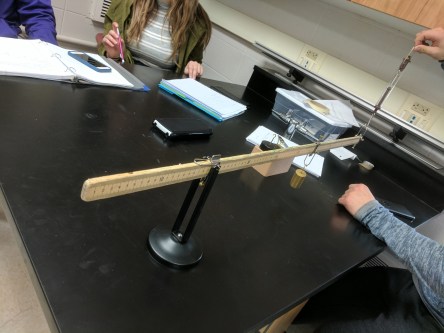
After formalizing the results of yesterday’s lab, I showed students a second class lever and asked them to decide whether the model we have for torque applies to these new levers and prepare a CER on a whiteboard. Most students went back to the first lever lab, where we looked for a relationship between the two forces and got beautiful results, including an intercept that’s too big to ignore. I was pleased at how many groups immediately decided to measure how much force it took to balance the lever with no additional weight on it and by how many had good conversations in their lab groups about what must be causing the intercept.

lever

Earth Science: Layers of the Sun

Students used the textbook to complete a jigsaw on the layers of the Sun. The textbook has a line about “bright hydrogen lines”, so we had some good discussion as a class about how to interpret that statement and connecting back to the spectroscope lab we did a few days ago.

Day 39: Assumptions & Moon Landscapes

AP Physics: Assumptions
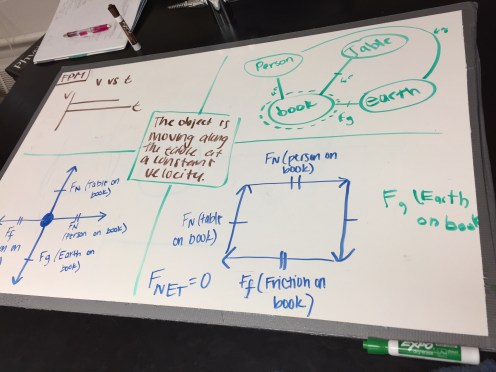
Some of my students are losing track of the tools they have for problems involving forces, so we started by whiteboarding as many different representations for a simple force problem as we could and then making a list of what we have in our forces toolkit. From there, students worked on some TIPERs problems. I had students answer each problem using a CER, but turned it into a CAER by asking them to state and justify key assumptions before diving into the evidence. We had some good conversation about what makes something an assumption rather than evidence or a claim. We will definitely need to revisit this as the year goes on, but I liked hearing my students start by articulating what they had to just agree is true before digging into the rest of the problem.

img_2451

Earth Science: Moon Landscapes

Students looked at a topographic map of an area of the Moon. They made some good observations and inferences about the craters formed, but students have had limited exposure to topographic maps so far and, as a result, had trouble connecting the map to what the would physically see. Next time, I think I’ll start by having them look at an actual image of the Moon, then transition to a topographic map of the same area.