Day 11: Uncertainty, Buggies, & Norms

AP Physics: Uncertainty

We had a board meeting on yesterday’s force of gravity lab, and the discussion was better than I expected at this point in the year. As we were talking about the slope, one student claimed “Gravity doesn’t change”, which lead nicely into what we mean by that and how we know. In response, another student shared that yesterday one of her group members said “The force goes up 10 N for every 1 kg of mass”; after finally reading Arons this summer, one of my goals is to have students make “for every” statements about slope, and I was thrilled it came up naturally.

I also introduced uncertainty during the board meeting. Students had a lot of great observations about the relative precision of measurements and how much mass it took to change the reading on the scale, which gave them a sound conceptual basis. I rushed the discussion since the end of the hour was coming, and it ended up more teacher-directed than I’d like, but I’m pleased with how the basic approach worked.

fg wb.jpg

Physics: Buggies

Students collected data for the buggy lab. Since when I ask for observations, there is usually a student who says the buggy is moving at a constant speed, I took a page from Michael Lerner and framed the lab as seeing how we can find out. A few groups are starting to make “for every” statements about their slope, which I did not see during the introductory unit and is great to see. I think the relationship is more obvious here than it was in the intro labs.

buggy.jpg

Chemistry Essentials: Norms

I’ve been struggling with classroom management. This is a very high-energy group, and there are a lot of things that are a lot of fun, but I’ve been having trouble keeping them on task and getting them to voices besides their own. I decided to pause today to spend some time developing norms as a class. I think a lot of students felt it was punitive, but many also agree that things aren’t working at the moment.

Day 9: More F-t Graphs & Board Meetings

AP Physics: More F-t Graphs

We discussed some of yesterday’s problems. To help with a few of the conceptual problems, we got out the force plate and had someone jump, once with their knees stiff and once bending their knees as they landed. Looking back, I wish I’d started this week’s impulse lab more qualitatively to set them up for some similar realizations to the ones we had today.

impulse jump

Physics: Board Meeting

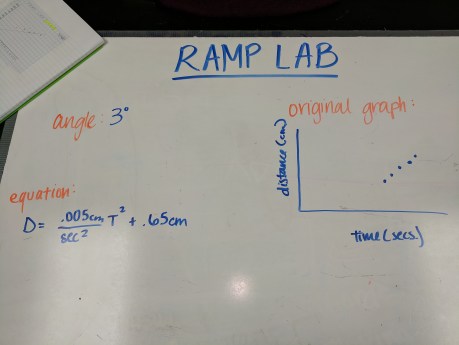
We had a board meeting for this week’s ramp lab. I struggled a bit with what I wanted students to have as their takeaway since we are still on an introductory unit, and the discussion suffered a bit as a result. The other physics teacher had his students focus on a qualitative relationship between ramp angle and slope, and was happy with how things went, so I need to do a better job of identifying opportunities like that if I do a similar intro unit next year. On Monday, however, we are on to actual physics!

ramp wb

Chemistry Essentials: Board Meeting

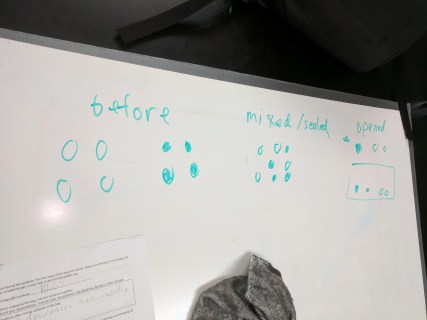
Students whiteboarded their particle diagrams for yesterday’s lab, along with a CER for whether a gas has any mass based on this lab. They did a nice job on preparing the whiteboards, but the class discussion was tough; a lot of students had trouble staying focused on the conversation at the end of the day on a Friday. I usually keep my class norms pretty broad, but I think it would be worth having the class develop some more specific norms for class discussions.

particle.jpg

Day 8: Board Meeting, Ramps, & Mass of a Gas

AP Physics: Board Meeting

We had a board meeting on this week’s impulse lab. I had one section where about half of the groups changed the mass of their cart for each trial, so I need to make sure I revisit experimental design concepts, like how to tell what variables should remain constant. Students still recognized all of the relevant patterns and we were able to get to the impulse equation nicely.

Physics: Ramps

Students finished collecting data for distance and time down a ramp to see a quadratic relationship. The results weren’t as clean as I hoped, largely because a lot of groups started their cart a fair distance behind the first photogate. It takes some background knowledge to understand why that matters, and with the cognitive load required to learn to use the photogates and set up the dynamics track, they lost track of that detail. If I do a graphing unit next year, I might give more traditional written directions rather than relying on discussion and expecting students to make the notes they need to help ease them in a little more.

Chemistry Essentials: Mass of a Gas

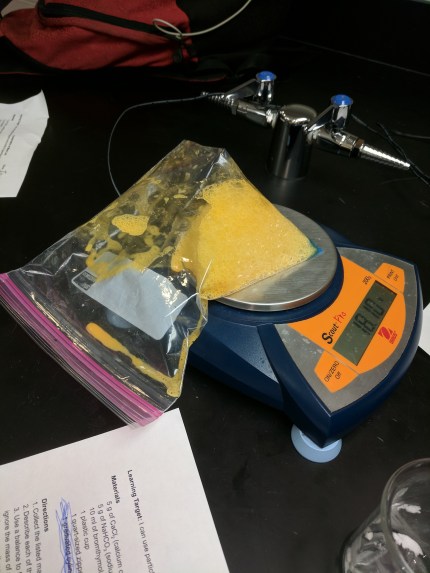
Earlier this week, a student asked what would have happened with the dissolving Alka Seltzer if we had a way to trap the gas and the rest of the class was very excited to discuss their ideas. Today, to answer that question, I had them mix calcium chloride and sodium bicarbonate, along with some indicator, in a Ziploc bag. Things were chaotic enough that I didn’t get much chance to listen to students reason about the reaction, but part of the chaos was a lot of groups were excited to tell me about their observations, which was a great kind of chaos to have.

gas.jpg

Day 134: Board Meeting & Artesian Wells

AP Physics: Board Meeting

Students whiteboarded the results of yesterday’s lab. Several students had already seen λ=c/f in AP Chemistry, and I was pleased to hear them discussing how their results fit with that formula.

wave wb

Earth Science: Artesian Wells

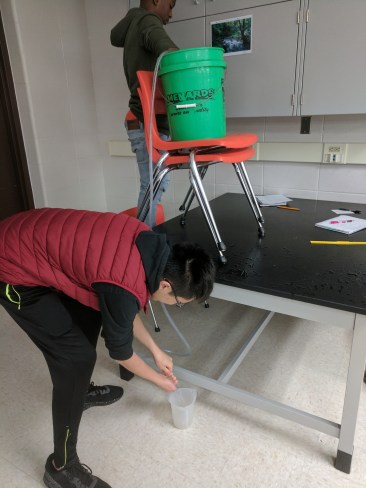
Students simulated an artesian well to find how the change in elevation affects the flow rate. I wish I’d spent more time on the pre-lab discussion to help set up what students should measure and why. I really liked the connections to energy it was possible to make; a few of the students I had last tri sketched bar charts and were able to generate some very nice explanations for why the big elevation change produced a high flow rate.

well

Day 119: Whiteboarding & Mineral Intro

AP Physics: Whiteboarding

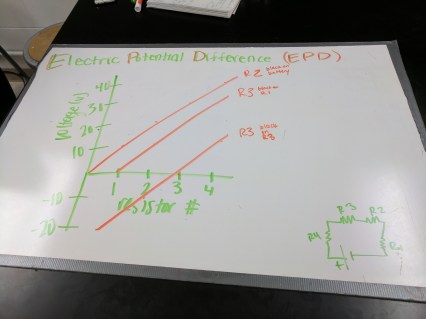
Students whiteboarded their results for the Ohm’s Law lab and an electric potential difference activity I had them try in yesterday’s sim. Students plotted voltage vs. resistor with the multimeter’s ground probe in several different positions to see the change is always the same. The analogy between gravitational potential and electric potential doesn’t seem as clear for my students as in the past, so next year I might go back to having students map electric potential.epd

Earth Science: Mineral Stereograms

I did a few notes on what caused the early Earth to melt and form layers. Afterward, students spent some time with books of stereograms of rocks, minerals, and gemstones. I wrote some questions to get students thinking about the key characteristics of each category and it was fun to listen to some of the things students were noticing.

stereo

Day 97: Energy & Free Fall

AP Physics: Energy

We had a board meeting on the two energy labs from this week. The kinetic energy groups tended to get very nice results; I had them check their model with multiple cart masses and ramp angles, and they saw the results were consistent. I had the elastic energy groups use multiple springs, but they didn’t see as clear a difference between the slopes as I would have liked. I’m wondering if the results would be less muddy if I had them plot gravitational potential energy on one axis rather than just plotting height. I shortchanged some of the pre-lab discussion, and I think that lead to students forgetting to do things like measure the cart’s starting height or measure both the starting and ending height from the same end of the cart.
kinetic.jpg

Physical Science: Free Fall

I got out washers, manila folders, and a few other things and tasked students with determining what affects the time an object takes to fall. In the pre-lab discussion, a student suggested the fluid an object falls through could affect the time, so next year I might make sure I have graduated cylinders and some different liquids available. I offered to grab materials if a group wanted to try that, but I think asking me to get stuff felt like an extra hurdle.

free-fall

Day 94: Intro to Energy & Motion Graphs

AP Physics: Intro to Energy

Students picked a height to raise their cart above the table, then made a rough force vs. displacement graph and repeated for additional angles. We compared the areas of the graphs, then defined that area as the change in gravitational potential energy. The biggest hangup is that students are so used to graphing their data that I have trouble getting across that I want a description of an individual run, instead. I might try some additional discussion prior to the lab next time.

As a side note, it was interesting to watch what looked like some gender dynamics in one of my classes. All but one of my all-male groups picked a fairly high point to raise their carts to, then used very steep angles, getting their tracks nearly vertical. The one all-female group in the class picked the lowest point they could, then did very shallow angles. I also had one mixed-gender group, and they picked both a height and angles right in the middle.


Physical Science: Motion Graphs

We finished whiteboarding results from the video analysis, following each up with a similar case on the motion detector. I should have broken up the discussion a bit more, which reinforces what I was already thinking about with going low-tech for constant velocity, then introducing video for constant acceleration. I also had students move away from their lab tables for the group discussion, and talked a bit about why I was doing it, and students were much more focused on the whole-class discussion this time.

Day 82: Board Meeting & Experimental Error

AP Physics: Board Meeting

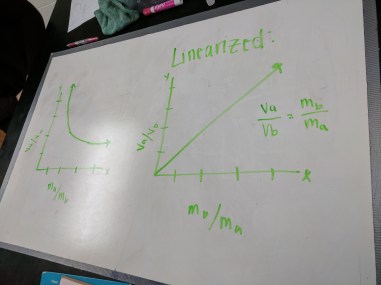
Students whiteboarded their results from the cart explosion lab to start building the momentum transfer model. I can tell its been a while since we’ve done a true model-building lab, so students needed some reminders about how to linearize or “translate” y=mx+b, but those skills came back pretty quickly. I did wish I’d had students linearize a bigger variety of graphs so far this year; a lot of students went straight to squaring a variable, so I may want to think about how to get more variety early in the year next year.

When we discussed the lab, a few groups had linerized based on a quadratic relationship and had a fairly large intercept. To decide whether the large intercept made sense, one student suggested exploding the plunger cart off empty space to get a mass ratio of zero and show the velocity ratio must also be zero.

img_20170118_092249

Physical Science: Experimental Error

We spent some time discussing yesterday’s speed of sound lab, focusing on error in measurements. I tried having students stand in different parts of the room based on how they thought frequency affects the speed of sound. When students were picking their spots, there was a lot of great conversation, including some contrasting frequency and speed, which was a great side effect. As we talked about error and what it means for values to be “close”, I had a lot of students ask to move because they changed their mind about what the answer should be.

Day 62: Board Meeting & Energy Types

AP Physics: Board Meeting

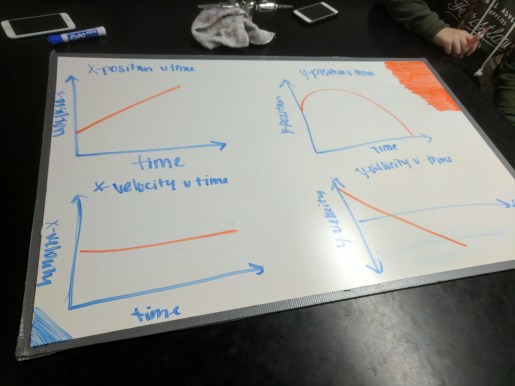
Today, students whiteboarded the results of yesterday’s video analysis. Since my 2nd hour had quite a bit of discussion and worked through much of the sense-making while they were in the computer lab yesterday, I skipped some of the structure I’ve been using in board meetings and we got to the big ideas pretty quickly, which left time to whiteboard CERs of predictions for a demo that drops one marble straight down while launching a second horizontally. In my 2nd hour, I barely had to speak as the students spoke to each other and had some fantastic discussion that accomplished exactly what I hoped it would. In my 4th hour, my students were much more hesitant to speak up. They are a naturally quieter group and had a lot less dialogue in the computer lab, so I think they would have benefitted from some pre-discussion in their lab groups and a little more structure, like Casey Rutherford’s Observations, Claims, & Evidence which I’ve used to frame most of the board meetings this year.

projectile graphs.jpg

Physical Science: Energy Types

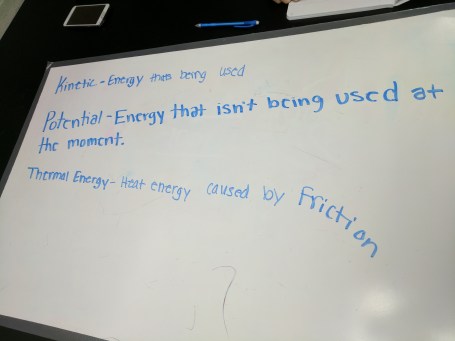
We had some discussion about what seemed to be key characteristics of the energy types in yesterday’s simulation to form a basis for some definitions. I took a page from Modeling Instruction and defined potential energy as coming from interactions, then had some discussion about what constitutes an interaction. In the past, I’ve used stored energy as the definition for potential in 9th grade, but I like that interaction energy solidifies the connection between potential energy and forces.

energy-defs

Day 54: Rotational Inertia & Big Bang

AP Physics: Rotational Inertia

We finally collected data and prepped whiteboards for the rotational inertia lab we’ve been working on. Tomorrow, we’ll spend part of the hour on a short whiteboard meeting to figure out what rotational inertia is proportional to. Students did a nice job of working through all the calculations they had to do to get from something they could measure to the rotational inertia, and it was a good review for the final exam later this week.


Earth Science: Big Bang

We discussed the lab from last Wednesday, where students made a graph to find Hubble’s Law. In the discussion, we focused on this result as evidence for the expansion of the universe. Afterwards, I ended up lecturing on the Big Bang Theory and some of the other evidence supporting it. I’m rushing a little bit as I try to cram material in at the end of the tri. Today was a reminder that over the summer, I want to spend some time with the curriculum, comparing it to the required state standards and the district-approved learning targets to get a better idea of what I can cut and where I can add build in more time for scientific practices.