Day 92: Board Meeting, Dissipated Energy, & Mistakes Game

AP Physics: Board Meeting
Students whiteboarded their results from a Pivot Interactives activity on Coulomb’s Law. There was some debate over whether inverse or inverse-square was the right linearization; I usually don’t have students sketch their points on their whiteboards, but I think that would have been helpful today. Students did a nice job connecting their results to Newton’s Laws and their knowledge from chemistry.

force charge lab.jpg

This group ran out of space for their linearization, but I found their set of graphs very satisfying.

Physics: Dissipated Energy

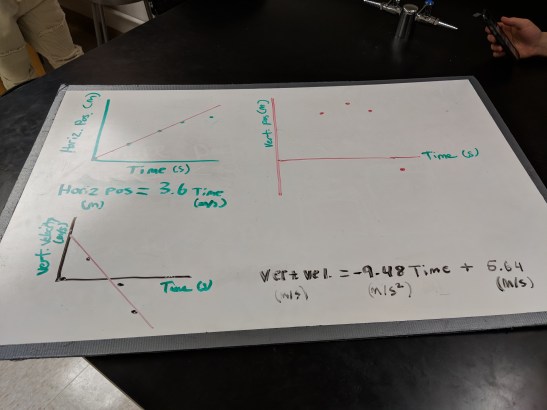
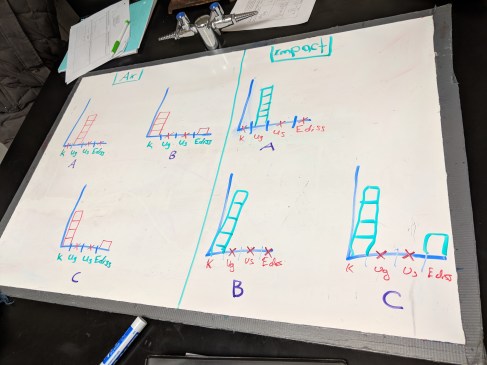
We continued prep for determining which interaction causes a bouncy ball to dissipate energy (my article about this activity was published in the January issue of The Science Teacher) by whiteboarding key points of yesterday’s work. Today really seemed to help a lot of students see the connections between the energy bar charts, free-body diagrams, and velocity vs. time graphs, which is exactly what I was going for.
bouncy lol.jpg

Chemistry Essentials: Mistakes Game

We used the mistakes game to go over yesterday’s problems. There was some great discussion, but it was very tough to keep students from breaking into side conversations. Next time, I should spend a little more time making sure behavior expectations are explicit as possible and helping students see the value in those expectations. There were also some students who were extremely engaged and clearly developed a lot of confidence in sketching Borh models today, which was awesome.

Day 88: Board Meeting, Energy CERs, & Periodic Trends

AP Physics: Board Meeting

Students whiteboarded their results from the standing waves lab and the wave equation came nicely out of the discussion. I usually give students a minute or two to pre-discuss with their lab group once we circle up with the boards, but I think I can skip that time in my 2nd hour; they dove immediately into asking questions and making comments across groups, which is a great sign of how comfortable with each other and with talking physics.

waves wb.jpg

Physics: Energy CERs

Students wrote CERs with their lab groups to make qualitative predictions about objects like the seismic accelerator and a ballistic pendulum. A lot of groups struggled a lot with what good reasoning looks like, which is not surprising. We’ve backed away from reasoning tasks in Physics this year because many students are struggling on the quantitative problems, but I need to remind myself that students need the reasoning tasks to practice the sensemaking we want them to do on problems.

nrg cer.jpg

Chemistry Essentials: Periodic Trends

Students used yesterday’s cards alongside their periodic tables to start looking at the patterns in the periodic table. Students made a lot of good observations and started asking questions about the legs used to represent valence electrons, which should make for a nice lead in to atomic structure.

card sort 2

Day 83: Inertial vs. Gravitational Mass, Board Meeting, & Freezing Lauric Acid

Several nearby districts had snow days today, so most of my classes were a little more off-task than usual today.

AP Physics: Inertial vs. Gravitational Mass

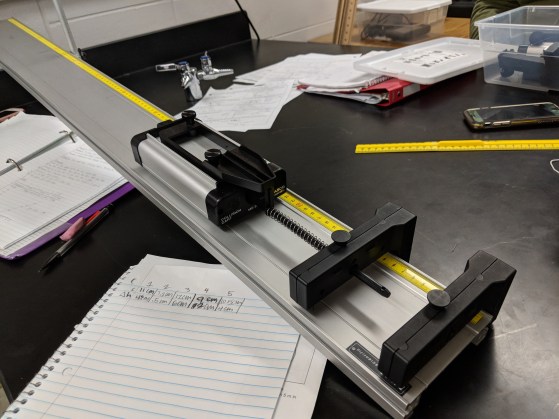
Students finished collecting data and making graphs for the period of a spring lab. We didn’t have enough time for a board meeting, but every group had decided mass is what matters so we took a few minutes to decide whether it is gravitational or inertial mass by comparing the period of a cart on a spring at different angles. This is the first year I’ve used the Pasco equal length springs, and several groups were able to get some pretty nice data for period and spring constant.

spring ramp.jpg

Physics: Board Meeting

Students whiteboarded their results from last week’s lab. I gave different groups different springs, and the slopes reflected that variation nicely which lead smoothly into fitting k into the formula. I had conversations with some groups about whether their results were “right” that reinforced just how uncomfortable some of my students still are with being even partially wrong. Talking to them, I think they don’t see this fear of being wrong as an obstacle to learning physics.

epe board 2.jpg

Chemistry Essentials: Freezing Lauric Acid

We worked on a lab to find the freezing point of lauric acid by melting it in a hot water bath, then making a temperature vs. time graph as it cools in a cool water bath. This is the last class of the day and we ended up getting released 13 minutes early due to a snowstorm, so only one group was able to get data. Especially since a third of the class was gone by 6th hour, I’m thinking about just repeating the lab tomorrow.

Day 81: Board Meeting, Energy Transfer, & LOL Diagrams

AP Physics: Board Meeting

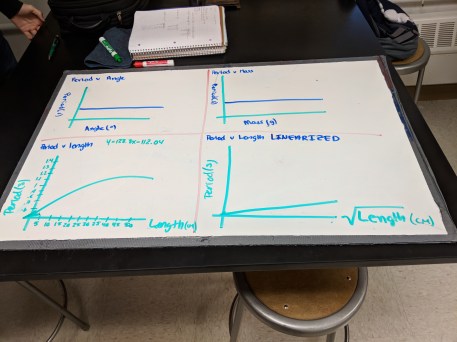
Students whiteboarded the graphs for the pendulum lab. It usually feels a little hand-wavy getting from the lines of best fit to the full equation; I had one group a couple of years ago that reasoned out gravity should be involved, and connected the dots from there. I’d like to work on scaffolding strategies next time to give students the opportunity to take those steps themselves.

pendulum wb.jpg

Physics: Energy Transfer

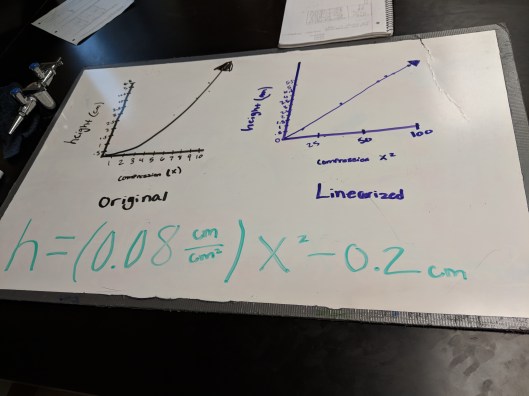
We revisited the previous energy transfer lab to come up with a formula for gravitational potential energy, then started a lab to find a relationship between the compression of a spring and the amount of gravitational potential energy transferred to a cart. Students were pretty quick to accept a linear fit to their data, so I want to make sure we spend some time tomorrow on the intercept of the graph.

epe to gpe.jpg

Chemistry Essentials: LOL Diagrams

I introduced students to LOL diagrams and they used them to represent some phase change problems. Students took to the diagrams pretty easily, which was great to see.

Day 71: Board Meeting, Practical, & Density Again

AP Physics: Board Meeting

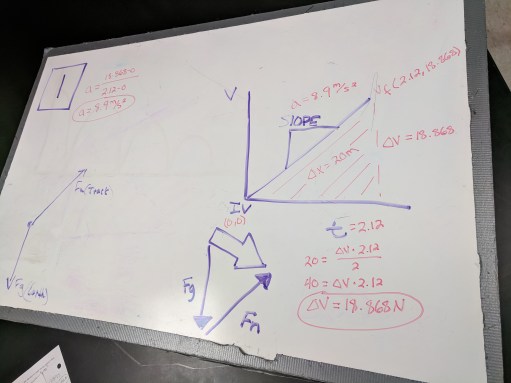
Students whiteboarded their graphs from yesterday’s video. Once I had my 2nd hour find a class average for the slopes of their vertical velocity vs. time graphs, everything fell beautifully into place and there were even gasps when one student sketched a free-body diagram. In my other hour, a lot of groups skipped the directions for making the v-t graph and tried to take shortcuts that didn’t work, so I had to step in a little more. This reinforces my thoughts yesterday that I should have spent some time discussing the midpoint method.

pm graphs.jpg

Physics: Unbalanced Forces Practical

Students started a practical to predict the time it will take a cart to roll down a ramp given the cart’s mass and the ramp angle. For the first time, I had several students ask if I could just do a diagram or calculation for them, so I left the pen I usually carry at my desk and kept my hands in my pockets to avoid encouraging that.

ramp prac.jpg

Chemistry Essentials: Density Misconceptions

Today, I have students blocks of the same material, but different volume, and asked them to determine whether volume affects density. A lot of groups had trouble funding the volume with a ruler, rather than later displacement, so I should have spent a little more time on a pre-lab discussion connecting yesterday’s volume measurements to today’s.

density (1).jpg

Day 67: Video Analysis, Speed Dating, & Density

AP Physics: Video Analysis

Students continued working to determine whether a bouncy ball dissipates most of its energy from impact or from air resistance (I’ll have an article about this activity in the January issue of The Science Teacher). Today, students used LoggerPro to analyze the videos they made yesterday and collect evidence. There were a lot of great conversations about connections between energy and motion, which is exactly what I’m after with this activity. Most students had a draft of a CER about where the energy was dissipated by the time they left class.


Physics: Speed Dating

As part of my effort to focus on lowering the social stakes in my class, I had students do some whiteboard speed dating to go over yesterday’s goal-less problems. There were a lot of great conversations; the best part was how many students I heard asking “How do you know?”. My 1st hour in particular did a great job of finding and correcting mistakes in each others’ work. I also am continuing to talk about my pedagogical choices more than usual, which seems to be helping students go along with what I’m asking and hold each other accountable for participating. Particularly in my 1st

speed dating.jpg

The units got fixed on the next rotation, but I forgot to snap a new photo

Chemistry Essentials: Density

We discussed the results of yesterday’s lab to get to a definition of density. I skipped doing a true board meeting because, with break looming, I was worried about time, but students didn’t have as solid a mental model of density as I would have liked when they were working on the worksheet. It was a good reminder that pedagogical shortcuts have their cost.

Day 63: Conservation Problems, Board Meeting, & Reaction in a Bag

AP Physics: Conservation Problems

Students started working on solving problems with conservation of energy. There was a fantastic moment when I overheard a student say “I don’t understand number 3 yet; I need to draw my LOL diagram.”

Physics: Board Meeting

Students discussed the results of the 2nd Law lab from earlier this week. I put more pauses into the whole-group discussion than usual for students to talk with their lab groups about some question and was very conscious of asking for claims the group, rather than the individual, had come up with and made explicit those claims were rough drafts. This seemed to ease some of the fears about speaking up.

Chemistry Essentials: Reaction in a Bag

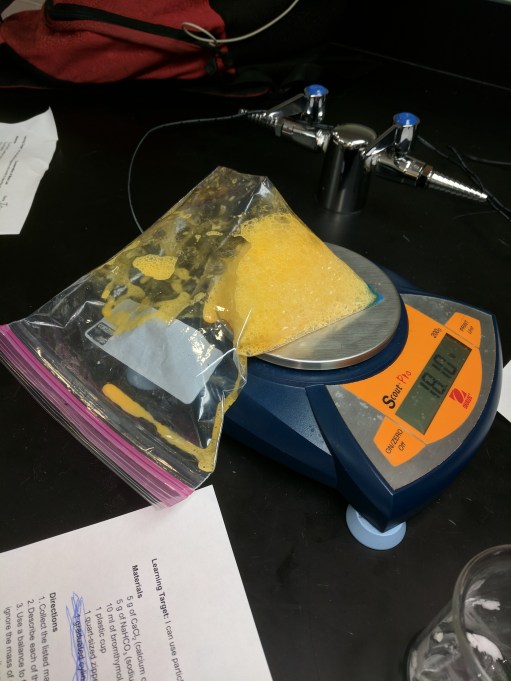
Students reacted calcium chloride, sodium bicarbonate, and bromthymol blue in a Ziploc bag. to see another example of conservation of mass in a reaction that forms a gas. Next time, I might combine this lab with the Alka Seltzer one to make a more involved exploration of whether gas has mass. Aside from this feeling more like a true chemistry lab than the Alka Seltzer one (students definitely connect goggles with “real” chemistry), that may give the opportunity to go into questions such as which was the better method of capturing the gas or whether all or some gasses have mass.

gas

Day 63: Bar Charts, Board Prep, & Particle Diagrams

AP Physics: Bar Charts

Students whiteboarded yesterday’s problems for the mistakes game. In both my classes, students were generally excited to do the mistakes game and I contributed almost nothing to the discussion, which was fantastic. Afterward, we took a few minutes to use some thermal camera images to see examples of energy dissipated by friction, including a photo I took of my car after driving it.

Physics: Board Prep

I’d planned to have the board meeting today, but we ended up just prepping whiteboards today since enough groups had issues with their data that I think it would have been tough to have a good discussion. I tended to let poor data slide last tri, since it was easy enough to recover during the board meeting, but I think a lot of groups are counting on being “that” group during the discussion. I think having those groups re-do their data collection today helped set the expectation that they shouldn’t plan on being “that” group.

n2l wb.jpg

Chemistry Essentials: Particle Diagrams

Students worked on a worksheet to practice drawing particle diagrams. The students who’ve been engaged in the labs so far were able to breeze through the worksheet and had some good discussions along the way. I’ve got more students than last tri, whoever, who checked out during those activities and had a lot of trouble with the worksheet as a result. I need to think about how I will interrupt the vicious cycle that is starting for those students.

chem particle.jpg

Day 47: Board Meeting, Whiteboarding, & Atomic Models

AP Physics: Board Meeting

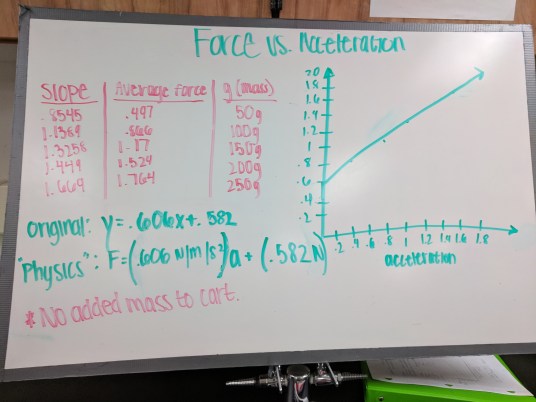
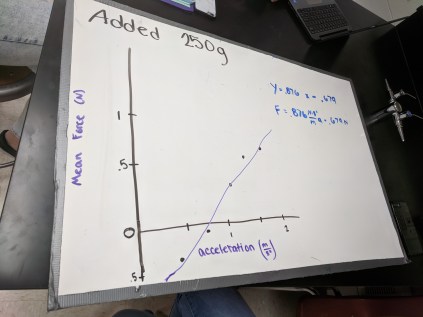
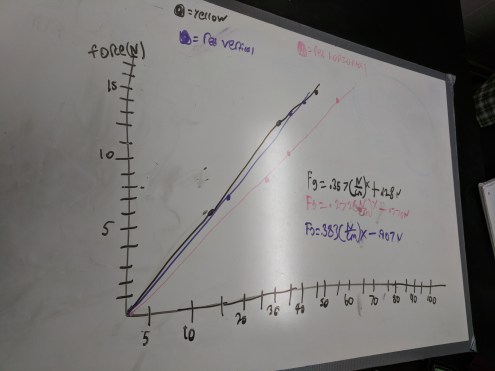
Students whiteboarded their results from yesterday’s lab. I forgot to remind my 2nd hour to zero their force sensors yesterday, which made for a good opportunity to talk about what the intercept means. They were initially bothered by the units on the slope of their graph, but the units of N/(m/s2) became really valuable when we made a “for every” statement about the slope; interestingly, a lot of students phrased their “for every” statement in terms of how the acceleration changes for every 1 N of force, even though that required inverting their slope. I thought about having students plot acceleration on the vertical axis, especially since the College Board’s formula sheet gives a = F/m, but I think the mass pops out more nicely when force is on the vertical. I may still flip the axes next year since acceleration on the vertical would fit better with how they talk about the graph.

fma lab.jpg

Physics: Whiteboarding

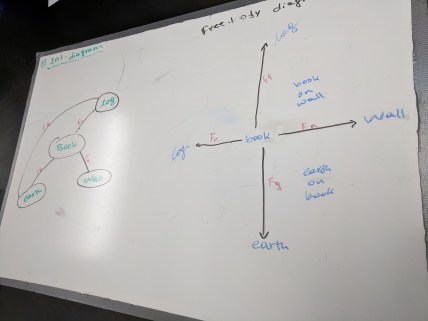
Students whiteboarded their answers to last Friday’s problems. We spent a long time on a problem about using a log to hold a book against the wall, and there was a lot of great discussion about what that force should be and why, as well as whether there should be any horizontal forces. I think a lot of students don’t see that discussion as productive, but I heard a lot of great physics talk.

log prob.jpg

Chemistry Essentials: Atomic Models

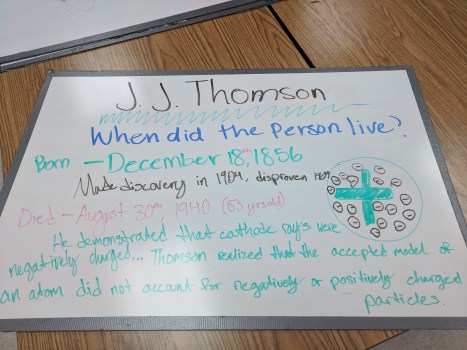
Students shared the information on the atomic models they looked at yesterday. They were surprised by the gap between Democritus and Dalton and were also very interested in the personal stories. I tend to skip past those, since most of the people the state standards call for are white guys, but its probably worth having some reminders in my class that science is done by people who live in a particular place at a particular time. Maybe next time, I’ll do a little more background research to try to come up with some other names, especially women and people of color.

Day 46: 2nd Law Lab, Board Meeting, & Atomic Models

AP Physics: 2nd Law Lab

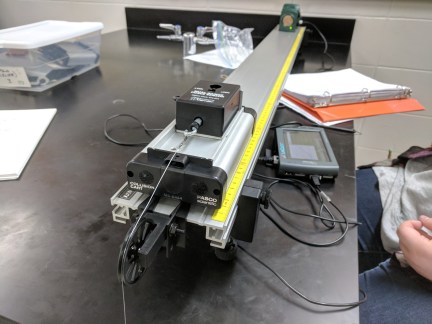
Students started collecting data for a relationship between force and acceleration. A few students took out their formula sheet to get a preview of what the equation should be; it was interesting to listen to their conversation on what they expected the graph to look like and whether their data was consistent with the equation they expect to need.

f a

Physics: Board Meeting

Students whiteboarded their results for the spring lab. They are getting better at “translating” lines of best fit into physics by selecting meaningful variables and putting units on slope and intercept. It was also clear in the discussion that students are gradually making more connections between the graphs and the reality of the lab. When discussing the intercepts, there was a great moment where a student speculated whether gravity could be contributing to the intercept, which lead nicely into comparing the vertical and horizontal springs.

spring graph

Chemistry Essentials: Atomic Models

Students worked on a jigsaw for the history of atomic models. This was a nice opportunity to talk about what we mean by a model in science since we are looking at how models of the atom evolved over time. I asked groups to name some of the evidence used to support each atomic model, and students had a lot of trouble with that. I think part of the issue is a lot of students are still shaky on what makes something evidence and part of it is there’s a lot of background knowledge required to make sense of the evidence used in many of the atomic models.

thompson.jpg