Day 24: Friction, Mistakes Whiteboarding, & Gas Law Problems

AP Physics: Friction

Students worked on collecting data for variables that affect the force of friction. I have some friction blocks with a fuzzy side and a plain wood side, and asked students to make a graph of friction force vs. mass for each side, then prepare a CER for whether surface area and speed matter. A few groups opted to add a graph of friction force vs. mass for the narrow side of the block to answer whether surface area matters, and got beautiful results where the slope matched for both sides covered in the same material.

friction.jpg

Physics: Mistakes Whiteboarding

We did mistakes whiteboarding with Thursday’s problems. I dropped the ball on taking pictures, but there were some fantastic mistakes, especially on problems where neither the final nor the initial velocity is zero. I’m also seeing some great things emerge in the way my students approach discussion; in my 1st hour, there is one student who tends to be one of the most vocal, but both he and the rest of the class were very conscious of finding opportunities for other students to speak up.

Chemistry Essentials: Gas Law Problems

Students worked on some problems doing calculations with the gas laws. Since a lot of my students have very weak algebra skills, we are doing these problems proportionally. While my students worked, my co-teacher and I conferenced with each student about their grade and their progress so far.
Day 23: Board Meeting, Annotating Graphs, & Gas Laws

Today was students’ last day before a 3-day weekend and our homecoming pepfest, so classes were short and students were more energetic than usual.

AP Physics: Board Meeting

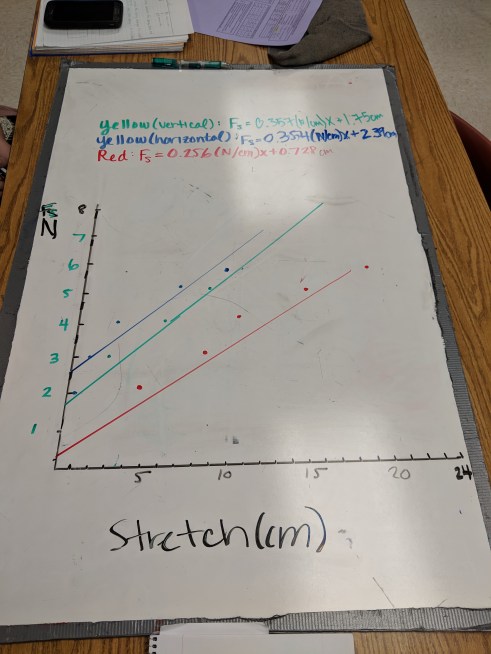
We had a board meeting for the spring force lab. Students initiated some good discussion about the intercepts in both sections, but I had to do a little coaxing to get them thinking about the values of the slopes. One of the challenges was a lot of groups hadn’t distinguished between mass and force of gravity, which tells me I should have done a little more pre-lab discussion, especially since that distinction was just introduced earlier this week.

spring wb.jpg
Physics: Annotating Graphs

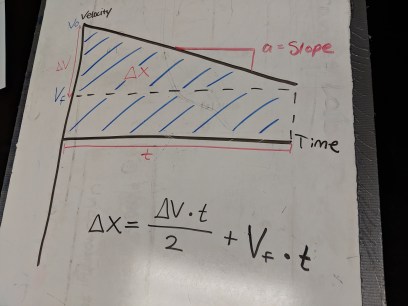
Students whiteboarded yesterday’s problems for a short gallery walk before trying some calculations. I think this is the first year where I didn’t have any students opt to use the formula for the area of a trapezoid on any of their graphs; it just felt more natural to most of my students to split the graph into a triangle and rectangle (which is what I usually do). When students started working with numbers, I had a lot of students independently start talking about specific times and velocities as coordinate pairs, which I haven’t seen students do before and was pretty great.

annot wb.jpg

Chemistry Essentials: Gas Laws

Students sketched their graphs from the past few days for a simplified board meeting. One of the things I really appreciate about this group is I have some students who are really willing to speak up when they are confused about something; one of my students was struggling to see how the graphs fit with the qualitative relationships we found earlier this week and didn’t hesitate to say so, which lead to some valuable discussion about how to read a graph.

gas laws wb.jpg

Day 22: Spring Force, Annotating Graphs, & Pressure vs. Volume

AP Physics 1: Spring Force

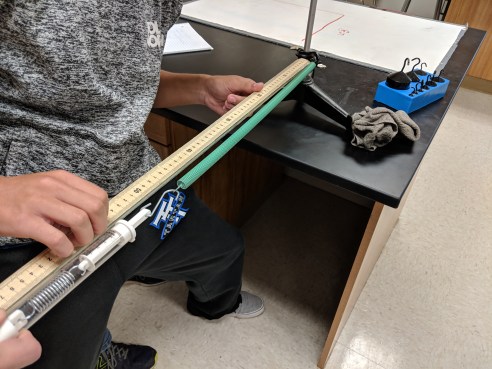
Students collected data for a relationship between the force on a spring and how much it stretches. I have them collect data for at least two different springs hanging vertically, then pick a spring where they also collect data by pulling it horizontally. I love the moment when groups call me over because something is “wrong” with their graphs because the line for when the spring is vertical matches the line for when the spring is horizontal.

spring lab.jpg

Physics: Annotating Graphs

As a stepping stone to graphical solutions for constant acceleration, students worked on annotating velocity vs. time graphs and building equations from the slope and intercept. Last year, this was really tough, so I changed some of the language I used to try and connect the annotations to the visible features of the graph a little more clearly, and it seemed to click for a lot of students.

graphical soln.jpg

Chemistry Essentials: Pressure & Volume

I am being compensated by Pivot Interactives for participating in a pilot of their chemistry materials.

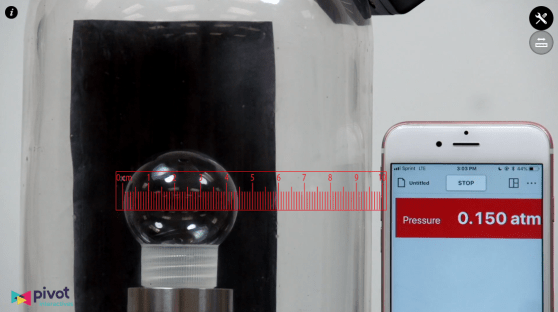
Students used another Pivot Interactives activity. This one used a bubble in a vacuum chamber to allow students to find a relationship between pressure and volume. In a previous lab on volume, finding the volume of a cylinder was a big hurdle for a lot of my students, so it was really nice for them to be able to use the tools in Pivot to do that number crunching without getting hung up on the math.

pivot pressure vol.PNG

Day 21: Board Meeting, Quiz, & Quantitative Gas Laws

AP Physics 1: Board Meeting

Students finished up their whiteboards for yesterday’s lab and we had our board meeting. Both classes got really nice results and had good discussions. I’m thinking about moving balanced forces to right after constant velocity next year since it gives some really good opportunities for students to be successful on experimental design.

fg whiteboard.jpg

Physics: Quiz

Today was our quiz on representations for constant acceleration. The quiz was pretty short, but I’ve been giving a few minutes before each quiz for students to do a reflection on their collaboration over the past few days. I also spent a few minutes talking with my students about today’s Nobel Prize announcement, and my students had a lot of questions about both this year’s prize and the Nobel Prize in general.

Chemistry Essentials: Quantitative Gas Laws

I am being compensated by Pivot Interactives for participating in a pilot of their chemistry materials.

Students used Pivot Interactives to collect data for a relationship between pressure and temperature. There were some minor issues with the computers, but once students got logged in they were pretty successful. We only have one gas pressure sensor in the school, so this particular activity makes it possible to do a quantitative lab we otherwise wouldn’t be able to and is more firmly rooted in reality than a simulation. The activity included some questions I really like the temperature when the pressure is zero; I overestimated how well my students understand the intercept of a graph, so I’ll need to make sure I allow time to discuss those questions tomorrow.

pivot pressure temp.PNG

Day 20: Force of Gravity, Graph Stacks, & Gas Laws

AP Physics 1: Force of Gravity

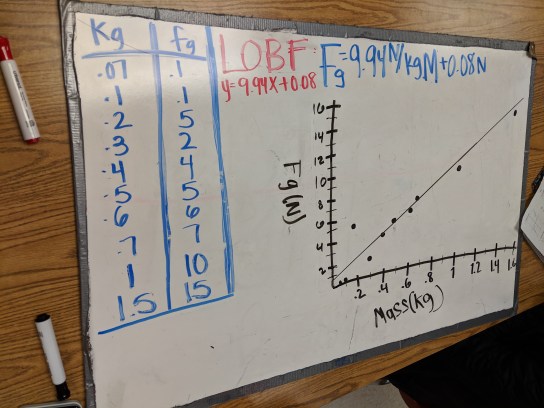
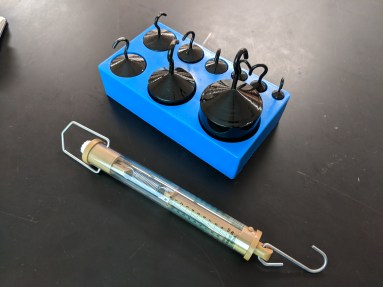
Students collected data to find a relationship between the force of gravity on an object and its mass. Not surprisingly, data is coming out pretty nicely. This is also giving students a chance to have some good conversations about uncertainty since their cognitive load on the rest of the lab is a little lighter.

gravity lab

Physics: Graph Stacks

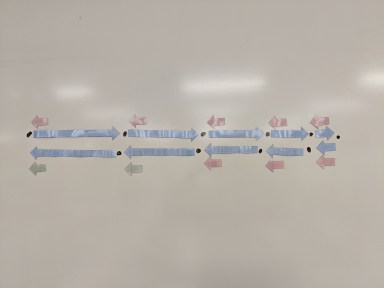
Students whiteboarded some problems from the Modeling Instruction curriculum sketching kinematic graph stacks for a cart on a ramp, a few of which we tested using a ramp with a motion encoder cart. I also got out Brian Frank’s magnetic vectors for the first time, which made it much easier to discuss the motion maps. For the problems we couldn’t test, I had students whiteboard a problem, then get with a group that did the same problem to come to a consensus, which lead to some great conversations between groups that disagreed.

motion map (2).jpg

Chemistry Essentials: Gas Laws

I got out some sealed syringes to do a qualitative exploration of ideal gas laws. Students made some great observations, and developed a nice, kinesthetic understanding of what pressure is.

gas laws.jpg

Day 106: Model Summaries, Collisions, & Gas Laws Review

AP Physics: Model Summaries

To help review for the final, students whiteboarded model summaries for the mechanics topics we’ve done so far. I just asked for key diagram types, along with relevant annotations, and key equations. For the first time, I saw a lot of groups including pieces of the force models, including free-body diagrams, system schema, and Newton’s 2nd Law, in summaries for other models. I’m excited that students are seeing and valuing the connections between different models.

Physics: Collisions

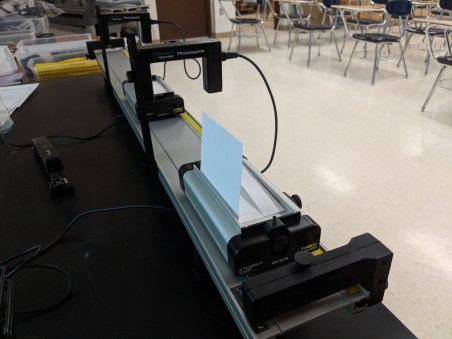
Students continued the cart collisions lab from the Modeling Instruction materials. A lot of groups struggled with interpreting the graphs produced by the photogates, which has been pretty common this year. The classic graph matching lab always seems to help students make sense of what the motion detectors are recording; I’m wondering if it would be worthwhile to have a lab that’s essentially play with photogates next year.

Maker:S,Date:2017-10-21,Ver:6,Lens:Kan03,Act:Lar02,E-Y

Chemistry Essentials: Vacuum Chamber

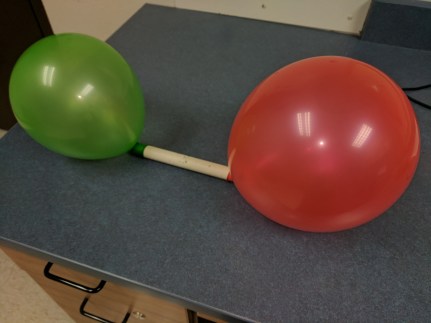
I got out the vacuum chamber and a few other demos, including balloons linked by a pipe, to revisit gas laws and pressure today. Sticking with pretty hands-on review seems to be helping a few students stay engaged as we approach the final exam.
balloons

Day 78: Pendulums, Bar Charts, & Quiz

AP Physics: Pendulums

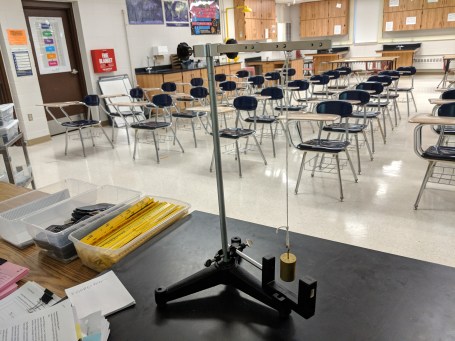
Students collected data for what variables affect the period of a pendulum. When we discussed what might be worth testing, one class was very quick to dismiss mass on the grounds that “mass never matters in physics”, which has me really excited for the period of a spring lab.

pendulum.jpg

Physics: Bar Charts

Students worked on representing energy with bar charts and switching between different systems. I had a sub for one section, but the section I was here was able to make the leap pretty independently, which was great to see.

Maker:S,Date:2017-10-21,Ver:6,Lens:Kan03,Act:Lar02,E-ve

Chemistry Essentials: Quiz

Students took their quiz on gas laws with a sub. This year, I framed the gas laws as proportional rules, rather than equations, and I’ve been pleased with how that’s impacted the math. I’m looking forward to see how that shows up on the quiz.

Day 76: Projectile Practical, Pie Charts, & Whiteboarding

AP Physics: Projectile Practical

Students did a lab practical to predict where a horizontal projectile will hit the ground. Once they succeeded, I asked them to predict where a lighter marble would land without any new measurements aside from mass. Some groups had an easier time than others explaining their prediction, so I need to keep embedding these opportunities in labs and holding students accountable for thorough explanations.

carbon-paper

Retired referral forms work well as carbon paper

Physics: Pie Charts

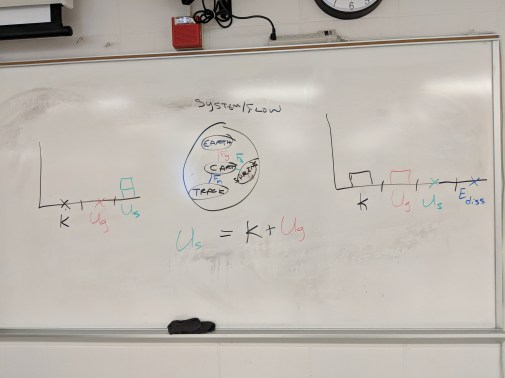
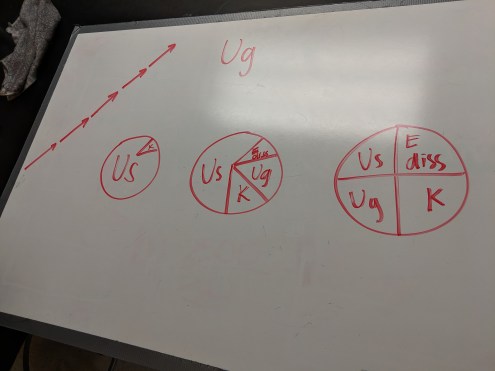
Students worked on sketching energy pie charts. I added defining the system today; during forces, we almost always ended up with systems that had a single object, so a few students were bothered by including multiple objects. I also worked very hard to avoid telling students whether they were right or wrong, which drove a few of them nuts, but pushed them to justify their answers to their groups.

Chemistry Essentials: Whiteboarding

Groups whiteboarded yesterday’s problems. I decided to have all groups whiteboard the same problem without any intentional mistakes, then have a consensus-building discussion for each problem. Students were pretty engaged; a lot of students who checked out yesterday felt like they had some extra accountability, which in turn pushed them to ask more questions and have some good discussions.

chem wb.jpg

Day 75: Projectile Whiteboarding, Pie Charts, & Gas Laws

AP Physics: Projectile Whiteboarding

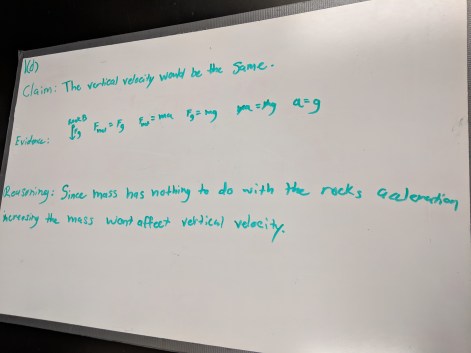
Around half of my students were on a field trip today. We did some mistakes whiteboarding with the problems from yesterday, followed by some practice writing good explanations for “explain your reasoning” problems using CER.

cer.jpg

Physics: Pie Charts

A lot of Physics students were also on the field trip, so my classes were pretty thin. After discussing yesterdays’ lab and introducing the “flavors” of energy, students worked on drawing energy pie charts. I usually skip this representation, but we decided to see if it helps with the struggles students have had this year with conceptual understanding.

Maker:S,Date:2017-10-21,Ver:6,Lens:Kan03,Act:Lar02,E-ve

Chemistry Essentials: Gas Laws

We went over the results of yesterdays’ simulation to derive the gas laws. Just like last trimester, I’m introducing them as proportions, rather than equations, and am pleased with how that’s working so far. I skipped spending a day on temperature and particle movement this tri, but I ended up missing that a lot today.

Day 74: Projectiles, Energy Transfer, & Quantitative Gas Laws

AP Physics: Projectiles

Students worked on some problems for projectile motion. I overheard a lot of students talking about the labs and demos from last week (which Brian Frank’s post on labs had me listening for!). They could use some more practice justifying answers with physics principles, along with lab results, but that will come.

Physics: Energy Transfer

I used a lab I got from Twitter (I wish I could remember who; if its you, I’m happy to give you credit!). To introduce energy, I had students measure the force and displacement required to pull a cart up ramps with different angles. Then, they sketched force vs. displacement graphs and found the areas.

energy transfer.jpg

Chemistry Essentials: Quantitative Gas Laws

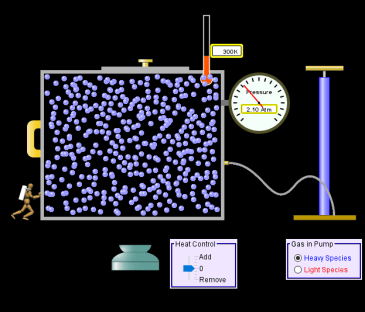
Students used PhET’s Gas Properties simulation to get quantitative relationships between temperature and pressure as well as volume and pressure. There were a lot of great observations about the movement of the particles and one student even pointed out the temperature skyrockets when you add gravity, which should feed nicely into tomorrows discussion.

Gas Laws Sim