This week was only 3 days due to the state union conference held this week.
This week we started working some balanced force problems using vector addition diagrams. I noticed my students were struggling with getting the interaction diagrams and free-body diagrams correct, which then made the rest of the problem trickier. In the middle of the week, we stepped back from the problems to really dig into setting up the interaction diagrams, free-body diagrams, and vector addition diagrams on whiteboards for a range of situations with the hover puck. We got to revisit some important ideas, like the idea that forces must be an interaction, and dig into some things that didn’t come up on previous problems, like how whether you include something like the air cushion under the puck as part of your system can change your diagrams. This day seemed to really help students see the value of some of the thinking I’ve been asking for and to feel more confident in drawing and using these diagrams, which is just what they needed!
This week, we focused on building mathematical models for the force of gravity and spring force. My students have taken very nicely to writing equations for lines of best fit in “physics” where they add units to their slope and intercepts as well as use variables that match their experiment. My students are also taking nicely to using “for every” statements like “the force goes up 10 N for every 1 kg of mass” to think conceptually about the meaning of their slopes. Students have also done really well with turning their intercept into statements like “the intercept is the size of the force when the mass is 0 kg” to think about what kind of intercept makes sense.
With the spring force experiment, I had students stretch their springs both vertically and horizontally to see the graph had the same slope in both directions. This usually seems to help address conceptions about the role of gravity in the behavior springs that come up when we get to energy and simple harmonic motion.
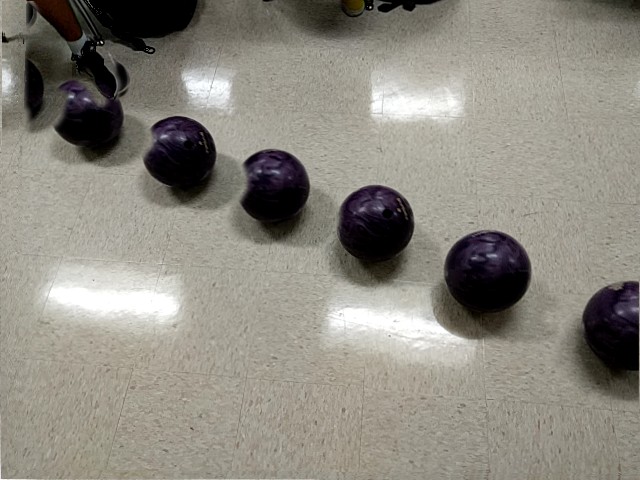
This week was all about starting to build a model of forces. We started by tapping bowling balls with mallets, using a version of the activity based on Frank Noschese’s. Students were quicker than usual to recognize that they had to juts leave the bowling ball alone once it was moving to keep it moving at a constant speed, but I still pulled up an old image I made with motion shot to get some additional evidence. After that, we moved into a version of interaction stations from Kelly O’Shea where students identified forces based on stretch, compression, and shear. Finally, we wrapped up the week with some mistakes whiteboarding with force diagrams. When I introduced system schema and free-body diagrams, I didn’t emphasize enough that the free-body diagram only needs to show forces that cross the system boundary, but that lead to some great conversations during the whiteboarding as students figured out what they needed to include. One student commented that almost all of their mistakes related to including more than they needed to, which lead to some nice discussion about the fact that the hardest part of physics is often figuring out what is relevant.
The biggest task this week was a lab to determine the equation for kinetic energy. On some recent labs, students have struggled to get good data. I think part of the issue is many don’t buy into the idea that knowledge should come from the labs they do, so they don’t invest the effort or attention into getting good data, which makes it hard to see how it leads to physics concepts or equations and becomes a self-reinforcing cycle I wanted to interrupt with this lab. We talked a little about what I observed and my hypothesis, then I re-did the gravitational potential energy lab as a demo and made a point of discussing the things I was doing to get good measurements and check the quality of my data as I went. When we were getting ready to whiteboard, I also checked in with groups to make sure they had quantities on the correct axis and were seeing that they needed to linearize. The result was data that really nicely showed the quadratic relationship between kinetic energy and velocity and most graphs even had slopes very close to half the mass of the carts students used! A lot of students were really proud of their results, which was great to see and I’m hoping will encourage them to continue those good data collection practices.
AP Physics 1: Centripetal Force
I like to ignore the College Board’s recommendation to do centripetal force as unit 3 because it is such a nice opportunity for built-in review of a lot of ideas about forces. We started by spinning some rubber stoppers on strings to talk qualitatively about how we could change the force in the string before moving over to Pivot Interactives to collect quantitative data (disclaimer: I am a content writer for Pivot Interactives). Next, we used an activity I originally got from Lucas Walker using exoplanet data to find the law of universal gravitation. Students are making the connections I want them to, but I can tell they are starting to feel some fatigue. I typically rely a lot on Pivot Interactives for this topic since we don’t have much equipment, but students got pretty into the brief hands-on activities we did this week, so I think I should make sure to keep working those in to help my students stay engaged these next few weeks.
This week has felt a little weird. Coming back from break, we’d gotten some messages to be ready to shift to virtual learning and all week the number of students and staff out went up, so everyone felt like we were in limbo. Near the end of my teaching day today, we got word that next week will be remote.
Physics: Values & Beliefs About Physics Learning
We started this week with a version of the values and beliefs lesson from Kelly O’Shea. There wasn’t as much discussion within groups as I was hoping (and it probably didn’t help that I was giving groups more space than usual to try and reduce my COVID exposure), but students had some great insights and really interesting things to say on the individual reflections I had them complete. One thing I felt like was missing in how I implemented this was some conversations about the costs and benefits of different views of physics and physics learning. One of the last things I had students do in their groups was pick some values or beliefs they think we should aspire to, and a lot of groups said we should aspire to do a better job of valuing memorizing facts and equations. I wonder if giving more space to why certain values and beliefs are or are not given a space in a particular classroom would have helped with some conversation about why they see memorizing as important and whether that is compatible with our classroom.
After two days of that, we spent the rest of the week on some problems about pushing cardboard boxes based on problems in Matt Greenwolfe’s More Models in Modeling materials. My goal was to refresh students on velocity vs. time graphs and free-body diagrams before we dive into momentum. There was a lot of great discussion, with lots of animated arguments. I was also really pleased at how often I could have students simply add a diagram, such as a system schema, to identify and fix their mistakes. I still need to work on how to facilitate a good whole class discussion with these problems, but I think part of the issue is I approach these problems with what I call consensus-building discussions, where I have every group whiteboard the same problem, then we try to resolve differences, but I don’t do this type of discussion very often so students don’t have much practice with it.
AP Physics 1: Energy
This week, we focused on going from LOL diagrams to doing calculations with conservation of energy. We started by doing a lab to find the equation for spring potential energy, which gives us all of the major energy types, then did a card sort that included equations based on just the types of energy and equations based on measurable quantities like velocity, mass, and height. The card sort made for a very nice bridge between the two types of mathematical representations.
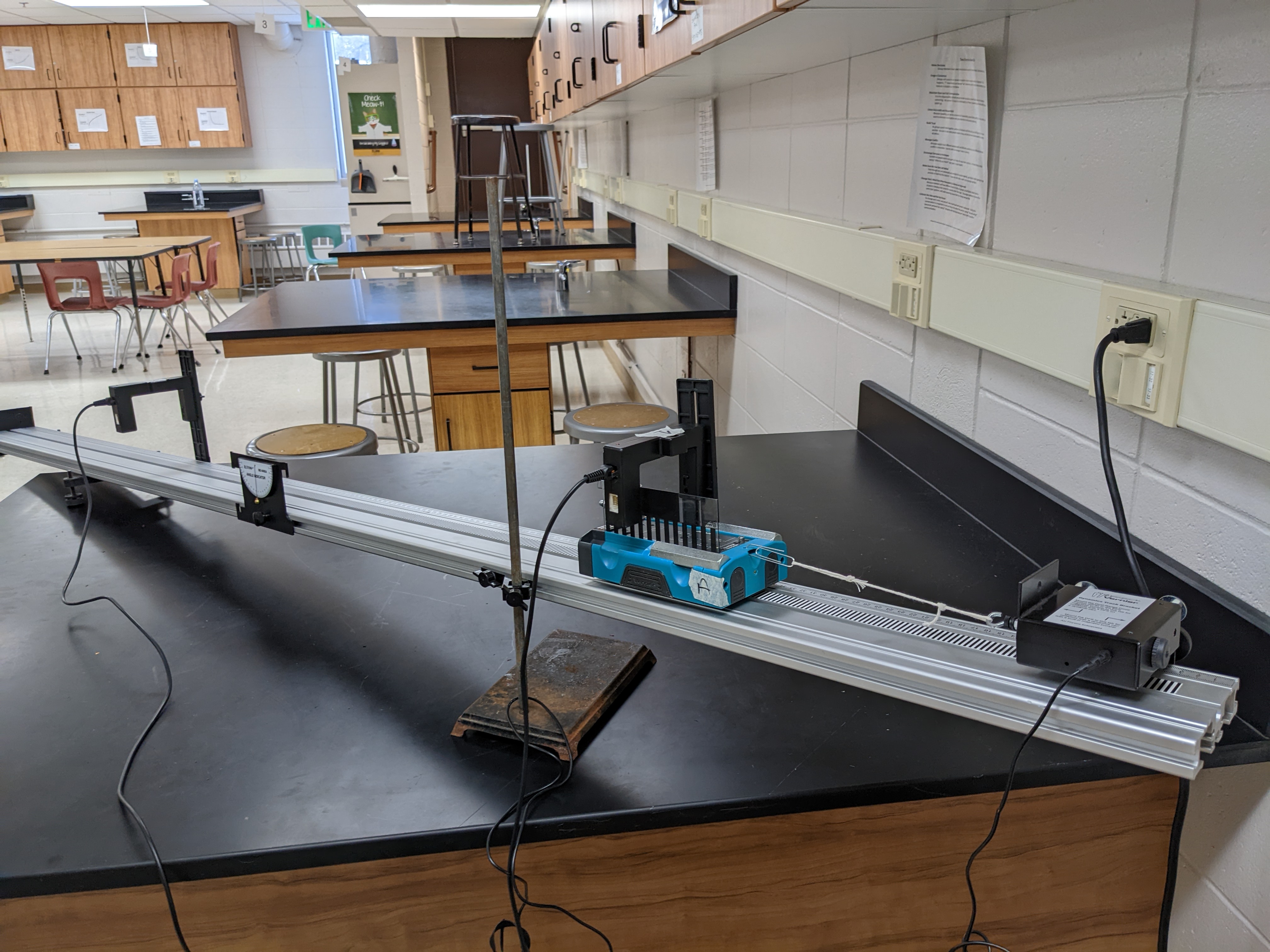
We wrapped up unbalanced forces this week with a lab practical. I put a cart on a ramp, held in place by a string attached to a force sensor. Students had to first predict the tension in the string and next predict the time it would take the cart to travel between two photogates on the track once I cut the string. It was trickier than I expected for students to recognize that the tension in the string would be the same as the net force on the cart once the string was cut. Since that was an important idea in the paradigm lab we did this year, I left students to figure out that point on their own, but I think it would have been worthwhile to give students some questions or other structure to think through that aspect of the practical. We haven’t revisited velocity vs. time graphs lately, so I was very excited to see how well they did annotating their graphs and setting up equations to find the time.
AP Physics 1: Kinetic Energy
Students used Pivot Interactives for a lab to find the mathematical model for kinetic energy. Their data came out beautiful, but the introductory section of the activity didn’t do as much as I’d hoped to prepare students to collect data. This fits with a larger pattern I’ve noticed this year where students in both my courses don’t seem to make a clear connection between the pre-lab discussion (which the introductory section was similar to) and the actual lab. I think I haven’t helped students make a clear connection between the experimental design thinking we do in those discussions and what they will actually need to do in the lab. I’m giving some thought to how I can do a better job of showing how those discussions lead naturally to what students will be doing in the lab.
I think last week is the first time I missed a post on this blog. The end of my grad school semester plus the usual challenges of the Thanksgiving to winter break stretch got the best of me.
Physics: Unbalanced Forces
Last week, we did a paradigm lab for unbalanced forces. I was really dreading the classic half-Atwood machine, so tried a lab Kelly O’Shea suggested. We set up a ramp, then used a string to connect a cart to a force sensor. Next, I cut the string and students observed that the cart accelerated down the ramp. Students were able to reason out that the tension in the string before it was cut must match how unbalanced the forces on the cart are after the string is cut. Students also were quick to recognize that we could change the tension in the string by changing the angle of the ramp. Students then went and collected data to find a relationship between the size of the unbalanced force and the acceleration of the cart. Compared to the half-Atwood, students had a much clearer conceptual understanding of the lab and the data was much cleaner, so I will be sticking with this approach.
This week, we introduced problems by starting with a card sort where students matched a situation to the motion map, free-body diagram, and vector addition diagram. The acceleration arrows on the motion maps seemed to help students with thinking about the direction of the net force, though a lot of students needed some prompting to use the motion maps. I think that is because they haven’t been a very meaningful sensemaking tool in my class before now. If I want students to be ready to use them with unbalanced forces, I need to give some thought to how I’m going to push students to make meaning from motion maps when they are first introduced.
AP Physics 1: Conservation of Momentum & LOL Diagrams
Last week, we worked on conservation of momentum. I introduced momentum bar charts so we could do some problems from the College Board’s AP Physics 1 workbook. They seemed to really help students, so I wish I’d introduced them much earlier. Students ended up not making much connection between the problems we’d done earlier and the momentum bar charts, so I think I needed to introduce the bar charts right off the bat. The quiz didn’t go as well as I would have liked, but next week’s quiz will include a retake. I’m thinking about what I want to build into class next week as a way to address the gaps I saw on the quiz.
This week, we’ve been focused on energy bar charts and LOL diagrams. We did a lab I’ve done in the past where students raise a cart to the same height above the table using ramps of different angles to see the force vs. distance graph always has the same area. After that, I defined the major forms of energy we’ll be dealing with and students practiced drawing energy bar charts, including for situations where they switch between systems. These are coming really easily to my students and we had some great discussions using mistakes whiteboarding on some bar chart problems. The big challenge will be helping my students revisit these ideas after break.
This week was the start of a new trimester for us.
Physics: Vector Addition Diagrams
At the end of last trimester, we were working on balanced forces, but had only done situations where all of the forces were completely vertical or completely horizontal. This week, we started working with balanced forces where at least one is at an angle. This year, students have been struggling to relate different representations and see the connections between system schema, free-body diagrams, and vector addition diagrams, so I tried to keep my focus on supporting those connections. We started with some mini-practical stations I got from Kelly O’Shea to remind students of what we’d been working on before Thanksgiving break. When students asked for help, I made a point of emphasizing how the representations they’d drawn already to show how it lead to the next diagram. Next, we did an activity from Casey Rutherford where students used pipe cleaners to make the arrows from a free-body diagram, then physically rearrange them to make vector addition diagram, which I think helped solidify those connections. During the stations, I noticed that when there were multiple upward forces, a lot of students were drawing the arrows curved, which I think contributed to them struggling to connect the diagrams. Doing an activity where they were already given the free-body diagram and all of the arrows were perfectly straight seemed to help. We wrapped up the week with some paper and pencil problems relating free-body and vector addition diagrams (also from Kelly O’Shea). Students seem to be getting the hang of how these representations are related, and were starting to work on the next problems in their packet where we add in calculations before I assigned them, which was really exciting!
AP Physics 1: Impulse
Before finals, my AP students were working on impulse, but we ran out of time to assess it. This week, I decided to start by revisiting impulse and taking a quiz over it before we move on to conservation of momentum. We focused on some problems from the AP Physics 1 workbook, some of which included momentum bar charts. I usually skip over momentum bar charts, but my students seemed to find them really useful, so I think next year I want to make them more central to my momentum transfer unit.
This week was the force of gravity lab and the spring force lab. Students have been struggling to draw meaning from labs, so I spent more time than usual on “translating” the line of best fit into physics and on the conclusions portion of our lab template for the gravity lab, which seemed to pay off. On the spring force lab, I tasked students with doing that more independently and encouraged students to use their force of gravity lab for reference. I noticed a lot of groups using Fg, rather than Fs, and N/kg as the slope unit, rather than N/cm, which tells me students were focusing on what the right answer was in the force of gravity lab, rather than why it was the right answer. This fits with some other observations I’ve made this year and tells me I need to keep thinking about how to get students focusing on their process in labs, rather than what should be the correct result.
The other physics teacher and I decided to use the spring force lab to introduce force sensors since we have some more involved labs coming up where they will need to use force sensors, and I was really pleased with how quickly students got comfortable with those as a tool. I think it was really valuable for students to have their first exposure one where the measurements were relatively straightforward. I tend to fall into using low-tech tools until there is a good reason to use probeware, but the downside is students are then learning to use the probeware in labs with relatively complex scenarios or when they need to use multiple probes to measure different things. I need to remember the value in starting to use probes in relatively simple labs where we don’t strictly need the probeware.
AP Physics 1: Impulse
This week we introduced momentum and impulse. We started with the Modeling Instruction cart explosion lab where students launch spring-loaded carts off each other and graph the ratio of the cart’s velocities vs. the ratio of the cart’s masses and establish the idea of momentum. Next, we did video analysis of two linked air pucks to introduce center of mass (based on an article in The Physics Teacher by Taylor Kaar, Linda Pollack, Michael Lerner, and Robert Engles). After that, we looked at the change in velocity of carts as they crashed into force sensors with hoop springs to introduce impulse. I’ve tried a few versions of that lab and have yet to have students collect satisfying data, so have been thinking about what I want to try instead. In the course of my thinking, I realized I don’t think I’m satisfied with the storyline of my unit. I like the cart explosion lab to introduce momentum and the center of mass piece to think about what it means to treat an object as a particle, but I think those activities lead more naturally into conservation of momentum than impulse. I think next year I want to try starting the momentum transfer model with the same two activities, but then go straight into conservation of momentum. One route to impulse from there could be asking what if we change the system, such as looking at just one cart at a time in the cart explosion lab to motivate new tools in our model.
We had staff development days on Monday and Tuesday, so this was a short week. I know my students really appreciated the four day weekend with how drained they’ve been feeling and it was helpful to me to have two days that were a big change of pace.
Physics: Force Diagrams
This week we focused on drawing system schema and free-body diagrams. Since students have been struggling to find meaning in our labs this year, I was much more conscious than usual of explicitly raising activities from last week when helping students or giving instruction. That seemed to help students see how what we’d done in the lab related to what we were now doing on paper and started referring to the labs themselves. I had a few students who got frustrated very quickly, so I think I need to work on making more explicit that I rarely expect students to see a problem and immediately know the answer, instead I expect them to work through piece by piece. I had some success keeping some students who’ve been very frustrated from shutting down by starting with what is correct on the work they’d already done. Those students haven’t always had work I can refer to yet when they are getting frustrated, but it is both unsurprising and important to keep in mind that it is helpful for students to know that they are doing some things right before we talk about where they are stuck.
AP Physics 1: Unbalanced Force Calculations
Students worked on some problems for unbalanced forces, including a mix of math-heavy and writing-heavy problems. They are getting better at work through calculations, but had some trouble seeing diagrams on a useful tool on more conceptual problems. Forces are where I think the usefulness of diagrams as a reasoning tool really starts to shine, and this just shows we haven’t done as much practice as usual with the kinds of problems where that is really useful. I need to make sure that we get some of that practice in so students can start seeing how they can use diagrams to support their thinking.




 stoeckel180