Day 35: Series vs. Parallel Circuits & Board Meeting

Physical Science: Series vs. Parallel Circuits

Students used PhET’s circuit construction kit to explore the differences between series and parallel circuits. When I’ve used batteries and bulbs, students really struggle to see (let alone articulate) what’s going on with the current, so the visible “electrons” in the simulation were a huge help in getting students to understand why certain changes happened.

Physics: Board Meeting

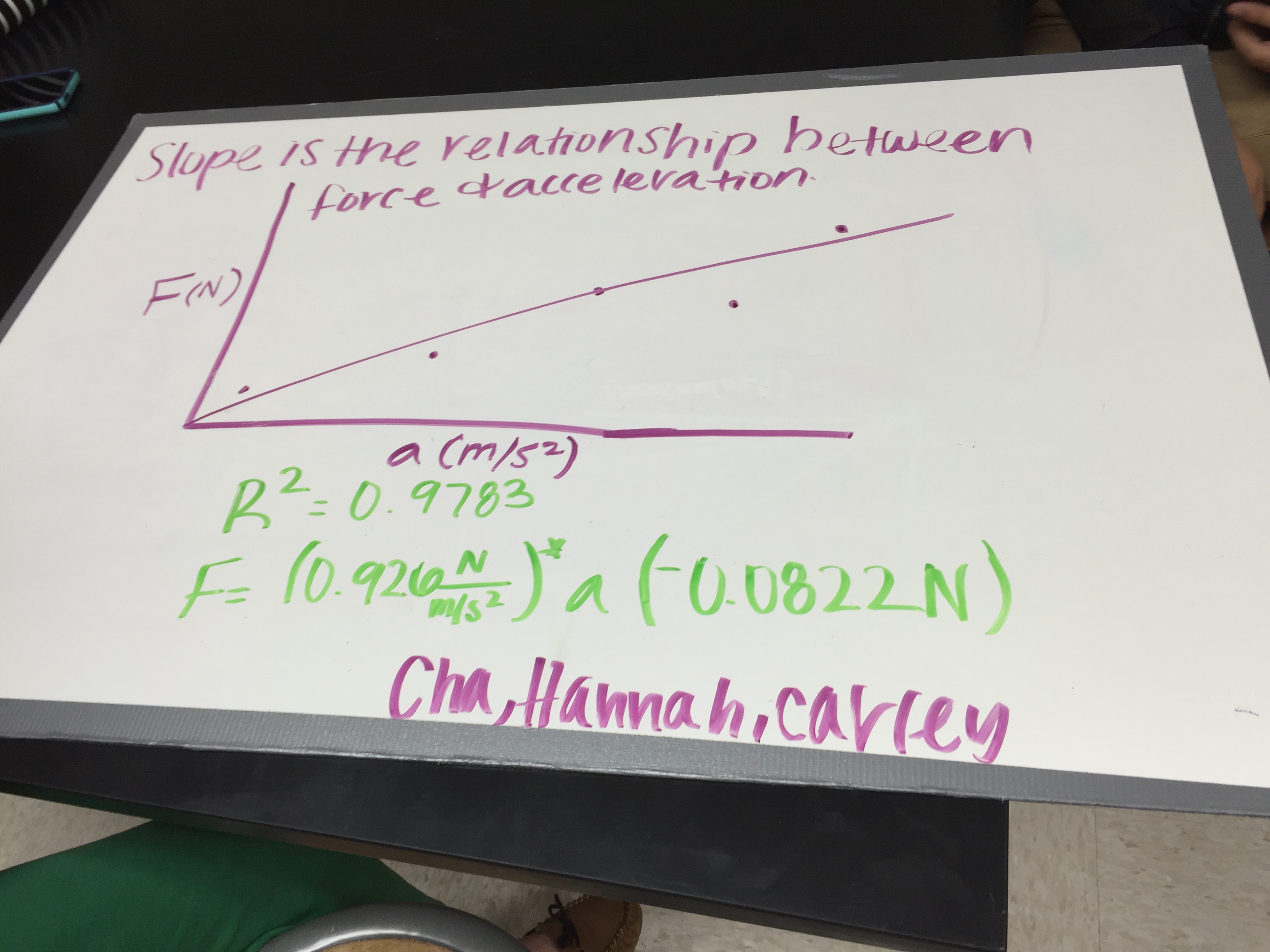
We discussed as a class the results of the Newton’s 2nd Law lab. I need to have students practice talking about the slope more; they were able to get to “The force needed to accelerate 1 m/s2“, but it took some pushing on my part; I think the issue is just lack of practice. I was pleased by the discussion; students are doing more articulating of the big ideas. I was really excited by the discussion students had about the intercept. I’d planned to declare the intercept zero and move on, but in both sections students seemed interested in talking about it. They decided it would be reasonable to have a non-zero intercept on this experiment and it would be equal to the amount of friction you have to overcome to start the cart moving.
IMG_1333

Day 34: Presentations & Newton’s 2nd Law

Physical Science: Presentation

Students delivered a presentation on the engineering projects they tested last week. They were asked to provide an overview of their design, their thinking behind it, and the results of their testing, linking back to Newton’s Laws to explain why things did (or didn’t) work. The presentation is meant to convince the project’s imaginary customer to develop their design into an actual product. I need to keep revising how I approach the presentation. I’d like to use it as an assessment over Newton’s Laws, and students make some great connections between the project and the science content, but as soon as they get to the presentation, those connections seem to disappear.

Physics: Newton’s 2nd Law

Students finished data collection and graphing for their Newton’s 2nd Law lab. The netbook cart I reserved actually worked, which meant students saw the advantages of graphing in the classroom. Several groups had a point that looked like an outlier, and their question was usually “Can we grab a track to check that point?” rather than “Can we ignore that point?” I like the first question a lot better.

Day 33: Ohm’s Law & Interactions

Physical Science: Ohm’s Law

I gave students some batteries, some light bulbs, and some wires and asked them to find a qualitative relationship between resistance and current. Groups that had some extra time decided to experiment with voltage, as well.

Physics: Interactions

Students worked through some questions that reinforce the idea of forces as interactions between two objects from the Modeling Instruction curriculum. I was out of the classroom for a field trip, so I’ll find out how it went tomorrow when we discuss some of the answers.

Day 32: Light the Bulb & Newton’s Second Law

Physical Science: Light the Bulb

I gave students a light bulb, a battery, an assortment of conductors and insulators, and instructions to figure out how to light up the bulb. As usual, a lot of students were quick to declare it would be easy because they did the same lab in elementary school. That confidence quickly fades once they get into the lab; I think a lot of students learned the trick without understanding why it works. Tomorrow, I’ll probably take a few minutes to show a clip of fresh MIT graduates struggling with the same task.

IMG_1321

Physics: Newton’s 2nd Law Lab

Students started data collection on Newton’s 2nd Law. A few groups wanted to try using a spring scale to apply a constant, known force to their cart, but ended up deciding the classic modified Atwoods machine would be easier. I’ve only got four LabQuests, so my students’ only exposure so far has been demonstrations and class discussions. I was very pleased when a couple of groups in each section asked if they could use a LabQuest and motion detector for their data collection, in spite of their lack of first-hand experience with the devices.

Day 31: Van de Graaff Generator & Newton’s 3rd Law

Physical Science: Van de Graaff Generator

After sharing and discussing observations from yesterday’s lab, we played with the Van de Graaff generator. I like to end with sending a shock through a chain of students, then have two students hold onto an aluminum rod instead of holding hands. Students aren’t too surprised when they still get shocked with the rod in the chain. Next, I switch out the rod for a wooden meter stick and students aren’t too surprised when the shock stops at the meter stick, which provides a nice segue into conductors and insulators. This year, I also had students hold one of the rubber rods they’d used in their static electricity lab. Since it had been easy to give the rubber rod a static charge, students expected it to work at least as well as the metal rod. I’d tried this on a whim, and it ended up being a great reminder for me that students don’t easily differentiate between carrying a current and holding a static charge.

Physics: Newton’s 3rd Law

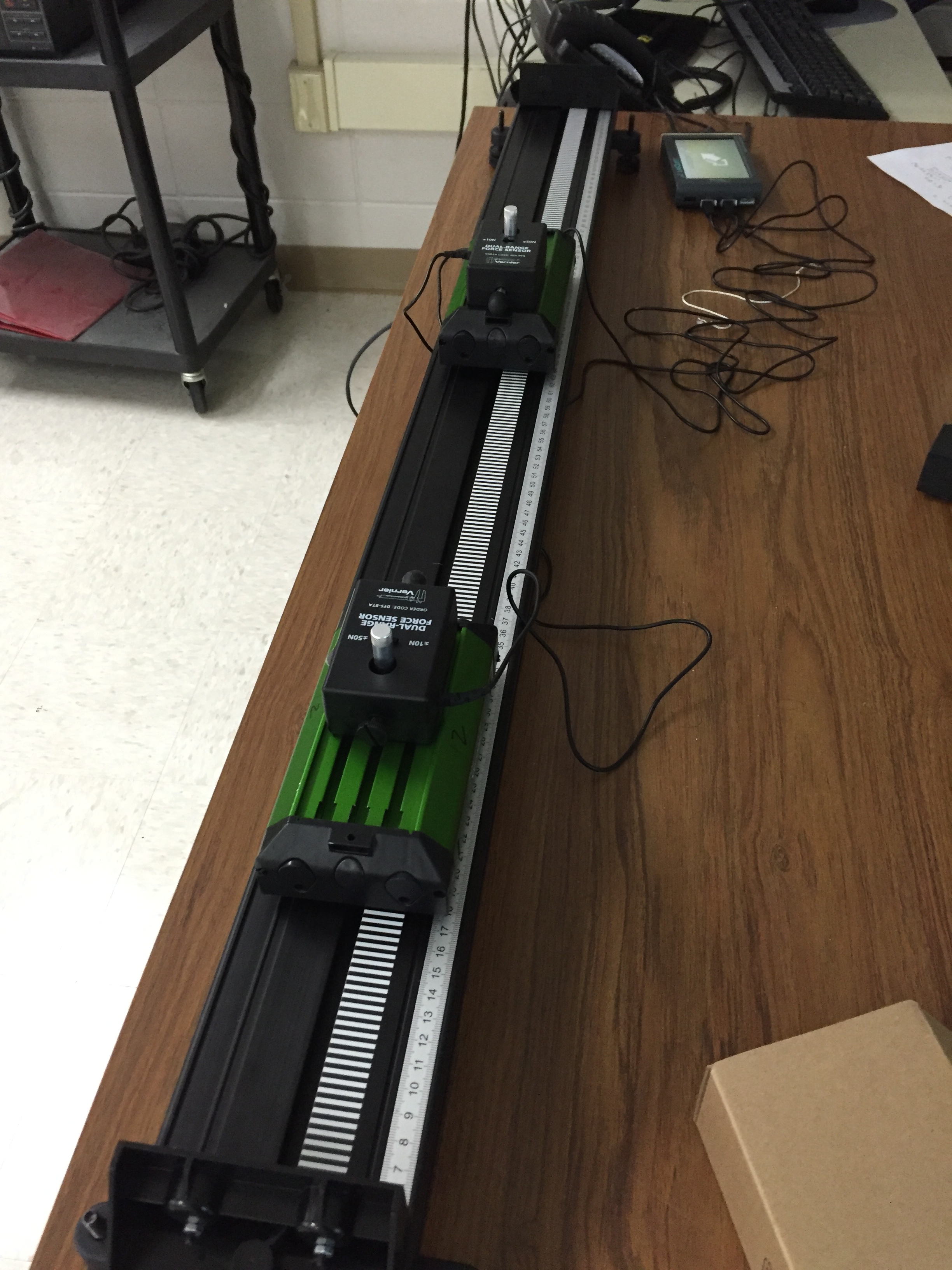
Students made free body diagrams for a variety of scenarios with two carts colliding, then predicted which cart would experience the greater force. After students had worked, we used a pair of force sensors to test their predictions. I’d also planned to show Frank Noschese’s great video of cart collisions, but ran out of time, so I’ll start with that on Monday. There were some great debates when students were working on their predictions, though students were more insistent than usual that I should step in and tell them who was right. This provided a good opportunity to talk with my classes about what we know is needed to really internalize a new concept, which helped alleviate some of the frustration with my non-answers.

IMG_1317

Day 30: Static Electricity & Mistakes Game

Physical Science: Static Electricity

Students did a lab with pith balls and charged rods to begin exploring static electricity. The lab is much more directed than I’d like, but my students have gotten so used to more open-ended labs that they were quick to latch onto interesting observations and were eager to go beyond the directions to try to make sense of their observations. My students are awesome.

IMG_1314

Physics: Mistakes Game

We played the Mistakes Game with some problems students worked on yesterday. Students have been embracing this approach to whiteboarding problems and are good about using their own actual mistakes when they make the whiteboards. My favorite moments, however, are when someone points out an unintentional mistake. The group presenting will usually admit it was unintentional and the rest of the class will happily discuss it without judgement. They’ve really embraced mistakes as an important and valuable part of the learning process. Its worth saying again that my students are awesome.

IMG_1315

Day 29: Presentations & Problems

I spent the day at a college fair with a group of seniors, so my students were left with a sub today.

Physical Science: Presentations

Students worked on a “sales pitch” for their engineering projects. Next week, they’ll present them to the rest of the class.

Physics: Quiz & Problems

Students took a quiz today. On the last quiz, a lot of students knew what they were doing, but hadn’t shown their work as clearly as I’d like. One of the things I love about standards-based grading is there’s always another chance, so I can be a jerk. I docked students on the last quiz if they didn’t clearly show their work, but put another problem for the same standard on today’s quiz to make sure everyone gets another shot.

After the quiz, students worked on some problems. Tomorrow, we’ll whiteboard.

Day 28: Finishing Testing & Spring Force

Physical Science: Final Day of Testing

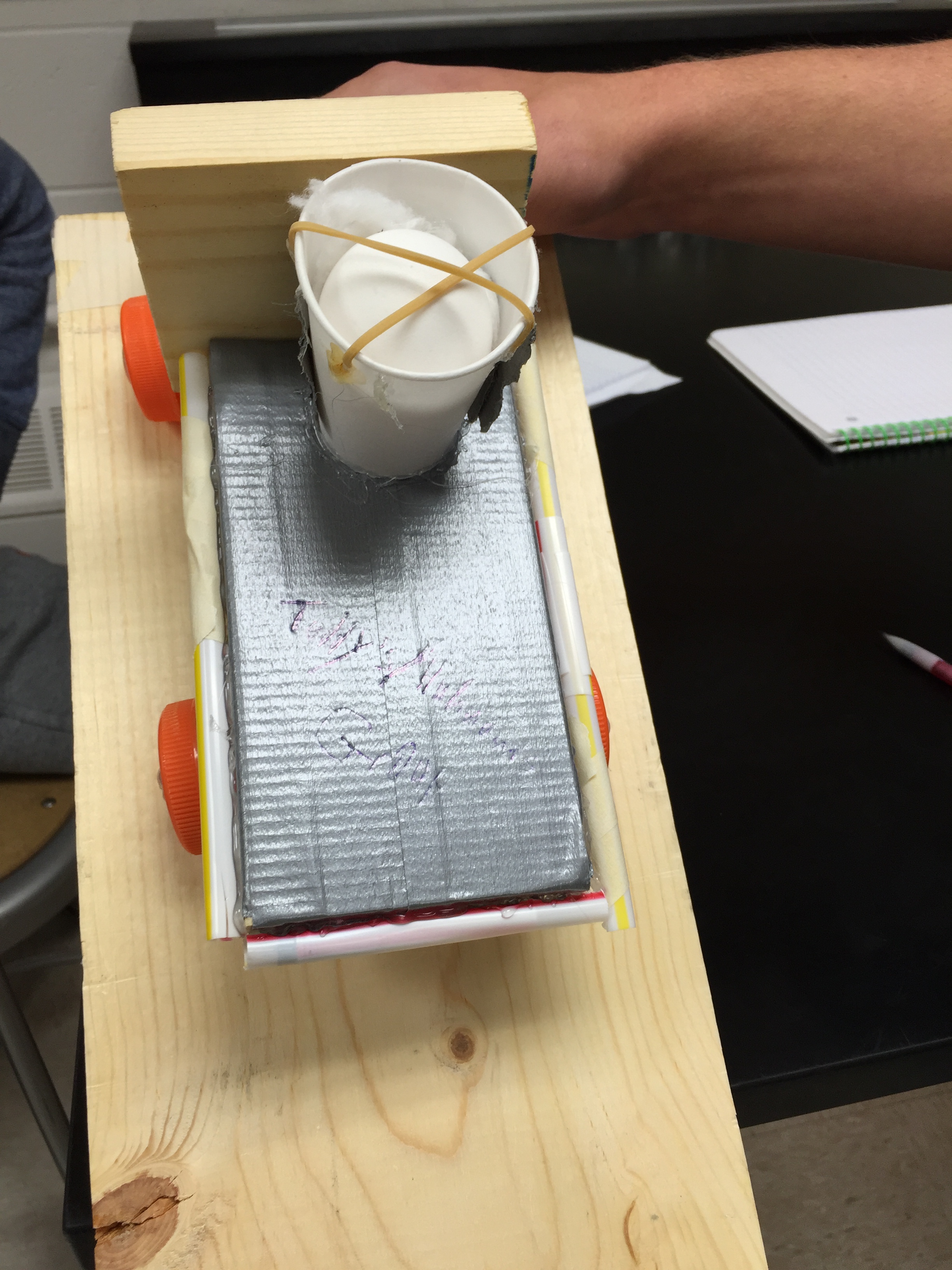
Students wrapped up testing their designs and started to work on a sales pitch to convince the project’s (imaginary) customer that their design should be scaled up into the real thing. One group’s duct tape came loose, which meant the cup holding their egg fell off in most of the collisions. I was very pleased when they suggested that might reduce the force the egg experienced and managed to use Newton’s 2nd Law to explain why that would be.

Testing a t-bone collision

Testing a t-bone collision

Physics: Spring Force Lab

Students collected data to find a relationship between the force a spring exerts and how much it is stretched. I had the spring scales still out from another lab, and many students used them as a handy hook to hang their springs from. Several students commented that the reading on the spring scale consistently matched the force exerted on the bottom of the spring. I’m looking forward to revisiting that when we get to Newton’s 3rd Law later this week.

IMG_1310

Day 27: Testing Again & Friction

Physical Science: Testing Again

Students tested the second iteration of their designs. This time around, groups had to plan three of their own tests, rather than doing the ramp test I’d devised for the first round. During the testing, each group also had to serve as an evaluator for another group’s tests. They were tasked with providing feedback on the validity of the tests and making their own assessment of whether the design passed each test.

Using dry ice to simulate skidding on a slippery road

Using dry ice to simulate skidding on a slippery road

Straw bumpers that went all the way around the car to protect against a range of collisions

Straw bumpers that went all the way around the car to protect against a range of collisions

Physics: Friciton

This week is about looking at some specific forces, and we started with friction. Students brainstormed what variables might affect how large the force of friction is, then came up with simple experiments to test a few of those variables. Groups measured the force of friction by pulling blocks along with spring scales, which opened the door for some good discussion on uncertainty. Every group did several trials for a given condition, then took an average. Several groups initially said that certain variables, such as surface area, had an impact because their average force was different for each condition. I got one of these groups to share their surface area data with the rest of the class for a closer look. While we haven’t covered uncertainty in this course, students were able to see that the range of forces measured for a given surface area was greater than the difference between the two averages. This lead students to conclude that the difference was probably not meaningful. Its a shift for students to think about the physical meaning of the numbers they are working with, whether in the lab or in a problem set, and I was pleased to see some evidence of that shift in the discussion of this data.

Day 26: Building Again & Net Force

Physical Science: Building Again

Students spent today building the second version of their projects based on yesterday’s design. While students worked, I visited each group to grill them on how they’d used Newton’s Laws to decide on an effective design as well as the specific ways the prototype had influenced their new design.

IMG_1296

Physics: Net Force

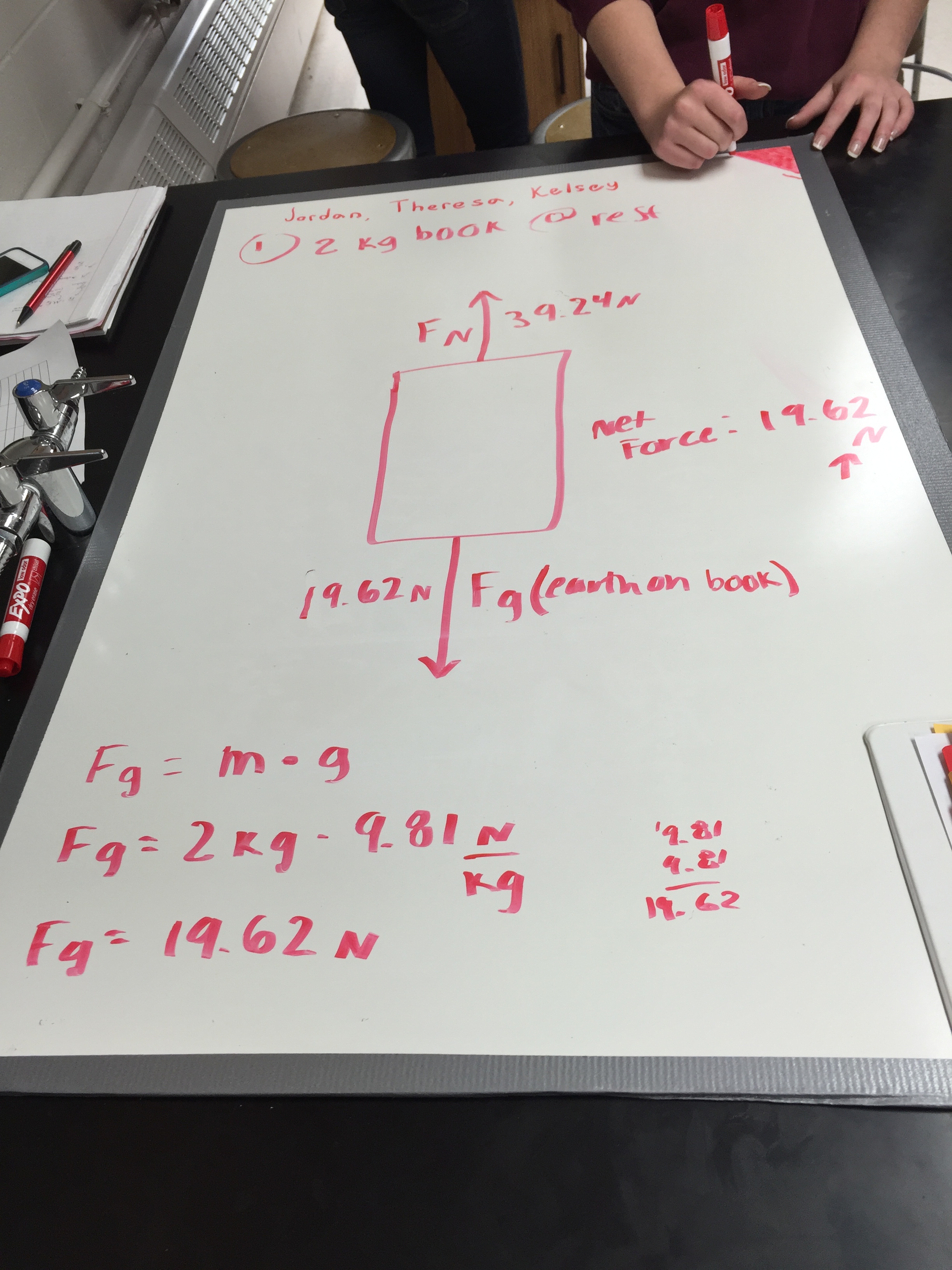
Students practiced some more free-body diagrams, this time also finding the net force. This included some problems finding the normal force exerted on a person in an elevator. Since my students finished quicker than I expected, I pulled up a force vs. time graph I’d saved after bringing a force sensor for a ride on our elevator, then asked my students to decide whether the elevator was moving up or down. I got really excited when I asked for a vote, and the class was pretty evenly split, thinking there may be some good debate. The first student to volunteer their explanation, however, gave such an eloquent and complete justification that no one wanted to argue with her. Fortunately, she was right 🙂

Did I take the elevator up or down?

Did I take the elevator up or down?