Day 41: Central Force & Comet Orbits

AP Physics: Central Force

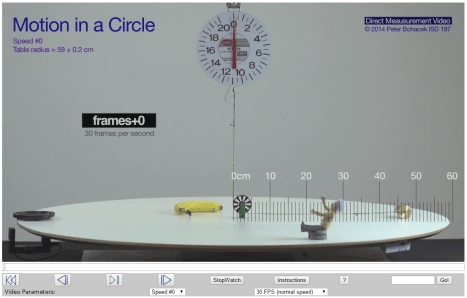
Students used a Direct Measurement Video of a weight on a rotating table to find a relationship between force and tangential velocity. One of the first questions on my activity was to draw a free-body diagram of the weight and determine whether there is any net force. A lot of groups had some great discussion as they tried to rectify the fact that the table rotates with a pretty constant speed with the fact that their free-body diagrams showed a net force on the weight. There were also some groups that asked questions like how the speed of the banana compared to the speed of the weight, bringing them back to a Direct Measurement Video of a rotating disk we’d used earlier in the year.
motin-in-a-circle-dmv

Earth Science: Comet Orbits

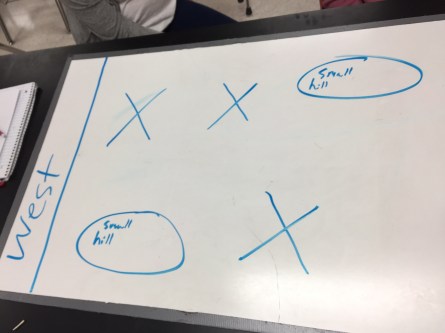
A major theme this week is comparing different kinds of solar system objects, so I decided to take an idea Michael Lerner gave me last week and have students compare the orbit of Halley’s Comet to Mars. I used an ellipse drawer to give students the orbit of both objects, then had them start by making some observations. Today, most groups only had time for the qualitative questions about the two orbits.

comet-orbit

Day 40: Mass & Craters

AP Physics: Mass

Students worked on a lab practical to find the mass of an unknown object using a modified Atwood’s machine. My plan is to use spring scales to verify the mass the determined, then use this to introduce the difference between inertial mass and gravitational mass, but time got tight and most groups need a little longer to finish their calculations.

img_2456

Earth Science: Craters

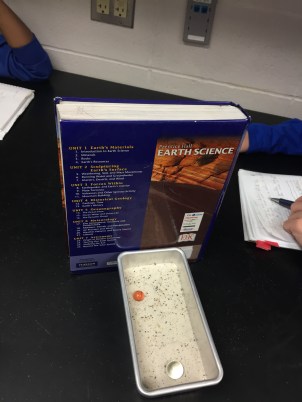
During yesterday’s lab, it quickly became clear that my students did not have much sense of how craters are formed. Today, I got out some trays of sand and an assortment of marbles and we explored how mass and impact speed affect the crater size. I was really excited when the groups who finished early started asking new questions, like how the depth of the sand or angle of impact changes the crater, and coming up with experiments to answer those questions. This is why I love freshmen! We also dropped a shot put into a bigger tray of sand and got some slow-motion video just because its cool.

img_2452

Day 35: TIPERs & Moon Phases

I’m at the NSTA Regional Conference, so students have a sub today.

AP Physics: TIPERs

Students worked through some problems applying Newton’s 2nd Law, mostly out of TIPERs with a few calculations thrown in. I love listening in on the conversations students have on their way to answering TIPERs problems, so I kind of hate leaving it for a sub, but I’m looking forward to seeing their work when I get back.

Earth Science: Moon Phases

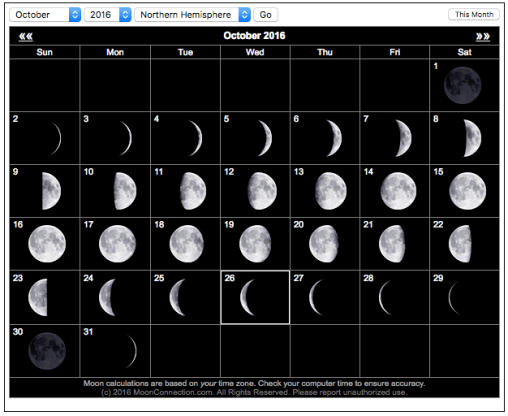
Students took their assessment on climate change, then did a follow-up to Tuesday’s lab modeling phases of the moon. Today, they used a moon phase calendar to determine which way the moon revolves around Earth.

moon-phase-calendar

Day 32: Dueling Fan Carts & Climate Change

AP Physics: Dueling Fan Carts

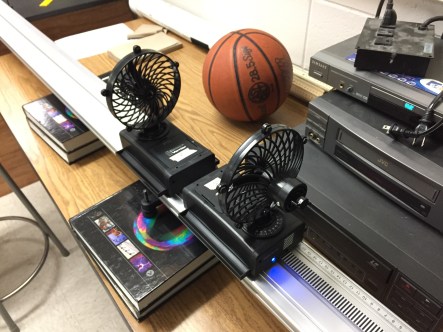
I borrowed Frank Noschese’s dueling fan carts activity to reinforce the relationship between net force and motion. We had some good whole-class discussion about using system schema to determine which forces matter. My fan carts don’t produce exactly the same thrust, so there was some acceleration with combinations like high vs. high, but I was pleased at how quickly my students jumped to wanting to find a combination of settings where the forces did balance.

IMG_2404.JPG

Earth Science: Factors in Climate Change

We’ve done a lot of reading graphs and data tables related to climate change, but haven’t really had a chance to synthesize the observations. I used a slide deck that goes one factor at a time and uses actual data to give students the opportunity to determine the impact each factor has on climate. I envisioned this being very discussion heavy, but I was having trouble getting student input and it quickly became more of a lecture, I think in part because I kept students in their desks. I think next time I need to get them at lab tables using whiteboards to get them more actively engaged.

Day 29: Board Meeting & Hurricanes

AP Physics: Board Meeting

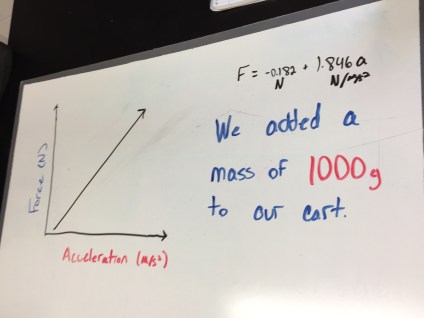
Students whiteboarded their results from the 2nd Law Lab and we had a board meeting. Students needed a reminder to translate the equation for their lines of best fit into “physics terms”, but they are getting more skilled at that. I was also pleased with how quickly students picked up on things like which groups had similar slopes, which made it easy to build some ideas like why the slopes would change.

img_2389

Earth Science: Hurricane Tracking

Students used some data from 1992’s Hurricane Andrew to plot its path and answer a few questions. They did a nice job connecting what they’ve learned about heat and wind so far to find some patterns in the hurricane’s path and wind speed, but the plotting took a long time. I’m debating whether I want to try and streamline the plotting next year so students can spend more time on the interpretation. It would be very easy to give them a completed map of the hurricane’s path, but I would need to revise or eliminate some of the questions where students paused their plotting to make predictions. Another option would be to put the map into Desmos as an image, then have students type in the coordinates. With the manual plotting, I overheard some conversations where students were connecting coordinates on the map to coordinates on a graph, which is a great connection for them to make and I can’t decide whether Desmos would help or hurt that connection. I also need to identify the key take-aways from this lab to help decide where I want students to spend their time.

Day 28: Modified Atwood’s & Project Wrap-Up

AP Physics: Modified Atwood’s Machine

Students used a modified Atwood’s machine to collect data for a relationship between force and acceleration. We spent some time unpacking that statement since I’ve found it really isn’t obvious to students what that means; last year, a lot of students really struggled to go from that statement to recognizing they needed to change the force and measure acceleration,

img_2383

Earth Science: Wind Turbine Wrap-Up

To conclude the wind turbine project, I gave students some information about an imaginary small farm and tasked them with selecting locations for three wind turbines and preparing a report for our “client” to justify their choice. Unfortunately, with the wind turbines and fans we have, it isn’t practical to set up both the topography and a trio of wind turbines for students to test their plans. Next year, I might try setting up a single, larger test area using a couple of our box fans so that we can have a big enough model for students to actually test their plan.

img_2358


Day 36: Electric Power & Unbalanced Force Problems

Physical Science: Electric Power

Students plugged several different light bulbs into Kill A Watt meters to find the power used by each, then calculated how much you’d pay for the electricity to use each one for a year. This is the first year I’ve done energy before electricity with my 9th graders, so I decided to have them sketch energy bar charts for each light bulb, using thermal energy and light as the energy types. For the first time, my students had an easy time articulating in a meaningful way why the low wattage LED was just as bright as the high wattage incandescent.

IMG_1334

Physics: Unbalanced Force Problems

Students worked on some problems that combined Newton’s 2nd Law with constant acceleration calculations. I was a little nervous, because they just got Fnet = ma yesterday and many are still mastering net force, so I wasn’t sure how they’d do with using multiple models on a single problem. However, a lot of pieces seemed to really click today. By the end of the hour, several students who’ve been struggling with constant acceleration declared today’s problems easy, including the portions where they had to do constant acceleration calculations.

Day 35: Series vs. Parallel Circuits & Board Meeting

Physical Science: Series vs. Parallel Circuits

Students used PhET’s circuit construction kit to explore the differences between series and parallel circuits. When I’ve used batteries and bulbs, students really struggle to see (let alone articulate) what’s going on with the current, so the visible “electrons” in the simulation were a huge help in getting students to understand why certain changes happened.

Physics: Board Meeting

We discussed as a class the results of the Newton’s 2nd Law lab. I need to have students practice talking about the slope more; they were able to get to “The force needed to accelerate 1 m/s2“, but it took some pushing on my part; I think the issue is just lack of practice. I was pleased by the discussion; students are doing more articulating of the big ideas. I was really excited by the discussion students had about the intercept. I’d planned to declare the intercept zero and move on, but in both sections students seemed interested in talking about it. They decided it would be reasonable to have a non-zero intercept on this experiment and it would be equal to the amount of friction you have to overcome to start the cart moving.

IMG_1333

Day 34: Presentations & Newton’s 2nd Law

Physical Science: Presentation

Students delivered a presentation on the engineering projects they tested last week. They were asked to provide an overview of their design, their thinking behind it, and the results of their testing, linking back to Newton’s Laws to explain why things did (or didn’t) work. The presentation is meant to convince the project’s imaginary customer to develop their design into an actual product. I need to keep revising how I approach the presentation. I’d like to use it as an assessment over Newton’s Laws, and students make some great connections between the project and the science content, but as soon as they get to the presentation, those connections seem to disappear.

Physics: Newton’s 2nd Law

Students finished data collection and graphing for their Newton’s 2nd Law lab. The netbook cart I reserved actually worked, which meant students saw the advantages of graphing in the classroom. Several groups had a point that looked like an outlier, and their question was usually “Can we grab a track to check that point?” rather than “Can we ignore that point?” I like the first question a lot better.

Day 32: Light the Bulb & Newton’s Second Law

Physical Science: Light the Bulb

I gave students a light bulb, a battery, an assortment of conductors and insulators, and instructions to figure out how to light up the bulb. As usual, a lot of students were quick to declare it would be easy because they did the same lab in elementary school. That confidence quickly fades once they get into the lab; I think a lot of students learned the trick without understanding why it works. Tomorrow, I’ll probably take a few minutes to show a clip of fresh MIT graduates struggling with the same task.

IMG_1321

Physics: Newton’s 2nd Law Lab

Students started data collection on Newton’s 2nd Law. A few groups wanted to try using a spring scale to apply a constant, known force to their cart, but ended up deciding the classic modified Atwoods machine would be easier. I’ve only got four LabQuests, so my students’ only exposure so far has been demonstrations and class discussions. I was very pleased when a couple of groups in each section asked if they could use a LabQuest and motion detector for their data collection, in spite of their lack of first-hand experience with the devices.