Day 106: Energy & Crashes

AP Physics: Energy

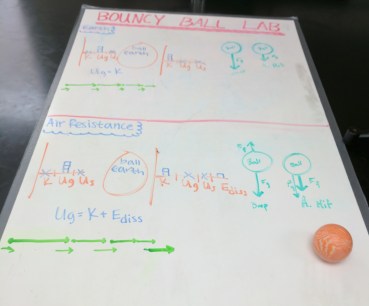
Students whiteboarded CER statements for various energy questions, including their answers to where the bouncy ball loses energy and why the tiny bouncy ball from a seismic accelerator flies off. I really liked that different groups tended to take different approaches, which made for some good sharing of ideas once whiteboards were ready and made students very confident in their responses.

bouncy-wb

Physical Science: Crashes

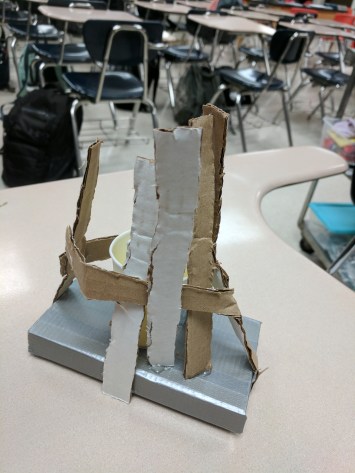
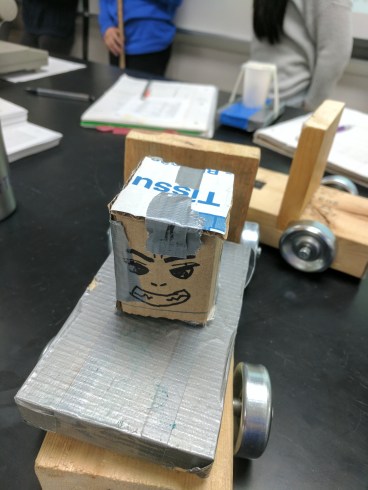
Students attached their cargo carriers to trucks, then sent them down to ramps for head-on collisions. My students usually get pretty animated on this day, which usually includes a lot of bragging about how well they expect their design to do. For some reason, a lot of students in this class were expecting their eggs to break right away, including some students who were filled with confidence yesterday, and the class as a whole was very anxious and nervous. None of the points come from how well the design performs, so it was interesting to see how much tension some students were feeling, anyway.
carrier-1

Day 105: Dissipated Energy & Building

AP Physics: Dissipated Energy

Students analyzed video of their bouncy balls and collected evidence to argue whether the energy is primarily dissipated by air resistance or by the impact with the table. There was a nice variety of approaches and I was pleased by how many students went back to the fact that we neglected air resistance during projectile motion to make a prediction about whether it should matter here.

pos-time-graph

Physical Science: Building

Students worked on building their cargo carriers based on yesterday’s designs. To help keep the focus on the science behind their designs, I stopped by each group and used a dice to pick someone to tell me how Newton’s Laws support their design decisions. For the first time, I had several tables where students were hoping they would be the one picked because they were excited to talk about their group’s work, which was fantastic!

carrier

Day 104: Missing Energy & Designs

AP Physics: Missing Energy

After watching a bouncy ball to see it loses mechanical energy, I tasked students with determining whether the energy is mostly dissipated during an impact with the table or mostly dissipated by air resistance. Today, they recorded video of the bouncy ball, then whiteboarded some representations for each explanation to get ideas about what could make good evidence. This is the first year I’ve done this activity where almost no groups think air resistance is the biggest factor. Students had a lot of great dialogue about forces and the motion of the bouncy ball as they worked on the representations.

bb

Physical Science: First-Round Designs

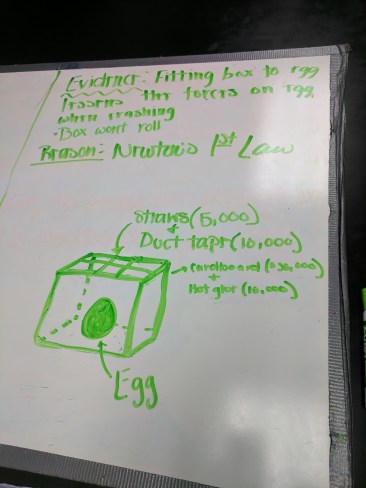
Students worked on their first design for a cargo carrier that will protect an egg in a head-on crash. I don’t want this project to become just building, so I had students fill in a graphic organizer version of a CER, replacing the claim with their design idea and using the evidence and reasoning to explain why they think their idea will work. Tomorrow, I’ll help them make those explanations deeper by talking to each group while they build.

plan

Day 103: Energy Practical & Explanations

AP Physics: Energy Practical

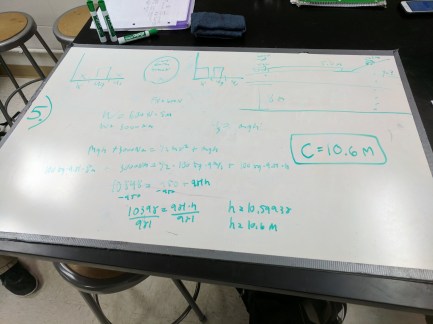
I tried a new lab practical for energy in an effort to integrate rotation and spiral back to some old ideas. Back in December, students measured the launch velocity of a marble, then predicted where it would hit the floor. Today, I had them use conservation of energy, including rotational kinetic energy, to find the launch velocity of their marble, then predict where it would hit the floor. I saw a lot of students pull out their old work, including their lab from December, to help remind themselves how to do the projectile portion of the problem, which is exactly what I hoped they would do. I overheard several students talking about how much they liked looking at an old problem through a new lens, as well as seeing how old ideas fit with the new ones.

practical.jpg

Physical Science: Explanations

Students practiced making predictions and writing explanations using Newton’s Laws. I showed students some videos and clips, including one from Smarter Every Day and an animation of the Mars Pathfinder landing, then had them write an explanation individually, followed by a revised explanation with their whole group. I was struggling more than usual to keep my students focused, but part of the problem might have been the English test next hour and the pep fest this afternoon. I’ve got some demos I’m planning to have students write explanations of as warm-ups, and I probably would have been better off using the demos today, then using the videos as warm-ups.

newton

Day 102: Gallery Walk & 2nd Law

AP Physics: Gallery Walk

I ended up having students do a gallery walk for yesterday’s problems.

wb-2

Physical Science: Newton’s 2nd Law

Students worked on a version of the modified Atwood’s machine lab for Newton’s 2nd Law. While I have students make a graph, we don’t go much deeper than whether each relationship is direct or indirect. I spent more time on the pre-lab discussion today than I have for most labs with this group, and I feel like that paid off with more confidence while they were actually working in the lab.

n2l

Day 101: Conservation & 1st Law

AP Physics: Conservation Problems

I left my AP classes to chaperone a field trip, so they worked on some conservation of energy problems. I’m not sure how I want to go over the problems yet; based on what I saw in class yesterday, they are pretty solid on making bar charts, but are a little shaky on connecting them to specific quantities. I might do the mistakes game, focusing on setting up the equations.

Physical Science: 1st Law

Students did a lab based on various tricks using Newton’s 1st Law where they focused on writing good explanations of WHY the trick worked. For conceptual development, I don’t like this as much as the bowling ball and mallet lab I do in physics, but I like that they get a chance to practice explaining things using Newton’s Laws, which is important in helping them connect the science to the upcoming engineering project. Next year, I might try to add a day to this unit so we can do some version of both.

washer.jpg

Day 100: Rotational Energy & Weight

AP Physics: Rotational Energy

Students whiteboarded yesterday’s problems and we spent some time discussing how changing the system changes the LOL diagram. I picked a problem where a block on a spring becomes an upward projectile and a second where a block is launched by a spring up a track; I really liked using this pair since it drives home that path is irrelevant in conservation of energy.

Afterward, I had students use conservation of energy to predict the velocity of a marble at the bottom of a ramp, then we measured with photogates. Their prediction was off by about 60%, which I used as motivation to introduce rotational kinetic energy to account for the “missing” energy at the bottom. When students saw the actual velocity, they were quick to attribute the difference to friction, even after seeing the percent difference, so now I’m wondering if there are other good ways to rule out friction. Maybe time the marble down the track, then compare the acceleration to the component of gravity along the track?

marble

Physical Science: Weight vs. Mass

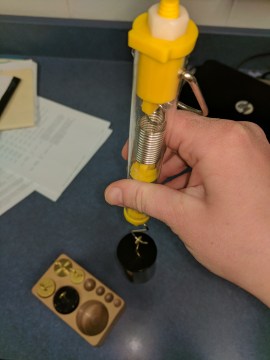
Students weighed hanging masses on spring scales to find a relationship between weight and mass. We moved this to the start of the unit since its the one thing we do with forces that doesn’t fit with our engineering project, but I feel like weight ended up separated from other important ideas from forces. As we dig more deeply into forces this week, I’ll make sure I circle back to the concepts of weight and mass, so I may decide this sequence was okay after all.

weight

Day 99: LOL Diagrams & Motion Detector

AP Physics: LOL Diagrams

Students went from bar charts to full LOL diagrams today. I am really coming to appreciate one of the worksheets from the Modeling Instruction curriculum that has students make LOL diagrams using several different systems for the same scenario, which really nicely illustrates why identifying your system matters. Students took to this easily enough that I think bar charts and LOL diagrams are a spot where I can pick up the pace a little next year.

lol

Physical Science: Motion Detector Lab

Students walked in front of the motion detector to reproduce the graphs they worked on Friday. Since we ran out of time on free fall day, I also showed a clip of Brian Cox when he visited a giant vacuum chamber to drop a bowling ball and feathers.


Day 98: Mistakes Game & Motion Detector Lab

AP Physics: Mistakes Game

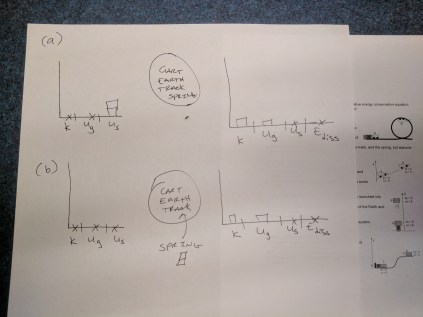
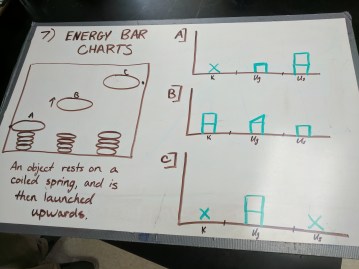
Students played the mistakes game with energy bar charts. My 2nd hour had a sub, so I’m not sure how things went. My meeting got done early, so I made it in time for my 4th hour class. This group is usually quieter during discussions, and they were much more nervous about doing the mistakes game without me since they were not confident they would get the right answers, but I was able to sit back while my students ran the show.

wb.jpg

Physical Science: Motion Detector Lab

Students worked on describing motion based on position vs. time graphs. On Monday, we’ll get out the motion detector to check their descriptions. They had a sub, so I’ll find out then how things went.

Day 97: Energy & Free Fall

AP Physics: Energy

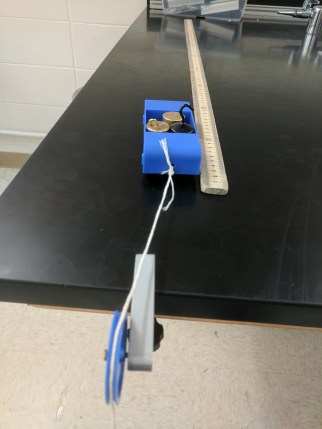
We had a board meeting on the two energy labs from this week. The kinetic energy groups tended to get very nice results; I had them check their model with multiple cart masses and ramp angles, and they saw the results were consistent. I had the elastic energy groups use multiple springs, but they didn’t see as clear a difference between the slopes as I would have liked. I’m wondering if the results would be less muddy if I had them plot gravitational potential energy on one axis rather than just plotting height. I shortchanged some of the pre-lab discussion, and I think that lead to students forgetting to do things like measure the cart’s starting height or measure both the starting and ending height from the same end of the cart.
kinetic.jpg

Physical Science: Free Fall

I got out washers, manila folders, and a few other things and tasked students with determining what affects the time an object takes to fall. In the pre-lab discussion, a student suggested the fluid an object falls through could affect the time, so next year I might make sure I have graduated cylinders and some different liquids available. I offered to grab materials if a group wanted to try that, but I think asking me to get stuff felt like an extra hurdle.

free-fall