Day 79: Pendulums, LOLs, & Phase Change

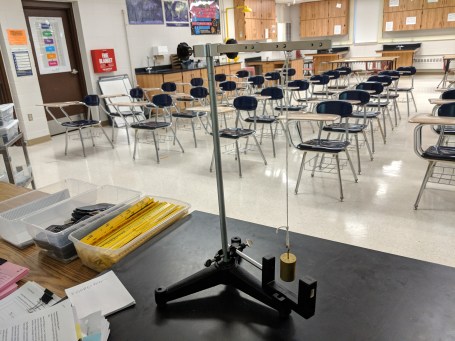
AP Physics: Pendulums

Students continued data collection and analysis for their pendulum lab. Today, I added that they need to predict the period of a roughly 5 m long pendulum we can hang in the front entrance, which drove some groups to get the longest pendulums they could at their lab tables. I had some groups try to use their formula sheets to calculate the period, rather than extrapolate from their data, but struggled to differentiate between the three formulas for period listed.

pend.jpg

One solution for measuring angle

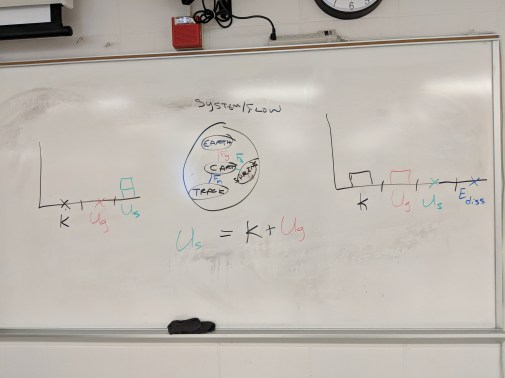
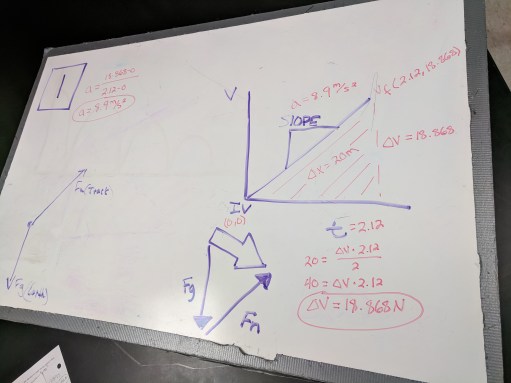
Physics: LOL Diagrams

Students whiteboarded the first part of the problems from Friday. In the section that had a sub, the majority of students did not attempt the problems and said it was because they were too confusing. I’m planning to spend some time tomorrow discussing general strategies for moving forward on a confusing problem.

lol.jpg

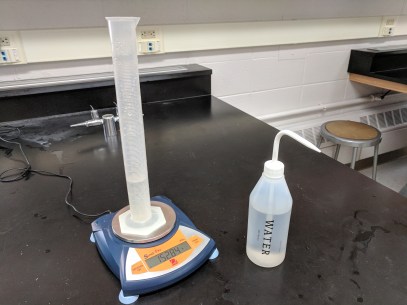
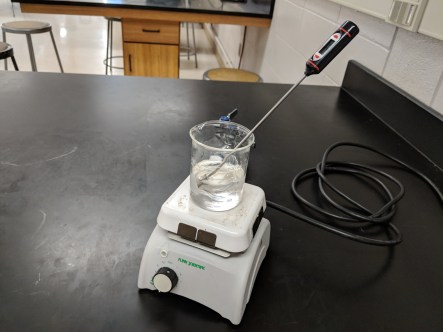
Chemistry Essentials: Phase Change

Students collected temperature vs. time data for heating up ice to boiling. Glancing at the numbers, I think most students will have pretty good results. Several groups called me over to say it wasn’t working since they didn’t have much temperature change at the beginning.
phase change.jpg

Day 78: Pendulums, Bar Charts, & Quiz

AP Physics: Pendulums

Students collected data for what variables affect the period of a pendulum. When we discussed what might be worth testing, one class was very quick to dismiss mass on the grounds that “mass never matters in physics”, which has me really excited for the period of a spring lab.

pendulum.jpg

Physics: Bar Charts

Students worked on representing energy with bar charts and switching between different systems. I had a sub for one section, but the section I was here was able to make the leap pretty independently, which was great to see.

Maker:S,Date:2017-10-21,Ver:6,Lens:Kan03,Act:Lar02,E-ve

Chemistry Essentials: Quiz

Students took their quiz on gas laws with a sub. This year, I framed the gas laws as proportional rules, rather than equations, and I’ve been pleased with how that’s impacted the math. I’m looking forward to see how that shows up on the quiz.

Day 77: CER, Mistakes Game, & Particle Diagrams

AP Physics: CER

Students have been struggling to explain their reasoning effectively, so we took a day to do some TIPERs problems on projectiles and energy using the CER framework. Most groups started with their claim, so I think next time, I will give some time for students to draw and interpret diagrams before I ask them for an answer. Its tempting to see what would happen with a goal-less TIPERs problem.

Maker:S,Date:2017-10-21,Ver:6,Lens:Kan03,Act:Lar02,E-ve

Physics: Mistakes Game

We played the mistakes game with yesterday’s pie chart problems. This is the first time I’ve done it this trimester, and I was surprised at how many students were very nervous about the prospect of presenting a board with unintentional mistakes, even after some discussion about whether anyone would know whether or a not a mistake was intentional. I need to keep working on building a sense of community and safety in this course.

Maker:S,Date:2017-10-21,Ver:6,Lens:Kan03,Act:Lar02,E-ve

Chemistry Essentials: Particle Diagrams

I showed students some examples of thermal expansion and had students whiteboard particle diagrams to explain what was happening. A few students made some great connections to the labs we’ve done.

Maker:S,Date:2017-10-21,Ver:6,Lens:Kan03,Act:Lar02,E-ve

Maker:S,Date:2017-10-21,Ver:6,Lens:Kan03,Act:Lar02,E-ve

Day 76: Projectile Practical, Pie Charts, & Whiteboarding

AP Physics: Projectile Practical

Students did a lab practical to predict where a horizontal projectile will hit the ground. Once they succeeded, I asked them to predict where a lighter marble would land without any new measurements aside from mass. Some groups had an easier time than others explaining their prediction, so I need to keep embedding these opportunities in labs and holding students accountable for thorough explanations.

carbon-paper

Retired referral forms work well as carbon paper

Physics: Pie Charts

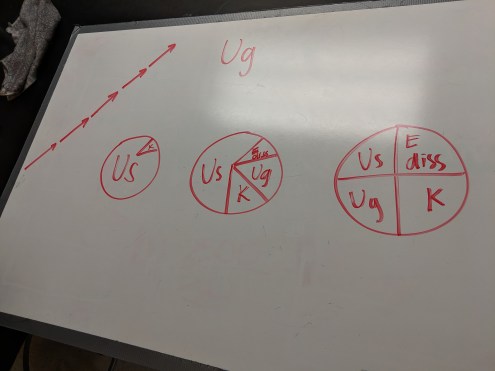
Students worked on sketching energy pie charts. I added defining the system today; during forces, we almost always ended up with systems that had a single object, so a few students were bothered by including multiple objects. I also worked very hard to avoid telling students whether they were right or wrong, which drove a few of them nuts, but pushed them to justify their answers to their groups.

Chemistry Essentials: Whiteboarding

Groups whiteboarded yesterday’s problems. I decided to have all groups whiteboard the same problem without any intentional mistakes, then have a consensus-building discussion for each problem. Students were pretty engaged; a lot of students who checked out yesterday felt like they had some extra accountability, which in turn pushed them to ask more questions and have some good discussions.

chem wb.jpg

Day 75: Projectile Whiteboarding, Pie Charts, & Gas Laws

AP Physics: Projectile Whiteboarding

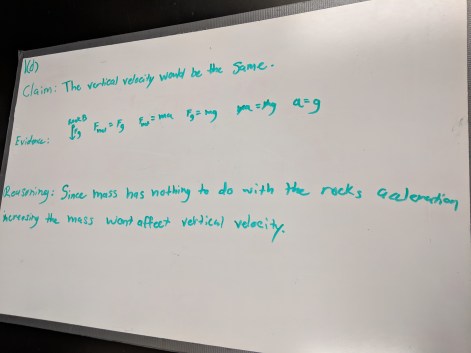
Around half of my students were on a field trip today. We did some mistakes whiteboarding with the problems from yesterday, followed by some practice writing good explanations for “explain your reasoning” problems using CER.

cer.jpg

Physics: Pie Charts

A lot of Physics students were also on the field trip, so my classes were pretty thin. After discussing yesterdays’ lab and introducing the “flavors” of energy, students worked on drawing energy pie charts. I usually skip this representation, but we decided to see if it helps with the struggles students have had this year with conceptual understanding.

Maker:S,Date:2017-10-21,Ver:6,Lens:Kan03,Act:Lar02,E-ve

Chemistry Essentials: Gas Laws

We went over the results of yesterdays’ simulation to derive the gas laws. Just like last trimester, I’m introducing them as proportions, rather than equations, and am pleased with how that’s working so far. I skipped spending a day on temperature and particle movement this tri, but I ended up missing that a lot today.

Day 74: Projectiles, Energy Transfer, & Quantitative Gas Laws

AP Physics: Projectiles

Students worked on some problems for projectile motion. I overheard a lot of students talking about the labs and demos from last week (which Brian Frank’s post on labs had me listening for!). They could use some more practice justifying answers with physics principles, along with lab results, but that will come.

Physics: Energy Transfer

I used a lab I got from Twitter (I wish I could remember who; if its you, I’m happy to give you credit!). To introduce energy, I had students measure the force and displacement required to pull a cart up ramps with different angles. Then, they sketched force vs. displacement graphs and found the areas.

energy transfer.jpg

Chemistry Essentials: Quantitative Gas Laws

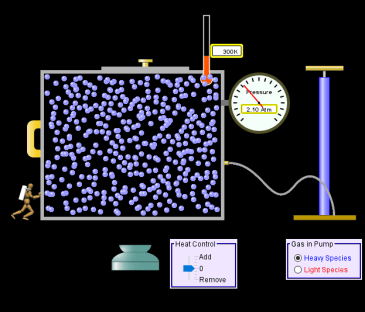
Students used PhET’s Gas Properties simulation to get quantitative relationships between temperature and pressure as well as volume and pressure. There were a lot of great observations about the movement of the particles and one student even pointed out the temperature skyrockets when you add gravity, which should feed nicely into tomorrows discussion.

Gas Laws Sim

Day 69: Quizzes Galore

Today is the last day before winter break.

AP Physics & Physics: Quiz & Mystery Tubes

AP quizzed over conservation of energy while regular quizzed on Newton’s Laws in 2D. Afterward, I got out the Mystery Tubes rather than starting a new topic. Students were a little fried since they had tests in just about every class, so I think they appreciated the chance to do something low-stakes after their quiz. My students were definitely loopier than usual, and that lead to some creative models of what’s inside the tubes. Next year, it might be worth putting a lab practical on this day instead of a typical quiz.

todd the bug.jpg

This bug’s name is Todd. He lives inside the tube and moves the ropes.

Chemistry Essentials: Mistakes Game & Quiz

There was only time for one group to present their board yesterday, so we continued the mistakes game today before students took a short quiz on density. The mistakes game was fairly chaotic, but there were also some really good questions. I need to put in some more time working on norms for discussion, but I’m hopeful they will be able to have some good whiteboard discussions.

Day 68: Whiteboarding, Problem Practice, & Whiteboarding

AP Physics: Energy Predictions

Students whiteboarded drafts of their answer to which interaction dissipates a bouncy ball’s energy. One of the things I like about this activity is every group agreed the table is where most of the energy is dissipated, but there was a variety of evidence cited that gave some good opportunities for discussion. Afterward, I showed a thermal video of a weighted tennis ball and we played with the happy/sad balls and seismic accelerator.

Physics: More Problem Practice

Students got some additional practice with unbalanced forces in 2D. It was one more day than I think was truly necessary for their understanding, but confidence has been a big struggle this year and it seemed to help a lot of them feel like they can do the problems.

Chemistry Essentials: Mistakes Game

I did the mistakes game with yesterday’s problems, and it was very rocky. I think it wasn’t ideal timing to introduce whiteboarding since tomorrow is our last day before break and a lot of students are very restless. I’m also really struggling in Chemistry Essentials, more than when I’ve taught it in past years, to get students focused on chemistry during chemistry.

chem mistake.jpg

Day 67: Video Analysis, Speed Dating, & Density

AP Physics: Video Analysis

Students continued working to determine whether a bouncy ball dissipates most of its energy from impact or from air resistance (I’ll have an article about this activity in the January issue of The Science Teacher). Today, students used LoggerPro to analyze the videos they made yesterday and collect evidence. There were a lot of great conversations about connections between energy and motion, which is exactly what I’m after with this activity. Most students had a draft of a CER about where the energy was dissipated by the time they left class.


Physics: Speed Dating

As part of my effort to focus on lowering the social stakes in my class, I had students do some whiteboard speed dating to go over yesterday’s goal-less problems. There were a lot of great conversations; the best part was how many students I heard asking “How do you know?”. My 1st hour in particular did a great job of finding and correcting mistakes in each others’ work. I also am continuing to talk about my pedagogical choices more than usual, which seems to be helping students go along with what I’m asking and hold each other accountable for participating. Particularly in my 1st

speed dating.jpg

The units got fixed on the next rotation, but I forgot to snap a new photo

Chemistry Essentials: Density

We discussed the results of yesterday’s lab to get to a definition of density. I skipped doing a true board meeting because, with break looming, I was worried about time, but students didn’t have as solid a mental model of density as I would have liked when they were working on the worksheet. It was a good reminder that pedagogical shortcuts have their cost.

Day 66: Missing Energy, Goal-Less Problems, & Mass vs. Volume

AP Physics: Missing Energy

Students started working on an activity to determine whether a bouncy ball mostly dissipates energy due to air resistance or due to the impact with a table (I’ll have an article on this activity in the January issue of The Science Teacher). Today, students worked on sketching LOL diagrams and velocity vs. time graphs for each explanation, which lead to some good conversations about the connections between energy and motion. Each group also recorded a video of a bouncy ball that they’ll analyze in LoggerPro tomorrow.

Physics: Goal-Less Problems

Students worked on some goal-less problems for Newton’s 2nd Law in two dimensions. I was very explicit with my students that I use them to make it okay to start a problem without knowing where you are going. We also spent some time discussing key steps students should take (like deciding whether the forces are balanced or unbalanced, drawing and annotating diagrams, etc) which helped a lot of students see where to start.

Chemistry Essentials: Mass vs. Volume

Students worked on finding a relationship between the volume of water and its mass. I had students design their own procedure for the lab and I think they could have used more pre-lab discussion; I usually keep the pre-lab pretty short in favor of doing a lot of coaching lab groups, but the class is bigger than usual this year and I was spread pretty thin, which in turn fed some classroom management issues. I’ll need to keep that in mind for future labs.mass vol.jpg