Day 90: Multiple Choice, Practical, & Bohr Model

AP Physics: Multiple Choice

Students took a quiz, then we used Plickers to practice some multiple choice. I intentionally picked some problems that go back to topics from earlier this year. I also spent some time reviewing what it looks like to take full advantage of this activity, and saw students more engaged than last time. I think doing multiple choice less often was a good call.

img_2398

Physics: Practical

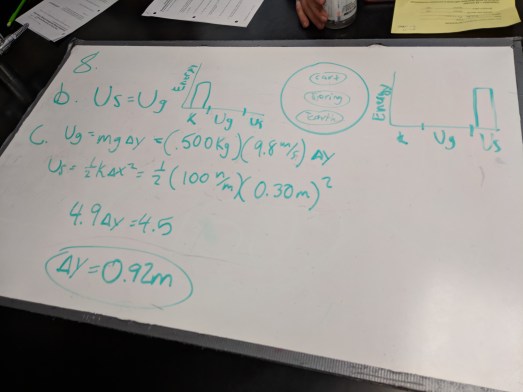
Students wrapped up the energy practical they started yesterday. I added a couple of conceptual questions to the task, and was pleased with the conversations I overheard. I think next time I’ll make explaining your group’s answer to those questions part of testing out the result.

Maker:S,Date:2017-10-21,Ver:6,Lens:Kan03,Act:Lar02,E-ve

Chemistry Essentials: Bohr Model

Students used PhET’s Build an Atom simulation to play with the Bohr model and explore how it connects to the periodic table. A few students wanted to know why we are using the Bohr model when the quantum model from yesterday’s reading is more complete, which is a great opener for conversation about what makes a useful scientific model.

build atom.PNG

Day 89: Superposition, Energy Practical, & Atomic Models

AP Physics: Superposition

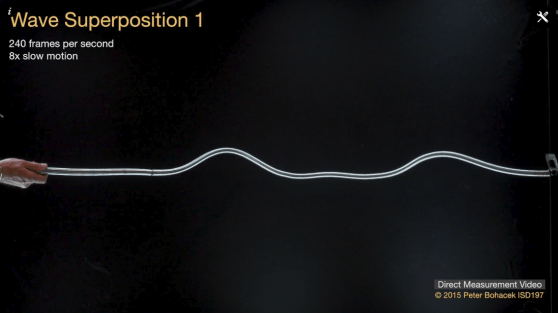
After a little playing with the snakey springs, students went to Pivot Interactives to explore wave superposition. There was a lot of great discussion about whether the wave pulses passed through each other or bounced off each other with students making some pretty detailed observations of the pulses.

pivot superposition.PNG

Physics: Energy Practical

Students worked on using conservation of energy to determine where to place a photogate on a ramp to get a cart moving at a certain velocity. A lot of groups had trouble interpreting their height measurements; I think a lot of them were not keeping track of where they placed the reference height. One group recognized this is pretty similar to the kinetic energy lab we did and used their lab results to confirm today’s calculation.

MVIMG_20180131_131952.jpg

Chemistry Essentials: Atomic Models

I still haven’t found a way I’m really happy with to address the state standard about the evolution of atomic models, but today was the day I tried. I used a POGIL activity where students read some summaries of the major steps in the atomic model and answered some questions. A few students felt overwhelmed by the length of the reading, so we talked about how to use the section headings to make it more manageable. I liked this better than last tri’s jigsaw since doing the full reading seemed to help more of them see the different models as part of the same story.

Day 88: Board Meeting, Energy CERs, & Periodic Trends

AP Physics: Board Meeting

Students whiteboarded their results from the standing waves lab and the wave equation came nicely out of the discussion. I usually give students a minute or two to pre-discuss with their lab group once we circle up with the boards, but I think I can skip that time in my 2nd hour; they dove immediately into asking questions and making comments across groups, which is a great sign of how comfortable with each other and with talking physics.

waves wb.jpg

Physics: Energy CERs

Students wrote CERs with their lab groups to make qualitative predictions about objects like the seismic accelerator and a ballistic pendulum. A lot of groups struggled a lot with what good reasoning looks like, which is not surprising. We’ve backed away from reasoning tasks in Physics this year because many students are struggling on the quantitative problems, but I need to remind myself that students need the reasoning tasks to practice the sensemaking we want them to do on problems.

nrg cer.jpg

Chemistry Essentials: Periodic Trends

Students used yesterday’s cards alongside their periodic tables to start looking at the patterns in the periodic table. Students made a lot of good observations and started asking questions about the legs used to represent valence electrons, which should make for a nice lead in to atomic structure.

card sort 2

Day 87: Standing Waves, Whiteboards, & Elements Card Sort

AP Physics: Standing Waves

Between parent teacher conferences and a bad cold, I failed to actually assign the Pivot Interactives activity I’d planned for Friday to any classes, which made it a little tricky for them to complete. Today, I actually assigned it and they collected data to find a relationship between the wavelength and frequency of a standing wave. The upside is my students had a very self-directed activity while I was still not at 100%.

standing waves pivot.PNG

Physics: Whiteboarding

The majority of my students attempted the problems I left for them to do with Friday’s sub, which is a nice sign of progress. Today, we spent some time whiteboarding the problems, mostly using gallery walks. I gave each problem to at least two different groups so they could compare answers and approaches before the gallery walk, which helped build some confidence. In another sign of progress, in one group that is usually pretty quick to ask for help, one member insisted that today, they would discuss every question before they asked me and told me to wait several times when her groupmates called me over. In the end, they were able to reason their way through every question they had.

lol wb (1).jpg

Chemistry Essentials: Elements Card Sort

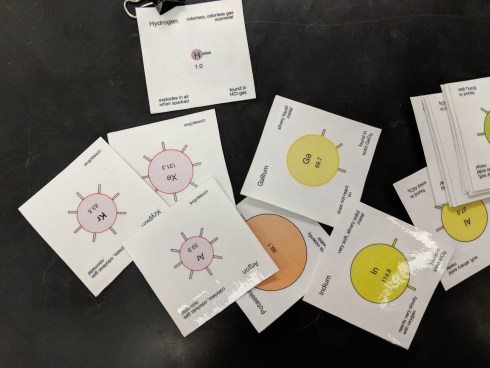
Students worked on a card sort activity loosely based on Mendeleev’s process for developing the periodic table. Each group picked two properties to sort by (one for columns and one for rows), and quickly noticed that other patterns started popping out. I also got a lot of students eager to know what some of the features of the cards represent, so it will be nice to tie some upcoming activities back to this one. Though, I need to brush up on my history a little bit to explain how Mendeleev knew some of these properties.

card sort (1).jpg


Day 86: Standing Waves, Energy Conservation, & Quiz

I was home sick, so no photos today.

AP Physics: Standing Waves

Students worked on a lab in Pivot Interactives to find a relationship between frequency and the wavelength of a standing wave.

Physics: Energy Conservation

Students worked on some problems using energy conservation. I’ve had some issues with students not attempting problems when there is a sub, so I spent some time yesterday on strategies for making progress on energy problems.

Chemistry Essentials: Quiz

Students too their quiz on energy and phase change.

Day 85: Whiteboards Galore

AP Physics: SHM Whiteboarding

Students did some whiteboarding to discuss yesterday’s trio of simple harmonic motion. There was some good discussion about whether the net force on each object is constant or changing for each object. In one section, I asked students for free-body diagrams and vector-addition diagrams to resolve that debate and in the other section, I asked them to sketch velocity vs. time graphs. The velocity vs. time graphs were much more effective for resolving the disagreement.

shm wb.jpg

Physics: Kinetic Energy Board Meeting

Students whiteboarded their results for the kinetic energy lab. This time, I didn’t specifically prompt them to linearize their graphs and only some groups tried plotting change in height vs. velocity squared, which made for a nice discussion.

ke (1).jpg

Chemistry Essentials: Freezing Lauric Acid

Students finished making their graphs, then we discussed the results of the lauric acid lab. A lot of students had trouble with a question about whether you can add energy to a system without changing the temperature, which reinforces my impression that many of those students are having trouble making sense of what the representations we’re using mean. I also forgot I wanted to have my students move before we shifted to whole group discussion and didn’t think of it until after class. Enough groups had trouble shifting to whole class mode that I need to make a note for next time.

Day 84: SHM Trio, Kinetic Energy, & Lauric Acid Take 2

Yesterday was a snow day.

AP Physics: SHM Trio

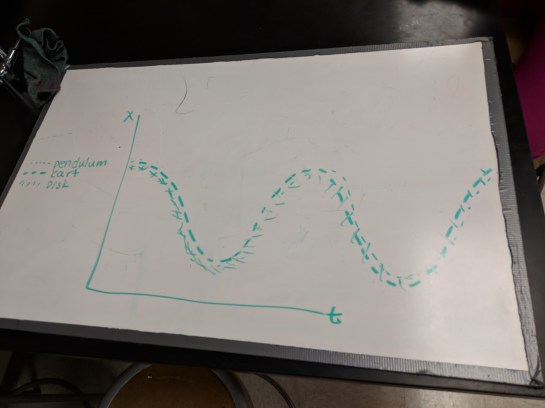
Students analyzed a video from Pivot Interactives of a pendulum, a spring, and a rotating disk in synchronized simple harmonic motion. I overheard some really good conversations about differences between the x-position vs. time and y-position vs. time graphs for the pendulum; a few students relate it back to the projectile Pivot Interactive we’d done and tried to imagine a camera that just showed the vertical motion of the pendulum.

SHM Trio.PNG

Physics: Kinetic Energy

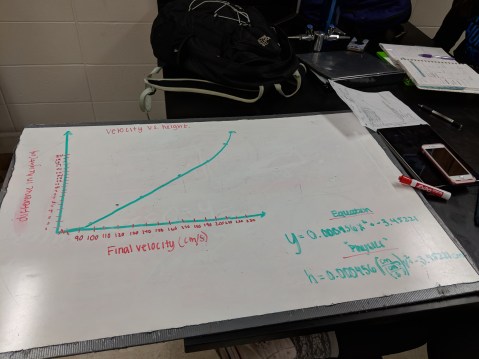
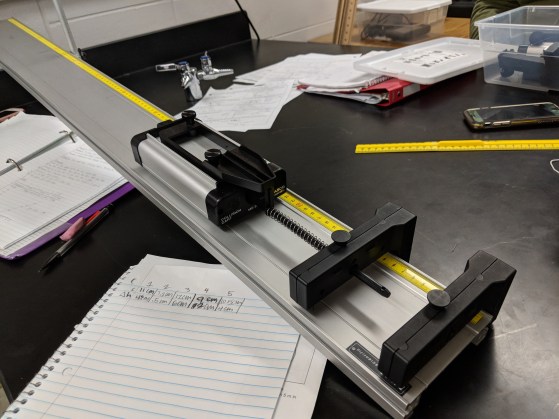
Students started collecting data to find a relationship between the change in height of a cart on a ramp and the velocity at the bottom. On the elastic potential energy lab, a lot of students just measured the height of the cart, rather than the change in height, so I spent some extra time on the pre-lab discussion to make sure students saw why the change is important.

ke.jpg

Chemistry Essentials: Lauric Acid Take 2

We took another shot at finding the freezing point of lauric acid since the weather on Monday cut us short. A few students who’d collected some data were frustrated that they had to start fresh, rather than picking up where they left off. It will probably be worth spending some time tomorrow on why they had to start fresh, especially since it connects to what the graph physically means.

Maker:S,Date:2017-10-21,Ver:6,Lens:Kan03,Act:Lar02,E-ve

Day 82: Springs, Linearization, & Whiteboarding

AP Physics: Springs

Students started collecting data for variables that affect the period of a spring. I found it interesting that students were quick to suggest stretching the spring farther to change the period after seeing angle doesn’t matter for a pendulum; I suspect they just aren’t making the connection yet. A lot of groups used motion detectors to measure the period, and one student found the graphs so satisfying she snapped a photo of the LabQuest to show off.

spring (1).jpg

Physics: Linearization

Students were pretty quick to treat yesterday’s data on the compression of a spring launcher vs. a cart’s change in height as linear, probably because we haven’t linearized any graphs in a while. We spent some time today talking about what intercept would make sense and why before a quick review of linearization. Afterwards, groups worked on making linearized graphs of their data.

Chemistry Essentials: Whiteboarding

Students did some whiteboarding the problems from yesterday. I had all groups whiteboard the same problem, when we shifted to whole group discussion. The physical space in my room lends itself pretty well to having whole group discussions with students at the lab tables, but a lot of students were having trouble with the transition to whole group discussion. Next time, I think I will have students physically move to give a clearer cue that we are changing the kind of activity.

Day 81: Board Meeting, Energy Transfer, & LOL Diagrams

AP Physics: Board Meeting

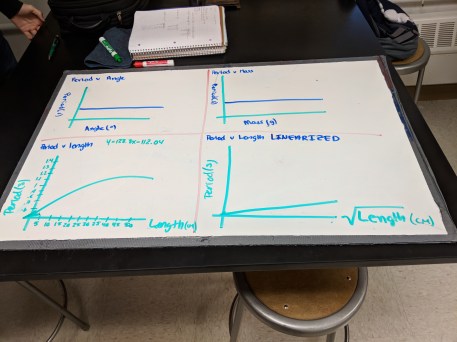
Students whiteboarded the graphs for the pendulum lab. It usually feels a little hand-wavy getting from the lines of best fit to the full equation; I had one group a couple of years ago that reasoned out gravity should be involved, and connected the dots from there. I’d like to work on scaffolding strategies next time to give students the opportunity to take those steps themselves.

pendulum wb.jpg

Physics: Energy Transfer

We revisited the previous energy transfer lab to come up with a formula for gravitational potential energy, then started a lab to find a relationship between the compression of a spring and the amount of gravitational potential energy transferred to a cart. Students were pretty quick to accept a linear fit to their data, so I want to make sure we spend some time tomorrow on the intercept of the graph.

epe to gpe.jpg

Chemistry Essentials: LOL Diagrams

I introduced students to LOL diagrams and they used them to represent some phase change problems. Students took to the diagrams pretty easily, which was great to see.

Day 80: Big Pendulum, Mistakes Game, & Phase Change

Classes were short today so we could work with our homerooms on registration for next year.

AP Physics: Big Pendulum

After a quiz, we went to the front entrance to measure the period of a 5 m long pendulum so students could see how well their model so far fits the result before tomorrow’s board meeting. I’m hoping the period of this pendulum will push students to try linearizing their data.

pendulum big

Physics: Mistakes Game

We did some mistakes whiteboarding with energy bar charts. One of my AVID students commented that it reminds her of AVID tutorials, which is spot on. I also had a group tell the class “If you need a hint, you should read the problem”, and I took the opportunity to point out that is always good advice.

Chemistry Essentials: Phase Change

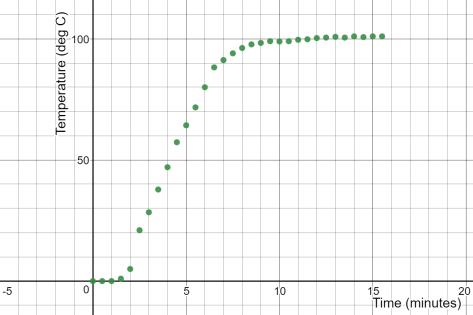
Students graphed their data and we started talking about the results of the phase change lab. Last tri, when I let students have one group member put the data into Desmos, I found that the rest of the group would typically ignore the graph, so I had every student graph by hand today. while students paid more attention to the shape of their graph, it was pretty laborious so I want to keep thinking about how to approach the graph for this lab.

desmos-graph (1).png