Day 43: Assessment Reflection & Movie

I was chaperoning a field trip today, so no photos and lessons that were easy to leave for a sub.

AP Physics: Assessment Reflection

Students took a test combining forces and constant acceleration today. On tests and quizzes, I’ve been asking students to rate themselves on each learning target and write a short reflection, so I took a few minutes to read over the reflections after the field trip. I like getting a sense of where my students feel confident and where they are struggling before I grade the whole test. It was also fun to see what students wrote. I’ve been trying to improve how explicit I am about what is included in a given model, so I was really pleased to see several students tell me that they started each problem by identifying what models apply, then thinking of the “toolbox” that goes with that model. I also was really excited to see a student who has been struggling write that, moving forward, he wants to shift from trying to understand what they answer is to trying to understand why its the answer.

Earth Science: Movie

The earth science curriculum calls for another movie this unit (I think I’ve shown more movies in Earth Science this year than I’ve shown in physics the last several years combined), and I went with it since that’s an easy thing for a sub. I’ve been using the existing worksheets to go with the movies, which have very factual questions in the order they appear in the movie. The next time I show a video, I might try getting the students to do a little more thinking by adapting some reading response techniques like four square notes or a 3-2-1 response.

Day 42: Mass & Comet Orbits

AP Physics: Mass

Students finished the lab practical we started on Thursday where they used a modified Atwood’s machine to find an unknown mass. Today, once they had an answer, we checked their result using a spring scale. One of my goals this year is to work on hearing from every student, so I tried posting three questions about the lab (one for each group member). Then, before groups could check their result, I would roll dice to decide which group member had to answer each question. Since there are three students in each group, I was able to hear from every student. Groups did a really nice job of making sure all three group members could answer all three questions, which is exactly what I hoped would happen.

img_2469

Earth Science: Comet Orbits

Students finished up yesterday’s lab contrasting Mars’ orbit with Halley’s Comet’s orbit. A lot of groups were surprised when they realized that the patterns from Kepler’s Laws worked equally well for both orbits, especially when they used mass as a proxy to compare the areas of two sections that represent equal times. Next time, I might see if I can get my hands on some card stock or other heavier paper to make it a little more convincing that the small differences are negligible. I also will probably re-work my Kepler’s Law introduction to include Halley’s Comet right off the bat, rather than waiting until we introduce comets.

img_2468

Day 41: Central Force & Comet Orbits

AP Physics: Central Force

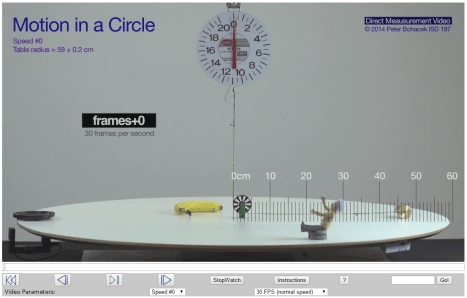
Students used a Direct Measurement Video of a weight on a rotating table to find a relationship between force and tangential velocity. One of the first questions on my activity was to draw a free-body diagram of the weight and determine whether there is any net force. A lot of groups had some great discussion as they tried to rectify the fact that the table rotates with a pretty constant speed with the fact that their free-body diagrams showed a net force on the weight. There were also some groups that asked questions like how the speed of the banana compared to the speed of the weight, bringing them back to a Direct Measurement Video of a rotating disk we’d used earlier in the year.

motin-in-a-circle-dmv

Earth Science: Comet Orbits

A major theme this week is comparing different kinds of solar system objects, so I decided to take an idea Michael Lerner gave me last week and have students compare the orbit of Halley’s Comet to Mars. I used an ellipse drawer to give students the orbit of both objects, then had them start by making some observations. Today, most groups only had time for the qualitative questions about the two orbits.

comet-orbit

Day 40: Mass & Craters

AP Physics: Mass

Students worked on a lab practical to find the mass of an unknown object using a modified Atwood’s machine. My plan is to use spring scales to verify the mass the determined, then use this to introduce the difference between inertial mass and gravitational mass, but time got tight and most groups need a little longer to finish their calculations.

img_2456

Earth Science: Craters

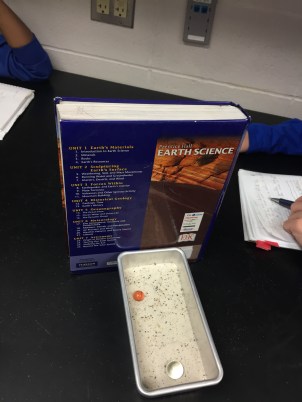
During yesterday’s lab, it quickly became clear that my students did not have much sense of how craters are formed. Today, I got out some trays of sand and an assortment of marbles and we explored how mass and impact speed affect the crater size. I was really excited when the groups who finished early started asking new questions, like how the depth of the sand or angle of impact changes the crater, and coming up with experiments to answer those questions. This is why I love freshmen! We also dropped a shot put into a bigger tray of sand and got some slow-motion video just because its cool.

img_2452

Day 39: Assumptions & Moon Landscapes

AP Physics: Assumptions
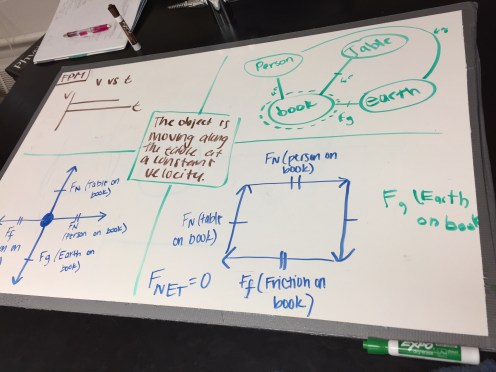
Some of my students are losing track of the tools they have for problems involving forces, so we started by whiteboarding as many different representations for a simple force problem as we could and then making a list of what we have in our forces toolkit. From there, students worked on some TIPERs problems. I had students answer each problem using a CER, but turned it into a CAER by asking them to state and justify key assumptions before diving into the evidence. We had some good conversation about what makes something an assumption rather than evidence or a claim. We will definitely need to revisit this as the year goes on, but I liked hearing my students start by articulating what they had to just agree is true before digging into the rest of the problem.

img_2451

Earth Science: Moon Landscapes

Students looked at a topographic map of an area of the Moon. They made some good observations and inferences about the craters formed, but students have had limited exposure to topographic maps so far and, as a result, had trouble connecting the map to what the would physically see. Next time, I think I’ll start by having them look at an actual image of the Moon, then transition to a topographic map of the same area.

Day 38: Pushing Blocks & Kepler’s 2nd Law

AP Physics: Pushing Blocks

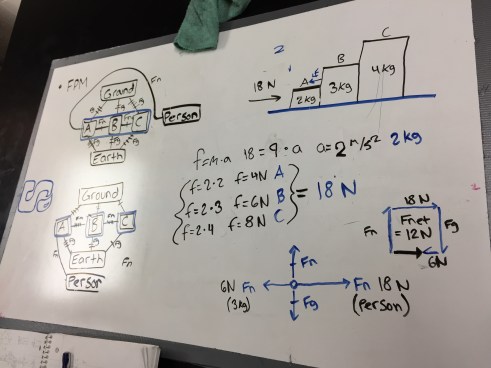
Students worked on a problem I’ve come to really like where three blocks of different masses are being pushed along by a certain force. Based on some of the struggles a few groups were having, I think it would be worthwhile to pause sometime soon to do a model summary. I loved the moment when students figured out how to use the 3rd Law to think about the normal forces between each pair of blocks. The best thing I overheard, though, was a student who said “You need to convince me you’re right! If you can explain your idea and your evidence, then I’ll believe you.”

img_2438

Earth Science: Kepler’s 2nd Law

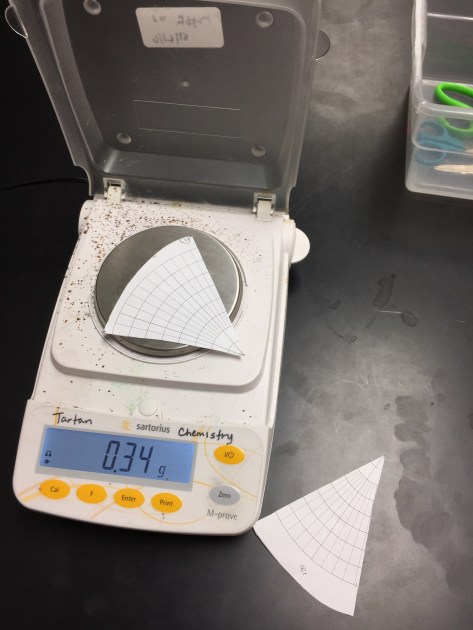
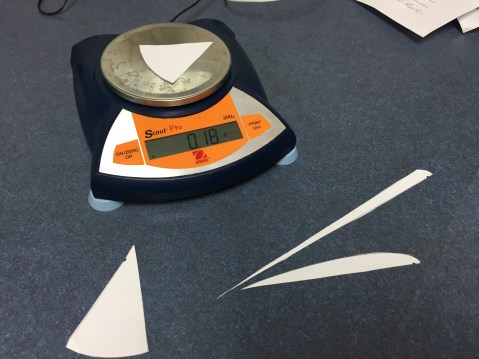
Students plotted the position of Mars along its orbit, then cut out some wedges that represent the same amount of time. We used the mass as a stand-in for area to show that an orbiting object sweeps out the same area in the same amount of time. We got really nice results; the class average for the mass was within 0.01 g for the two wedges. I think students lost track of what they were plotting, however, so I need to think about how I can reinforce what the numbers they are plotting has to do with the actual path of Mars.

img_2436

Day 37: 3rd Law & Kepler

AP Physics: 3rd Law

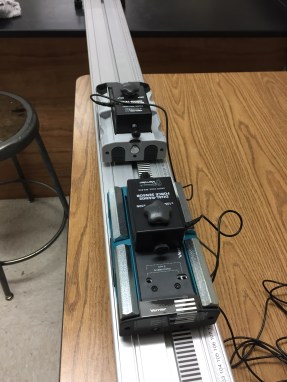
On Friday, students predicted how the force on a pair of carts would compare for various collisions. Today, we got out a pair of carts and force sensors to test out their predictions. I got pretty excited when, after seeing the first couple collisions had the same force, one student took another look at her system schema and free-body diagrams, then pointed out both forces are measuring the same interaction, so the magnitude should be consistent. Afterward, we watched Veritasium’s excellent video on the 3rd Law.
img_2435

Earth Science: Kepler’s Laws

Students drew ellipses and measured the distance between the foci and points on the ellipse to look for patterns. Students were pretty successful at finding the pattern in the distance to the focal points. I tweaked the lab as written to try to have students discover the equal areas law, but I did not account for the fact that the length of the string loops varies a lot. Tomorrow is slated for more time on this lab, so I think I’m going to try and find some data they can use to plot actual positions of one of the planets tomorrow.

img_2433

Day 36: 3rd Law & Cosmic Voyage

Today is day 2 of the NSTA Regional Conference, so students have a sub again.

AP Physics: Newton’s 3rd Law

Students drew free-body diagrams for various cart collisions and predicted how the force on each cart should compare. It usually drives students nuts that I won’t tell them whether they are right in this activity, so I think it will be less frustrating for them to do this with a sub, even if I’ll miss out on hearing them talk it through. On Monday, we’ll put some force sensors on carts and see if the students were right.

Earth Science: Cosmic Voyage

The curriculum calls for showing The Cosmic Voyage during the astronomy unit, so I took advantage of the easy sub plan.

Day 35: TIPERs & Moon Phases

I’m at the NSTA Regional Conference, so students have a sub today.

AP Physics: TIPERs

Students worked through some problems applying Newton’s 2nd Law, mostly out of TIPERs with a few calculations thrown in. I love listening in on the conversations students have on their way to answering TIPERs problems, so I kind of hate leaving it for a sub, but I’m looking forward to seeing their work when I get back.

Earth Science: Moon Phases

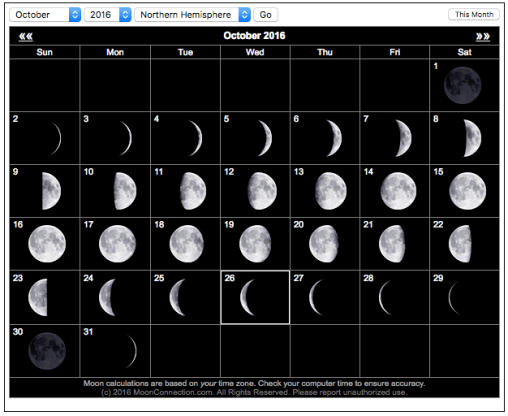
Students took their assessment on climate change, then did a follow-up to Tuesday’s lab modeling phases of the moon. Today, they used a moon phase calendar to determine which way the moon revolves around Earth.

moon-phase-calendar

Day 34: Springs & Review

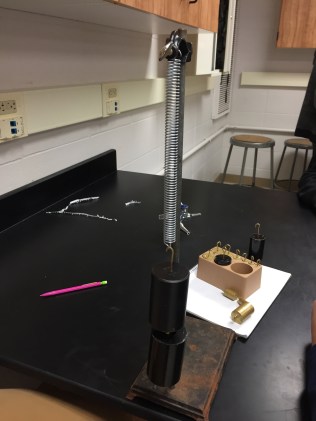
AP Physics: Spring Force

Students looked for a relationship between the force on a spring and the amount it stretches. I rushed the follow-up discussion since I’m going to be out the rest of the week, so I want to make sure to revisit some of the key ideas next week, especially when it comes to interpreting the graphs.

img_2423

Earth Science: Review

I used the same review activity from earlier units where students work with their lab group to write some questions for each learning target, then pass their questions on to another group. Overall, I could tell my students were struggling more to come up with questions than in some of the earlier units. I think a lot of that stems from my own struggles interpreting the learning targets and connecting them to the established lessons. If I’m not clear on what the learning targets mean or how everything connects, my students definitely won’t be.

img_2420