Day 83: Inertial vs. Gravitational Mass, Board Meeting, & Freezing Lauric Acid

Several nearby districts had snow days today, so most of my classes were a little more off-task than usual today.

AP Physics: Inertial vs. Gravitational Mass

Students finished collecting data and making graphs for the period of a spring lab. We didn’t have enough time for a board meeting, but every group had decided mass is what matters so we took a few minutes to decide whether it is gravitational or inertial mass by comparing the period of a cart on a spring at different angles. This is the first year I’ve used the Pasco equal length springs, and several groups were able to get some pretty nice data for period and spring constant.

spring ramp.jpg

Physics: Board Meeting

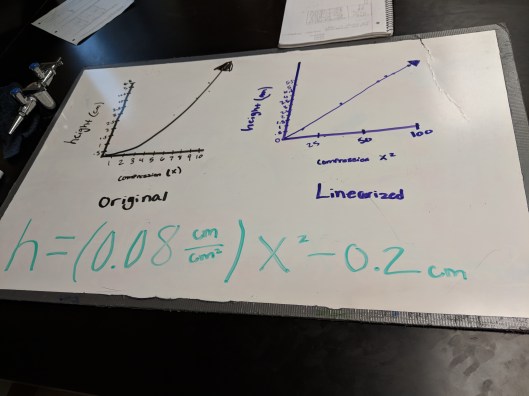
Students whiteboarded their results from last week’s lab. I gave different groups different springs, and the slopes reflected that variation nicely which lead smoothly into fitting k into the formula. I had conversations with some groups about whether their results were “right” that reinforced just how uncomfortable some of my students still are with being even partially wrong. Talking to them, I think they don’t see this fear of being wrong as an obstacle to learning physics.
epe board 2.jpg

Chemistry Essentials: Freezing Lauric Acid

We worked on a lab to find the freezing point of lauric acid by melting it in a hot water bath, then making a temperature vs. time graph as it cools in a cool water bath. This is the last class of the day and we ended up getting released 13 minutes early due to a snowstorm, so only one group was able to get data. Especially since a third of the class was gone by 6th hour, I’m thinking about just repeating the lab tomorrow.
Day 72: Projectiles, Forces Practical, & Qualitative Gas Laws

AP Physics: Projectiles

We worked through some problems I got from Michael Lerner where students apply other models from this year so far to an object dropped straight down and I was pleased with the connections students were making. I also asked students to predict what should happen to the time if the object were heavier and if it were launched horizontally, and got some great discussion. We wrapped up by trying each and checking the results with slow-motion video.


Physics: Forces Practical

Students wrapped up the forces practical from yesterday. I scaffolded the practical more than usual by breaking it into small steps, asking students for each representation and several calculations along the way. Several students commented that was very helpful when they took another look at the problems from earlier this week.

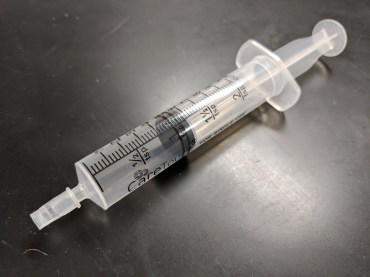
Chemistry Essentials: Qualitative Gas Laws

I got out the syringes for students to make some qualitative observations about the ideal gas laws. The ice water baths didn’t produce much change for the groups I was able to talk to today. With this class, I’m spending more time redirecting students or dealing with groups damaging lab equipment than I am talking to students about chemistry, so I need to think about how to shift that. There is a para who is going to work on helping to keep students on task. I also need to remember the instructional coaches have offered to help manage things on lab days.

syringe.jpg

Classroom Display

Earlier this week, I put up a “Scientists can be…” display inspired by Liz Mastalio. Its been a lot of fun listening to students react to it; some are looking for which ones they don’t know while others are clearly drawn to specific identities. My AP students have been telling me who they’d like to see up there, so I want to open the door for them to submit a poster with a label. That could help me get some identities I missed that matter to my students.

Maker:S,Date:2017-10-21,Ver:6,Lens:Kan03,Act:Lar02,E-ve

Day 70: Projectiles, Forces Reintroduction, & Density

AP Physics: Projectiles

Students did an activity on Pivot Interactives to watch the motion of a projectile from three different vantage points and produce position vs. time and velocity vs. time graphs. From what I saw, most groups got pretty good results. This was the first time students saw the midpoint method for finding slope of a curve, and I think I should have spent a little more time introducing that. We can have some discussion about it tomorrow.

projectile.PNG

Physics: Forces Reintroduction

Especially because a lot of students really struggled with the forces assessment right before break, we started this week getting back into the swing with some problems similar to what we worked on right before break. Before break, I was also seeing more and more students getting off-task during time with their groups, so I spent some time sharing my observations and having some discussion about how that fits with what it takes to be successful in a class like this.

Chemistry Essentials: Does shape affect density?

I had students determine whether the shape of a block affects its density using a set of aluminum blocks with different shapes, but the same volume. Last tri, I’d asked students to predict the shape of the mass vs. volume graph, but it was tricky to collect class data and the graph was kind of boring since I didn’t have much variety of volumes. This approach got the same misconceptions out on the table, but gave more meaningful results.

density.jpg

Day 69: Quizzes Galore

Today is the last day before winter break.

AP Physics & Physics: Quiz & Mystery Tubes

AP quizzed over conservation of energy while regular quizzed on Newton’s Laws in 2D. Afterward, I got out the Mystery Tubes rather than starting a new topic. Students were a little fried since they had tests in just about every class, so I think they appreciated the chance to do something low-stakes after their quiz. My students were definitely loopier than usual, and that lead to some creative models of what’s inside the tubes. Next year, it might be worth putting a lab practical on this day instead of a typical quiz.

todd the bug.jpg

This bug’s name is Todd. He lives inside the tube and moves the ropes.

Chemistry Essentials: Mistakes Game & Quiz

There was only time for one group to present their board yesterday, so we continued the mistakes game today before students took a short quiz on density. The mistakes game was fairly chaotic, but there were also some really good questions. I need to put in some more time working on norms for discussion, but I’m hopeful they will be able to have some good whiteboard discussions.

Day 58: Scoring Guide, Broken Circles, & Steel Wool

AP Physics: Scoring Guide

The tri 1 final exam included some free response problems off past AP tests, so today I gave students the scoring guides and some student samples to make sense of the scoring before letting them see their own tests. One of the problems was problem 3 off the 2016 free response and, inspired by a participant in Greg Jacob’s AP Summer Institute, I used rubber bands to make a bumpy ramp so we could actually try out the experiment in the problem. The class had some good discussion about key takeaways, like the importance of explaining EVERYTHING. Students also noticed that the student samples with high scores had a lot of marking the text.

Physics: Broken Circles

I struggled to get the class culture I wanted in my physics class last trimester and, with students shuffling between hours and about half coming from the other physics teacher, the new tri is a great opportunity to try again. Students worked on a broken circles activity from Designing Groupwork  by Lotan & Cohen, then we had some discussion about what it took to succeed and how that fits with what effective groups in physics look like.

broken circles.jpg

Chemistry Essentials: Steel Wool

This course is two trimesters long, and we only offer the second half during tri 3, so I’m restarting the first half of the course with a new group of students. Students measured the mass of steel wool before and after pulling it apart. To help students focus on good lab practice, I had them do the experiment once with minimal instructions. Then, we had a brief discussion to get at some sources of error before students completed the lab again with a handout and a paper plate to help catch stray bits of steel wool. Just like tri 1, I made a class histogram with Post-Its, but the results were much nicer this time.

chem histo


Day 35: Motion Representations, Lab Practical, & Mystery Tubes

AP Physics: Motion Representations

Students started practicing translating between different representations of constant velocity. Students have already done some similar problems with momentum vs. time graphs, so things went very smoothly.

Today’s quiz also included the first free response problem from an AP exam that students have worked. Afterwards, as they discussed their answers, there were a lot of kids high-fiving each other while another student told me she enjoyed the quiz. Its great to see students getting the hang of physics and feeling good about it.

Physics: Lab Practical

Students continued work on yesterday’s lab practical. I only had a few groups finish and was running into a lot of the same roadblocks I’ve been seeing for most of the unit. Both my students and I feel like we are beating our heads against the wall with this unit; since we’ll get another crack at acceleration with unbalanced forces, I think its best to cut our losses for now. On Monday, before we dive into balanced forces, I’ll take some time to have some conversation with students about what’s working and what isn’t so we can try to get on a better path.

Chemistry Essentials: Mystery Tubes

Today was a quiz day. About half of my students take their quizzes in the special ed room and usually stay up there the full period, while those who stay in the classroom rarely need more than half the period, so I’m trying to plan interesting activities that aren’t required for the content. Today, I pulled out the mystery tubes and it was fantastic. Every student was engaged, making fantastic observations and sharing ideas about what’s going on inside. One student in particular who is normally pretty checked out asked if she could sit the activity out because it seemed too hard, but got into it once she got her hands on a tube. The best part was when the para supporting the class stopped by at the end and asked about the tubes, this student confidently insisted he check out her model to see exactly how the tubes work. It was a great way to end the week.IMG_1734


Day 28: Conservation of Momentum, Mistakes Game, & Measurement

AP Physics: Collisions

After their quiz, students wrapped up the data collection on the collisions lab. Things went very smoothly, and a lot of groups have already commented on the pattern in their momentums.  This is one of the times I love having quantitative uncertainty in the course, because students are independently deciding whether their momentums are close or effectively equal.

Physics: Mistakes Game

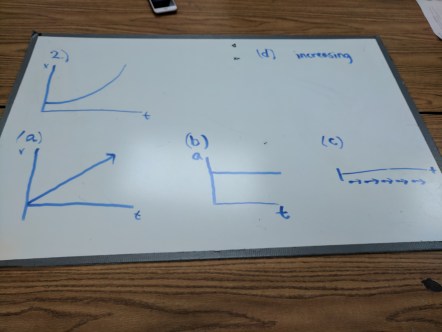
Students played the mistakes game with stacks of kinematic graphs. In class discussions, I’ve been struggling to get students to speak up and it is usually one or two students who do most of the talking after lots of long silences. Today, one of those students asked a question about the a vs. t graph, a member of the group presenting said, without any shame or fear, “We don’t really understand those graphs, so we just drew something.” All of the sudden, the whole class was animated and students who are normally quiet, even in small groups, were jumping in with fantastic questions. It was a fantastic way to end the week with that class.

phys wb.jpg

Chemistry Essentials: Measurement

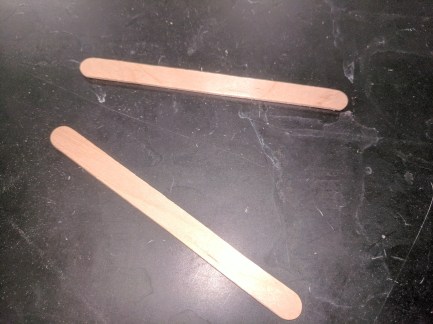
When I gave some notes on temperature scales yesterday, I had a student ask whether Kelvin is a more accurate scale than Fahrenheit and several others questioned it when I said 98.6 rounds to 100. I’m really excited about the thinking about measurement this shows, so I decided to lean in and do a Modeling Instruction measurement lab I’d skipped during the first unit. I had students measure the lab tables with popsicle sticks, gradually adding marks to make them more accurate. Next time, I think I will have them measure a bigger mix of objects, including some shorter than their tool.

pop sticks.jpg

Day 26: CoM Board Meeting, Breaking Down Problems, & Gas Laws

AP Physics: Center of Mass Board Meeting

We had a board meeting to discuss the results of the video analysis from the last few days. I asked students to write a CER for whether the forces on each system of pucks were balanced or unbalanced. This lead nicely into some conversation about what exactly we mean by the two -puck system. I ended up wishing students had more experience interpreting position vs. time graphs prior to this discussion; we’ve mostly worked with velocity vs. time graphs so far, and the various uncertainties piled up to make it look like the velocity was changing. The position vs. time graphs were much more convincing, but students weren’t as likely to look at those.

Afterwards, we played with the coupled carts from Kaar, Pollack, Lerner, and Engles’ The Physics Teacher article. The graphs were very satisfying.

Physics: Breaking Down Problems

On the last quiz, a lot of students really struggled to interpret the problems, so we spent some time today on how to break down a physics problem. As we discussed how to approach a problem, we took time for students to apply each step to the problems on the most recent quiz.

quiz tips

Chemistry Essentials: Gas Laws

We used the results of yesterday’s simulation to develop the gas laws. I’ve found a lot of my students really struggle with algebra, so, rather than developing equations, we came up with statements using proportional reasoning which students then applied to some problems. Some of my students who really struggled to manipulate the density equation were very successful with today’s gas laws problems, so I think this approach was a success.

Day 18: Trig It Out, Dueling Buggies, & Density Problems

AP Physics: Force Problems

Students worked on using vector addition diagrams to solve balanced force problems (one of many things I learned from Kelly O’Shea). I really like that while many of my students still ended up using a version of components, they see where the components come from. Once students set up their vector addition diagrams, the slogan for the day was “Trig it out!”, a line from last year’s students.

Physics: Dueling Buggies

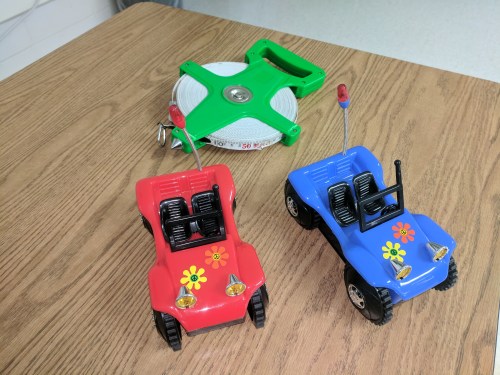
Students worked on the Modeling Instruction lab practical to predict where two buggies will collide. I didn’t give quite enough instruction to my 1st hour, but once I suggested they try drawing some representations and play with them, they started making some progress.

One of my goals this year is to help students value ways of being successful in class besides knowing the answer quickly, so as part of the lab practical I gave them a list of skills based on similar lists from Kelly O’Shea and Ilana Horn, then asked them to identify at least one example for each group member where they demonstrated one of those skills. I’m looking forward to reading their responses.

dueling buggy.jpg

Chemistry Essentials: Density Problems

Students worked on some density calculations. Some students really struggled with the algebra, so I’m trying to decide whether that really needs to be in the course. Most are getting to a point where they are successful with the graph, and I think that is more valuable in the long term than using the equation.

I also handed back the first quiz; most students performed about how I expected, but I was surprised at how many students had underestimated how they did and were genuinely excited about their score. Several confirmed with me (multiple times, in one case) that they got to keep their quiz so they could show their parents. I need to work on reinforcing the connections between our day-to-day work and the assessments so that more students will see that kind of success.

Day 11: Uncertainty, Buggies, & Norms

AP Physics: Uncertainty

We had a board meeting on yesterday’s force of gravity lab, and the discussion was better than I expected at this point in the year. As we were talking about the slope, one student claimed “Gravity doesn’t change”, which lead nicely into what we mean by that and how we know. In response, another student shared that yesterday one of her group members said “The force goes up 10 N for every 1 kg of mass”; after finally reading Arons this summer, one of my goals is to have students make “for every” statements about slope, and I was thrilled it came up naturally.

I also introduced uncertainty during the board meeting. Students had a lot of great observations about the relative precision of measurements and how much mass it took to change the reading on the scale, which gave them a sound conceptual basis. I rushed the discussion since the end of the hour was coming, and it ended up more teacher-directed than I’d like, but I’m pleased with how the basic approach worked.

fg wb.jpg

Physics: Buggies

Students collected data for the buggy lab. Since when I ask for observations, there is usually a student who says the buggy is moving at a constant speed, I took a page from Michael Lerner and framed the lab as seeing how we can find out. A few groups are starting to make “for every” statements about their slope, which I did not see during the introductory unit and is great to see. I think the relationship is more obvious here than it was in the intro labs.

buggy.jpg

Chemistry Essentials: Norms

I’ve been struggling with classroom management. This is a very high-energy group, and there are a lot of things that are a lot of fun, but I’ve been having trouble keeping them on task and getting them to voices besides their own. I decided to pause today to spend some time developing norms as a class. I think a lot of students felt it was punitive, but many also agree that things aren’t working at the moment.