Day 161: Final Project Presentations, Lab Final, & Nuke Whiteboarding

This will probably be my last post of the year. Today was the last day for seniors, so my Physics and AP Physics 1 classes wrapped up today. My Chemistry Essentials class is mostly juniors, which means they will continue through the end of next week, but I’ll miss out since I’m going to the AP Physics reading.

This year, I’ve been doing a lot of work to try and build a strong whole-class culture and, compared to previous years, I had a lot more students talk about how they’ll missing being in their specific hour of physics, suggesting there was a strong sense of community. That was a really exciting element of my last day for the year.

AP Physics 1: Final Project Presentations

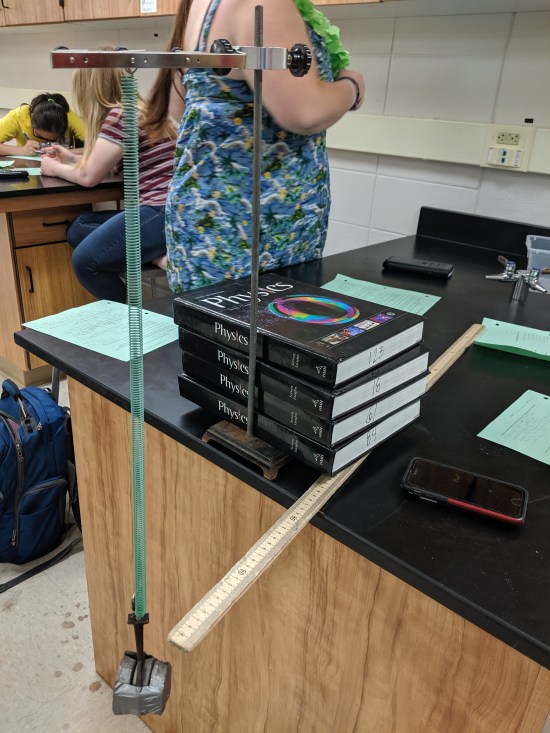
We finished up final project presentations. There was one group that designed and built a rig to reliably launch a hockey puck to measure the stopping distance along various surfaces in order to determine toe coefficient of friction. For the final, students were given a spring with a known spring constant and tasked with finding the mass of a mystery object.
phys lab final

Physics: Lab Final

Students did a lab practical for the second half of their final exam. There was lots of great conversation as students worked through the problem and it was a lot of fun for me to see students using so many of the skills we’ve been working on this year.

Chemistry Essentials: Nuke Whiteboarding

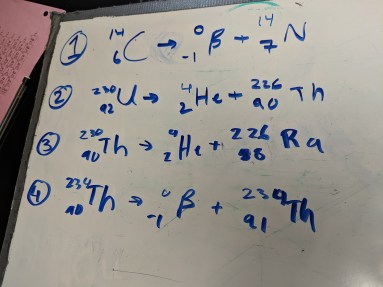
We did a quick refresher on nuclear decay using the whiteboards before taking the quiz on nuclear chemistry.
chem wb.jpg

Day 148: Survey, Curved Mirrors, & Pivot Reaction Types

I was out today, so my classes had a sub.

AP Physics 1: Survey

My district requires all teachers to have students complete a teacher evaluation survey. Since it’s ideal to have students complete it without the teacher in the room, I picked today.  Teachers chose which classes to give the survey to; since AP Physics 1 is the only class where I keep the same students all year, I decided to survey them. While there are certainly flaws in student evaluations, I am interested in seeing the results to get another view of the culture in my classroom.

Physics: Curved Mirrors

Students did a lab to play with curved mirrors to start building some ideas about the images formed by concave and convex mirrors.

Chemistry Essentials: Pivot Interactives Reaction Types

I am as part of Pivot Interactive’s Chemistry Fellows program.

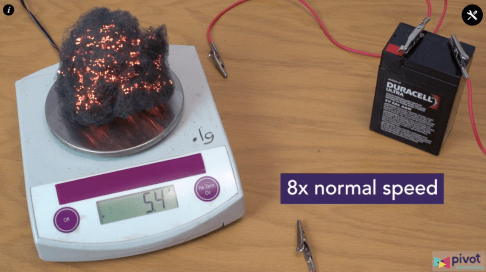
Students used Pivot Interactives to get one more look at some of the different reaction types before their quiz. Along with a single replacement and a double replacement reaction, I had students use what they know about synthesis reactions to finally explain why burning steel wool gets heavier.

pivot steel wool.png

Day 131: Pivot Angular Motion, Whiteboarding, & Pivot Stoich

I am a part of the Pivot Interactive’s Chemistry Fellows program.

AP Physics 1: Pivot Interactives Angular Motion

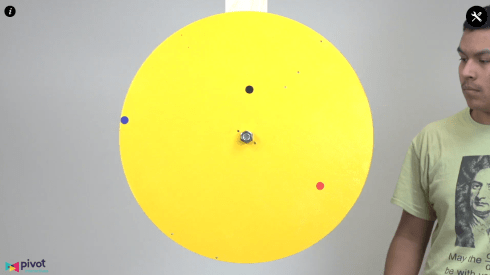
As students finished their torque quiz, I had them use Pivot Interactives to look at the motion of a spinning disk and come up with two different answers to which dot on a spinning disk is moving the fastest. Tomorrow, we’ll use those two answers to get into angular velocity vs. tangential velocity.Pivot angular.PNG

Physics: Whiteboarding

We spent some time whiteboarding yesterday’s problems. Students resisted drawing the diagrams for standing waves, but, once they got the diagrams, they were able to solve the problems.

Chemistry Essentials: Pivot Interactives Stoichiometry

Students used Pivot Interactives to compare their prediction for how much hydrogen gas should be produced in a reaction to how much was actually produced. I ran into an issue where a few students were very insistent that a prediction is a guess, so their calculation could not be a prediction. I didn’t have a great response in the moment aside from in science, a prediction should have something to back it up, which can be a calculation.

Another hurdle I ran into today is I have one section where a lot of students really resist talking to their group members, and the computers made it easier for them to work in isolation. As a result, I realized partway through the hour I was frequently answering the same questions multiple times with a given group and I was helping individual students with portions of the activity their partners knew how to do. I need think about how I can help my students have more productive collaboration within their group.

Pivot stoich.PNG

Day 118: Board Meeting, Mistakes Whiteboarding, & Conservation of Mass

AP Physics 1: Kirchhoff Board Meeting

We had a board meeting where students shared the rules they’d come up with for current and potential difference, which lead into Kirchhoff’s rules. My students missed some details, especially around current, that I wanted them to see; normally, I would have sent them back to the lab to experiment a little more, but I ended up pointing out the info in the interest of time.

Physics: Mistakes Whiteboarding

We did some mistakes whiteboarding with yesterday’s problems. There are some students who haven’t had me before, so this was their first exposure to mistakes whiteboarding. A few of them started laughing and making some comments when a group clearly had some clearly unintentional mistakes, so I stepped in more than usual and, with help from students who’ve done this before, managed to shift the tone pretty quickly. I’ve been more conscious this year overall that I need to reset the culture in my classroom each trimester, but I dropped the ball today and didn’t revisit what it looks like to contribute during this kind of whiteboard discussion.

phys mistake (1).jpg

Chemistry Essentials: Conservation of Mass Lab

Students did a reaction in a Ziploc bag to see the conservation of mass in action. Students got good results, but balancing the reaction was tricky. The reaction is one of the trickier ones I ask students to balance in this course, so this may have been better near the end of the unit.

reaction in bag.jpg

Day 106: Assessment Bonanza

Tomorrow was originally scheduled to be a staff development day, so all three of my classes took assessments wrapping up their last topic.

AP Physics 1: Waves Assessment

This quiz included an experimental design problem off a past AP exam. My students still find those kinds of problems really intimidating, but I’m really pleased with the work on the quizzes I’ve looked at so far. In general, both this year and in the past, I’ve had a lot of trouble helping my students feel as confident as I think they should when it comes to the AP Physics 1 exam, and I think their reaction to experimental design problems is one symptom. I have noticed that one of my sections is much more confident, and I don’t think its coincidence that they are also a MUCH smaller section. As we get into the home stretch to May 7, I need to give some thought to how I can help all of my students recognize the progress I’ve seen in them.

Physics: Pendulum Assessment

Students took their quiz on pendulums, then started working on a final review.

Chemistry Essentials: Formula Writing Assessment

Students quizzed over formula writing. Most were feeling very good about their work at the end of the quiz, which is a great place to be at the end of the term.

Day 25: Friction, Groupwork Reflection, & Pressure

AP Physics 1: Friction

Students whiteboarded the friction lab from yesterday.  There was some good discussion and I can tell students are getting more comfortable talking about graphs. Its been a couple of years since I last did this lab, and the results are as messy as I remember, but students already seem to have a clearer idea of what the coefficient of friction is telling them, so I think it was worth the time.

friction lab.jpg

Physics: Groupwork Reflection

Today was a quiz day and the routine has become to spend the first part of the hour on an assessment doing some groupwork reflection. I spent some time on discussions about what skills students had used working on certain tasks to reinforce the value of multiple abilities. I have one class that seems to be buying in to valuing multiple abilities more than the other, but I think progress is happening on that front.

Chemistry Essentials: Pressure

To wrap up gas laws, I did a few demos. Before each one, I had students whiteboard a CER with their prediction. My favorite is a demo where I put a pipe between a large and a small balloon with each balloon clamped shut. Students have to predict what will happen when I remove the clamps. The version I first saw calls for putting a very small amount of air in the little balloon, so it isn’t stretching much, which forces air into the big balloon when you remove the clamps. I prefer inflating the small one enough that the rubber has stretched and, when the clamps are removed, the air just stays put in both.

pressure demo

Day 10: p-t Graphs, Groupwork Reflection, & Density

AP Physics: p-t Graphs

Students sketched momentum vs. time graphs for bowling balls hit with various combinations of taps, then we got out billiard balls and motion detectors to transition to true momentum vs. time graphs. It was a little tricky for students to predict what the graph would look like when the billiard ball reversed direction, but we got there by the end of the hour.

Physics: Groupwork Reflection

Today we had a few whiteboards to finish from Friday and a quiz to take. One of my goals this year is to improve the quality of the collaboration in my classroom, so we also took a few minutes to talk about some of the different abilities students needed to complete the problems and mistakes whiteboarding, then I asked students to complete a short reflection based on a list of things effective groups do I got from Scot Hovan at a modeling workshop. I haven’t had a chance to read the reflections yet, but it looked like students were giving it some good thought and I overheard several students showing their reflection to a peer they’d used as a positive example.

Chemistry Essentials: Density

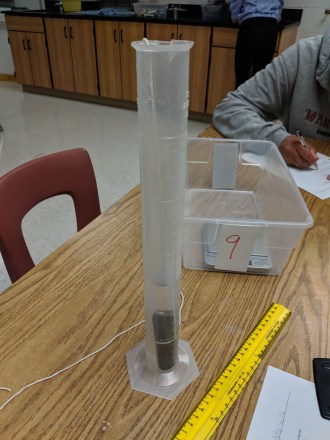
We got out the metal dowels from last week’s volume lab to find their density. I asked groups to design their own experiment, and wished I’d taken the time for a little more discussion on what makes a good experiment. The worksheet I used started with questions about what variables they needed and how to measure those variables, but a lot of students had trouble with articulating how they would get a variety of values for the data table.

volume.jpg

Day 1: Buggies, Broken Circles, & Mystery Tubes

AP Physics 1: Buggies

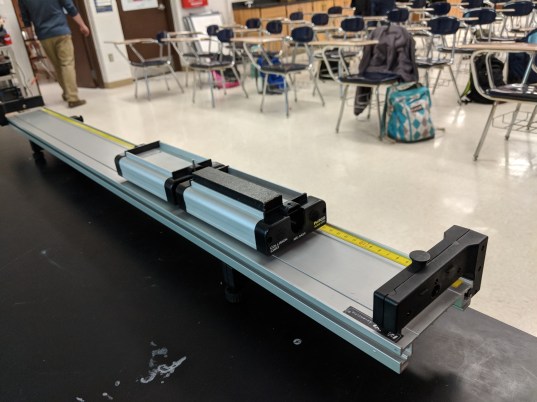
I took a page from Frank Noschese and embraced the idea that “Any lab worth doing is worth doing twice.” I gave groups the very vague directive to collect data on the buggy’s motion, then represent it on a whiteboard and turned them loose. My students seemed very comfortable with the ambiguity and dove right in, which was fantastic. I had a good mix of data tables and graphs on whiteboards, along with a lot of variations on graphs, which led to some good conversation on what would make it easier for us to compare results. Tomorrow, we’ll re-do the lab with a focus on being able to compare results. I talked more than I’d like today, but that’s pretty typical of when I do a new discussion.

buggy

Physics: Broken Circles

To start building class culture and learning how to collaborate, I started today with Frank Noschese’s subversive lab groups. Once they were in groups, students did the broken circles activity from Designing Groupwork: Strategies for the Heterogeneous ClassroomEach student got an envelope with pieces of a circle inside. As a group, they had to assemble four complete circles without talking. Afterward, we had some discussion about what skills groups needed to complete the task.

broken circles

Chemistry Essentials: Mystery Tubes

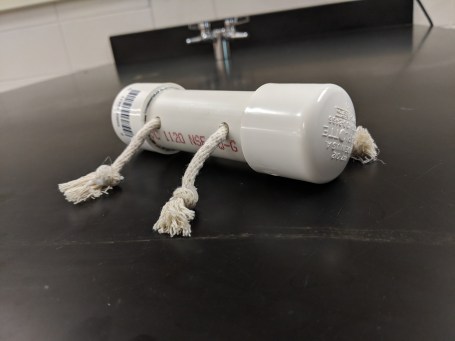
Today was also about class culture in chemistry. This class also started with subversive lab grouping, but  I stepped in more than I did in physics. There were more students in this class who seemed nervous about approaching their peers and it was tougher for them to identify other possible solutions when a group got too big. Afterward, we got out the mystery tubes. I could tell I didn’t make the goal as clear as I sometimes do; while there were a lot of groups who were very engaged and had great conversations, others had trouble getting started.

mystery tube

Day 104: Plickers, Explosions, & Quiz

AP Physics: Plickers

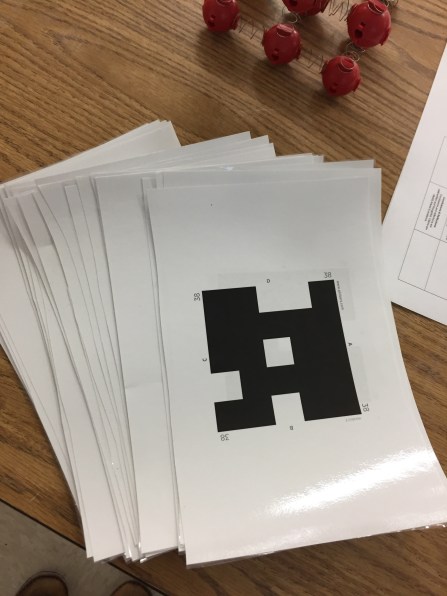
After a quiz, we used Plickers for some multiple choice practice. We happened to do several that involved the slope or area of different graph types, and it was clear from the conversations that a lot of students were having trouble keeping them all straight, so we spent some time looking at how to work backwards from the formula sheet to get what a slope or area represents.

img_2398

Physics: Explosions

Students took a quiz on impulse, then worked on analyzing their data for the cart explosion lab. Linearization has been a struggle in this course this year, but it seems to be clicking for a lot of students, which is good since plotting ratios means there’s a lot to think through.

One class brought up their anxieties about a drill we’re planning in conjunction with the local police department, which lead into a discussion about their fears about school shootings in general. With the drill already making students nervous, I’m going to need to carefully monitor the mood in my classes and make a concerted effort to make students feel as safe as possible.

Maker:S,Date:2017-10-21,Ver:6,Lens:Kan03,Act:Lar02,E-Y

Chemistry Essentials: Quiz

Today’s formula writing quiz took the full hour, which was much longer than I expected. I had a lot of students come up to me during the quiz to ask questions that indicated they were struggling to differentiate the different types of diagrams as well as the meaning of subscripts and superscripts on atomic symbols. I need to think about what kinds of scaffolds I can provide to help students develop those skills; one option may be to have students help name the diagram types, rather than using a standard name.

Day 95: Electric Potential Difference, Conservation of Energy, & Quiz

AP Physics: Electric Potential Difference

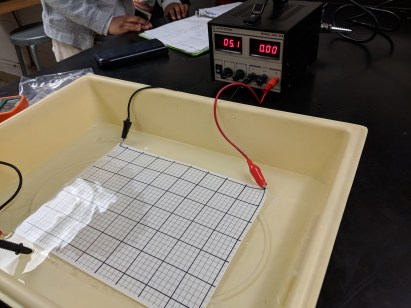
Students did a variation on the lab to map an electric field in a tray of water. Since I just wanted to define electric potential difference, they measured the voltage along a line with the multimeter’s ground probe in a few different positions (my article about this lab was in the January issue of The Physics Teacher). There was a lot of good discussion within lab groups about what negative voltages mean.

epd.jpg

Physics: Conservation of Energy

Before their quiz, students whiteboarded a couple of conservation of energy problems (which I spaced out on taking a picture of). For a lot of students, this reinforced the importance of the meaning-making steps and gave them a boost of confidence before starting the quiz. The downside is there are students who approach the pre-quiz problems as a chance to cram, rather than a warm-up. I’m trying to decide if I’m okay with that trade-off.

Chemistry Essentials: Quiz

Students took their quiz on atomic models and classifying matter. I’ve been working a lot on the class culture and finding ways to connect with students I’ve been clashing with, and it paid off today when, for the first time, I didn’t have to police students staying quiet after they finished their quiz.