Day 133: Closed Pipes & Percent Yield

Physics: Closed Pipes

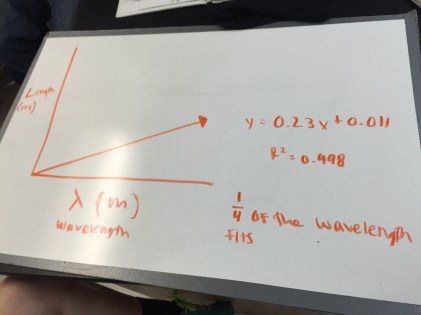
Students whiteboarded and discussed their results from yesterday’s lab on closed pipe resonators. They pretty easily recognized that, since the graphs of tube length vs. wavelength consistently have a slope near 0.25, 1/4 of the wave must have “fit” into the tube to produce a standing wave. This lab is traditionally used to find the speed of sound, but I always ended up just giving them length = wavelength/4, which bugged me. By having students use the lab to find that relationship, they only needed to use relationship between speed, wavelength, and frequency they found using snakey springs and the speed of sound, which they found using both a Direct Measurement Video and a Vernier microphone.

IMG_1798

Chemistry: Percent Yield

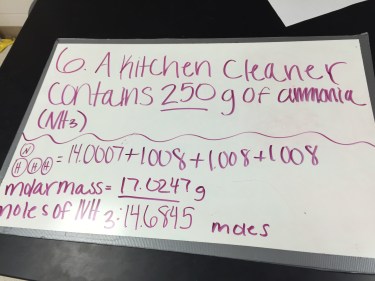
Students continued working on their percent yield problems today. We spent some time discussing the physical meaning of the numbers they were using, especially the numbers in the balanced chemical equation and the molar masses since confusion about what those represent lead to a lot of the struggles students had on yesterday’s quiz.

Day 132: Closed Pipes & Percent Yield

Physics: Closed Pipes

Students whiteboarded their results from yesterday’s lab and we discussed the results. Afterward, students started working on finding a relationship between wavelength and the length of an air column needed for a standing wave, using the speed of sound from the video to get the wavelength of a tuning fork.

Chemistry: Percent Yield

I introduced the concept of percent yield and students started working through some problems. They also took a quiz on stoichiometry, which didn’t go as well as I hoped. Looking at their work, I think a lot of students lost track of what all the different numbers mean, so I’m tweaking some lessons for later this week to try and get back to the physical meaning of the numbers they are using.

Day 131: Speed of Sound & Speed Dating

Physics: Speed of Sound

After some time playing with the wave generator to confirm Thursday’s lab results, students used a Direct Measurement Video to produce a position vs. time graph and find the speed of sound. Tomorrow, they’ll put that speed to use in closed pipe resonators.

speed of sound DMV.PNG


Chemistry: Speed Dating

Students needed just a little more practice to firm up their stoichiometry skills, so we did some whiteboard speed dating with problems similar to what will be on tomorrow’s quiz. I was really pleased at the number of groups who were really talking through problems , taking turns with the marker, and taking other steps to ensure that both students really understood what was going on.

Day 130: Standing Waves & Stoich Practice

Physics: Standing Waves

Students used a Direct Measurement Video to look for patterns in the wavelengths and frequencies that can produce a standing wave on a string. I’d set up the wave driver this morning to try some ideas for Monday, and several students asked if they could try it to answer some questions the videos raised for them, but didn’t have a great way to answer.

Chemistry: Stoich Practice

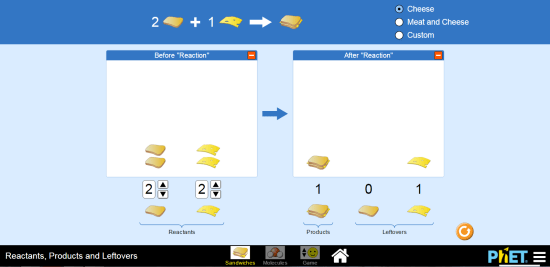
Students finished up their stoichiometry practice problems today. I’m trying to really focus conceptually on what the math means, so we spent some time drawing repeated reaction diagrams to better connect the math to the lab they did a few days ago.

IMG_1791

Day 129: Wave Superposition & Stoich

Physics: Wave Superposition

We spent some time discussing the observations students had made about wave superposition yesterday. There was some good debate about whether pulses were reflecting off each other or passing through each other. Students then practiced sketching superpositions based on the original waves.

IMG_1788

Chemistry: Stoich

We spent some time discussing the lab students did yesterday and really focused on how they knew when and what to multiply or divide. We also spent some time explicitly discussing what the hardware represented and how what they were doing was similar to a chemical reaction. Afterwards, I gave students some more traditional problems using actual chemical reactions.

IMG_1785

Day 128: Wave Superposition & Molar Mass in Reactions

I’m out today, so I’ll find out tomorrow how things actually went.

Physics: Wave Superposition

Students used a Direct Measurement Video to start exploring wave superposition. Since I’m not there to listen in on their conversations, I’m having them submit answers to some questions in Google Classroom so I can look over what my students are thinking before class on Wednesday.
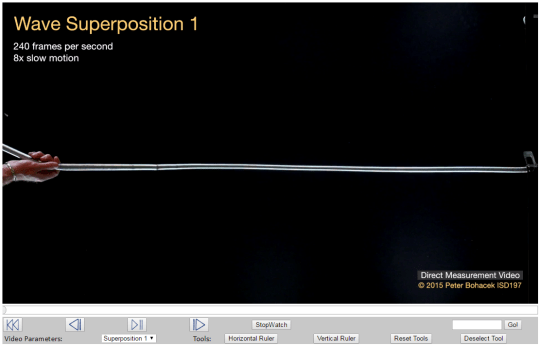
Wave DMV

Chemistry: Molar Mass in Reactions

Students went back to the nuts, bolts, and washers to introduce the idea of stoichiometry. I made up a “reaction” using those three elements and provided a total mass available for one of the reactants. Students used the hardware as manipulatives to determine how much of the other reactants would be needed along with how much of the product would be produced. When I did this last tri, students tended to ignore the manipulatives, so I reworked some of the questions to try and emphasize how the physical nuts, bolts, and washers can be used to check an answer.

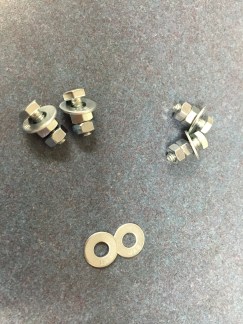
IMG_1599

Day 127: Wave Equation & Molar Mass

Physics: Wave Equation

Students used snakey springs data for a relationship between wavelength and frequency and made graphs. I’d hoped to share the graphs today, but there just wasn’t enough time. They spent a lot longer than last year’s students figuring out how to measure the wavelength. Last year, the weather was nice enough to do the lab outside, and a lot of groups found ways to use their spring’s shadow to mark key points on the ground. Today, we had snow, so were stuck doing the lab inside. Students were quick to recognize, based on the units, that the slope of their linearized graph was the speed of the wave.

Chemistry: Molar Mass Practice

Students worked on some practice molar mass problems, then whiteboarded solutions for a gallery walk. A lot of students initially struggled going from a measured mass to a number of moles, but when I asked students to think back to the lab they did a few days ago and tell me how they would figure out how many bolts I had if all they knew was the mass, things clicked pretty quickly.

IMG_1782

Day 126: Snakey Springs & Molar Mass

Physics: Snakey Spring Waves

Students used the snakey springs to start exploring properties of mechanical waves. Today, they found ways to affect the speed of the wave and made observations about what happens when a pulse reaches the end of the spring.

IMG_1776.JPG

Chemistry: Molar Mass

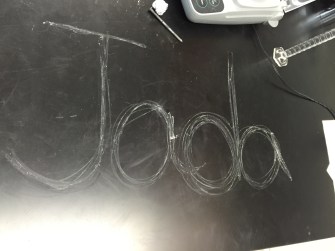
Today molar mass got a little more abstract as students calculated the molar mass for actual chemical formulas and answered questions like how many moles of chalk it takes to write their names on a lab table. A lot of students sketched diagrams of the formulas to help figure out what they had to add or multiply to get the molar mass and most felt pretty confident by the end of the hour.

IMG_1774