Day 165: Final Review & Isotopes

Physics: Final Review

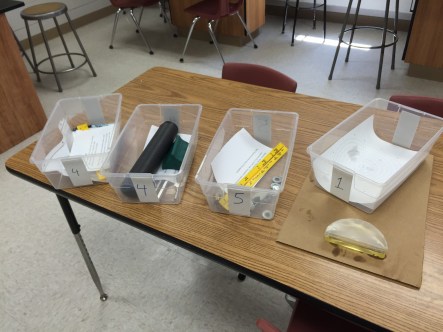
Students continued working through the lab practicals to review for the final exam. Overall, I’m pretty happy with how the review has been doing, though a lot of groups were confused about what they were being asked to do on the standing waves practical. I need to revise the directions to make it clearer that they should calculate the length of the tube needed to resonate, then use the materials to test it.


Chemistry: Isotopes

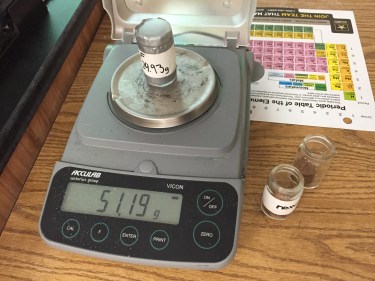
Students used what they know about isotopes to determine how many pennies in a sealed container were made before 1982 vs. after. They struggled to make the connection between the lab and what we’ve done so far on isotopes, so I need to make some changes to help students better build that link.
IMG_1916

Day 164: Senior Skip Day & Half Life Whiteboarding

Physics: Senior Skip Day

Today was the unofficial senior skip day, so I had less than a third of my students in class. I normally limit students to two reassessments per week, but gave students who were in class today an opportunity to do some additional reassessments. A few came to my class just to take advantage of that. A couple of students who were in school so they could play in a baseball game this weekend asked if they could work on the final review.

Chemistry: Half Life Whiteboarding

Only a few of my students in chemistry are seniors, so we continued as usual. Students finished the problems from yesterday and whiteboarded their solutions. I got some pushback from a few students who were very vocal about their opinion that if the seniors are gone, they shouldn’t have to work on chemistry. This may make the last week of school tough since seniors are dismissed a week early, so I need to start thinking about how I will keep my juniors motivated.

IMG_1905

Day 163: Final Review & Half Life Data Analysis

Physics: Final Review

Students started reviewing for next week’s final exam. I put together a lab practical for each of the four major topics from this trimester, and groups can pick and chose which ones they complete.

  • Simple Harmonic Motion: Given a 50 g mass, spring, ruler, and stopwatch, find the mass of a set of washers.
  • Mechanical Waves: Predict what length an adjustable tube needs to be for a given tuning fork to resonate when (a) both ends are open and (b) one end is plugged.
  • Reflection: Given the placement of a laser pointer and a target, use at least three mirrors to direct the beam to the target.
  • Refraction: Determine the index of refraction of oil.

There was a lot of demand for the simple harmonic motion and mechanical waves practicals since those were the oldest content. I’d prepared three sets of equipment for each practical, and ended up putting together a few more simple harmonic motion sets during my largest class, especially since they just did the index of refraction task for water yesterday.

IMG_1901

Chemistry: Half Life Data Analysis

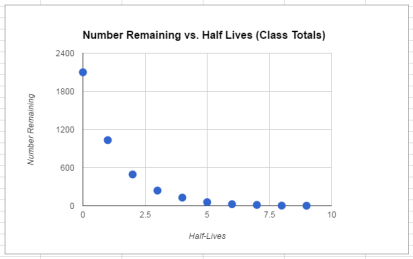
Students graphed their half life data from yesterday, then we compared their results to their predictions and the class totals, including data from previous years. We had some good conversation about the role randomness plays in the lab and why its useful to have data that relies on thousands of pennies, rather than just the 100 students had.

half life class data

Day 162: Snell’s Law & Half Life

Physics: Snell’s Law

I got out the refraction dishes and showed students how to use them to find a refracted angle. Then, I asked them to get me a graph where the slope is the index of refraction of water. This is the first time I asked students to start with an equation (in this case, Snell’s law) and pick their axes to get a certain value as the slope, but they were pretty successful.

IMG_1899

Chemistry: Half Life

Students measured the “decay” of pennies by shaking them up, then setting aside any that came up tails. Each group make a graph of pennies remaining vs. half lives and submitted their results via a Google Form so we could produce a graph of the class average. Tomorrow, we’ll use that to have some conversations about randomness.

Day 160: Lens Misconceptions & Solubility

Physics: Lens Misconceptions 

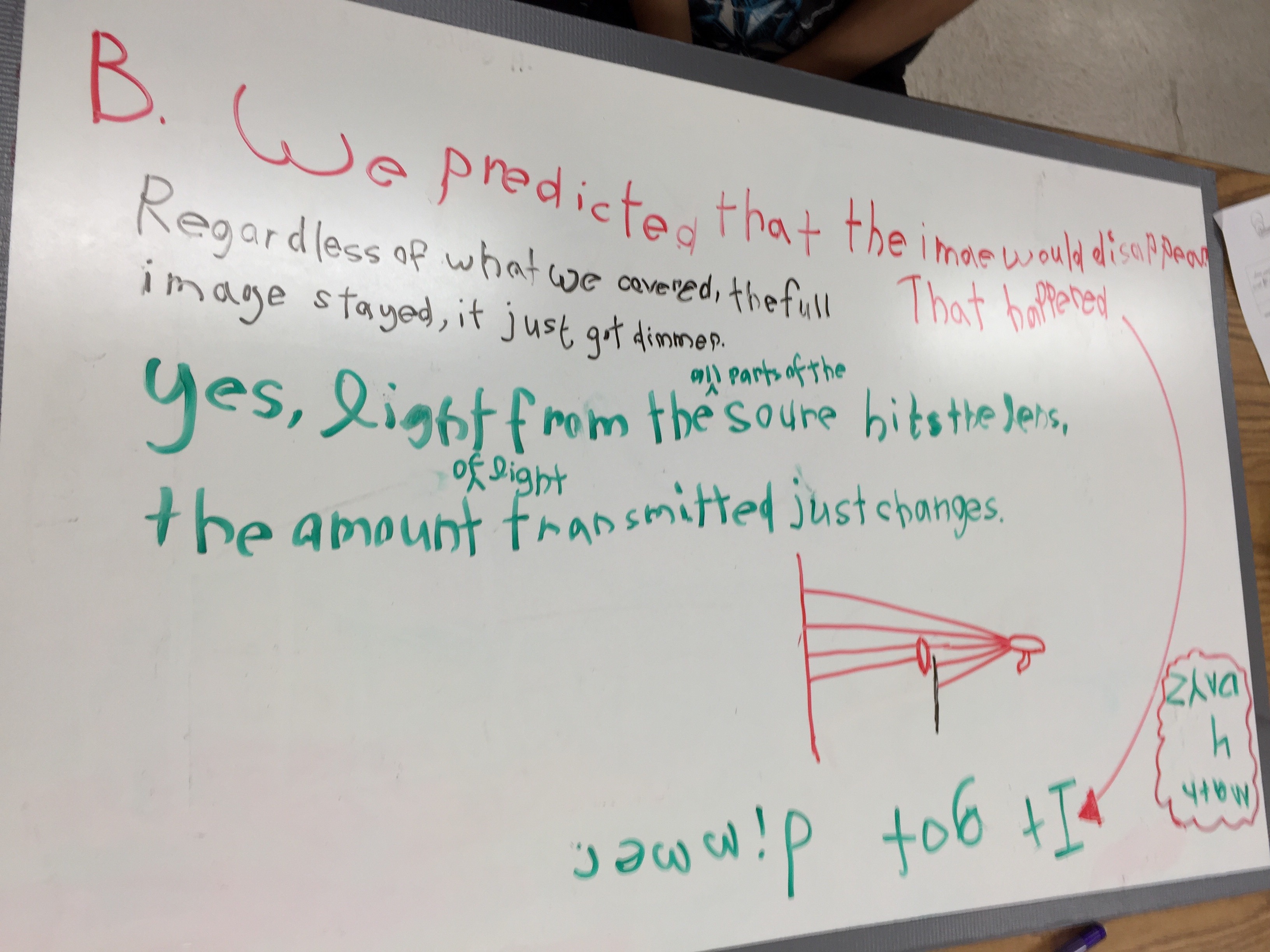
Students whiteboarded and discussed the results of Friday’s lab. I’m always intrigued by the conversations about the image formed when part of the lens is covered up. Students consistently express the common misconception that blocking the lens will block part or all of the image with very little analysis of that idea. Once they saw the full image, however, they quickly and easily made connections to partially covered mirrors to declare a dimmer, but whole image is exactly what they should see. Without the unexpected observations in the lab, my students felt no need to consider related observations or apply tools like ray diagrams to challenge their ideas. I know this is exactly how misconceptions tend to play out (Derek Mueller’s video on Newton’s 3rd law is a great example), but there’s seeing this process happen always fascinates me.

Chemistry: Solubility

Students did a simple solubility lab where they measured how much sugar could be dissolved in water at different temperatures.

Day 159: Lenses & Concentration

Tonight is Tartan’s Relay for Life event, which the majority of our students participate in, so my students were definitely wound up, but still managed to focus on some science.

Physics: Lenses

We did a whiteboard gallery walk on yesterday’s problems, then got out some lenses to make some observations. I based my activity on a packet of optics activities originally written by Dewey Dykstra of Boise State University, which walks students through some things to try, like blocking part of the lens, and asks them to make observations. Students were surprised by a lot of the results and several were really vocal that they were glad I had them try it themselves because they would not have believed it if I told them.

IMG_1893

Chemistry: Concentration of Solutions

I introduced students to the idea of concentration and gave them some time to work through some problems.

Day 158: Refraction & Solutions

Physics: Refraction Problems

Students worked on some refraction problems, including a lot of ray diagrams. I also left out some refraction demos and asked students to try and come up with explanations for what they saw.

Chemistry: Solutions Reading

Students did some reading to introduce some vocabulary for chemical solutions. I’m trying to emphasize translating vocabulary from textbook language to everyday language, and my students are getting more comfortable with that.

Day 157: Refraction & Empirical Formula Lab

Physics: Refraction

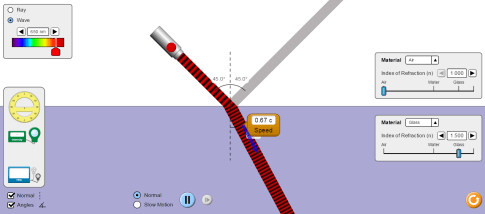
Students played with PhET’s Bending Light simulation to start building some ideas about refraction. I tried to keep the questions very broad and focused on conceptual understandings. Students really took advantage of all the tools available and made a lot of very detailed observations that would have been tough or impossible in a more traditional lab.

Bending Light

Chemistry: Empirical Formula Lab

Students worked on a lab that terrifies me (I once had a careless student singe his eyebrows), but gives really nice results. Students started with a sample of copper II oxide, then burned off the oxygen to get pure copper. They then used their initial and final mass to determine how much oxygen was in the original sample and find an empirical formula.

IMG_1886

So much fire!

Day 156: Mistakes Game & Speed Dating

Physics: Mistakes Game

We played the mistakes game with ray diagrams for curved mirrors. Its been a while since we last did that, and a lot of students were excited to play.

IMG_1884

Chemistry: Speed Dating

We did some whiteboard speed dating with empirical formula problems. By the end of the hour, most students were feeling pretty confident. Just to solidify that confidence, we did a “practice pop quiz” where I put up a problem and had students work through it in quiz-like conditions, then went through the answer and had some conversation about the next steps for people who didn’t do well on that quiz.