Day 46: 2nd Law Lab, Board Meeting, & Atomic Models

AP Physics: 2nd Law Lab

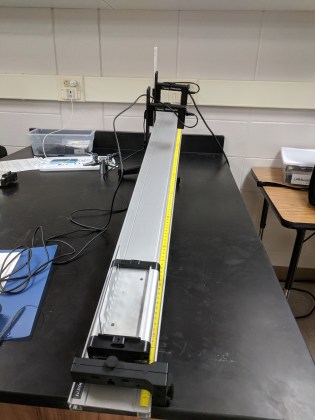
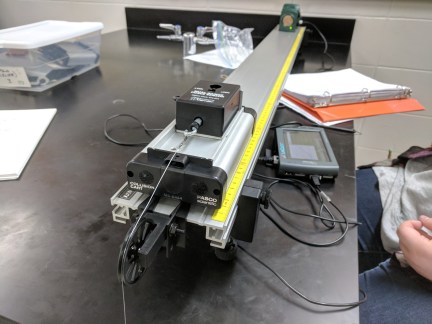
Students started collecting data for a relationship between force and acceleration. A few students took out their formula sheet to get a preview of what the equation should be; it was interesting to listen to their conversation on what they expected the graph to look like and whether their data was consistent with the equation they expect to need.
f a

Physics: Board Meeting

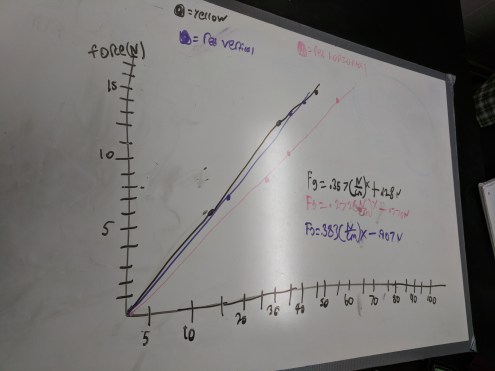
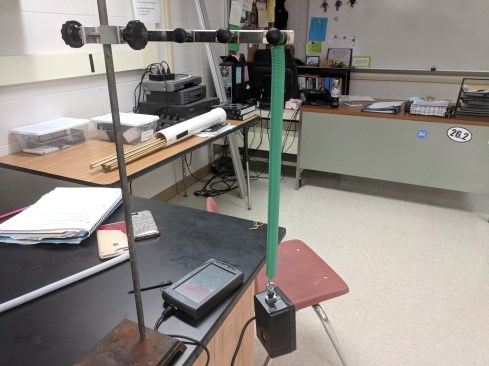
Students whiteboarded their results for the spring lab. They are getting better at “translating” lines of best fit into physics by selecting meaningful variables and putting units on slope and intercept. It was also clear in the discussion that students are gradually making more connections between the graphs and the reality of the lab. When discussing the intercepts, there was a great moment where a student speculated whether gravity could be contributing to the intercept, which lead nicely into comparing the vertical and horizontal springs.
spring graph

Chemistry Essentials: Atomic Models

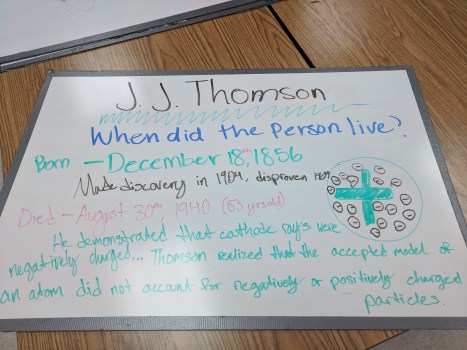
Students worked on a jigsaw for the history of atomic models. This was a nice opportunity to talk about what we mean by a model in science since we are looking at how models of the atom evolved over time. I asked groups to name some of the evidence used to support each atomic model, and students had a lot of trouble with that. I think part of the issue is a lot of students are still shaky on what makes something evidence and part of it is there’s a lot of background knowledge required to make sense of the evidence used in many of the atomic models.
thompson.jpg

Day 44: Practical, Spring Force, & Vocab Review

AP Physics: CAPM Practical

Students figured out where to start a buggy so that a marble rolling down a ramp would land in it. Some groups had some trouble translating their strategies for yesterday’s problems to this lab practical, which has been pretty common this year. However, once students got going, there was a lot of success!

Physics: Spring Force

Students worked through the spring force lab I’d previously done with my AP Physics classes. We used force sensors to stretch the spring instead of spring scales or hanging masses so that students could pick one of their springs to also stretch horizontally. From what I saw in notebooks, results are coming out pretty nicely.

spring.jpg

Chemistry Essentials: Vocab Review

This unit has had more vocabulary and factual knowledge than many of the others, so we took some time to review key terms and reinforce connections between the different ideas.

chem vocab.jpg

Day 43: v-t Graphs, Board Meeting, & Chemical Change

AP Physics: v-t Graphs

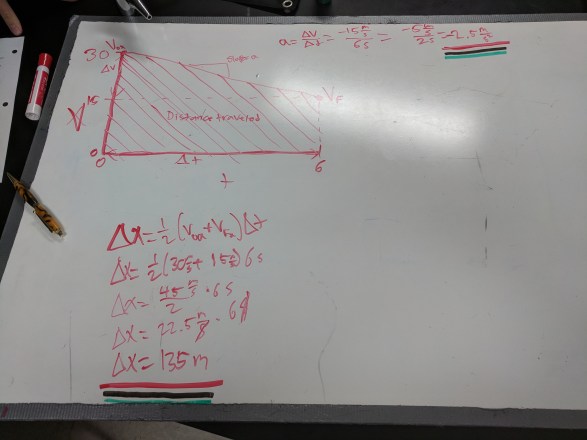
Students took their first stab at solving problems for objects with a constant acceleration using velocity vs. time graphs. Groups were consistently getting the problems down pretty quickly, so we did a gallery walk of solutions for these problems rather than a full whiteboarding session. My students with some calculus knowledge are getting genuinely excited about the connections between physics and calc, which is a lot of fun. I also had some students think week talking about how momentum vs. time graphs fit with what we’re doing now, which has me really excited to start the Newton’s 2nd Law lab next week.

graph soln.jpg

Physics: Board Meeting

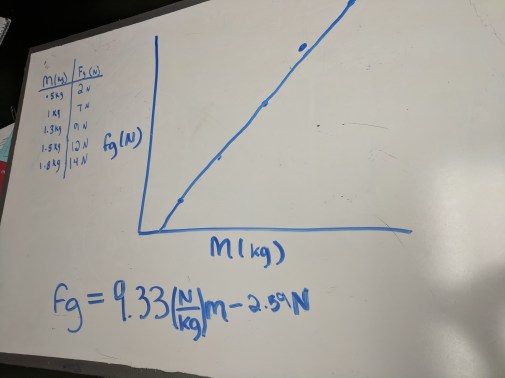
Students whiteboarded the results of the force of gravity lab. The results were pretty good and I had some students speaking up who are usually quiet during whole-class discussions. I’m also seeing students get more confident finding the line of best fit and translating y=mx+b into “physics”.

fg lab.jpg

Chemistry Essentials: Chemical Change

Students did a lab observing several chemical reactions to recognize signs of chemical change. One of the reactions produced a precipitate, and it was interesting that a lot of students were not convinced the precipitate was a solid since it was a fairly fine powder.

chem change.jpg

Day 42: Mistakes, Force of Gravity, & Periodic Trends

AP Physics: Mistakes

Since my students are pretty confident on motion graphs, we went straight to mistakes whiteboarding with some stacks of motion graphs. Students were pretty successful at coming up with interesting mistakes. In addition, during the presentations there was a lot of joking around and students were very willing to own unintentional mistakes, which was great to see.

mistake

Physics: Force of Gravity

Students collected data for a relationship between mass and the force of gravity. One of my classes was able to get their graphs and linear regressions done, and were more successful than I expected at “translating” their line of best fit into physics by adding units to the slope and intercept and replacing x and y with appropriate variables.

gravity lab

Chemistry Essentials: Periodic Trends

Today, I handed out periodic tables and students worked on marking them up based on some of the patterns and trends we’ve been talking about the past few days. Yesterday, several students noticed that the sodium card said it reacts strongly with water. Since many also recognized sodium is in table salt, they weren’t entirely convinced it would react with water, so I got out the pure sodium today to drop a piece into some water. I got a small flame during class, which really blew their minds.


Day 41: Board Meeting, Mistakes Game, & Periodic Table

AP Physics: Board Meeting

We had the board meeting for last week’s ramp lab. Students were pretty successful at picking out the key concepts, though the results were a little messier than usual, which made it tough to compare results for different angles and cart masses. Next year, it may be worth having each group do two angles or two masses. I’ll also take more time to introduce students to the photogates. The students in calculus had some great reactions when they realized the slope of the position vs. time2 was half the slope of the velocity vs. time graph.

Physics: Mistakes Game

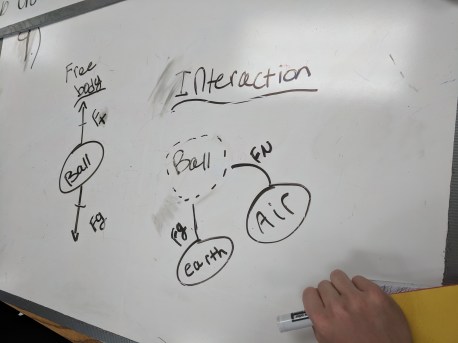
Students played the whiteboard mistakes game with Friday’s free-body diagram problems. Lots of groups had great conversations about the forces on an object already moving and the language of interactions, including many of the ideas from the interaction stations, really helped them convince each other whether or not there should be a force. I also took a few minutes prior to presenting any whiteboards to talk about what it looks like to get something out of this when you’re not presenting, and saw a lot more students than usual with their own work out.

IMG_20171106_131548.jpg

Board with intentional mistake for a ball at the peak of a throw

Chemistry Essentials: Periodic Table

We revisited Friday’s card sort. When I looked over students’ work from Friday, it looked like many of them got stuck on the word “pattern” in the directions because they were looking for something that was all the same, rather than a trend. Today, I had them get out actual periodic tables to use as a guide to set out the cards. From there, it was much easier to scaffold students to identifying interesting trends. Students were also really interested in things like how we discover new elements, or how they get named.

card sort 2.jpg

Day 40: Ramp Graphs, FBDs, & Card Sort

I ended up home sick today.

AP Physics: Ramp Graphs

Students took a longish quiz, then started working on some problems to sketch graphs and motion maps for objects on a ramp. Since we haven’t actually discussed the ramp lab yet, I’m expecting these problems to be a little tricky. There are enough students currently in calculus that I’m hoping they can help their classmates make sense of the graphs. Regardless, I’ll need to make sure I allow time after the ramp lab discussion to make sense of those problems.

Physics: FBDs

I left students a worksheet of interaction diagrams and free-body diagrams. On my last sub day, very few students attempted the problems, I asked my sub to remind students that I’m after an attempt, not right answers. I also asked the sub to collect papers at the end of the hour so I can see where students are at before class on Monday.

Chemistry Essentials: Card Sort

Since we are starting to talk about elements, I left a card sort activity for students to build a version of the periodic table using cards that represent some of the properties of each element. I asked students to snap a photo of their final sort and upload it to Google Classroom so I can see what they came up with.

card sort.jpg

Day 38: Ramps, Interaction Stations, & Pure Substances

AP Physics: Ramps

Students worked on collecting position vs. time and velocity vs. time data for a cart on a ramp. Based on the questions I was getting during the lab, a lot of groups would have benefited from more discussion about what the photogates were measuring and how that translated into the graph and data table on the LabQuest. I should talk to our tech guy about installing the LabQuest emulator to help facilitate those conversations.

ramp.jpg

Physics: Interaction Stations

To keep building up the idea of forces, students worked through a series of interaction stations Brian Frank wrote about using a worksheet from Kelly O’Shea. Students got tripped up identifying where the interaction was taking place, mostly because they were overthinking it. Some were bothered that they could see more than one interaction, but only needed to talk about one on their worksheet. Next time, I might make it more open to encourage students to discuss multiple interactions.

station d.jpg

Chemistry Essentials: Pure Substances

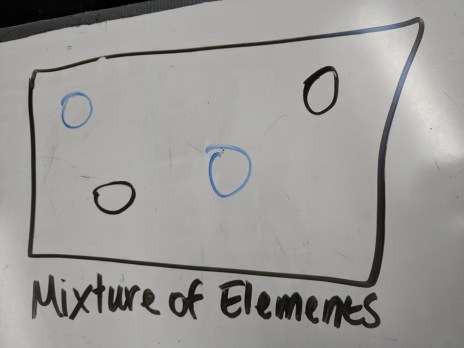
Students worked on a Modeling Instruction worksheet differentiating between pure substances, mixtures, compounds, and elements. I like pure substance, mixture, and compound were all motivated by the labs with iron and sulfur, but students had trouble connecting the idea of an element. We haven’t done hydrolysis yet, and I wonder if that might have helped motivate elements.

Day 37: Dueling Buggies, Dueling Fan Carts, & Chemical Change

AP Physics: Dueling Buggies

Students wrapped up the dueling buggies lab practical with very satisfying results. Usually, most of my students look for the intersection of the position vs. time graphs, but this year I had a lot of groups decide to solve the system of equations. I think that is just an artifact of doing the lab later than usual, when students are in the routine of connecting math and physics, and of moving pretty quickly through the CVPM worksheets.


Physics: Dueling Fan Carts

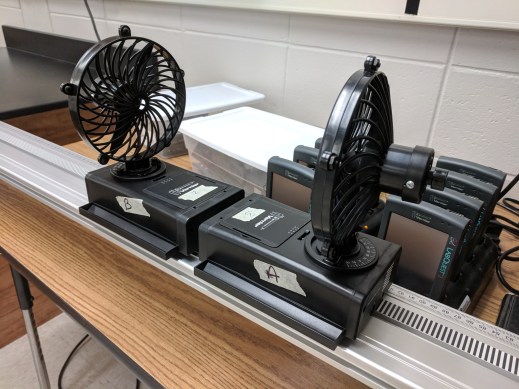
We talked about the rules students had for tapping and motion after yesterday’s bowling ball lab, then moved into a version Frank Noschese’s dueling fan carts. Frank’s activity calls for high vs. off, but I added in off vs. high as a separate scenario to help with the idea of directionality. This is the first time I had groups revise their rule after the fan carts, and I was really pleased with how that went. I think that approach also helped cement the connections between the bowling ball lab and the fan carts, and the connections are something I’ve seen missing so far.

fan carts,

Chemistry Essentials: Chemical Change

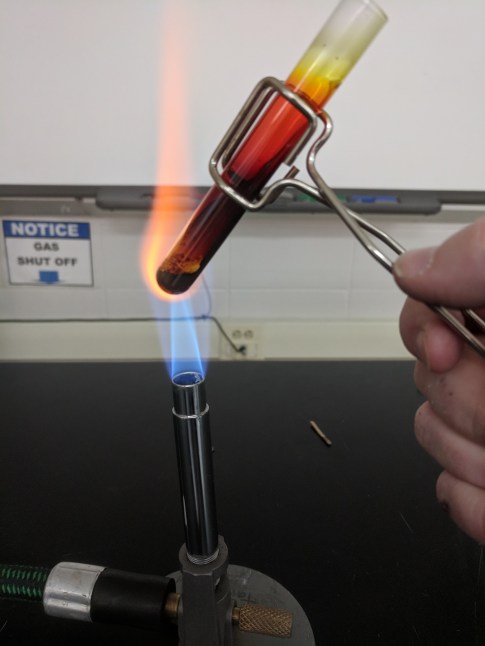
Students heated yesterday’s mixture of iron and sulfur to see if the properties changed. Just about everyone was very excited about using fire, but it was tough to keep them focused on making and interpreting their observations. Since I only had a few questions, I projected them, rather than making a handout, but something about a handout seems to give my students more sense of individual accountability. I think the handout serves as a physical reminder of the questions they need to answer, so I will try to stick with making handouts.

chem change

Day 36: Dueling Buggies, Bowling Balls, & Properties of Mixtures

AP Physics: Dueling Buggies

We did an abbreviated whiteboard session on Thursday’s problems since students had correct answers and were feeling pretty confident on the material. Afterward, we started working on the dueling buggies lab practical. I had several groups decide to have different people try different approaches, then compare answers as a way to check their work. Tomorrow, we’ll actually crash the buggies.

buggies.jpg

Physics: Bowling Balls

I started class today by talking a little about why I use Modeling Instruction and the kinds of actions that make a student successful in this type of classroom. Students seemed receptive and the atmosphere in the room was much more positive than it has been in a while. I think moving on to forces was a good call.

Students worked on the bowling ball and mallets lab to start building ideas about forces. I also gave students roles within their groups and explained this was to help them learn how to be a productive member of the group, even when they don’t know the answers. Students were much more consistently engaged than I’ve seen this year and a lot of great conversations were happening in groups.

bowling

Chemistry Essentials: Properties of Mixtures

As a demo, I asked students to observe properties of water and ethanol before and after mixing. The whole class discussion got a little rocky because a lot of students had great questions and great observations, but it was tough to keep them from talking over each other (or me). That’s something I need to keep working on with this class, but its a good problem to have.

Afterward, students did something very similar with solid sulfur and iron. Again, there were a lot of great observations. Students seem pretty clear on the idea that a mixture has a combination of properties from both materials.

fe s.jpg

Day 35: Motion Representations, Lab Practical, & Mystery Tubes

AP Physics: Motion Representations

Students started practicing translating between different representations of constant velocity. Students have already done some similar problems with momentum vs. time graphs, so things went very smoothly.

Today’s quiz also included the first free response problem from an AP exam that students have worked. Afterwards, as they discussed their answers, there were a lot of kids high-fiving each other while another student told me she enjoyed the quiz. Its great to see students getting the hang of physics and feeling good about it.

Physics: Lab Practical

Students continued work on yesterday’s lab practical. I only had a few groups finish and was running into a lot of the same roadblocks I’ve been seeing for most of the unit. Both my students and I feel like we are beating our heads against the wall with this unit; since we’ll get another crack at acceleration with unbalanced forces, I think its best to cut our losses for now. On Monday, before we dive into balanced forces, I’ll take some time to have some conversation with students about what’s working and what isn’t so we can try to get on a better path.

Chemistry Essentials: Mystery Tubes

Today was a quiz day. About half of my students take their quizzes in the special ed room and usually stay up there the full period, while those who stay in the classroom rarely need more than half the period, so I’m trying to plan interesting activities that aren’t required for the content. Today, I pulled out the mystery tubes and it was fantastic. Every student was engaged, making fantastic observations and sharing ideas about what’s going on inside. One student in particular who is normally pretty checked out asked if she could sit the activity out because it seemed too hard, but got into it once she got her hands on a tube. The best part was when the para supporting the class stopped by at the end and asked about the tubes, this student confidently insisted he check out her model to see exactly how the tubes work. It was a great way to end the week.IMG_1734